Dividend Stocks vs. Bonds for Retirement Income: Which Is Better?
A 10-year Treasury yields 5.05% today, more than most dividend stocks pay. Of the 865 dividend stocks we rate, only 16 combine a yield of 5% or more with a Safe or Very Safe Dividend Safety Score.
So why own dividend stocks for retirement income at all? Because a bond's interest never rises, while a growing dividend can. The stocks we rate Safe or Very Safe have raised their dividends at a median pace of 7.3% a year over the last five years, about double today's 3.7% inflation rate.
The answer for most retirees is not one or the other. Bonds give you certainty for money you will spend in the next few years. Safe dividend growth stocks give you income that can keep rising for the decades after that.
Below we show how long it takes a growing dividend to catch a 5% Treasury, how dividends held up in the last deep recession, and how the two can work together.
Prefer to watch? Check out our YouTube video 3 Safe Dividend Stocks on Track to Out-Pay a 5% Treasury, where we worked out how much dividend growth it takes to beat a Treasury.
Why Bonds Have Been a Retirement Staple
Bonds are designed to deliver dependable income.
When you buy a bond, you receive scheduled interest payments and the return of your principal at maturity. That structure makes bonds useful for funding near-term spending because the cash flow is known in advance.
High-quality bonds also tend to be far less volatile than stocks, which can help retirees stay invested during market downturns. A Treasury held to maturity pays back exactly what it promised, on a known date.
Bond income is also more attractive than it has been in years. The 10-year Treasury yielded 5.05% on October 28, 2026, up from 4.19% at the start of the year, according to the Treasury Department's daily rates.
Fixed Bond Income Loses Ground to Inflation
The tradeoff is that bond income does not grow. Once you lock in a yield, the check stays the same until the bond matures.
Retirement is not a five- or 10-year problem, though. For many investors it lasts 25 to 30 years, and expenses rarely stay flat over that time.
Consumer prices rose 3.7% over the 12 months through September 2026, according to the Bureau of Labor Statistics. If prices kept rising at that pace, the $5,050 a year paid by a $100,000 Treasury would buy about 30% less in 10 years. The $100,000 you get back at maturity would buy about 30% less, too.
That creates a gap between what a bond portfolio earns and what a retiree needs to spend. Covering it means selling principal, which is the problem we explore in our guide comparing the 4% rule with living off dividends.
How Much Dividend Growth It Takes to Out-Pay a 5% Treasury
A growing dividend closes that gap from the other direction. It can start below a bond's yield and still pay you more over time.
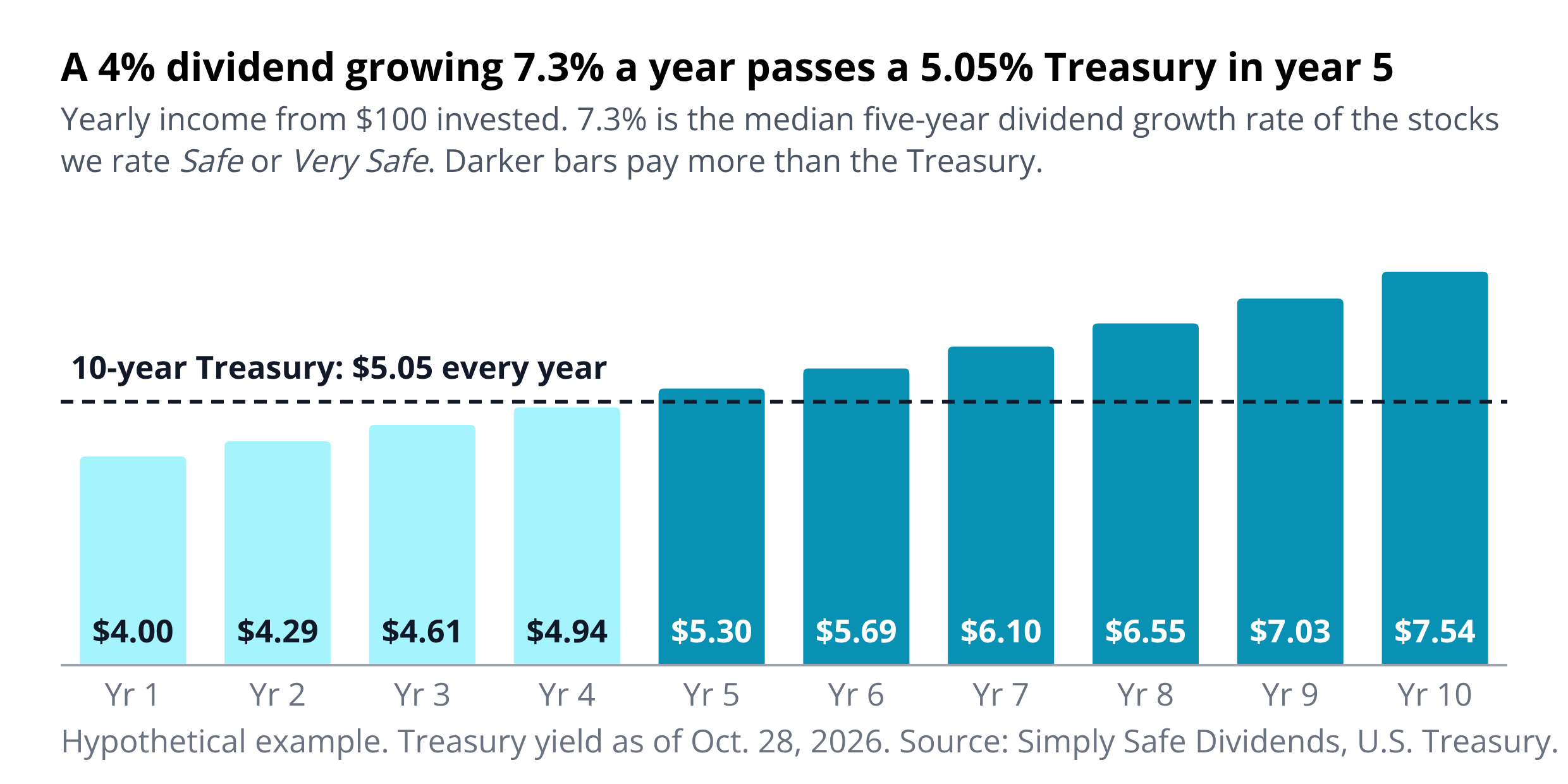
The math is simple to run. Over 10 years, a 5.05% Treasury pays $50.50 on every $100 invested. A stock yielding 4% today needs its dividend to grow about 5% a year to match that total. A stock yielding 3% needs about 11% a year, a pace few companies can sustain.
That bar is lower than it may sound. The stocks we rate Safe or Very Safe have grown their dividends at a median rate of 7.3% a year over the last five years. At that pace, a 4% yield would pass the Treasury's income in year five and pay $7.54 per $100 in year 10, about 50% more than the bond.
Those raises are not guaranteed, of course. A Treasury's interest is a legal promise, while a dividend is a board decision that can be cut. That is why the safety of a dividend matters as much as its growth.
Paychex, Prudential and Agree Realty Need Small Raises to Out-Pay a Treasury
Some high-quality stocks already clear this bar with room to spare. When we screened the stocks we rate for our video 3 Safe Dividend Stocks on Track to Out-Pay a 5% Treasury, three combined a Safe or better Dividend Safety Score, an S&P credit rating of BBB+ or higher, at least 10 straight years of dividend growth and a yield above 4%.
Based on today's yields, each one has been raising its dividend much faster than it needs to.
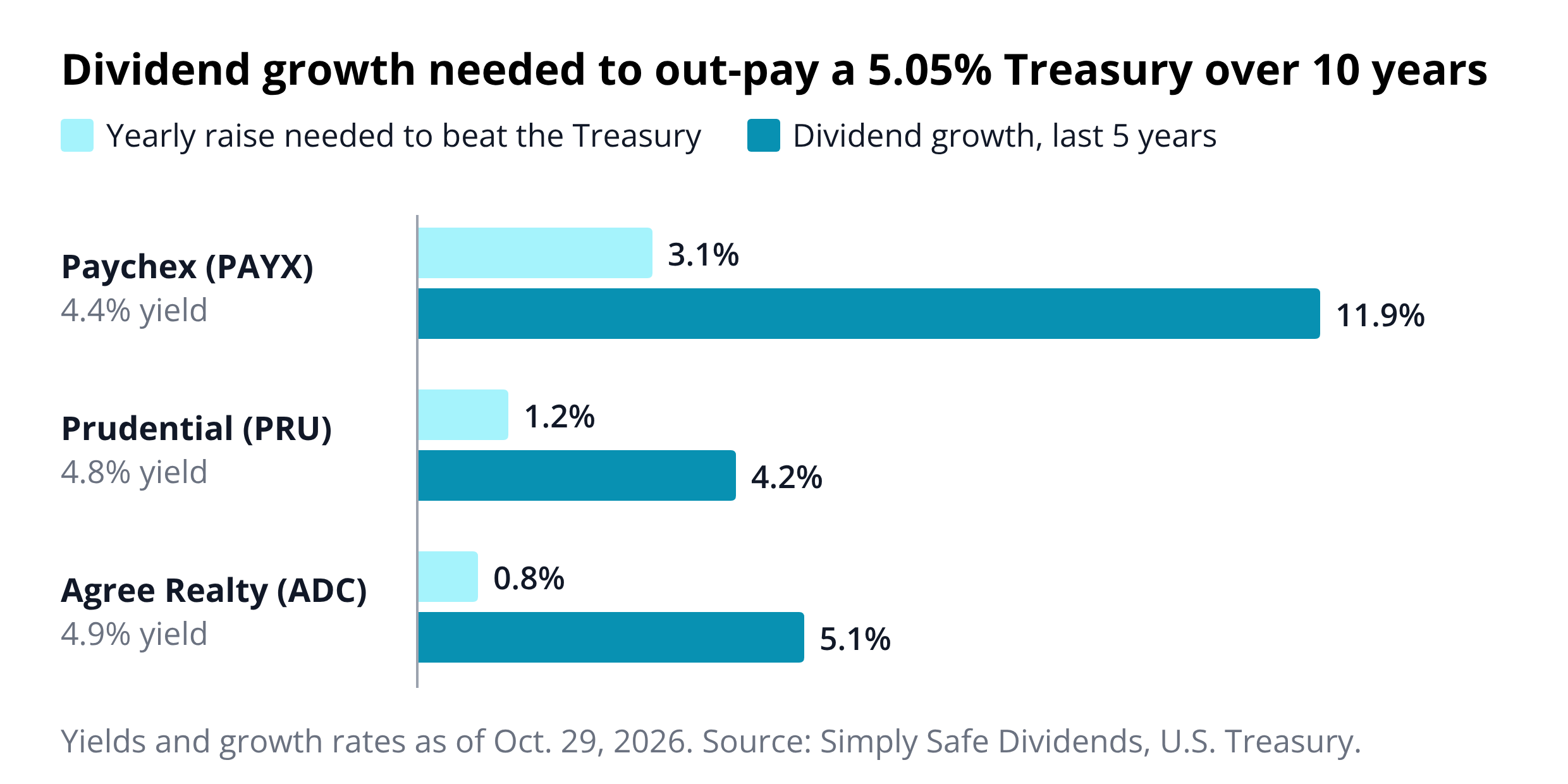
Paychex (PAYX) runs payroll for more than 800,000 small and midsize businesses, and almost all of that revenue repeats every pay period. Its dividend needs to grow about 3% a year to out-pay the Treasury. It has grown 11.9% a year over the last five years and has risen for 15 straight years.
Paychex pays out about 81% of its earnings, so future raises will likely track earnings growth rather than repeat that pace. The stock yields 4.4% today, well above its five-year average of 2.9%. Worries that artificial intelligence could disrupt payroll software have weighed on the shares, leaving the yield unusually high for this company.
Prudential Financial (PRU) sells life insurance and annuities and takes over company pension plans. It needs dividend growth of just 1.2% a year. Its latest raise was 3.7%, and it has raised its dividend for 17 straight years since cutting it during the financial crisis.
The insurer pays out about 36% of its earnings, below the 50% we like to see for insurance companies, and holds an A credit rating. The main risk is Japan, where regulators suspended part of its life insurance business until the end of January 2027. The company expects that to cost about $1 billion of operating profit over two years. Prudential yields 4.8%, close to its five-year average of 4.9%, so the shares look about fairly priced by that measure.
Agree Realty (ADC) is a REIT that owns about 2,900 stores leased to national chains such as Walmart, Home Depot and Dollar General. It needs dividend growth of just 0.8% a year, and its dividend has grown 5.1% a year over the last five years. At that pace, its income would pass the Treasury's in year two.
Agree pays monthly and holds a BBB+ credit rating. It did cut its dividend in 2011, when a few tenants, including the bookstore chain Borders, made up much of its rent. Its tenant base is far more diversified today, with Walmart under 6% of rent. Agree yields 4.9%, above its 4.2% five-year average, as rising bond yields have pulled REIT prices down.
Stock Prices Fall Further Than Bonds in a Downturn
That growth comes with a cost. Stocks are far more volatile than a Treasury, and even high-quality ones can drop 20% or 30% in a bad year.
The 2007-09 recession showed how far prices can fall. The median dividend stock we rate today lost 50% of its value over that stretch, compared with 55% for the S&P 500. A Treasury held to maturity paid back its full principal on schedule.
Rising rates can hurt as well. As the 10-year Treasury yield climbed from about 4.7% in late July to 5.3% in early October, bond-like dividend stocks such as Realty Income, NextEra Energy and Southern fell 13% to 17%. Higher bond yields make their dividends look less attractive, and these companies borrow constantly to grow.
Not every dividend stock trades that way. We explain which kinds of businesses have held up as yields rose in our video Four Kinds of Dividend Stocks That Rising Rates Don't Hurt, and our guide to REITs vs. bonds in retirement covers how real estate stocks compare.
How Dividends Held Up in the 2007-09 Recession
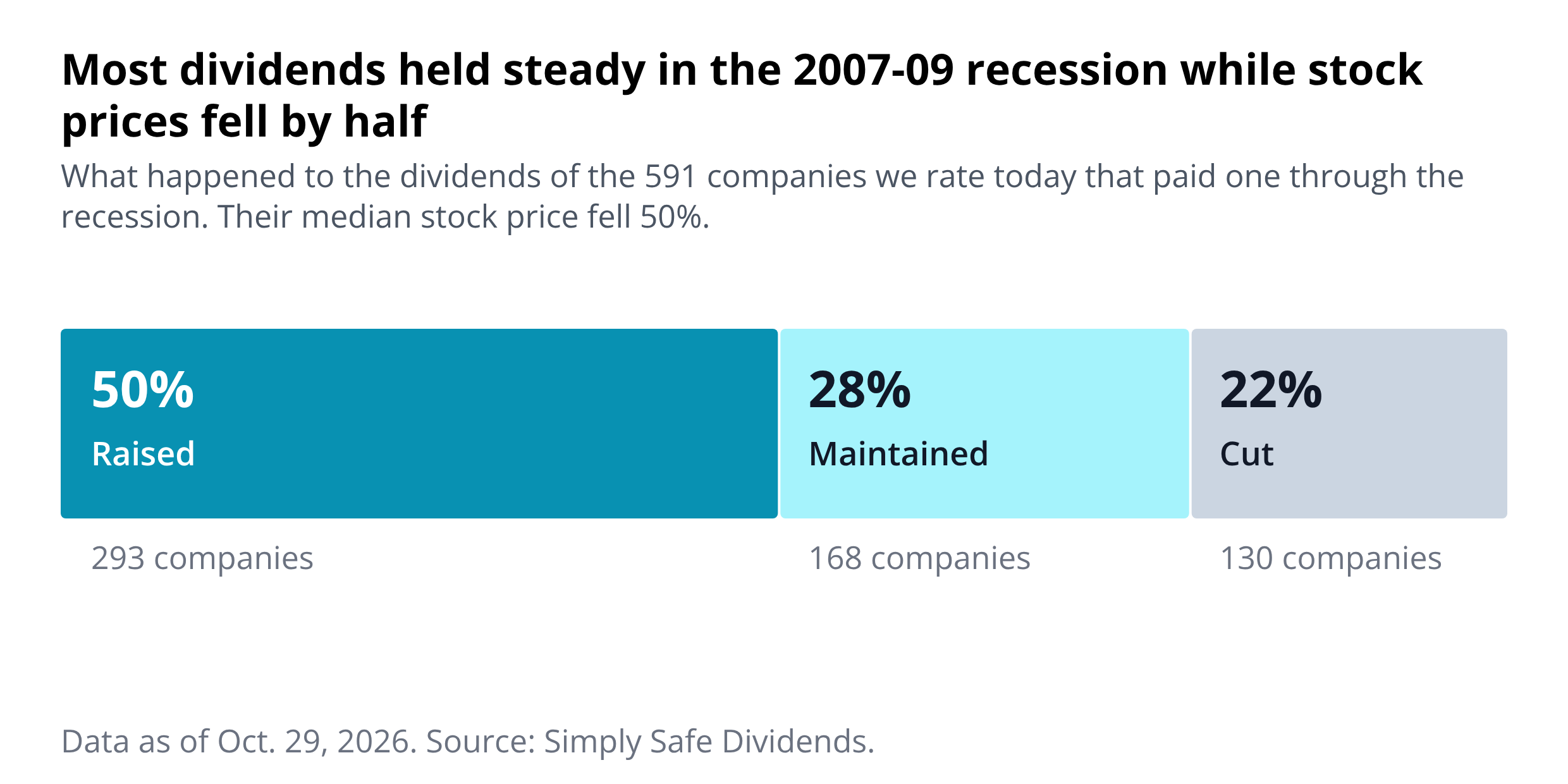
Stock prices and dividends are different things, though. A retiree living on dividends cares most about whether the checks keep coming, and most of them did.
Of the 591 companies we rate today that paid a dividend through the 2007-09 recession, 293 raised it and 168 held it steady, even as their share prices sank. Only 130, or 22%, cut.
Avoiding that minority is the job of our Dividend Safety Scores. Since we launched them in 2015, investors who stuck with companies scoring above 60, our Safe threshold, would have avoided 926 of the 947 dividend cuts we have tracked, according to our public Dividend Safety Score track record.
Our list of recession-proof dividend stocks highlights companies whose payouts have held up best in past downturns.
Higher Yields Usually Mean Riskier Dividends
Safety matters most when yields look tempting. One of the most common mistakes income investors make is chasing the highest yield available, whether in bonds or stocks.
In bonds, a higher yield usually means weaker credit. Dividend stocks work the same way. Of the 191 stocks we rate that yield 5% or more, roughly what a Treasury pays, only 16 earn a Safe or Very Safe Dividend Safety Score, or 8%. Across all the stocks we rate, 48% do.
So a stock that out-yields a Treasury today deserves more scrutiny, not less. A retirement income strategy should focus first on reliability, not on maximizing current income. Our list of the top 25 high dividend stocks shows how we weigh yield against safety.
Why Many Retirees Own Both
You do not have to choose between a Treasury and a dividend grower. They do different jobs.
Bonds give certainty. A known check and principal back on a known date suit money you plan to spend in the next few years, and they can spare you from selling stocks during a downturn.
Dividend growth stocks support the later decades. A 65-year-old may need income for 30 years, and a check that never rises across three decades of higher prices creates its own risk. For many retirees, that is a bigger danger than a share price they never plan to sell.
If you own dividend stocks for this role, spread your money across a couple dozen companies in different industries and favor those with Safe or Very Safe Dividend Safety Scores. We walk through how much income a portfolio can support in our guide to living off dividends.
Frequently Asked Questions
Are dividend stocks or bonds better for retirement income?
Neither is better on its own. A 10-year Treasury pays a fixed 5.05% today, while the stocks we rate Safe or Very Safe have grown their dividends at a median 7.3% a year over the last five years. Bonds suit near-term spending, and safe dividend growth stocks suit income needs further out, so most retirees benefit from owning both.
Neither is better on its own. A 10-year Treasury pays a fixed 5.05% today, while the stocks we rate Safe or Very Safe have grown their dividends at a median 7.3% a year over the last five years. Bonds suit near-term spending, and safe dividend growth stocks suit income needs further out, so most retirees benefit from owning both.
Do bonds pay dividends?
No. Bonds pay interest, usually twice a year, and return your principal at maturity. Bond funds pass that interest along in regular distributions, which brokers often label dividends. Unlike a stock's dividend, a bond's interest payment never grows.
No. Bonds pay interest, usually twice a year, and return your principal at maturity. Bond funds pass that interest along in regular distributions, which brokers often label dividends. Unlike a stock's dividend, a bond's interest payment never grows.
Are bond funds or dividend stocks better for steady income?
A bond fund's payout rises and falls with the rates on the bonds it holds, and most bond funds never mature, so there is no date when your principal comes back. Dividend stocks can raise their payouts over time. Of the 591 companies we rate today that paid dividends through the 2007-09 recession, 78% maintained or raised them.
A bond fund's payout rises and falls with the rates on the bonds it holds, and most bond funds never mature, so there is no date when your principal comes back. Dividend stocks can raise their payouts over time. Of the 591 companies we rate today that paid dividends through the 2007-09 recession, 78% maintained or raised them.
How much dividend growth do you need to beat a 5% Treasury?
To match the total income from a 5.05% Treasury over 10 years, a stock yielding 4% needs its dividend to grow about 5% a year. A stock yielding 3% needs about 11% a year.
To match the total income from a 5.05% Treasury over 10 years, a stock yielding 4% needs its dividend to grow about 5% a year. A stock yielding 3% needs about 11% a year.
Which safe dividend stocks yield as much as a Treasury?
As of October 29, 2026, 16 of the 865 dividend stocks we rate yield 5% or more with a Safe or Very Safe Dividend Safety Score. They include Verizon, Realty Income, NNN REIT, Enterprise Products Partners and Mid-America Apartment Communities.
As of October 29, 2026, 16 of the 865 dividend stocks we rate yield 5% or more with a Safe or Very Safe Dividend Safety Score. They include Verizon, Realty Income, NNN REIT, Enterprise Products Partners and Mid-America Apartment Communities.
Do dividend stocks keep up with inflation?
The best ones have. Of the 401 stocks we rate Safe or Very Safe with five years of dividend history, 340 grew their dividends faster than 3% a year. Consumer prices rose 3.7% over the 12 months through September 2026.
The best ones have. Of the 401 stocks we rate Safe or Very Safe with five years of dividend history, 340 grew their dividends faster than 3% a year. Consumer prices rose 3.7% over the 12 months through September 2026.
The Bottom Line
Dividend stocks and bonds are not competitors. They are complementary tools.
Bonds can provide stability and predictable cash flow, especially for near-term spending needs. At 5%, Treasuries deserve a look from any income investor.
Safe dividend growth stocks can deliver rising income and help protect purchasing power over decades. A 4% yield that grows is not necessarily the weaker choice it seems next to a 5% bond.
The goal is not to chase yield. It is to build an income stream that can endure across many different economic environments.
Our portfolio tools track your bonds and CDs alongside your dividend stocks, show the Dividend Safety Score of every stock you own, and project the income your portfolio will produce. You can see how it works here. Thanks for reading!