The highest-yielding stocks on this list are Enterprise Products Partners (6.1% yield), Verizon (6.1%), NNN REIT (6.0%), Hormel Foods (5.9%), Realty Income (5.9%), and Enbridge (5.9%). All six earn a Safe Dividend Safety Score.
The safest name here is Public Storage. It yields 4.2% and holds a Very Safe Dividend Safety Score, the highest on this list.
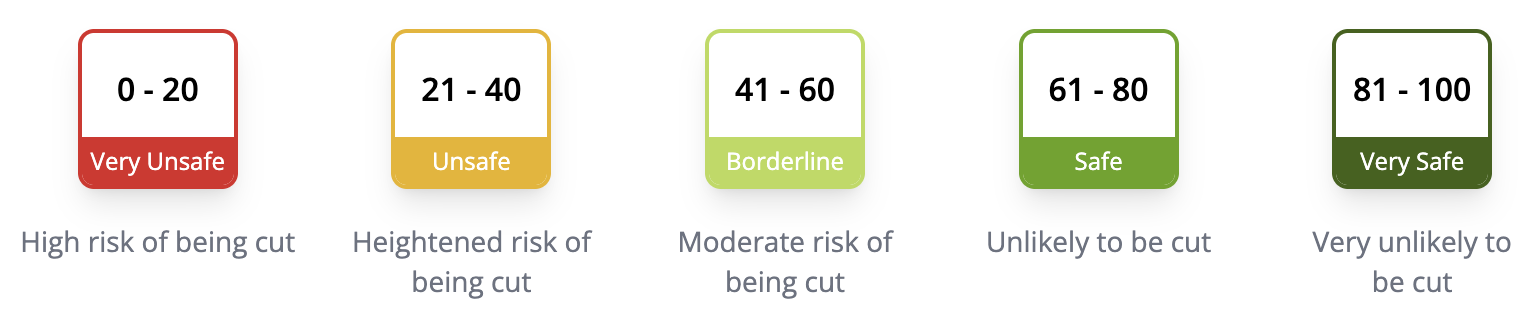
Our Dividend Safety Score rates how likely a company is to cut its dividend:
Dividend Safety Scores run from 0 to 100. Very Unsafe 0 to 20, Unsafe 21 to 40, Borderline Safe 41 to 60, Safe 61 to 80, Very Safe 81 to 100. Source: Simply Safe Dividends.
All 25 stocks below yield at least 4%. Every one scores Safe or Very Safe for Dividend Safety, and every one carries an investment-grade credit rating from S&P.
Yields run from 4.2% to 6.1%. Names paying 8% and more get their own section near the end, where the higher income comes with risks these 25 do not carry.
Here are all 25 high dividend stocks:
That is a short list for a reason. Of the 867 dividend-paying companies we rate, 296 yield 4% or more, but only 54 of them score Safe or Very Safe. Above a 6% yield, only 4% of stocks clear that bar.
Data as of September 28, 2026. Yields, scores, and credit ratings change daily, and we update this list as our ratings change.
Eighteen of the 25 currently yield more than their own five-year average, which is another way of saying the market has marked most of them down. Each stock below shows both its payout ratio and its yield against that five-year average.
Every stock on this list meets four tests:
Yield: a dividend yield of at least 4%.
Dividend safety: a Dividend Safety Score of Safe or Very Safe.
Balance sheet: an investment-grade credit rating from S&P.
Fresh research: a score we reviewed within the past three months.
We rank them by how many consecutive years each has paid dividends without a cut, starting with the longest streak. How we score dividend safety, and how those scores have held up, is explained below the list.
Hormel's dividend looks secure despite an elevated payout ratio. The food maker holds an A- credit rating and has paid dividends for 98 straight years.
Founded in 1891, Hormel Foods (HRL) sells meats, refrigerated meals, snacks, and spreads under brands including SPAM, Skippy, Planters, Jennie-O, and Applegate.
It is unusual to find a stock yielding more than 5% with an A- credit rating, nearly a century of uninterrupted dividends, and 60 consecutive annual increases. Hormel checks all of those boxes.
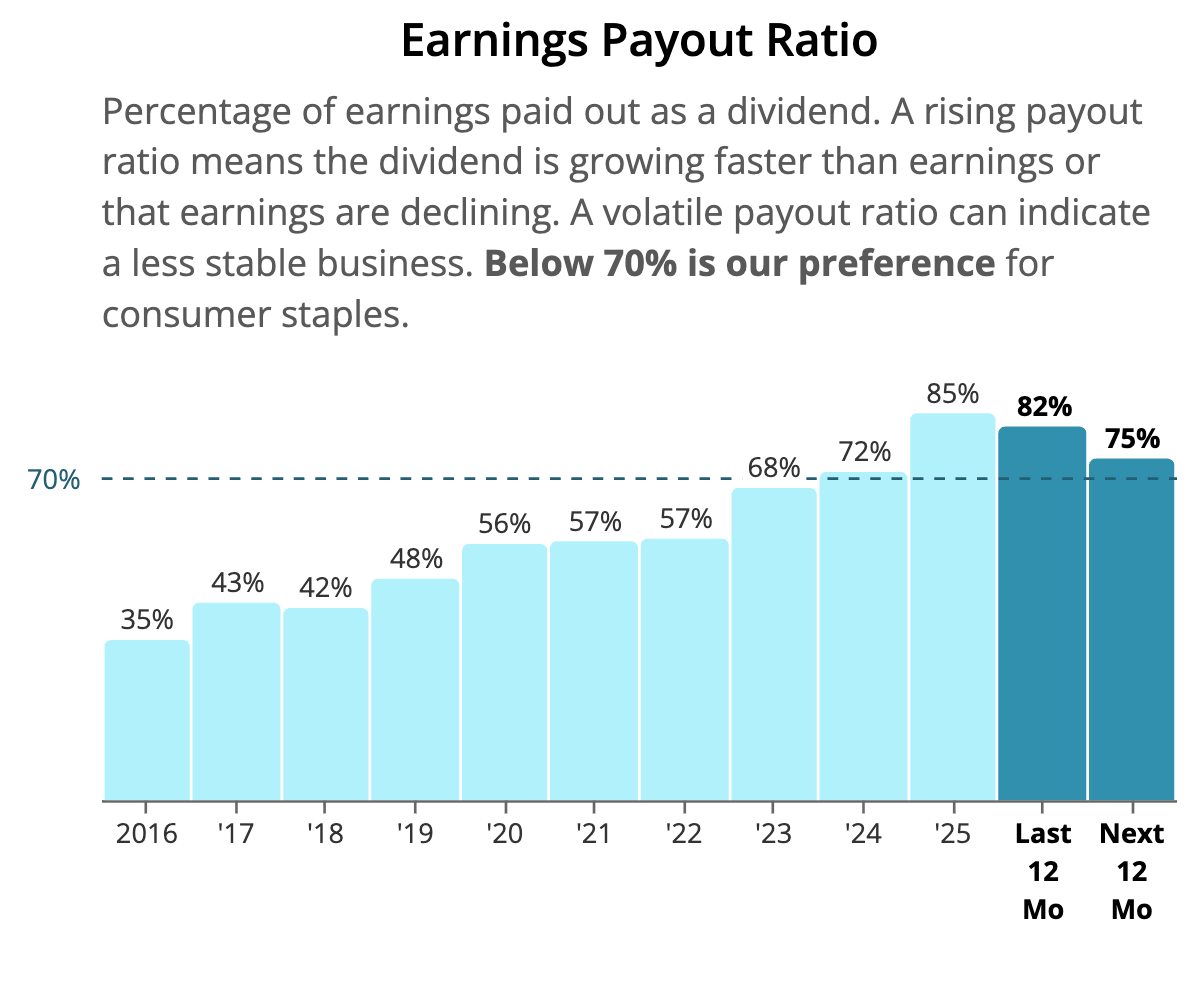
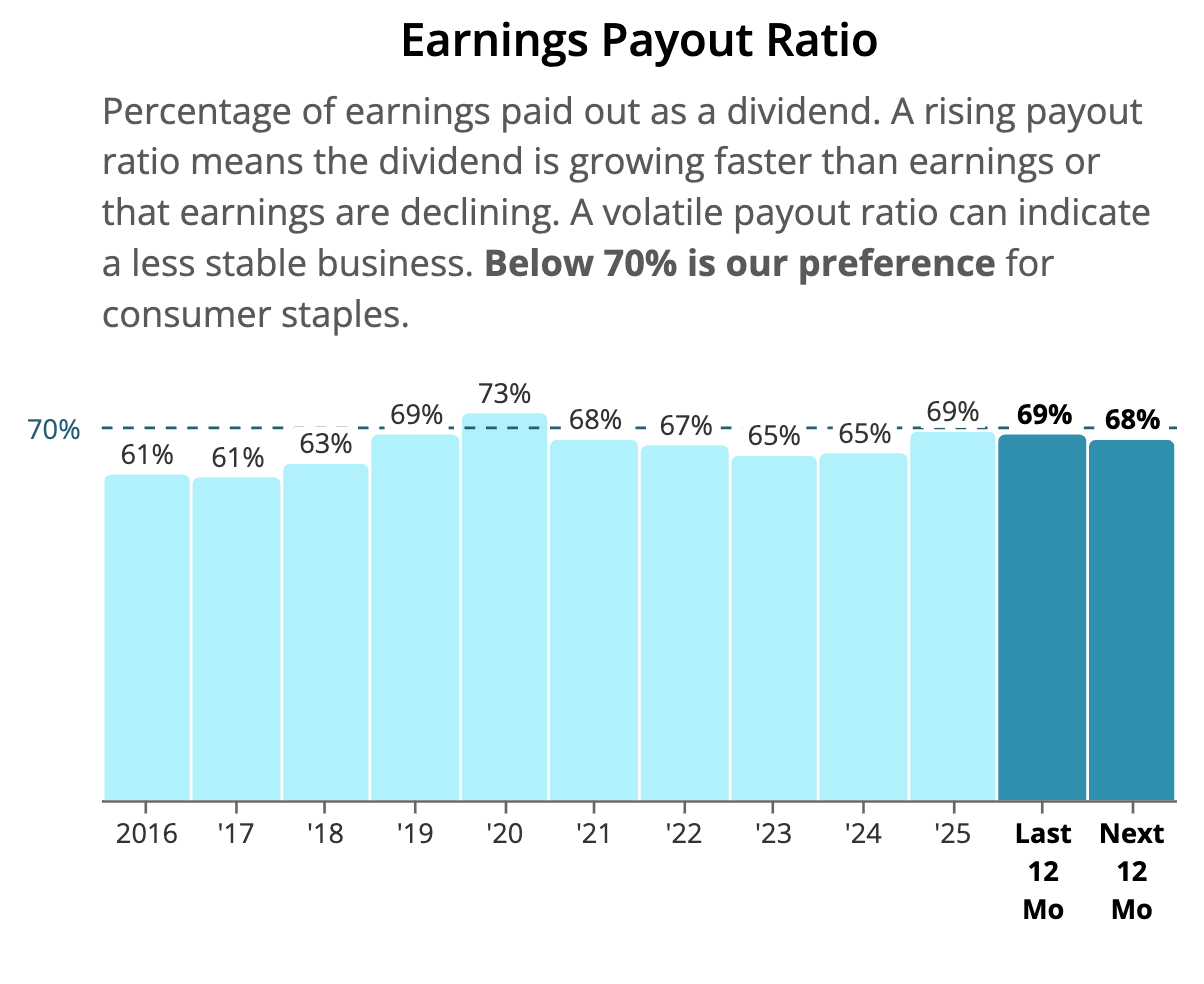
Hormel's payout ratio is running above our 70% preference for consumer staples but is expected to ease over the next 12 months. Source: Simply Safe Dividends.
The last few years have been tough. Pork, turkey, and nut costs rose faster than prices, and higher labor and freight costs squeezed margins further. The payout ratio climbed to its highest level in decades, and we trimmed Hormel's Dividend Safety Score from Very Safe to Safe in September 2025.
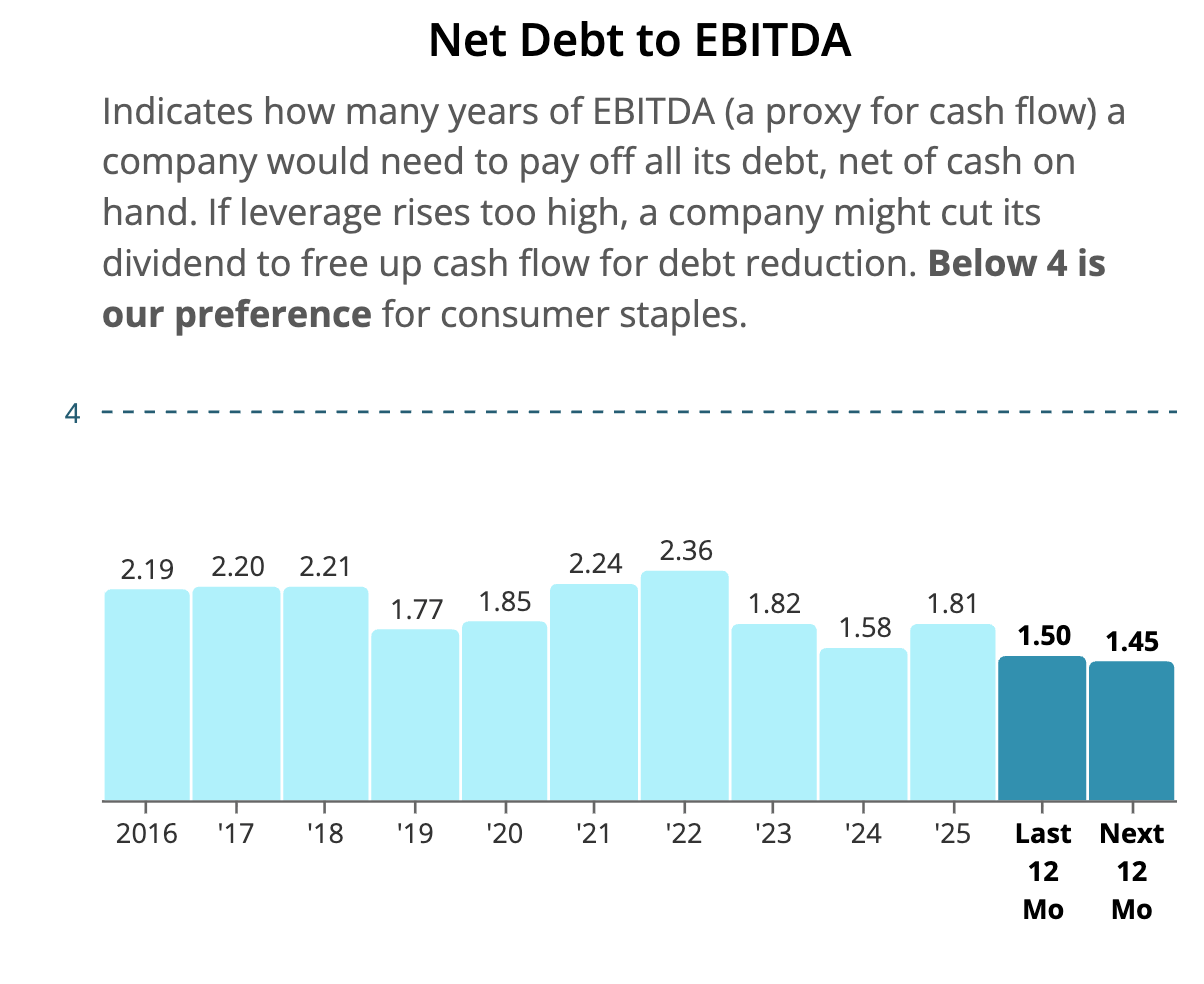
We still think the dividend is well supported. Hormel's Transform and Modernize program targets $250 million of added operating income by the end of 2026, leverage is low, and cost pressures like these tend to ease as higher prices bring on more supply.
The Hormel Foundation also owns nearly half of the shares, which limits the usefulness of buybacks and makes the dividend the main way Hormel returns cash to shareholders.
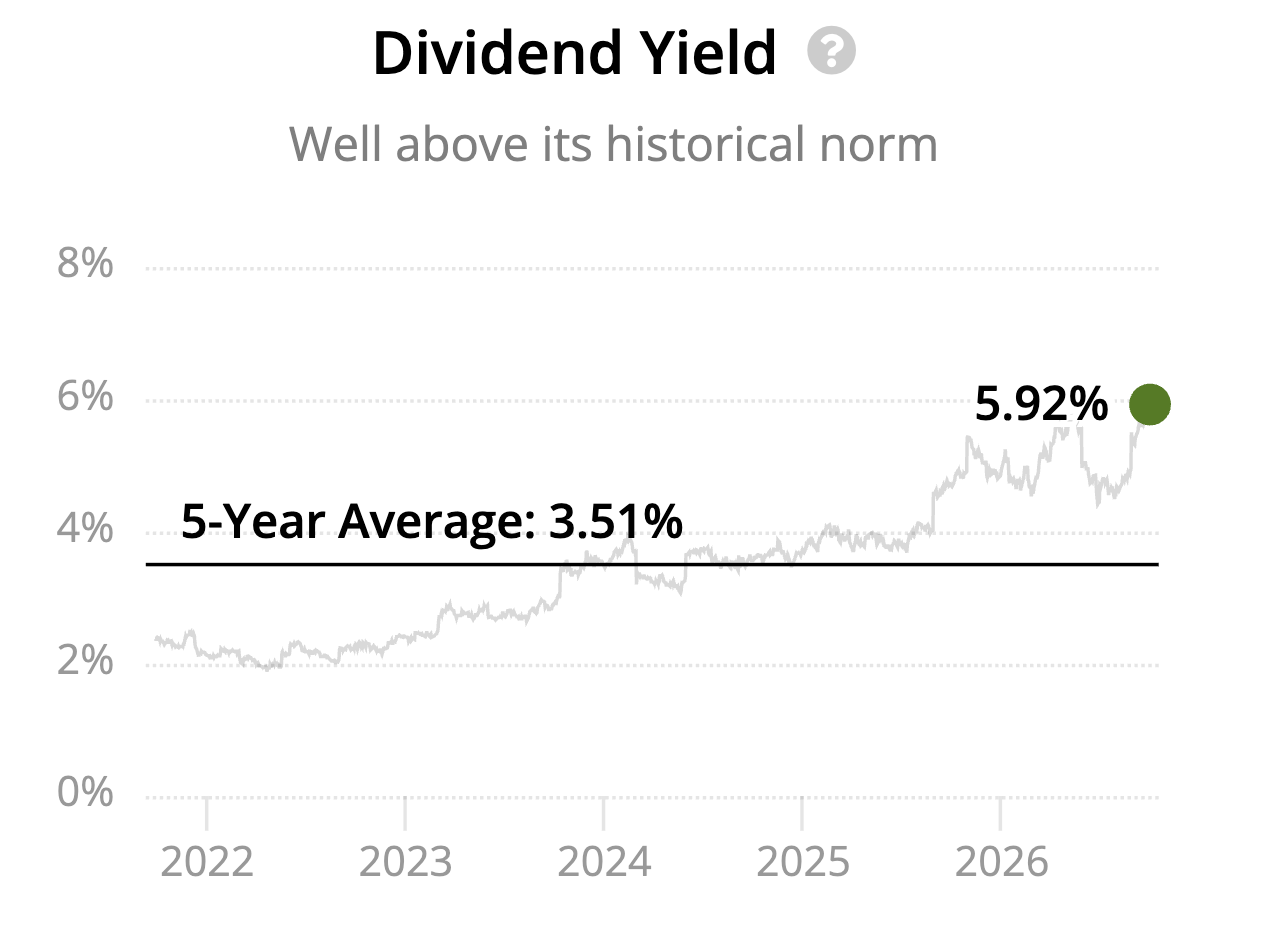
Hormel yields 5.92% against a five-year average of 3.51%, the widest gap on this list. Source: Simply Safe Dividends.
Kimberly-Clark's dividend looks safe, with its pending Kenvue acquisition the main thing to watch. The company holds an A credit rating and has raised its dividend for 53 consecutive years.
Kimberly-Clark (KMB) grew from a paper mill founded in 1872 into one of the world's largest tissue and hygiene companies. Its brands include Huggies, Kleenex, Cottonelle, Scott, Kotex, and Depend, and an estimated one in four people worldwide use its products every day.
Demand for these everyday essentials barely moves with the economy, which has supported 53 consecutive years of dividend increases.
Kimberly-Clark's leverage is low today, which gives it room to absorb the debt from its Kenvue acquisition. Source: Simply Safe Dividends.
The risk is the pending acquisition of Kenvue, the maker of Tylenol, Band-Aid, and Listerine, in a deal valued at nearly $50 billion. Kenvue has struggled to grow and carries litigation risk, and the deal is expected to push leverage toward 3 times EBITDA, above management's 2 times target.
We lowered Kimberly-Clark's Dividend Safety Score from Very Safe to Safe when the deal was announced in November 2025 to reflect that execution risk. The combined payout ratio is expected to land around 70% to 75%.
An A credit rating and today's low leverage give Kimberly-Clark room to absorb the added debt while it integrates the business.
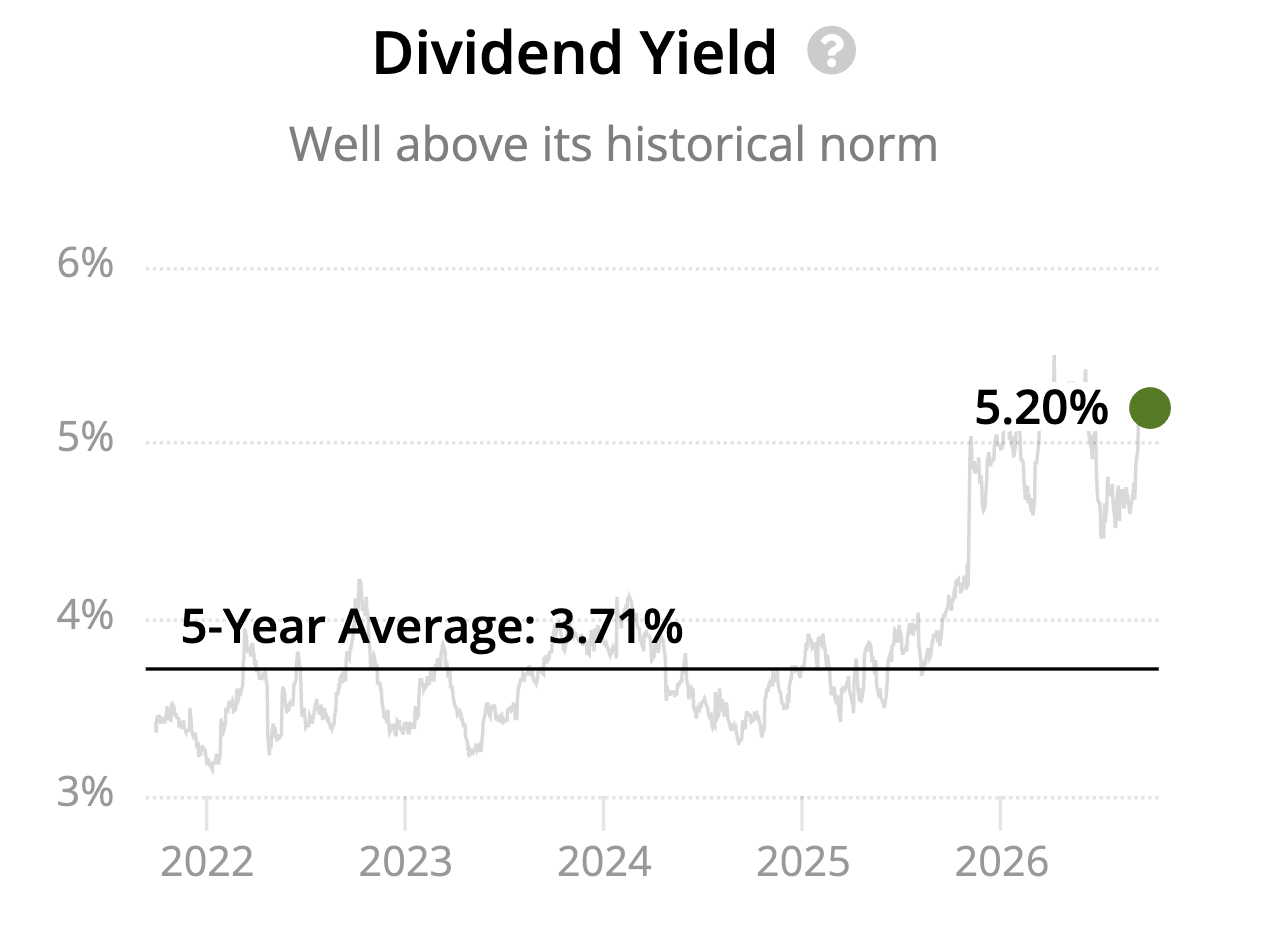
Kimberly-Clark yields 5.20% against a five-year average of 3.71%. Source: Simply Safe Dividends.
Enbridge's dividend looks safe. The pipeline operator earns nearly all of its cash flow from long-term contracts and has paid stable or higher dividends every year since 1953.
With roots in a single Canadian pipeline built in 1949, Enbridge (ENB) is North America's largest midstream energy company. Its pipelines, terminals, storage facilities, and processing plants earn roughly 75% of profits, and regulated gas utilities contribute around 20%.
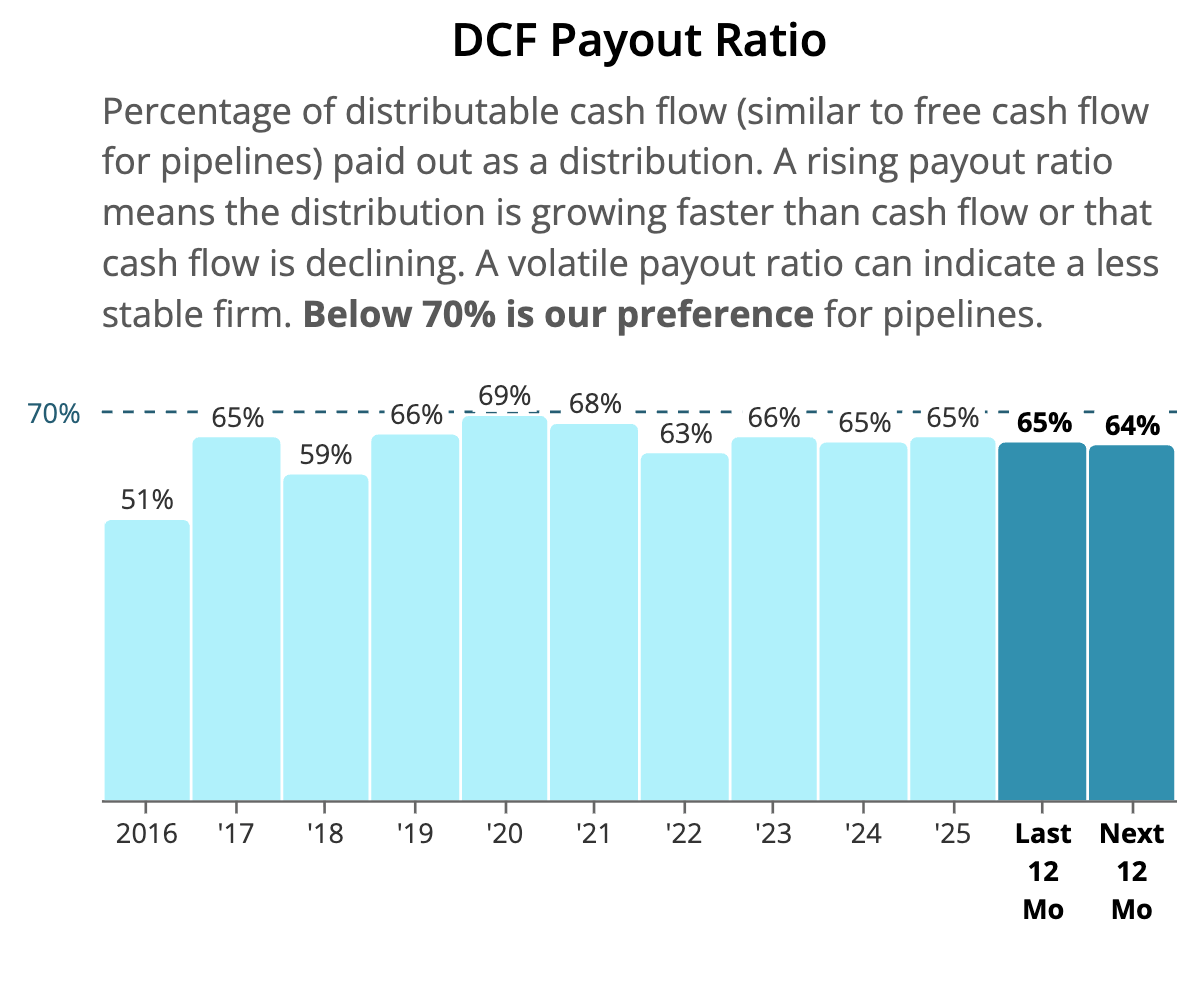
Enbridge has paid out around two thirds of its distributable cash flow for a decade, inside our 70% preference for pipelines. Source: Simply Safe Dividends.
Nearly all of Enbridge's revenue comes from long-term contracts, so the company has minimal direct exposure to oil and gas prices. That annuity-like cash flow has supported stable or higher dividends every year since 1953.
Enbridge carries a BBB+ credit rating. Investors should be comfortable owning fossil fuel infrastructure for the long haul.
Canadian companies' dividends paid to U.S. investors are subject to a 15% withholding tax.
Holding Enbridge in a retirement account avoids it, and in a taxable account you can generally claim a foreign tax credit. Our guide to foreign tax withholding explains how.
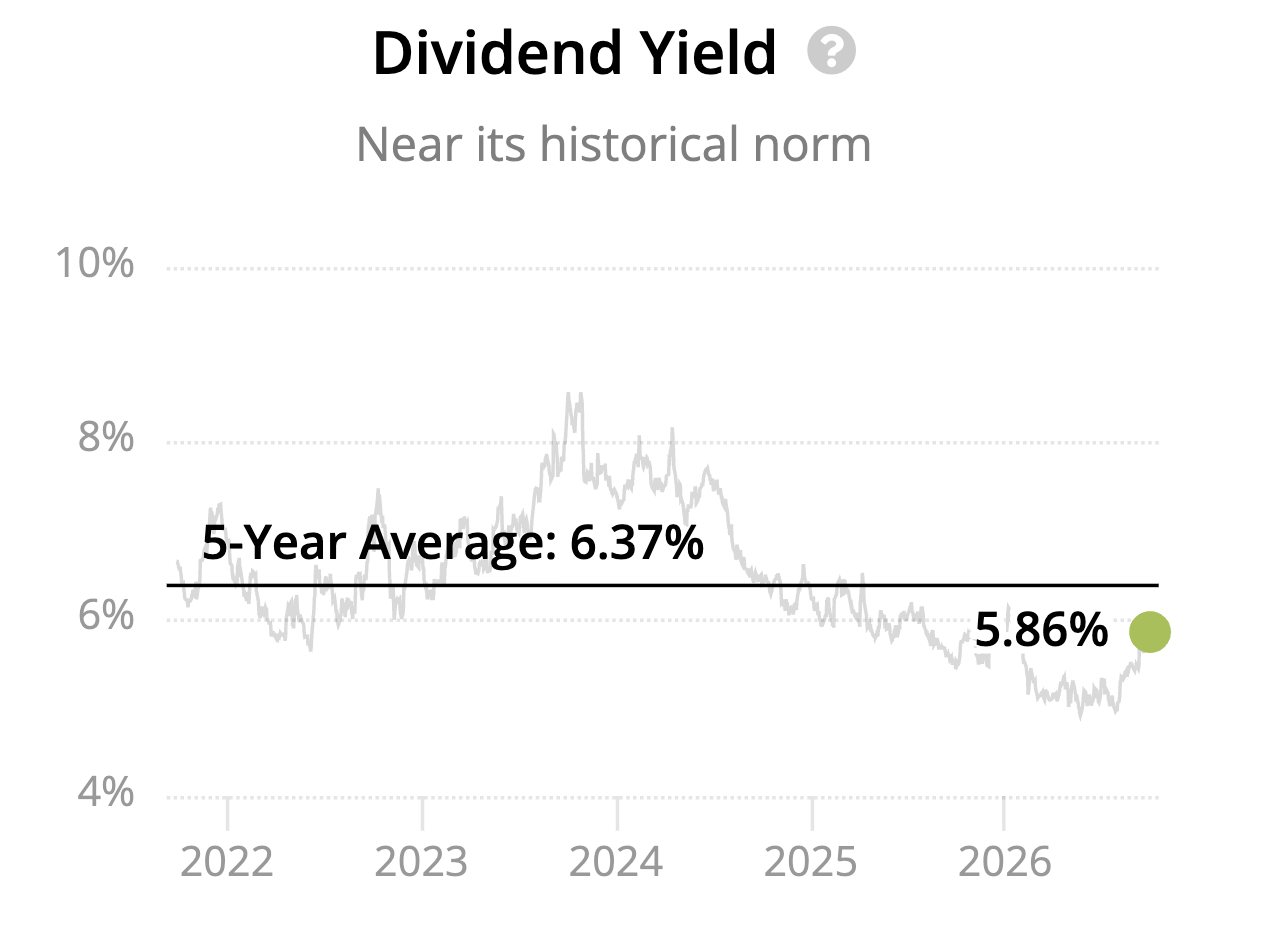
Enbridge yields 5.86%, below its five-year average of 6.37%. Source: Simply Safe Dividends.
Northwest Natural has the longest streak of dividend increases on this list. The gas utility holds an A- credit rating and has raised its dividend for 70 consecutive years.
Tracing its roots to 1859, Northwest Natural (NWN) delivers natural gas to homes and businesses in Oregon and southwest Washington. It also distributes gas in the Dallas, Houston, and Austin areas of Texas and runs water and wastewater utilities in five states.
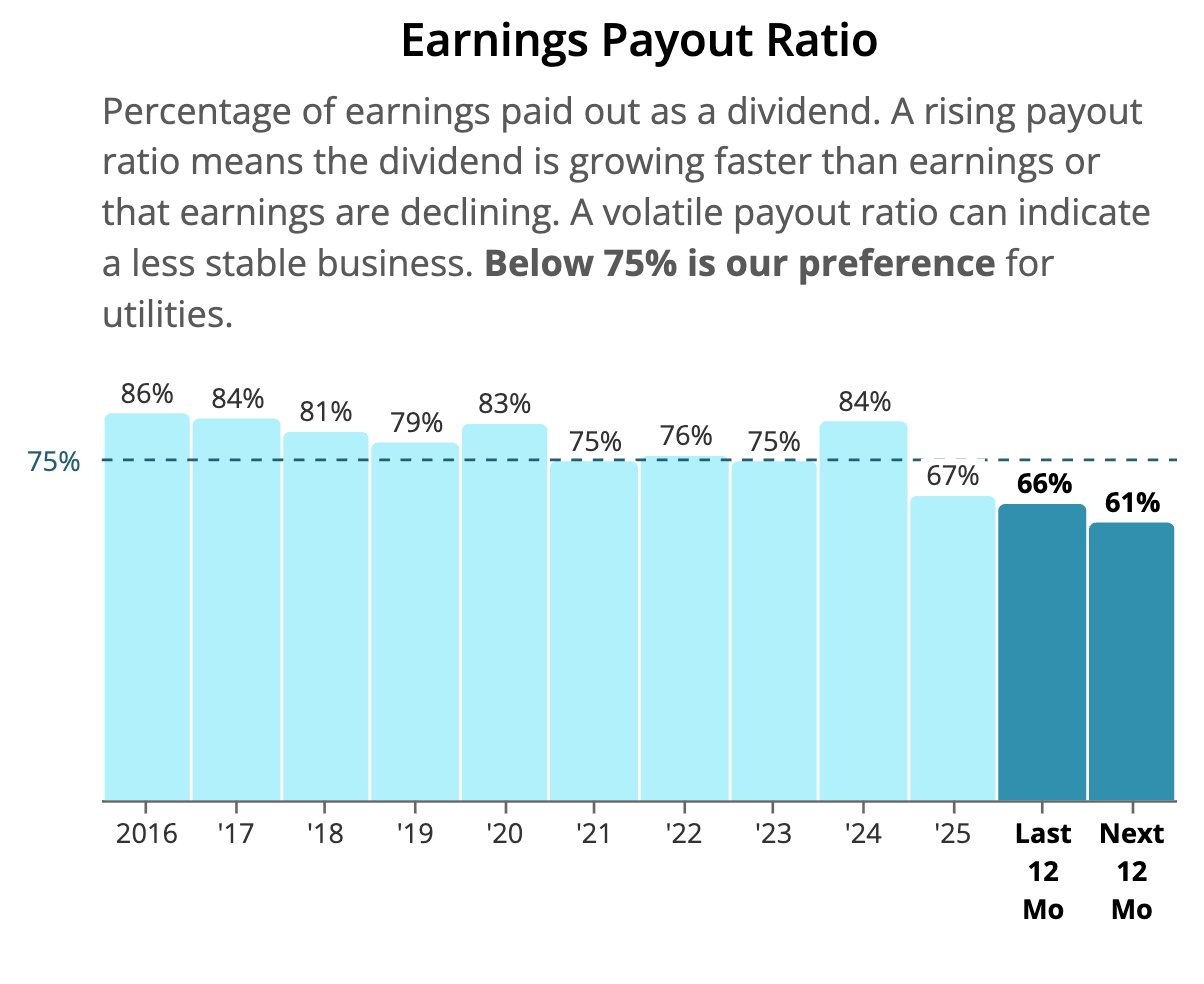
Northwest Natural's payout ratio has fallen to 66% and is expected to reach 61%, inside our 75% preference for utilities. Source: Simply Safe Dividends.
Only a few dozen American companies have raised their dividend for 70 straight years, and regulated rates are why this one has. State commissions set what Northwest Natural can charge, so its earnings barely move with the economy. The company raised its dividend straight through the 2007 to 2009 recession.
The increases are token. The dividend has grown about 0.5% a year for the past decade, so this is a holding for current income rather than income growth.
A Dividend Safety Score of 61 sits one point above our Safe threshold. Leverage near 5.4 times EBITDA is edging high for a utility and the company is small, but its payout ratio is falling rather than rising.
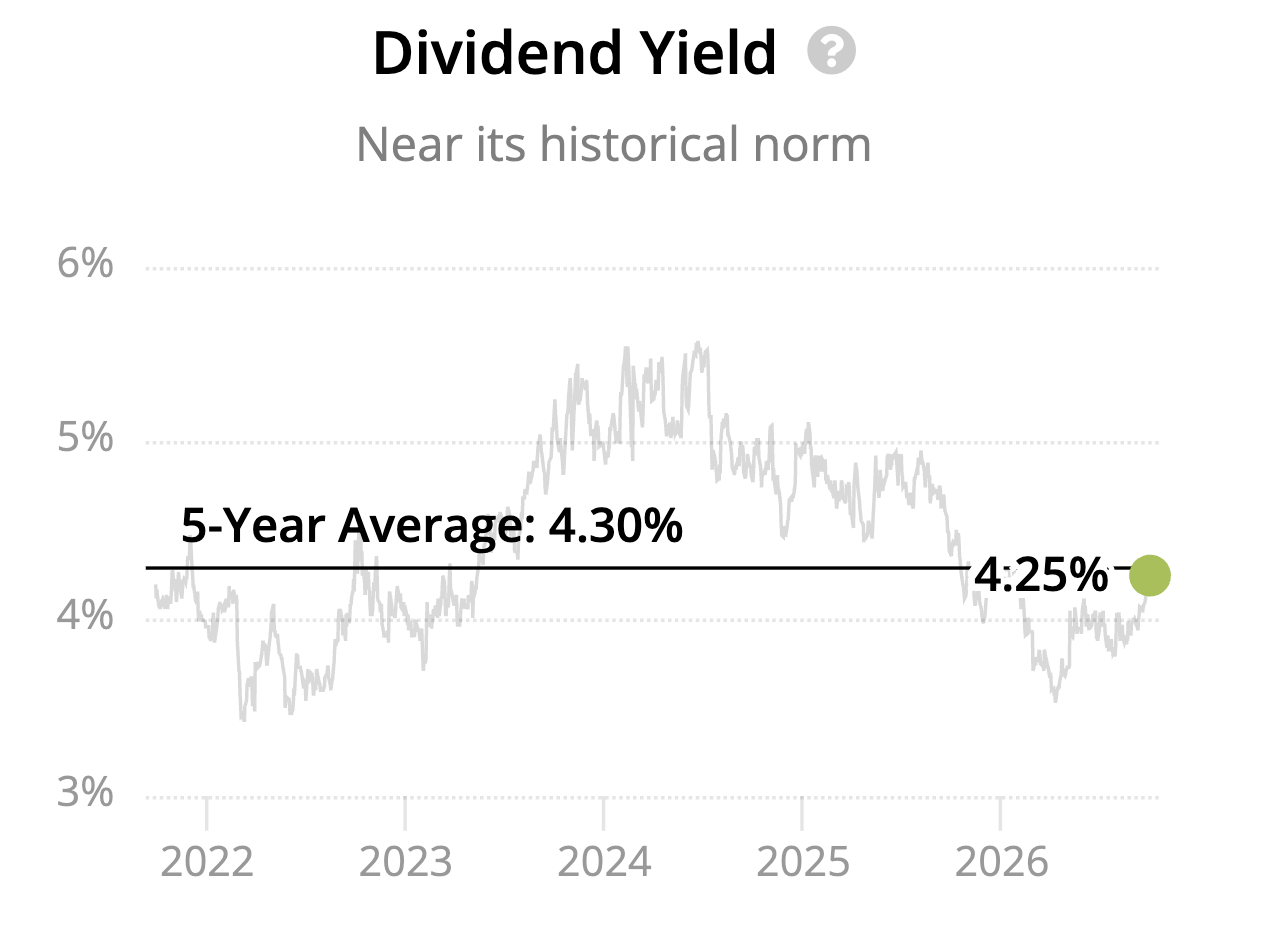
Northwest Natural yields 4.25%, right at its five-year average of 4.30%. Source: Simply Safe Dividends.
Federal Realty's dividend looks safe and is getting safer. We raised its Dividend Safety Score to 80, near the top of our Safe range, in July 2026, and the REIT has raised its dividend for more than 55 straight years.
Federal Realty (FRT) owns more than 100 shopping centers and mixed-use properties in dense, affluent suburbs of markets such as Silicon Valley, New York, and Washington, D.C.
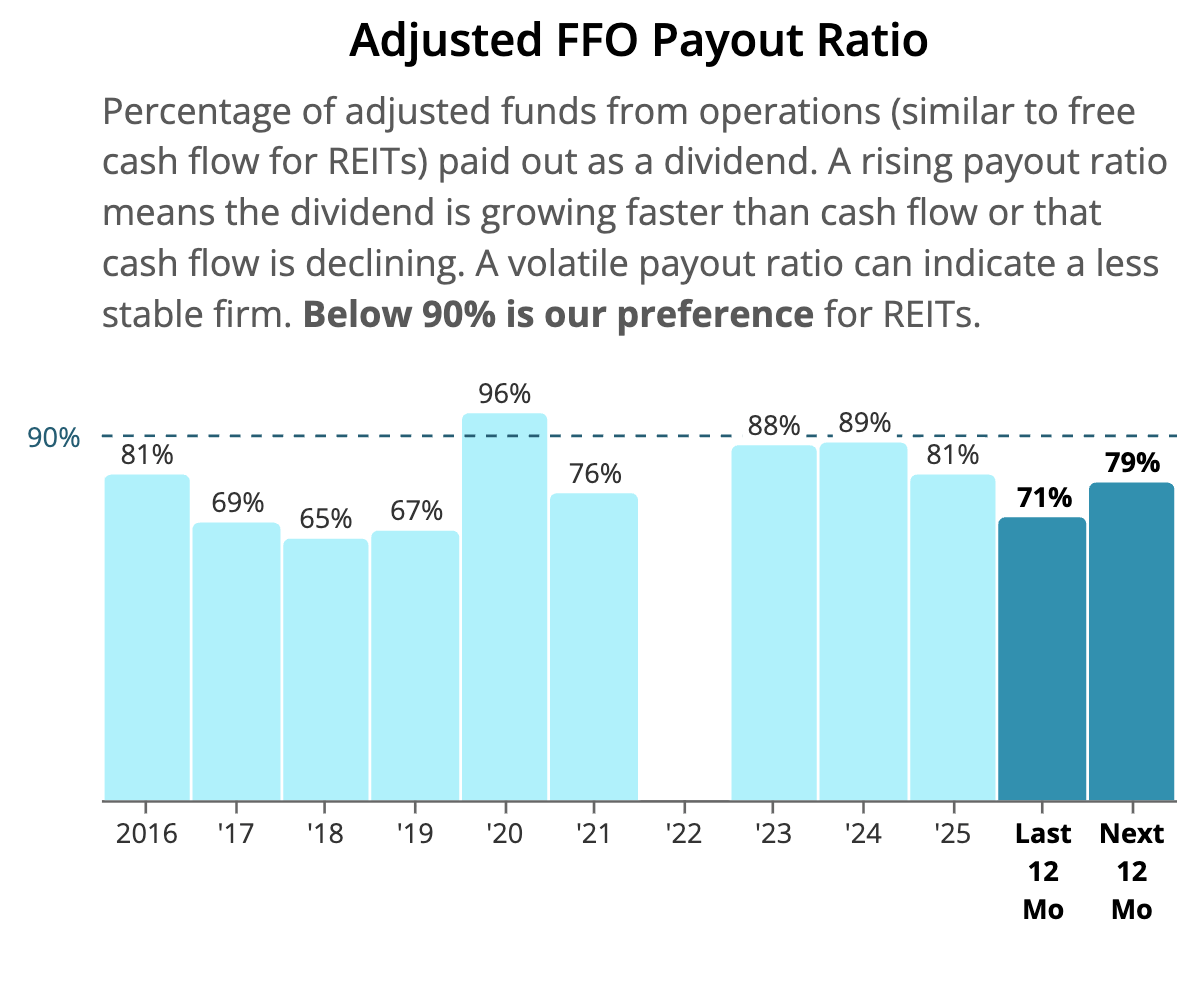
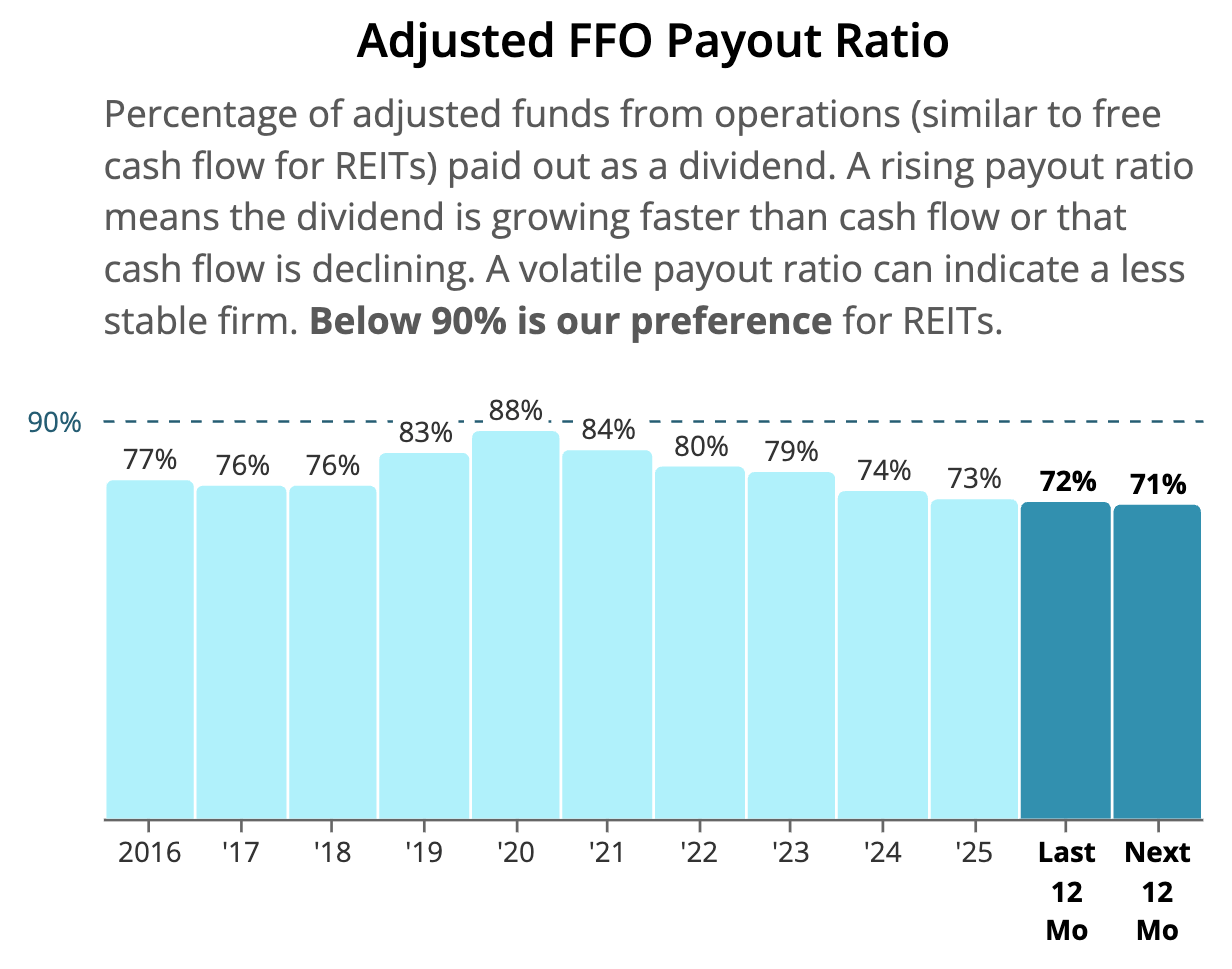
Federal Realty's payout ratio sits near 71%, well below our 90% preference for REITs. Source: Simply Safe Dividends.
Over 75% of its centers include a grocery store, and apartments and offices generate around a quarter of rent. None of its more than 3,000 tenants tops 3% of rent.
We upgraded Federal Realty's Dividend Safety Score from 70 to 80, higher inside the Safe range, in July 2026. Management expects roughly 6% annual growth in funds from operations per share, the cash flow measure REITs report in place of earnings, leverage is falling toward its lowest level in at least a decade, and the payout ratio should drop to about 70% by 2028.
The REIT has raised its dividend for more than 55 straight years, including a 2.7% increase in July 2026. Its slower-growing coastal markets are the main tradeoff for owning one of the highest quality property portfolios of any REIT.
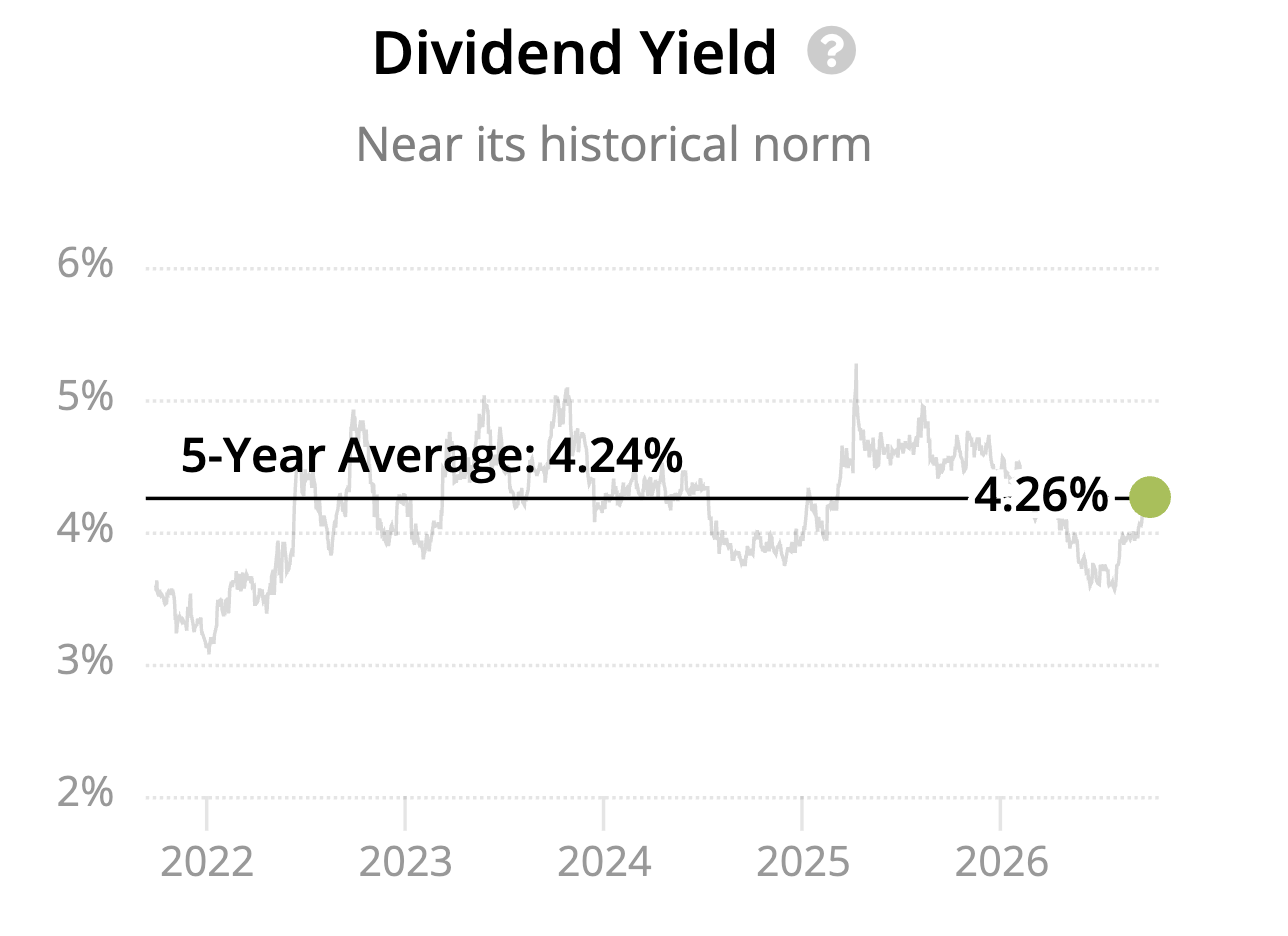
Federal Realty yields 4.26%, in line with its five-year average of 4.24%. Source: Simply Safe Dividends.
PepsiCo's dividend looks safe even as its growth slows. The company holds an A+ credit rating and has raised its dividend for more than 50 consecutive years.
PepsiCo (PEP) generates over $80 billion in annual revenue from snacks (about 60% of sales) and beverages (about 40%), led by brands such as Frito-Lay, Pepsi, Gatorade, and Quaker.
Shoppers in North America, which accounts for roughly 60% of revenue, have become more price-sensitive and more interested in simpler, lower-sugar products. GLP-1 weight loss drugs add another question mark.
PepsiCo has kept its payout ratio between about 60% and 70% for a decade. Source: Simply Safe Dividends.
We lowered PepsiCo's Dividend Safety Score from Very Safe to Safe in April 2026 because the business looks less predictable than it once did, not because the dividend is in danger.
PepsiCo still carries an A+ credit rating, generates substantial profits, and keeps its payout ratio below our 70% preference. It has raised its dividend for more than 50 consecutive years, though increases will likely stay in the low single digits until growth improves.
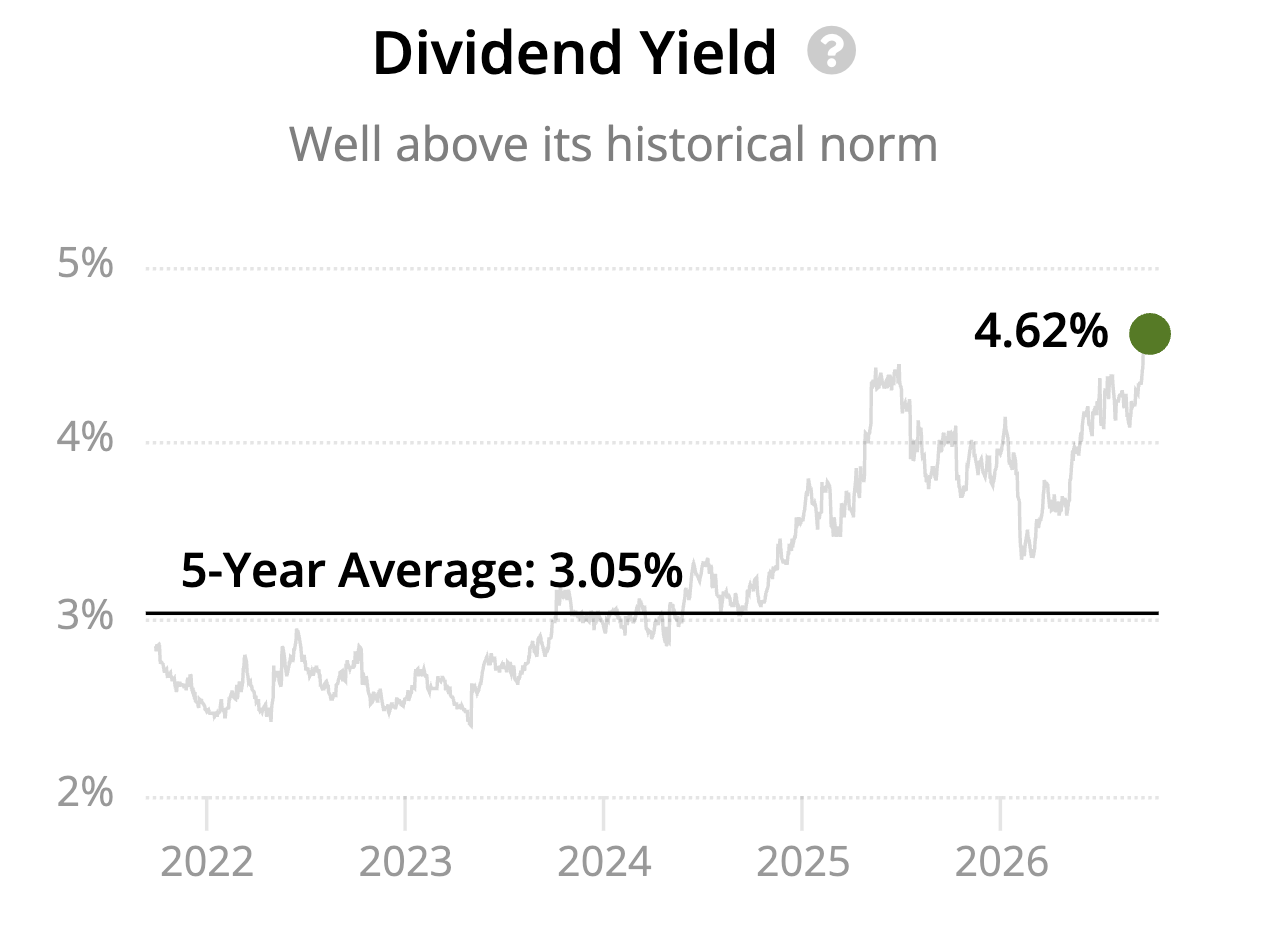
PepsiCo yields 4.62% against a five-year average of 3.05%. Source: Simply Safe Dividends.
Realty Income's dividend looks safe. The monthly payer holds an A- credit rating and a record of raising its dividend every year since going public in 1994.
Realty Income (O) got its start in 1969 with a single Taco Bell. Today it owns thousands of properties across the U.S., the U.K., and continental Europe, mostly retail with industrial and gaming properties making up the rest.
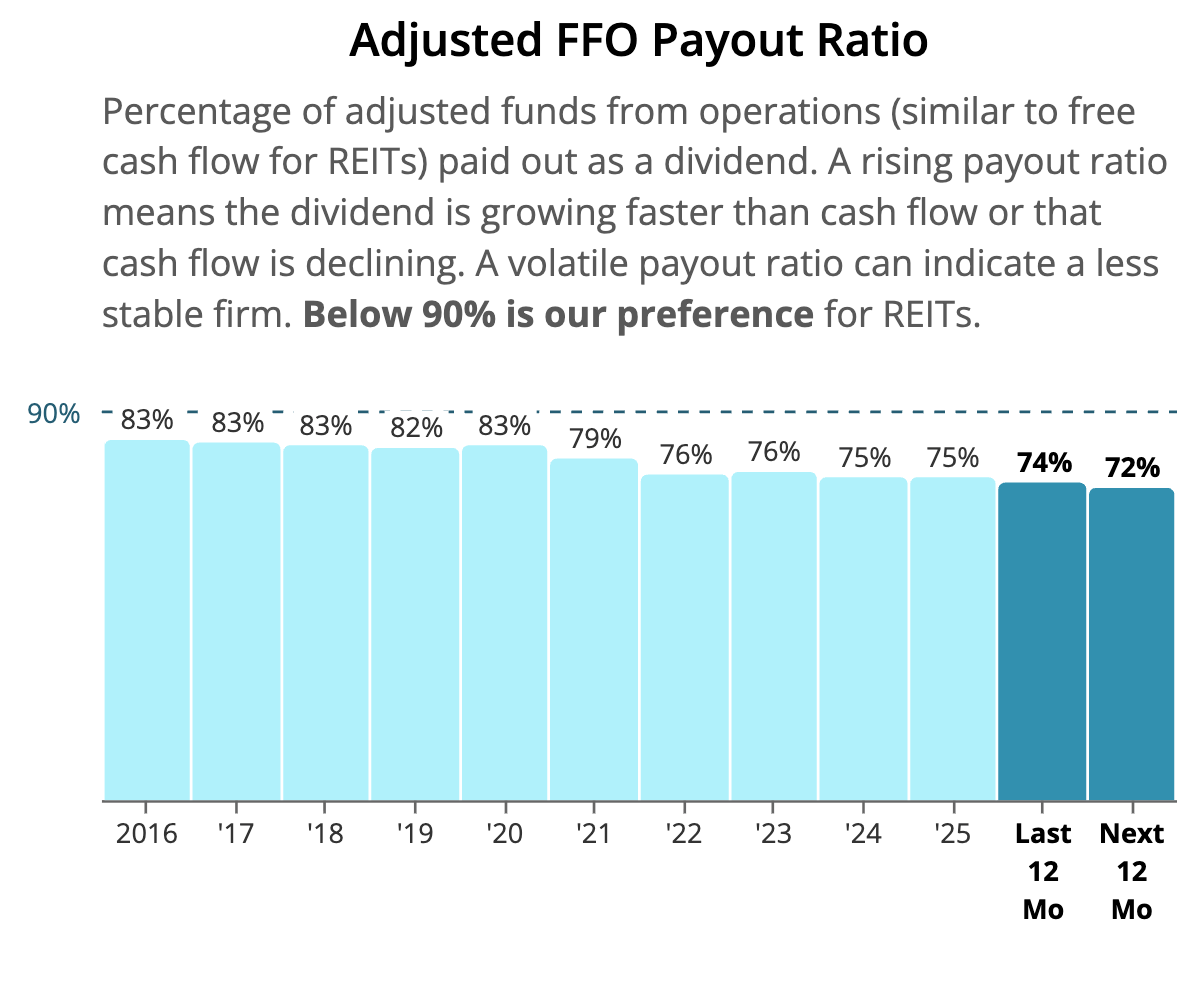
Realty Income's payout ratio has fallen steadily since 2016 and is expected to reach 72%. Source: Simply Safe Dividends.
Long-term, triple-net leases, which push property taxes, insurance, and maintenance onto tenants, keep costs predictable, and the REIT's occupancy rate has never fallen below 96%, even during the financial crisis and pandemic. No top tenant exceeds 5% of rent, and no industry exceeds 12%.
Realty Income has raised its dividend every year since going public in 1994 and pays monthly. It carries an A- credit rating.
The tradeoff is slow growth. The dividend has grown about 3% per year over the last five years, and the stock tends to trade like a bond when interest rates rise.
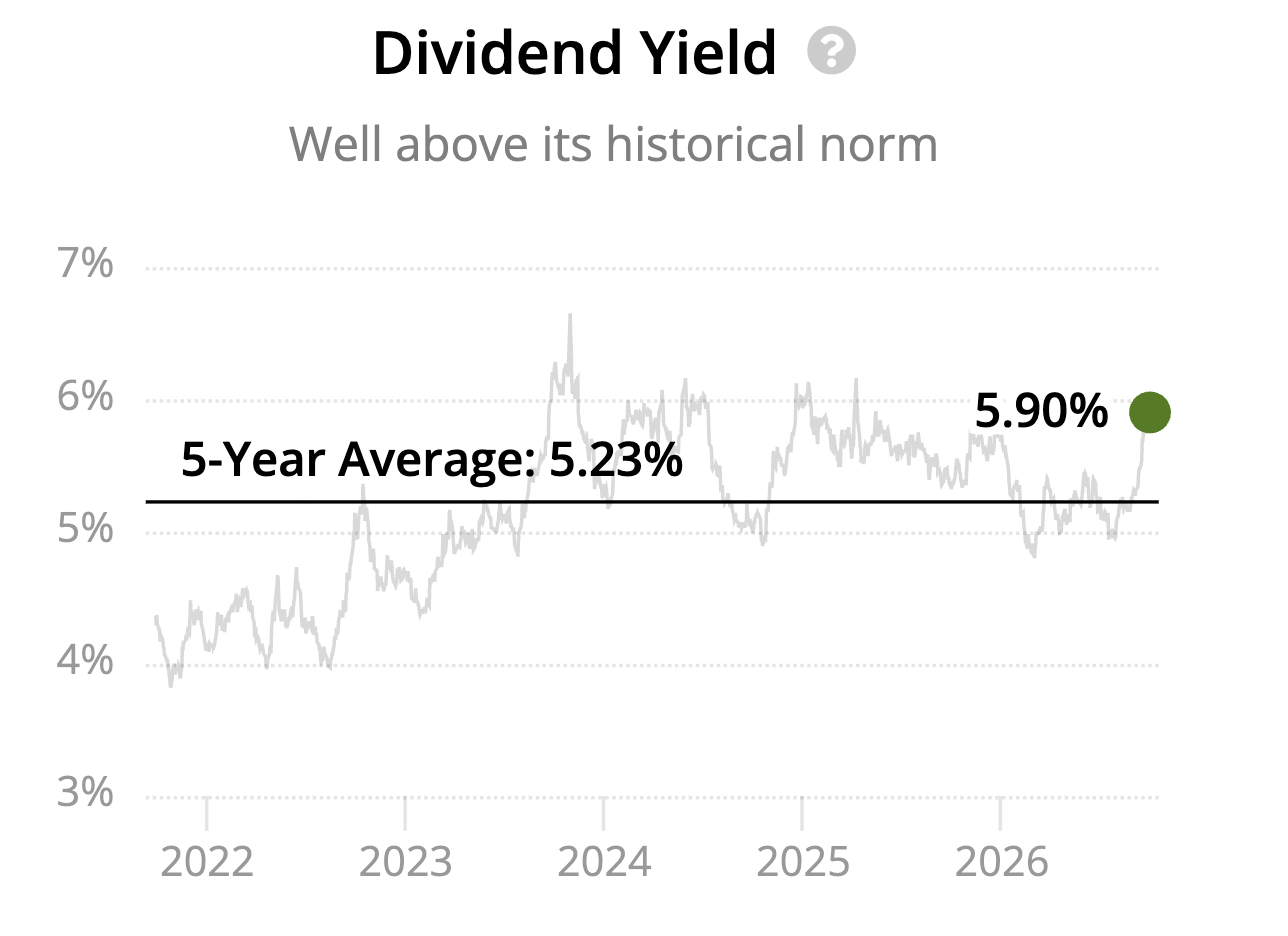
Realty Income yields 5.90% against a five-year average of 5.23%. Source: Simply Safe Dividends.
Public Storage (PSA)
Sector: Real Estate – Self-Storage REITs Dividend Yield: 4.2% Dividend Safety Score: Very Safe (90) Uninterrupted Dividend Streak: 45 years Credit Rating: A
Public Storage has the safest dividend on this list. It holds an A credit rating and has paid uninterrupted dividends for 45 years.
Public Storage (PSA) is the largest self-storage owner in the U.S., with roughly 3,000 properties. Customers are slow to move their belongings once settled, which makes rent streams sticky through economic cycles.
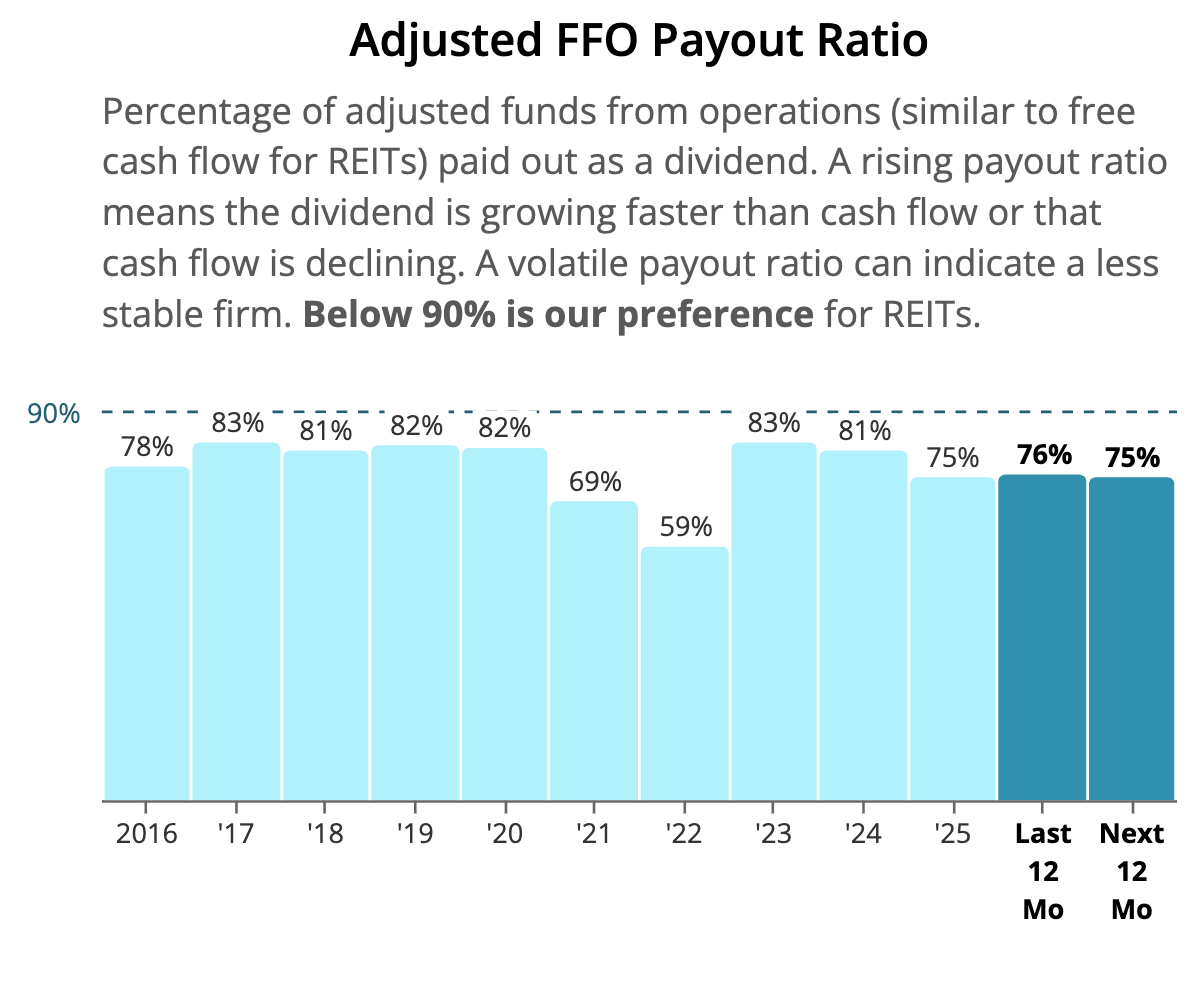
Public Storage's payout ratio near 76% leaves a wide cushion against our 90% preference for REITs. Source: Simply Safe Dividends.
Public Storage is one of only three stocks we rate that yield at least 4% and score Very Safe, and the only one on this list. At 4.2%, its yield sits closest to this list's 4% floor.
We trimmed its Dividend Safety Score from 96 to 90, still Very Safe, in March 2026 after it agreed to acquire National Storage for $10.5 billion. The deal adds more than 1,000 properties, mostly in the Sunbelt, but pushes leverage modestly higher while occupancy has dipped to 92% from a pandemic peak near 96%.
S&P reaffirmed Public Storage's A credit rating after reviewing the deal. The dividend has been flat since 2023, so this is a stock for safety and current income rather than growth.
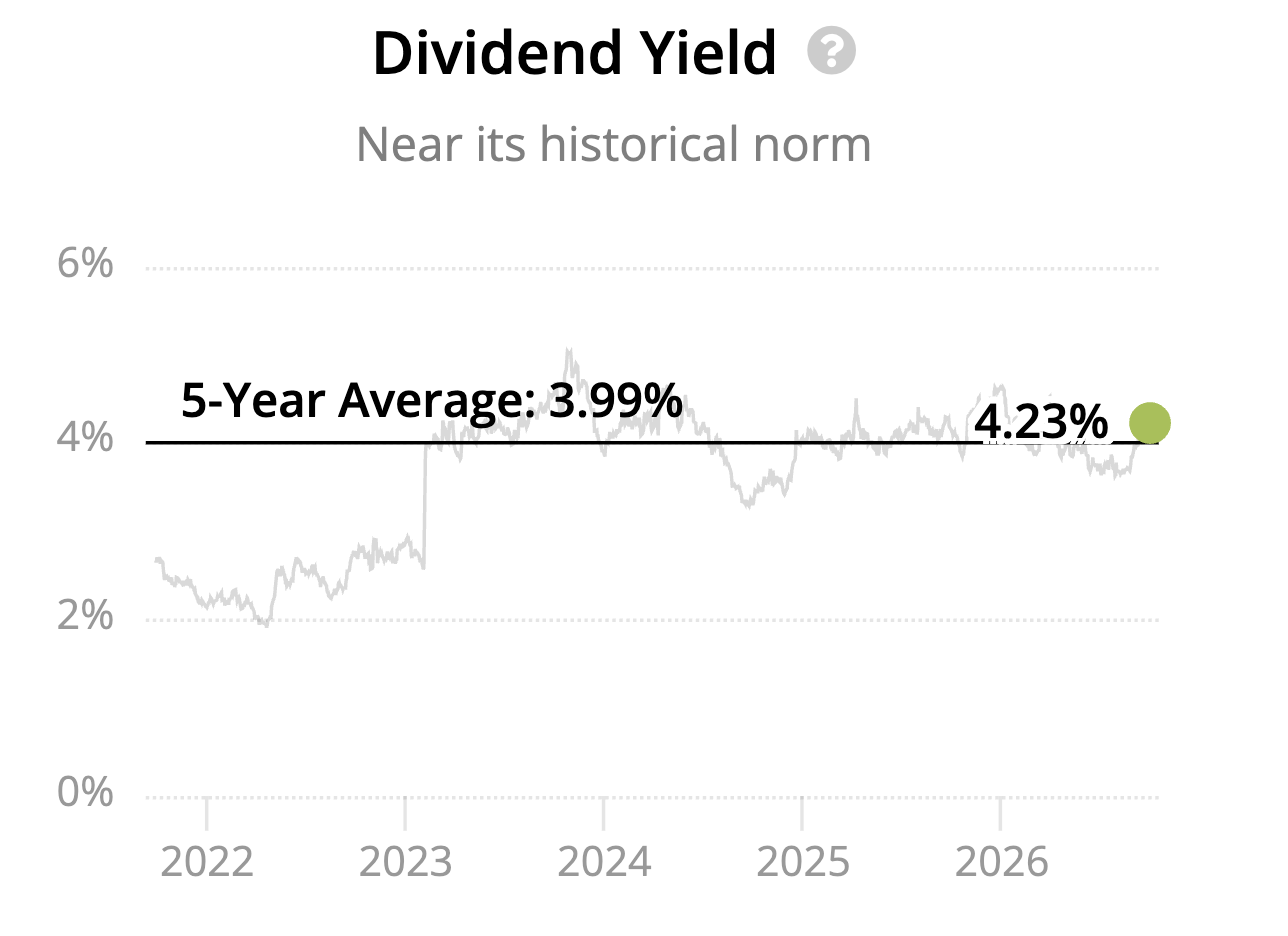
Public Storage yields 4.23%, just above its five-year average of 3.99%. Source: Simply Safe Dividends.
Verizon's dividend looks safe. The carrier keeps its payout ratio below 60% and has paid uninterrupted dividends for 42 years.
Verizon (VZ) is one of three companies that dominate the U.S. wireless market, a capital-intensive business with high barriers to entry.
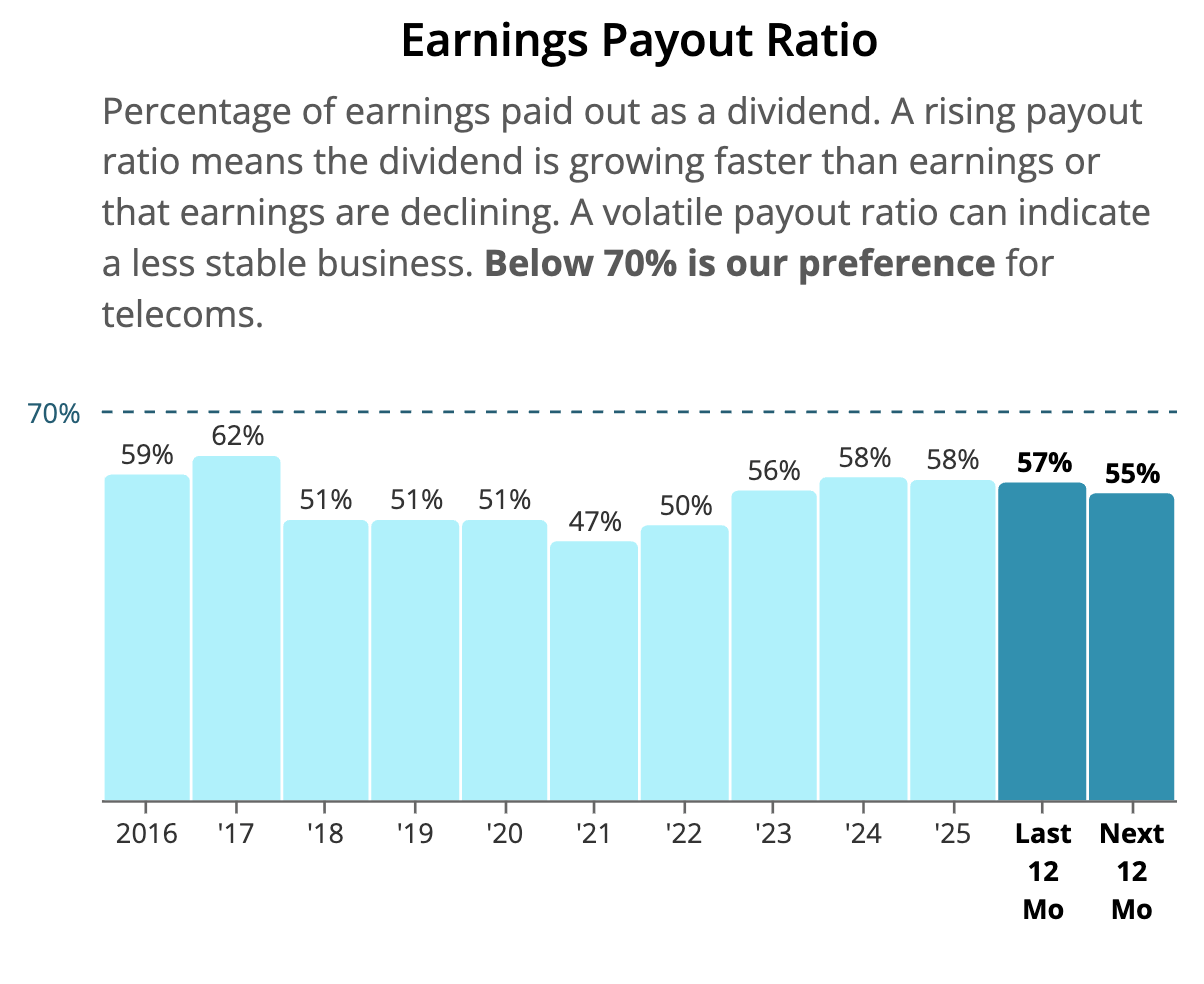
Verizon's payout ratio has stayed below our 70% preference for telecoms every year since 2016. Source: Simply Safe Dividends.
Shares fell about 15% from mid-March 2026 on fears that Starlink could become a fourth major wireless carrier. We think those concerns are overdone. A competitive satellite phone service looks unlikely before 2029 or 2030, and satellites are poorly suited to carrying the dense, indoor traffic that dominates Verizon's network.
CEO Dan Schulman, who took over in October 2025, has reaffirmed the company's commitment to the dividend. Verizon maintains a payout ratio below 60% and a BBB+ credit rating, and it has paid uninterrupted dividends for 42 years.
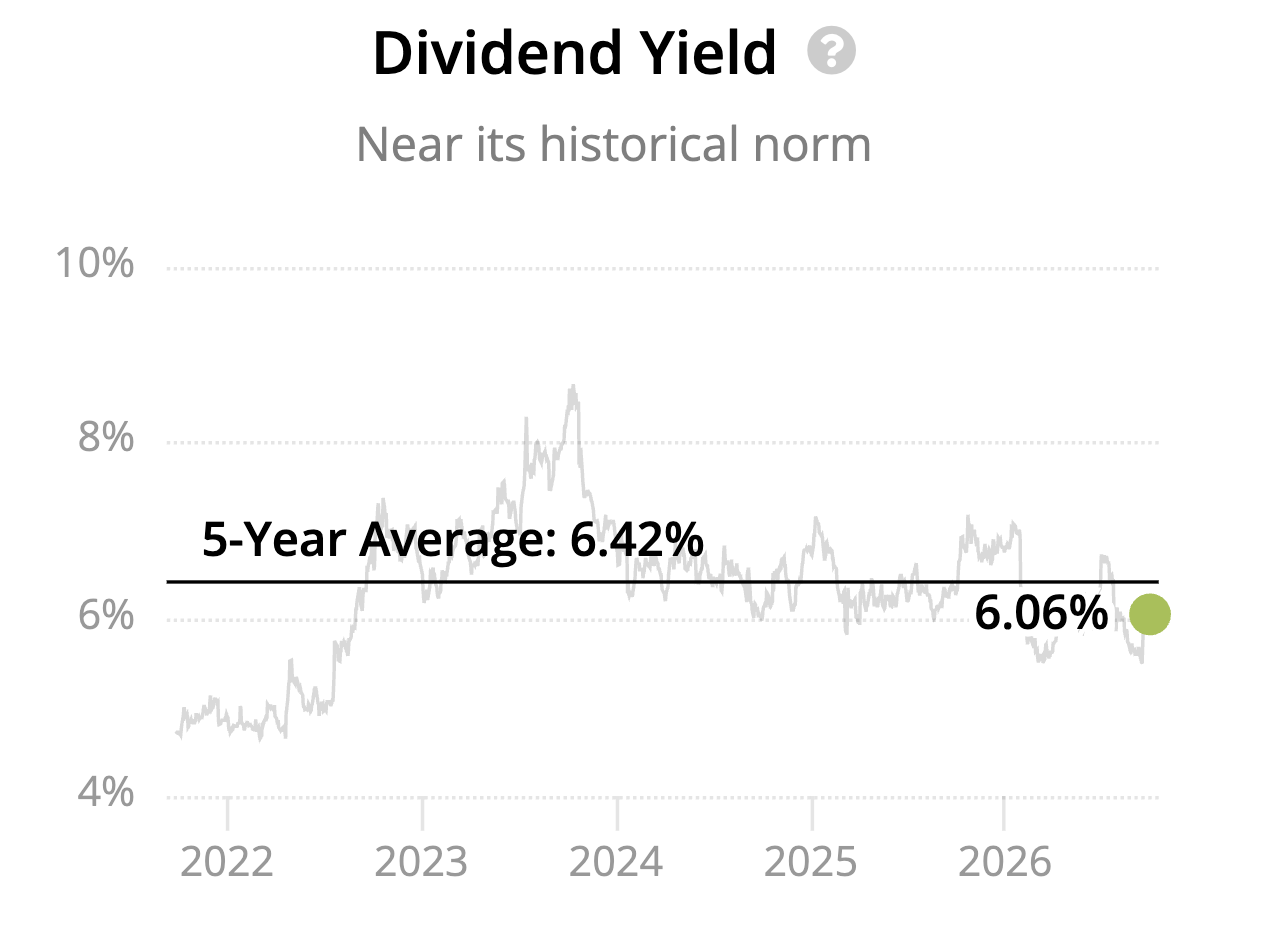
Verizon yields 6.06%, below its five-year average of 6.42%. Source: Simply Safe Dividends.
NNN's dividend looks safe. The retail REIT holds a BBB+ credit rating and has raised its dividend every year since 1990.
NNN REIT (NNN), formerly National Retail Properties, traces its roots to 1984, when restaurant chain Golden Corral formed a REIT to buy its properties and lease them back.
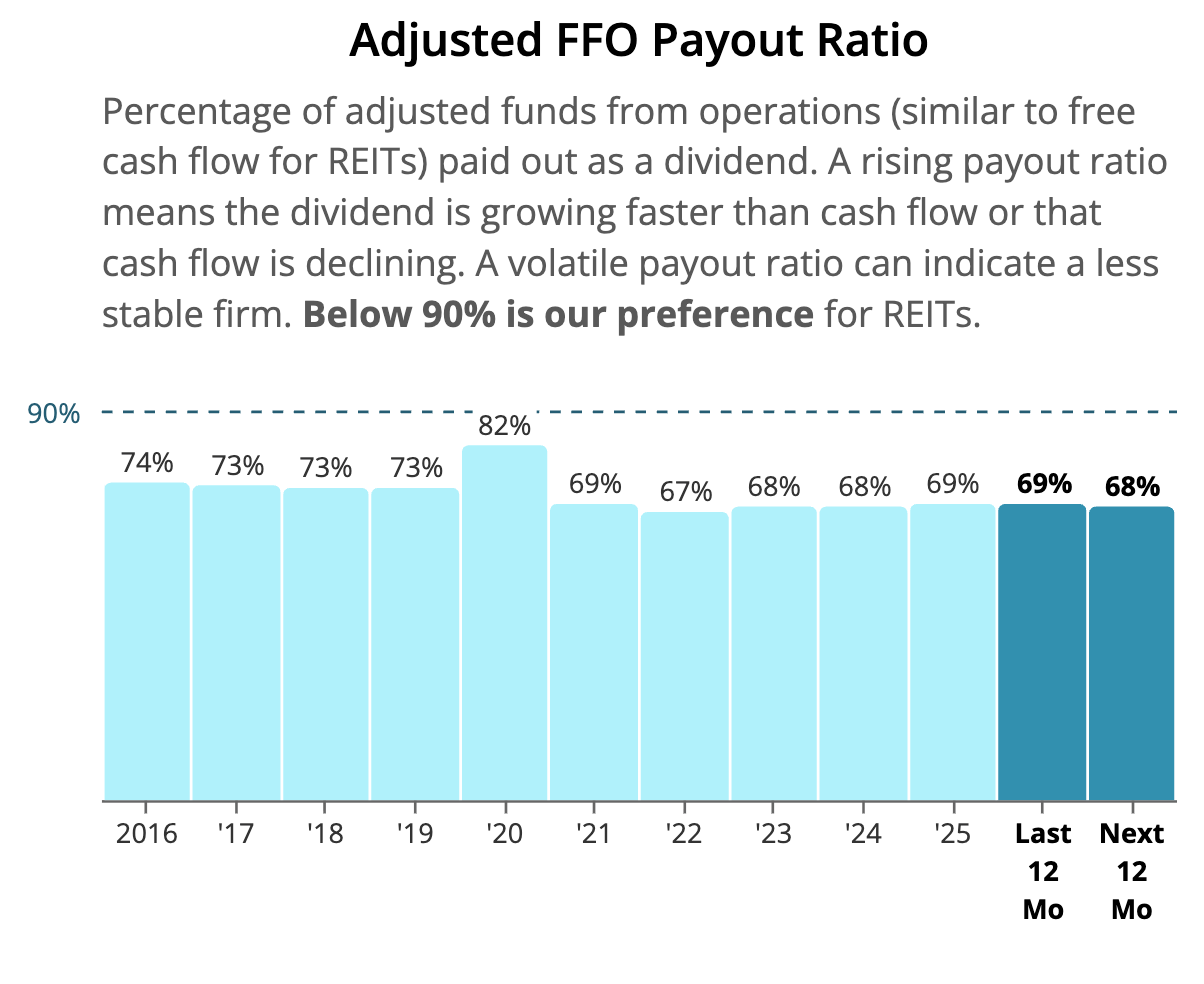
NNN has held its payout ratio near 68% since 2021, comfortably inside our 90% preference for REITs. Source: Simply Safe Dividends.
NNN still follows that sale-leaseback model. Tenants sign long-term, triple-net leases and pay for insurance, maintenance, utilities, and property taxes, leaving NNN with a steady stream of high-margin rent.
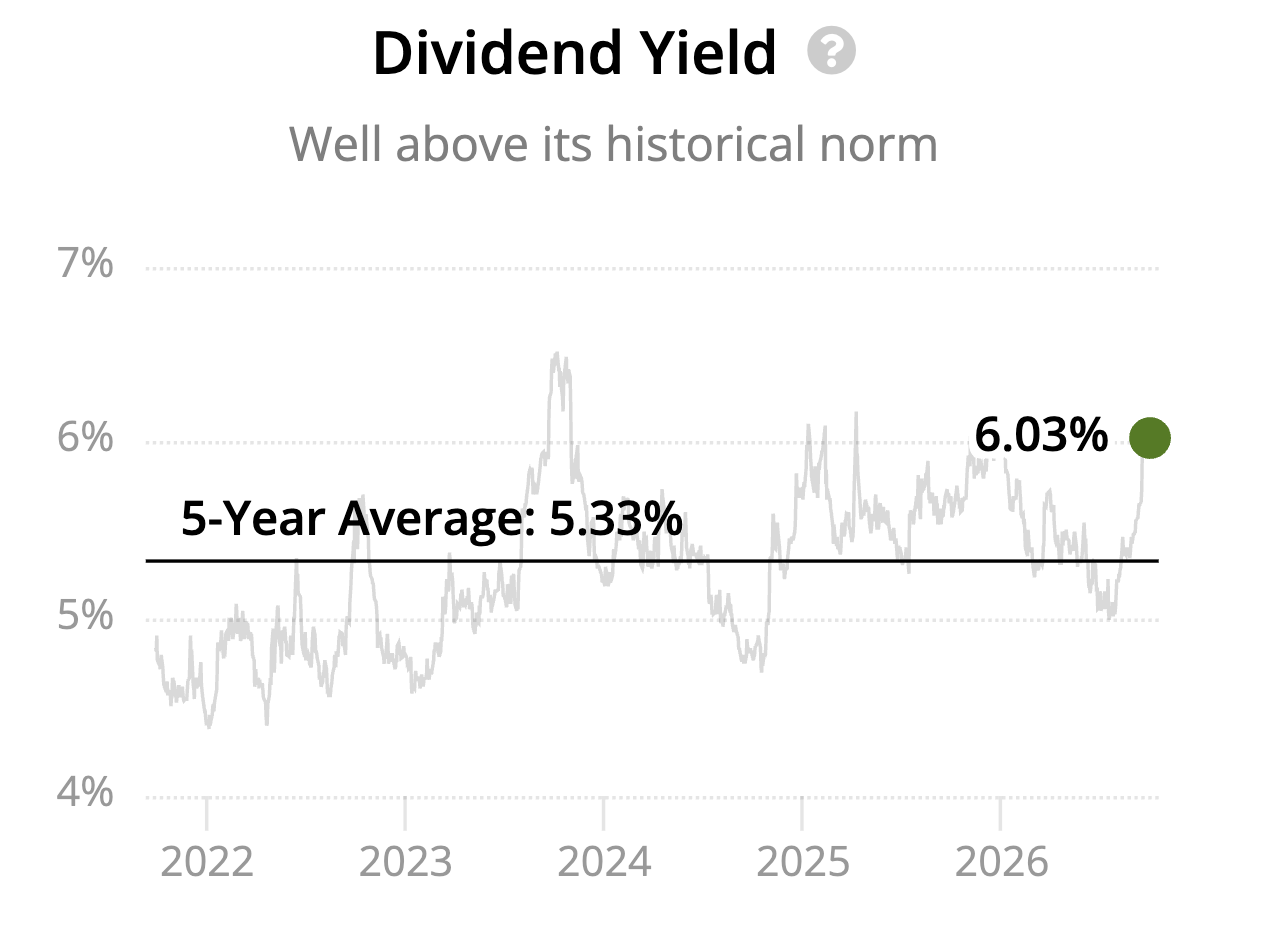
The REIT has raised its dividend every year since 1990 and carries a BBB+ credit rating. At 6.0%, it is among the highest-yielding stocks on this list that still score Safe, alongside Enterprise Products Partners and Verizon.
NNN yields 6.03% against a five-year average of 5.33%. Source: Simply Safe Dividends.
Paychex's dividend looks safe even though its payout ratio runs above our preference. The payroll processor holds a BBB+ credit rating and has paid uninterrupted dividends for 35 years.
Founded in 1971, Paychex (PAYX) handles payroll, tax filing, benefits, and compliance for hundreds of thousands of small and mid-sized employers. Customers pay recurring fees, and most of them renew.
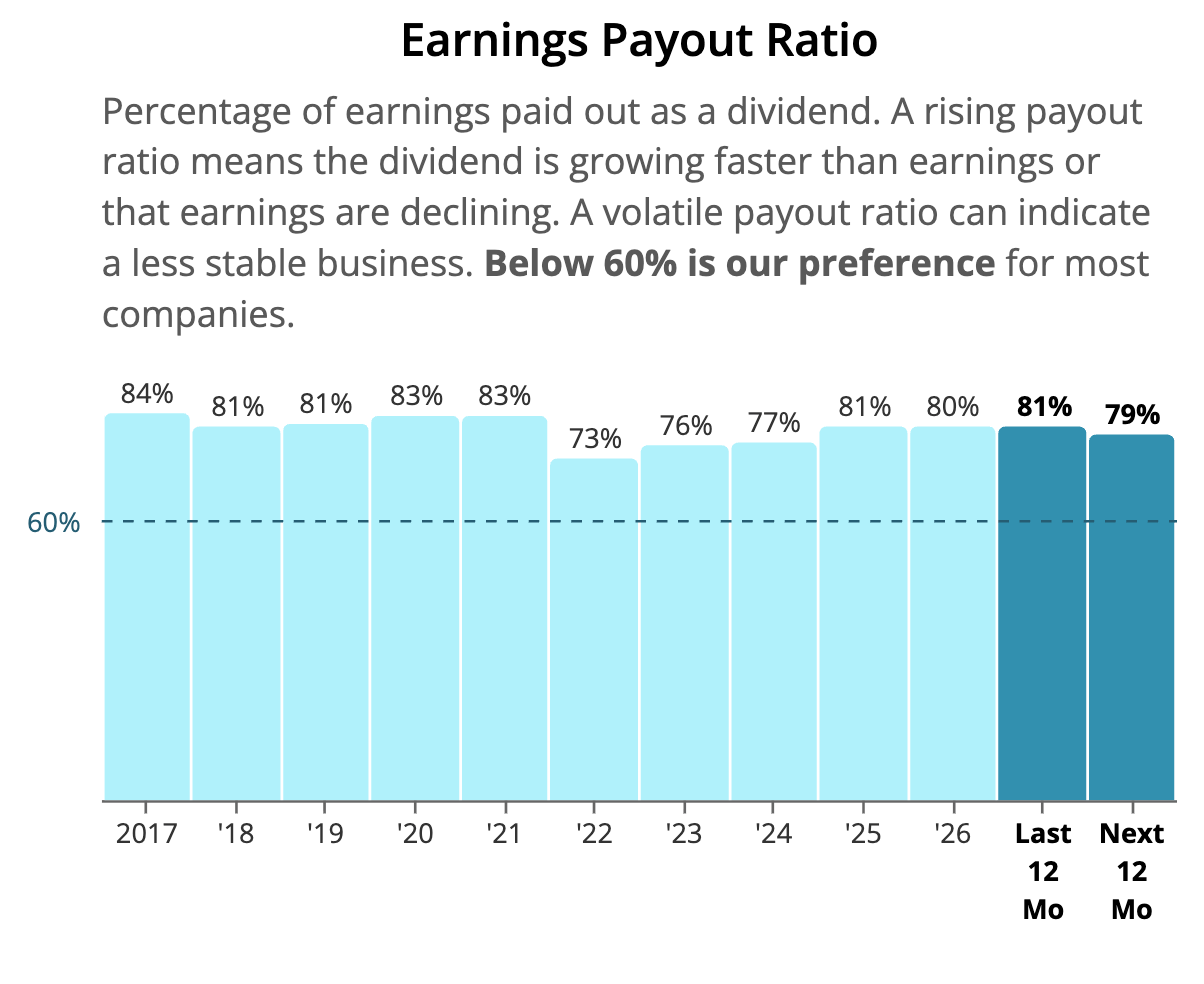
Paychex has paid out about 80% of its earnings every year for a decade, above our 60% preference but remarkably steady. Source: Simply Safe Dividends.
That is above our 60% preference for most companies, and in a cyclical business it would concern us. Here it reflects a model that needs almost no reinvestment and turns nearly all of its earnings into cash, with net debt at about 1.1 times EBITDA.
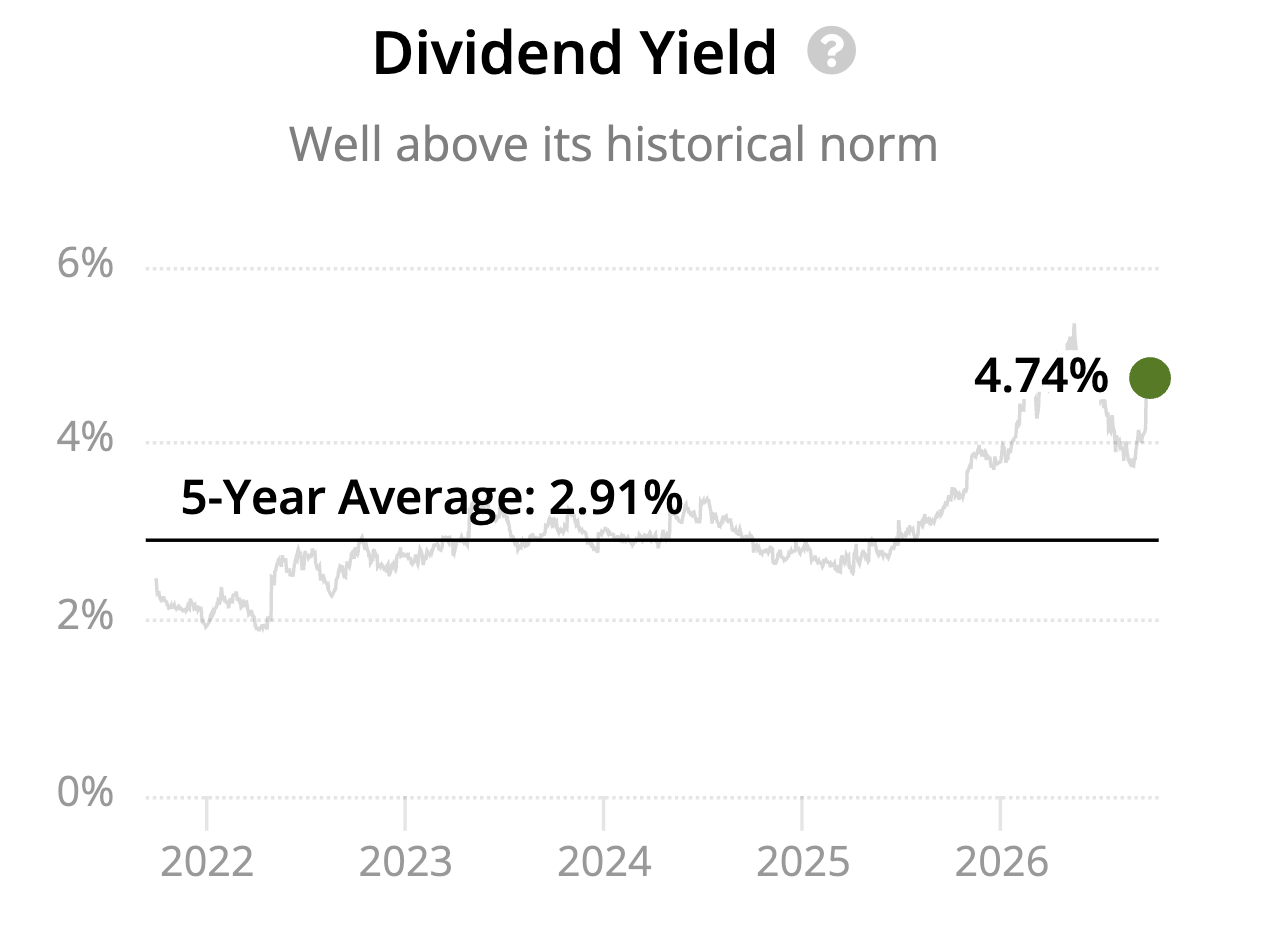
The stock has fallen about 20% from its 52-week high as small business hiring slowed and investors began asking whether AI tools will reduce demand for payroll services. That decline is why a company that usually yields around 3% now pays 4.8%.
Paychex maintained its dividend through the 2008 financial crisis, raised it 10% in May 2026, and is integrating its Paycor acquisition.
Paychex yields 4.74% against a five-year average of 2.91%. Source: Simply Safe Dividends.
Mid-America's dividend looks safe, though its cushion has narrowed. The apartment REIT holds an A- credit rating and has paid uninterrupted dividends for 31 years.
Strong migration during the pandemic encouraged developers to build too many units in MAA's markets. Demand held up, but new supply arrived faster than renters could absorb it, forcing landlords to cut prices on new leases.
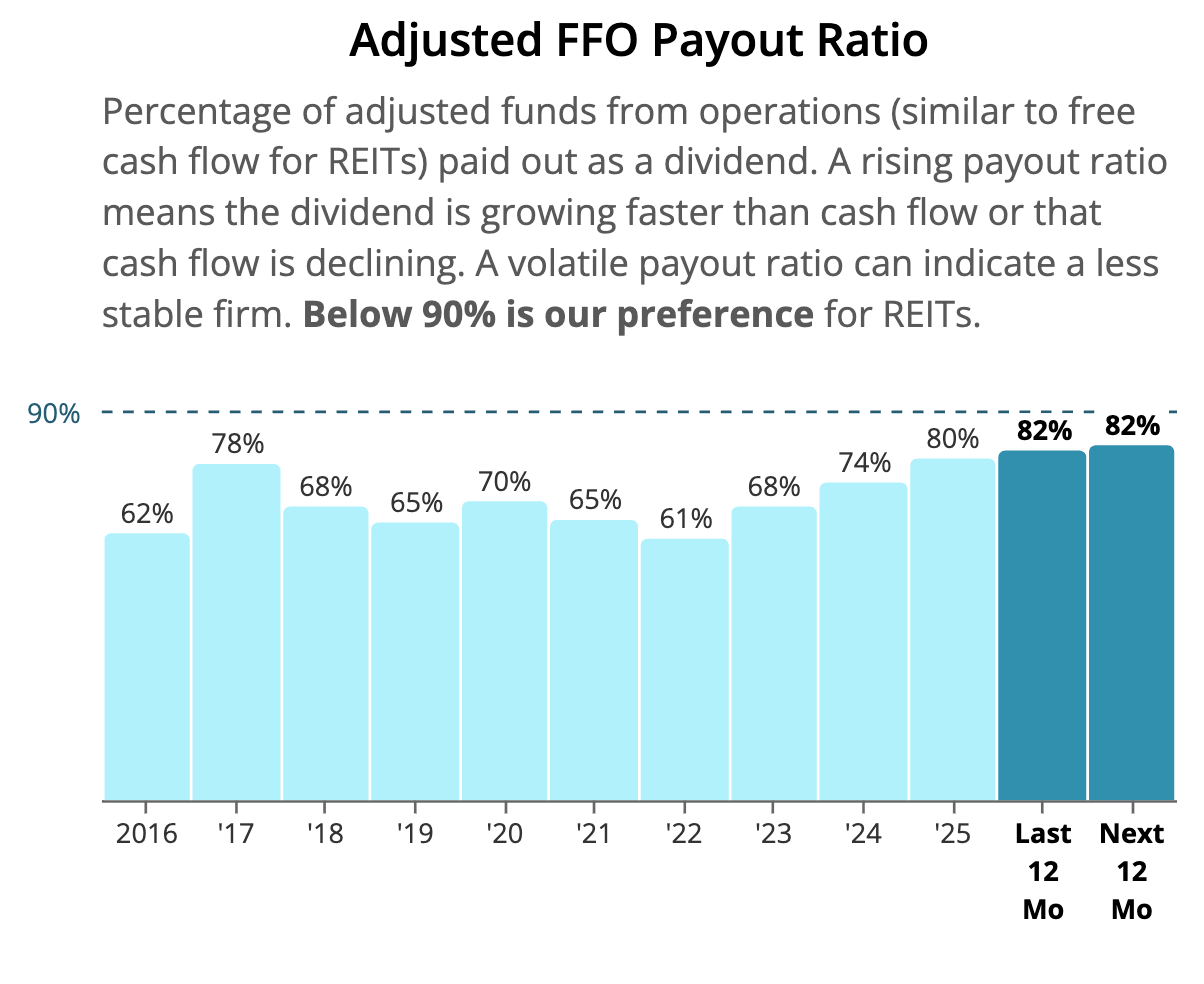
Mid-America's payout ratio has climbed from 61% in 2022 to 82%, still below our 90% preference for REITs. Source: Simply Safe Dividends.
MAA protected occupancy at about 95% and kept resident turnover near record lows, but weaker pricing pushed its payout ratio steadily higher. We lowered its Dividend Safety Score from Very Safe to Safe in July 2026.
The REIT entered this downturn with healthy dividend coverage and an A- credit rating, and new construction has now slowed. Conditions could take several years to fully normalize, so dividend growth will likely stay modest until then.
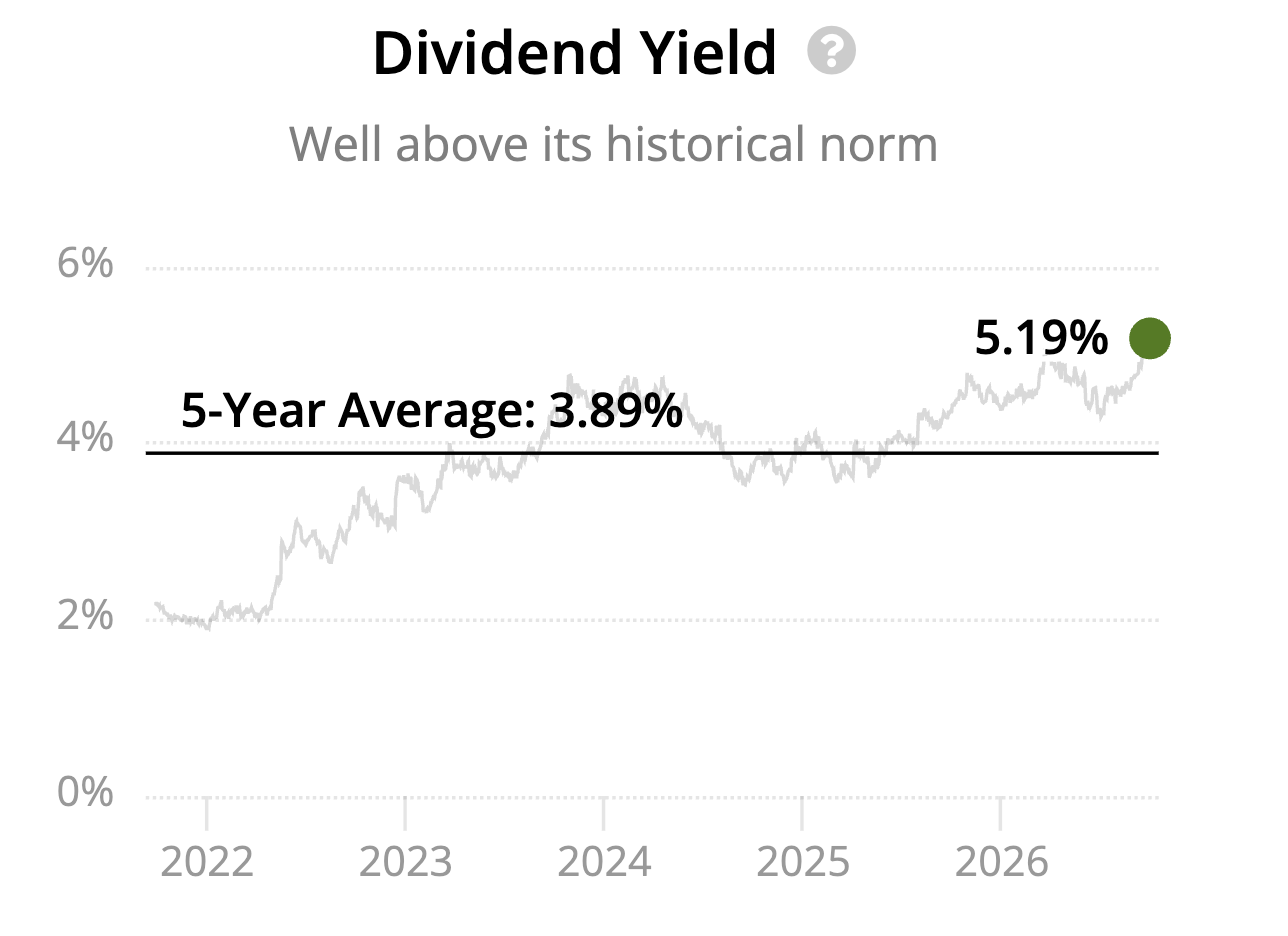
Mid-America yields 5.19% against a five-year average of 3.89%. Source: Simply Safe Dividends.
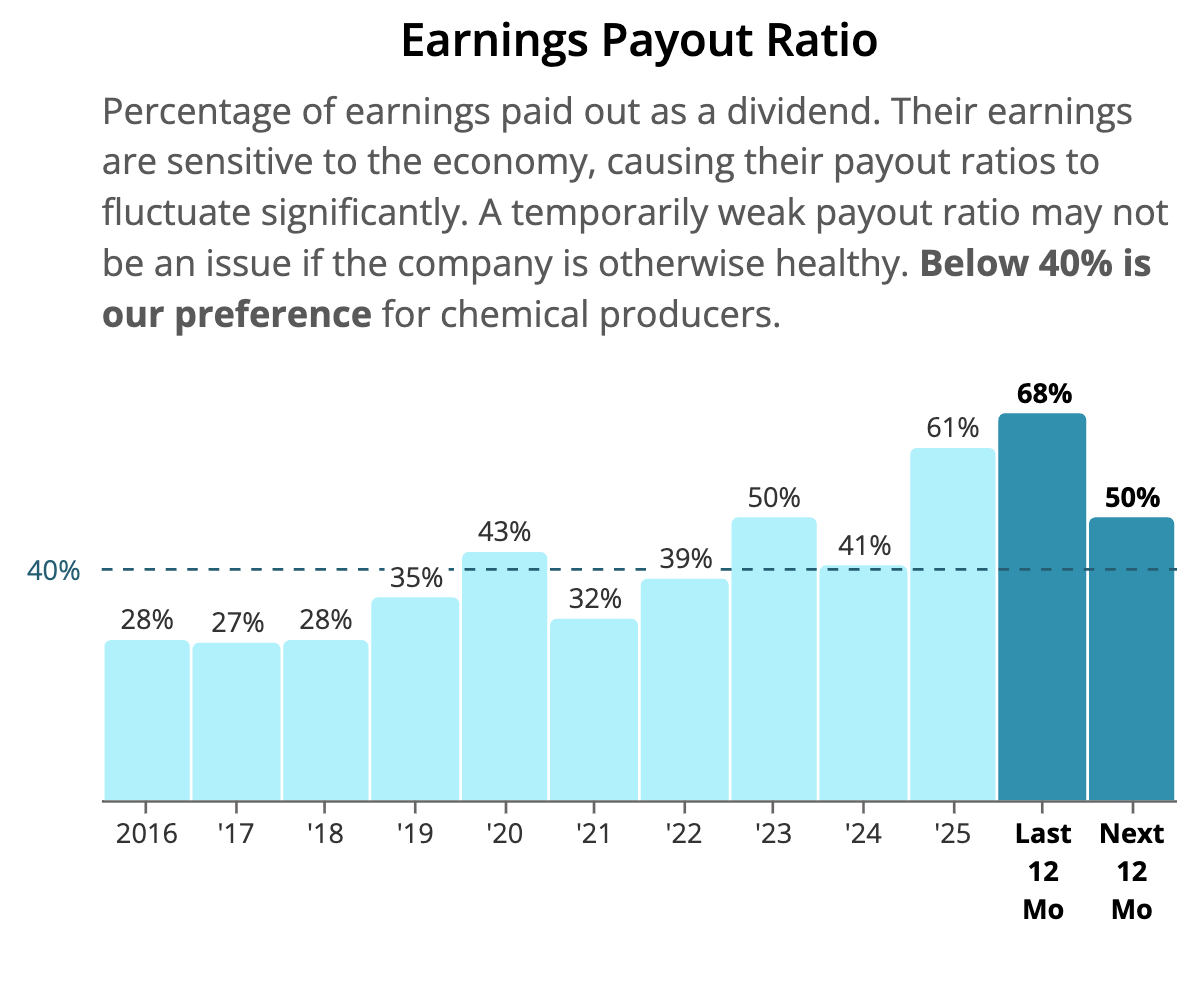
Eastman Chemical's dividend looks safe despite the cyclical business. The chemical maker pays out 68% of earnings and has raised its dividend for 16 straight years.
Eastman Chemical (EMN) makes specialty plastics, films, and fibers used in cars, home construction, appliances, and packaging.
Eastman's payout ratio jumped to 68% as earnings fell, though it is expected to drop back to 50%. Source: Simply Safe Dividends.
Demand in those markets has been soft for several years, and Chinese producers have been exporting chemicals at very low prices. Margins have compressed, the payout ratio has drifted higher, and S&P revised the outlook on Eastman's BBB credit rating to negative.
We lowered its Dividend Safety Score from 80 to 70, still Safe, in July 2026. Eastman has held up better than most chemical peers because its proprietary formulations are hard to replace and its U.S. plants run on cheap domestic natural gas as a raw material.
Cost cuts and a growing chemical recycling business should help earnings recover. Investors need to be comfortable with the industry's cyclicality.
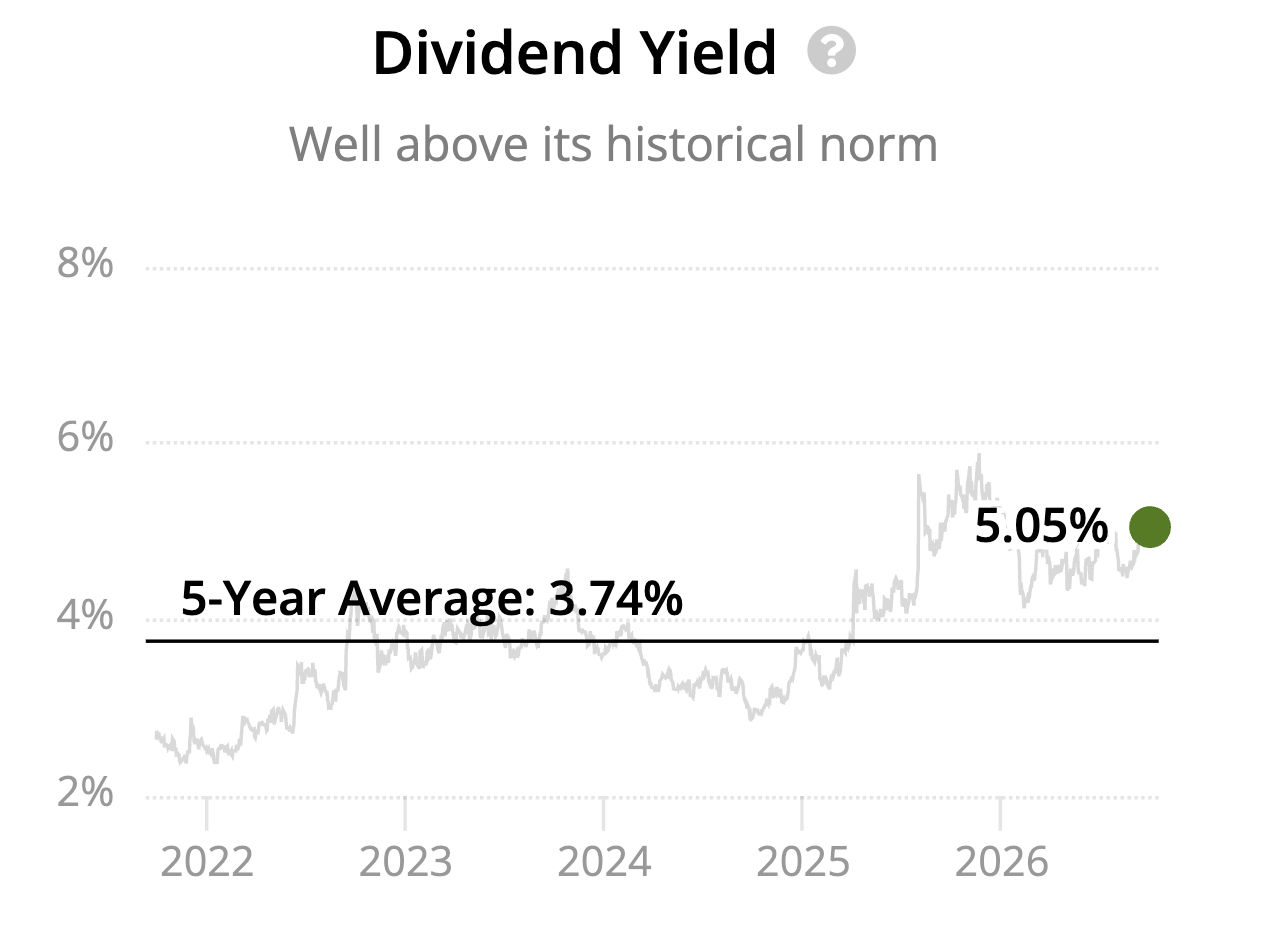
Eastman yields 5.05% against a five-year average of 3.74%. Source: Simply Safe Dividends.
Enterprise Products Partners runs one of the most conservative balance sheets in the midstream industry. The partnership holds an A- credit rating and has raised its distribution for 27 consecutive years.
Enterprise Products Partners (EPD) began in 1968 as a wholesale marketer of natural gas liquids and is now one of America's largest master limited partnerships, a structure that passes income straight through to investors instead of paying corporate tax.
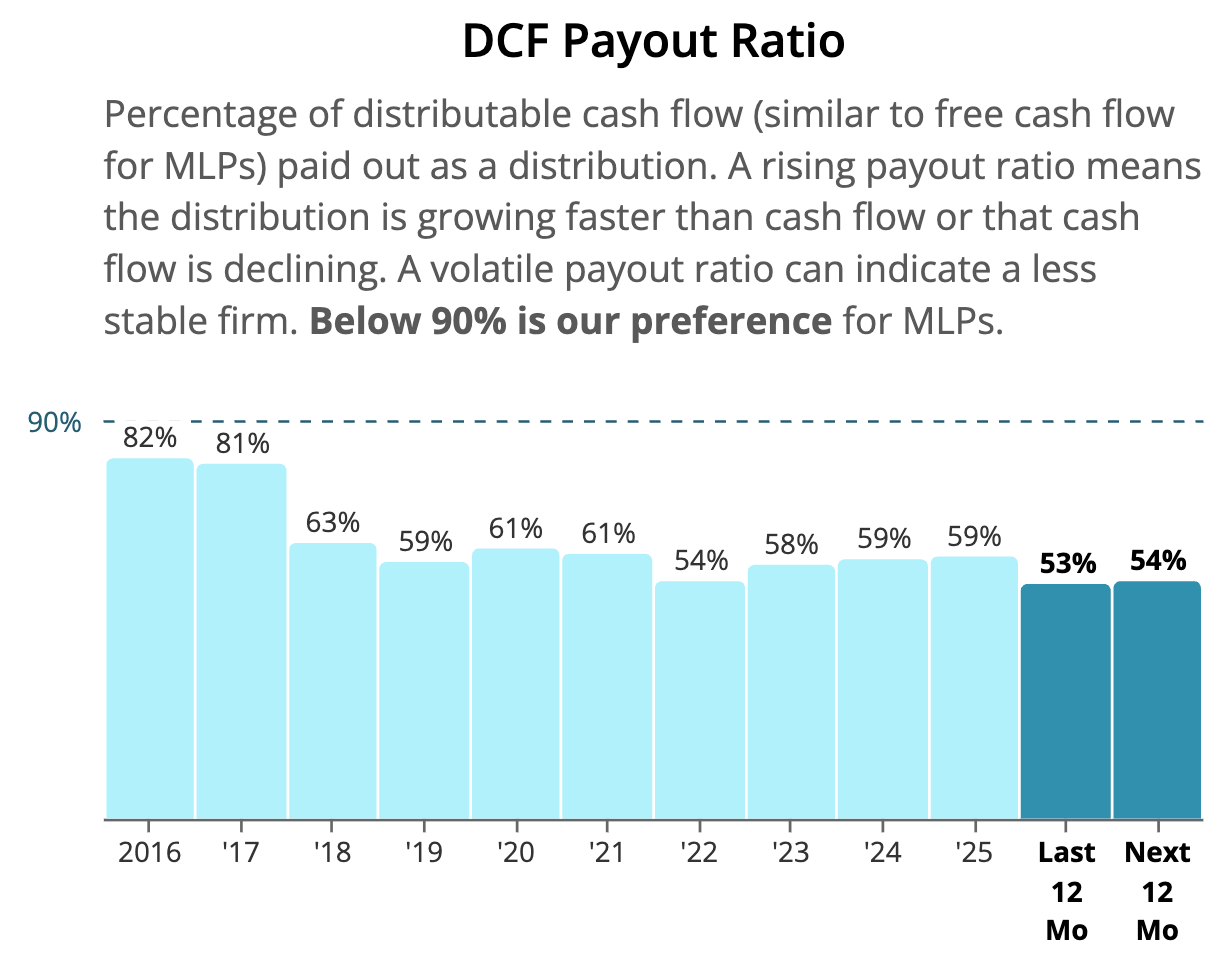
Enterprise's payout ratio near 53% is one of the lowest in the midstream industry, against our 90% preference for MLPs. Source: Simply Safe Dividends.
Its pipelines, processing plants, storage facilities, and terminals connect to nearly every major U.S. shale basin. Long-term, fee-based contracts have insulated cash flow from volatile energy prices.
Enterprise has raised its distribution every year since going public in 1998 and holds an A- credit rating.
Enterprise is a partnership, so investors receive a K-1 tax form instead of a 1099. Our MLP tax guide covers what that means.
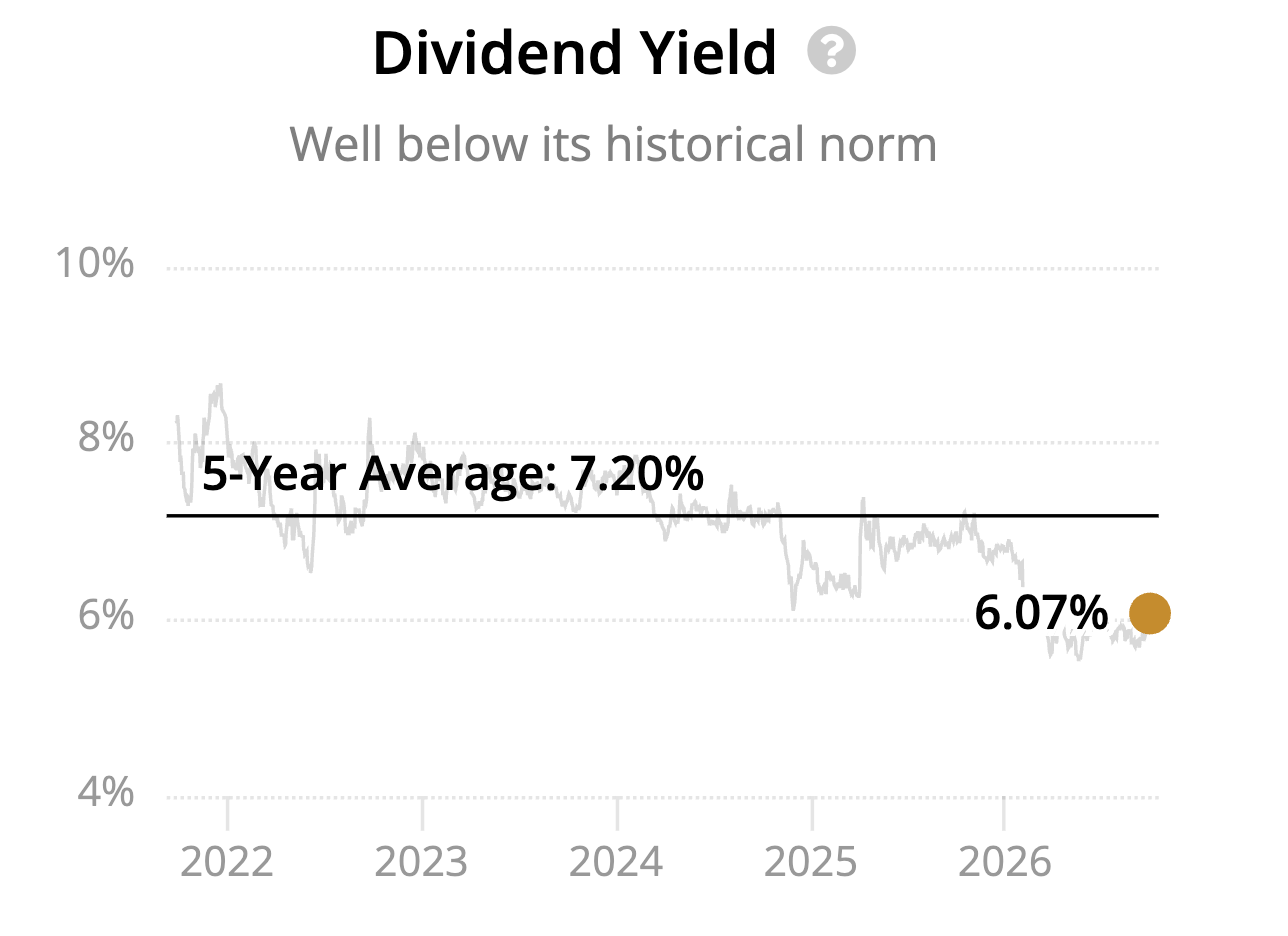
Enterprise yields 6.07%, well below its five-year average of 7.20%. Source: Simply Safe Dividends.
Avista's dividend looks safe. The regulated utility holds a BBB credit rating and has raised its dividend for 23 straight years.
Incorporated in 1889, Avista (AVA) sells electricity and natural gas to customers in parts of Washington, Idaho, Oregon, and Alaska, much of it generated at its own hydroelectric dams and other power plants.
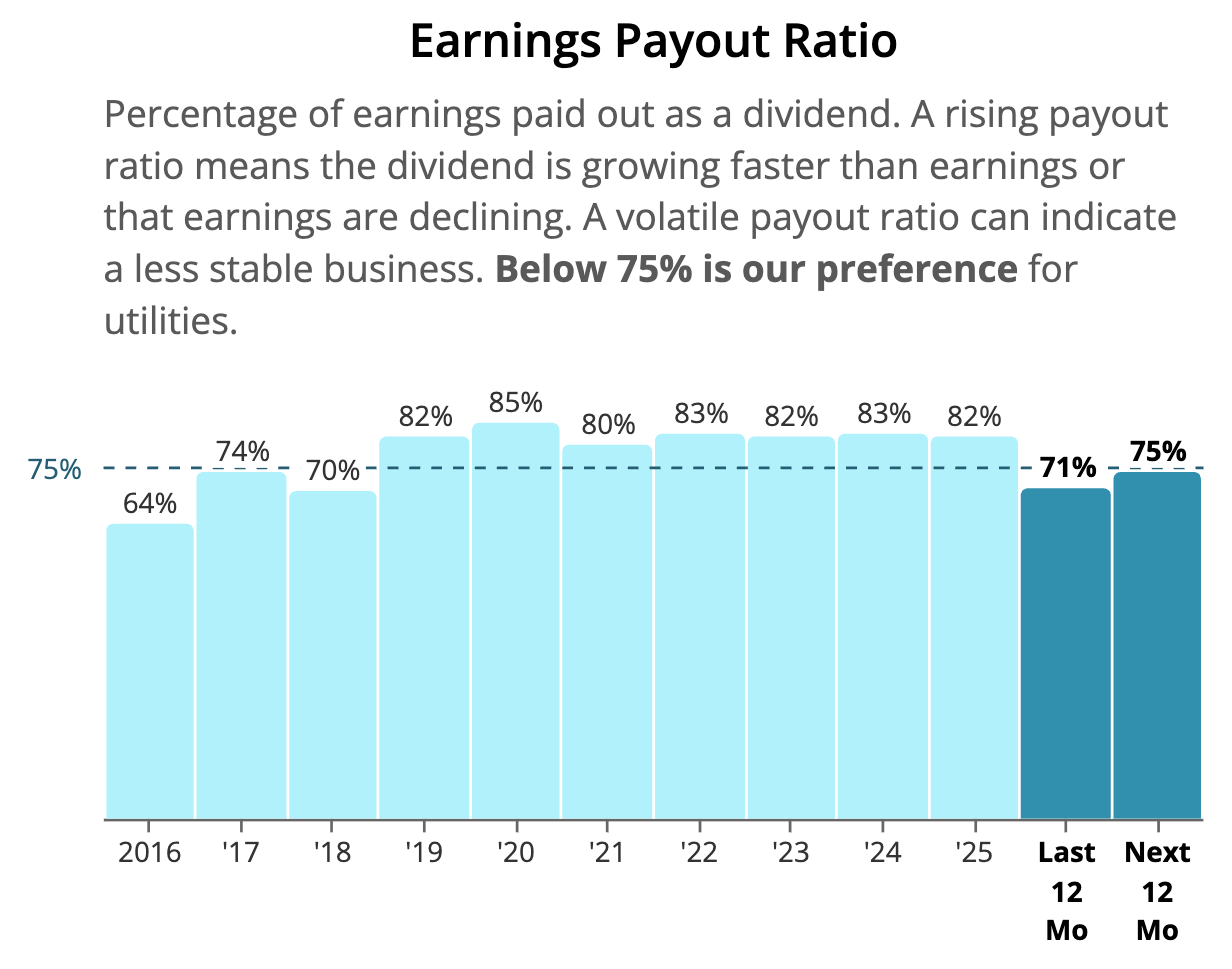
Avista's payout ratio has come down to 71%, just inside our 75% preference for utilities. Source: Simply Safe Dividends.
As a regulated utility, Avista earns predictable profits. The main exception to its long dividend record came in 1998, when a new CEO cut the payout to fund a growth plan that failed.
Today Avista sticks to its regulated businesses, carries a BBB credit rating, and keeps its payout ratio near 71%, which is low for a utility.
The stock trades at a discount to many utilities, likely reflecting its small size, slower growth, and wildfire risk in the Pacific Northwest.
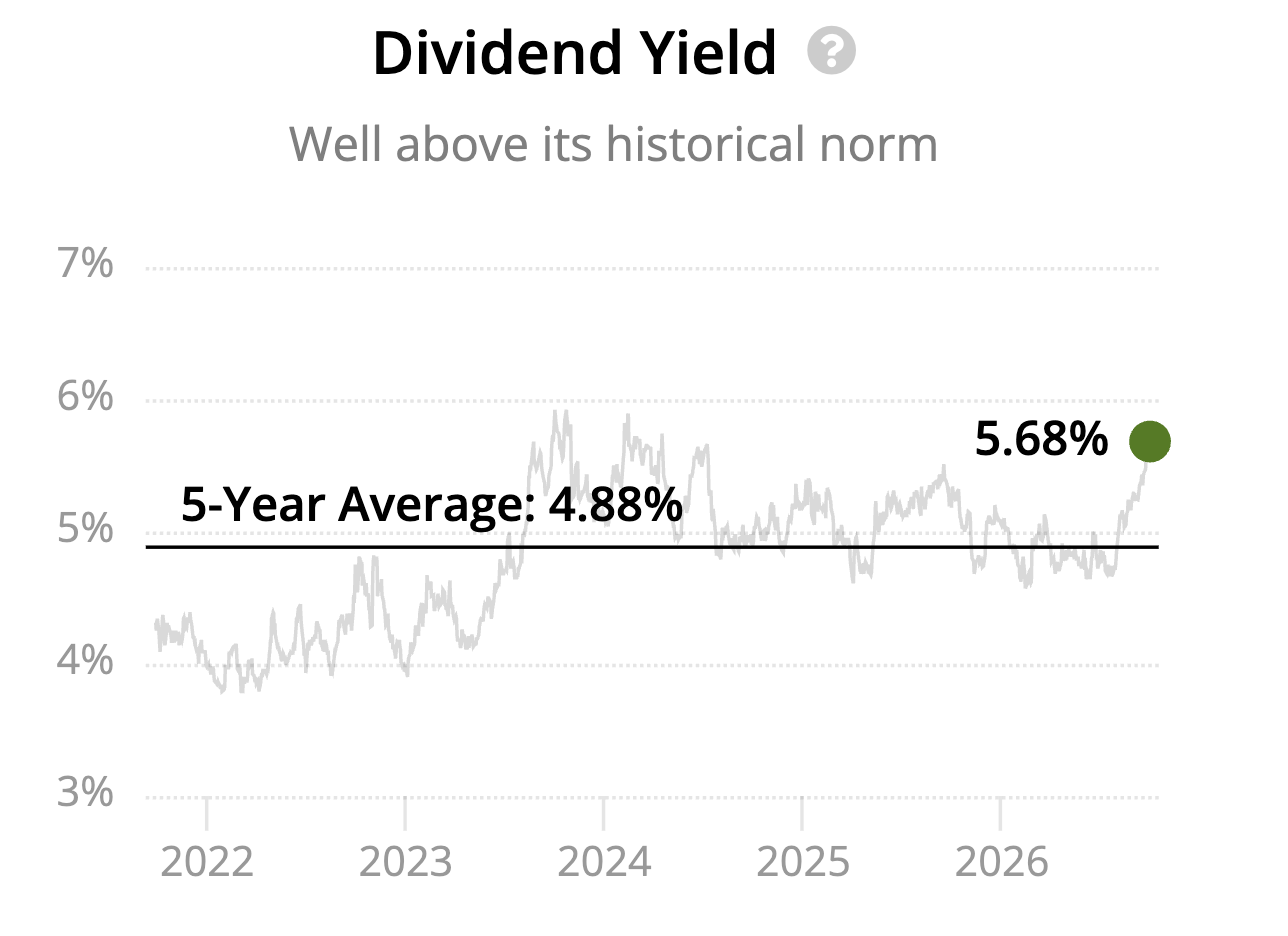
Avista yields 5.68% against a five-year average of 4.88%. Source: Simply Safe Dividends.
Portland General Electric's dividend looks safe. The Oregon utility holds a BBB+ credit rating and has raised its dividend for 19 consecutive years.
Founded in 1889, Portland General Electric (POR) generates and delivers electricity across much of northern Oregon. Its power comes from natural gas plants, wind farms, hydroelectric dams, solar arrays, and battery storage.
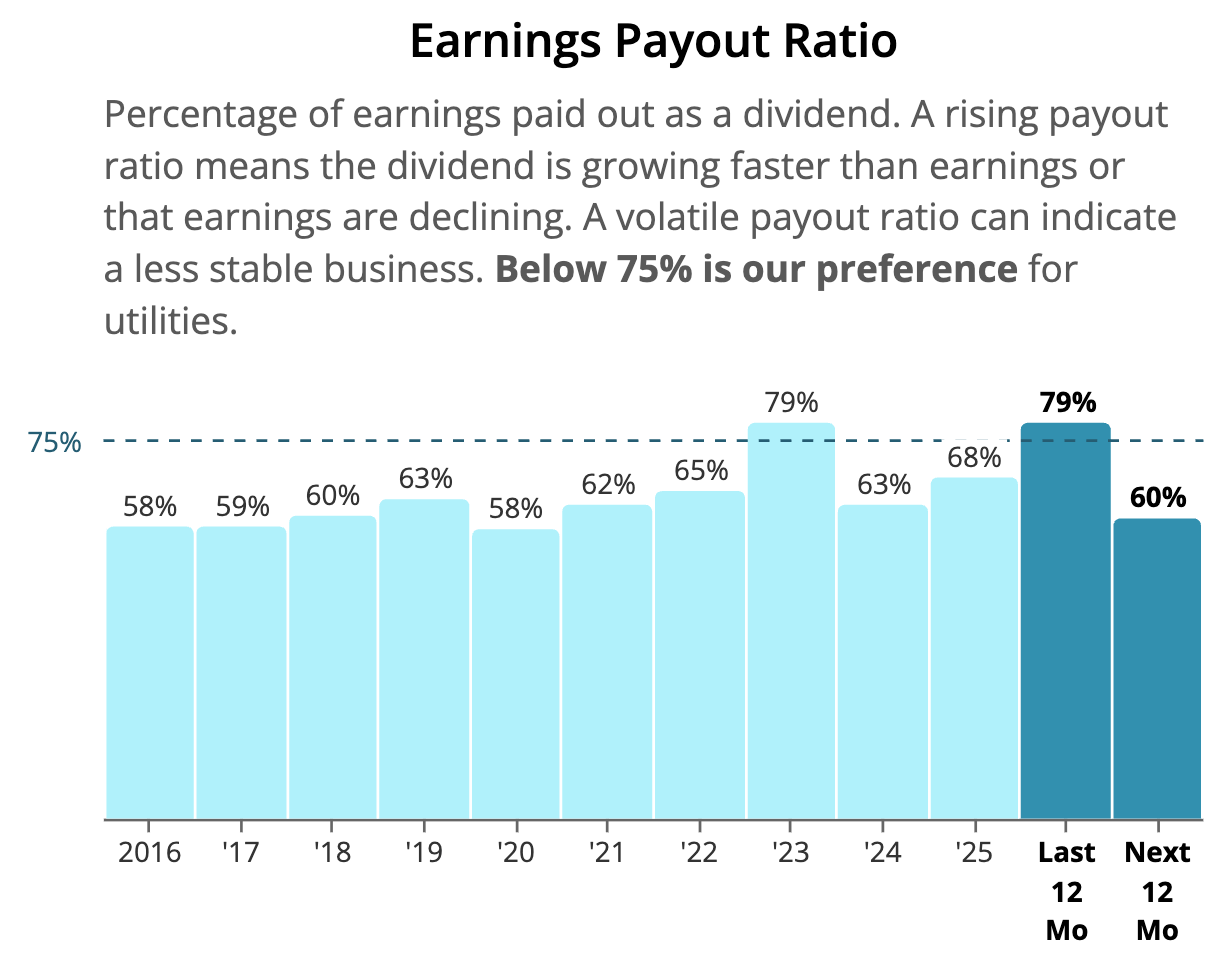
Portland General's payout ratio is expected to fall to 60% as approved rate increases take effect. Source: Simply Safe Dividends.
Oregon regulators set the rates POR can charge, which makes its earnings predictable. The utility raised its dividend through the 2007 to 2009 recession, and demand in its territory is growing as data centers expand around Portland.
The payout ratio reached 79% over the past year, just above our 75% preference for utilities, and management expects it to ease as approved rate increases take effect.
Wildfire risk in the Pacific Northwest is the main worry, the same issue that weighs on Avista, and it is part of why the stock trades at a discount to most utility peers.
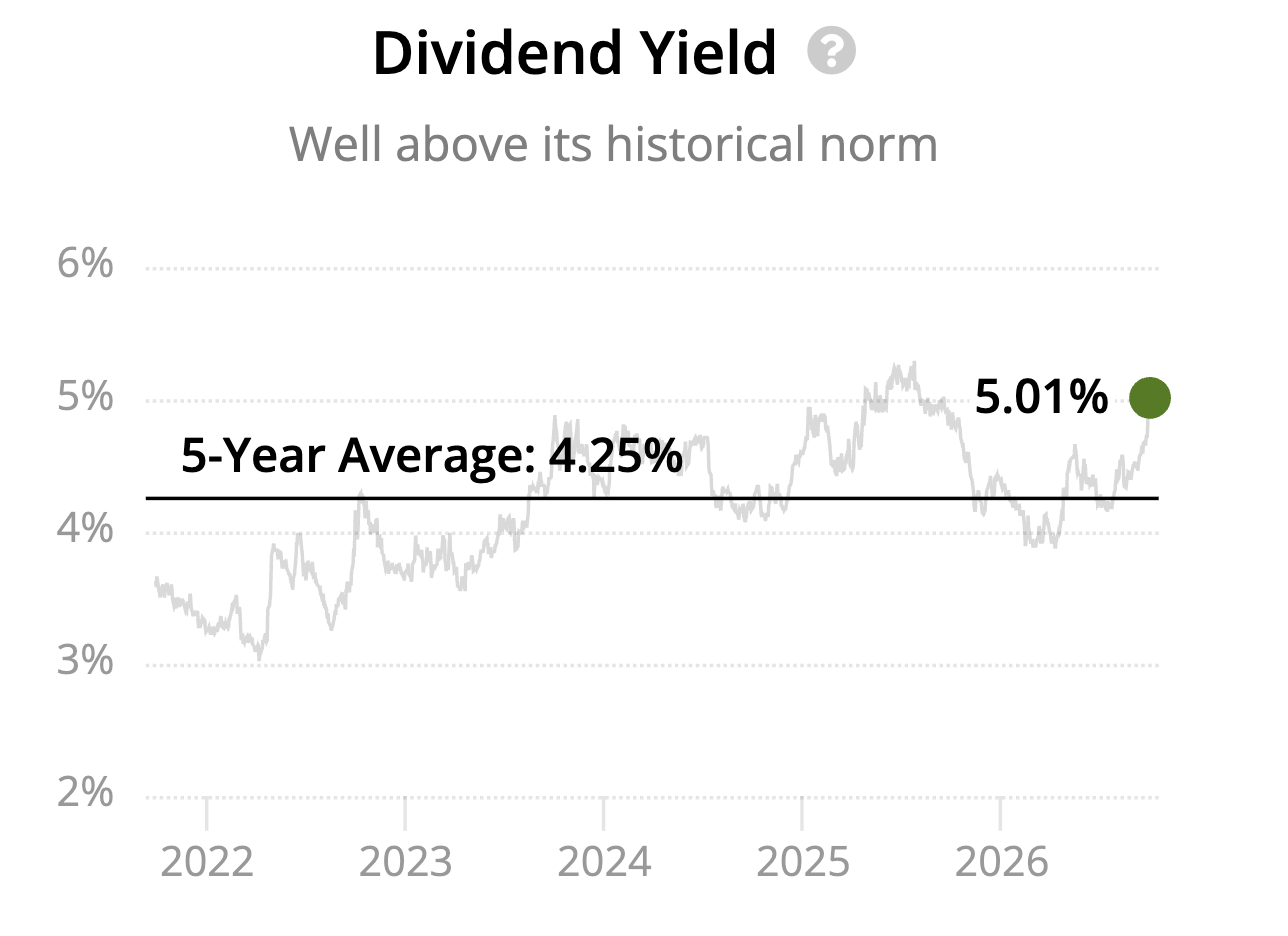
Portland General yields 5.01% against a five-year average of 4.25%. Source: Simply Safe Dividends.
Main Street Capital (MAIN)
Sector: Financials – Business Development Companies Dividend Yield: 5.8% Dividend Safety Score: Safe (62) Uninterrupted Dividend Streak: 18 years Credit Rating: BBB-
Main Street Capital's dividend looks safe for a business development company. The monthly payer has never cut its regular dividend since going public in 2007.
Main Street Capital (MAIN) provides debt and equity capital to small, private businesses that cannot easily borrow from banks. It pays dividends monthly.
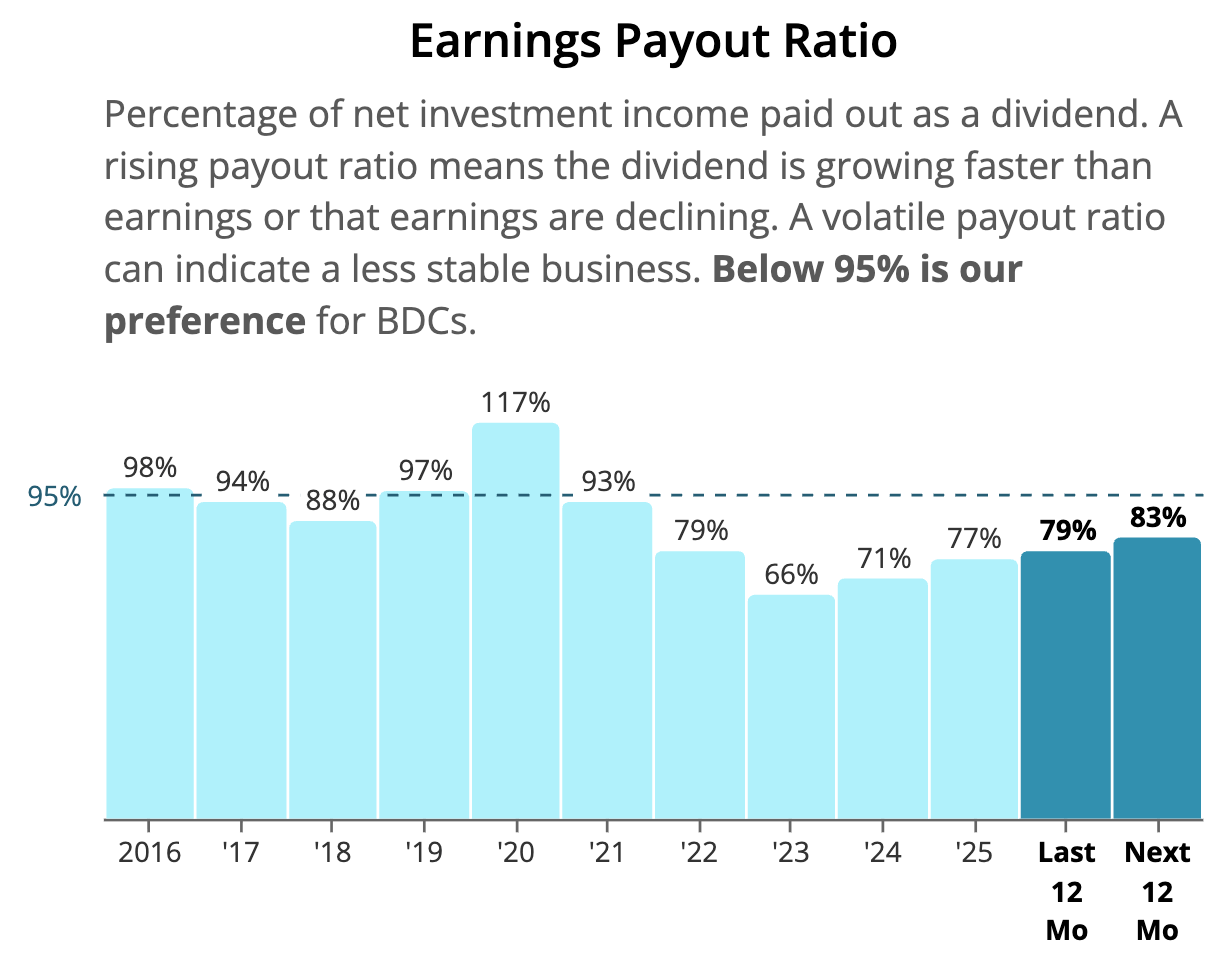
Main Street's payout ratio near 79% sits below our 95% preference for business development companies. Source: Simply Safe Dividends.
Business development companies have had a rough 2026. More than a dozen have cut their dividends as falling interest rates shrink the income from their floating-rate loans.
Main Street stands apart. Its co-founders still run the company, its loans are mostly first-lien, meaning it gets repaid before other lenders if a borrower fails, the share of loans where borrowers have stopped paying sits within its normal range, and it has never reduced its regular dividend since its first payout in 2007.
With a Dividend Safety Score of 62, Main Street sits just above our Safe threshold, and it holds a BBB- credit rating. Expect sharp price swings when credit markets turn. Our guide to BDCs explains the risks in more detail.
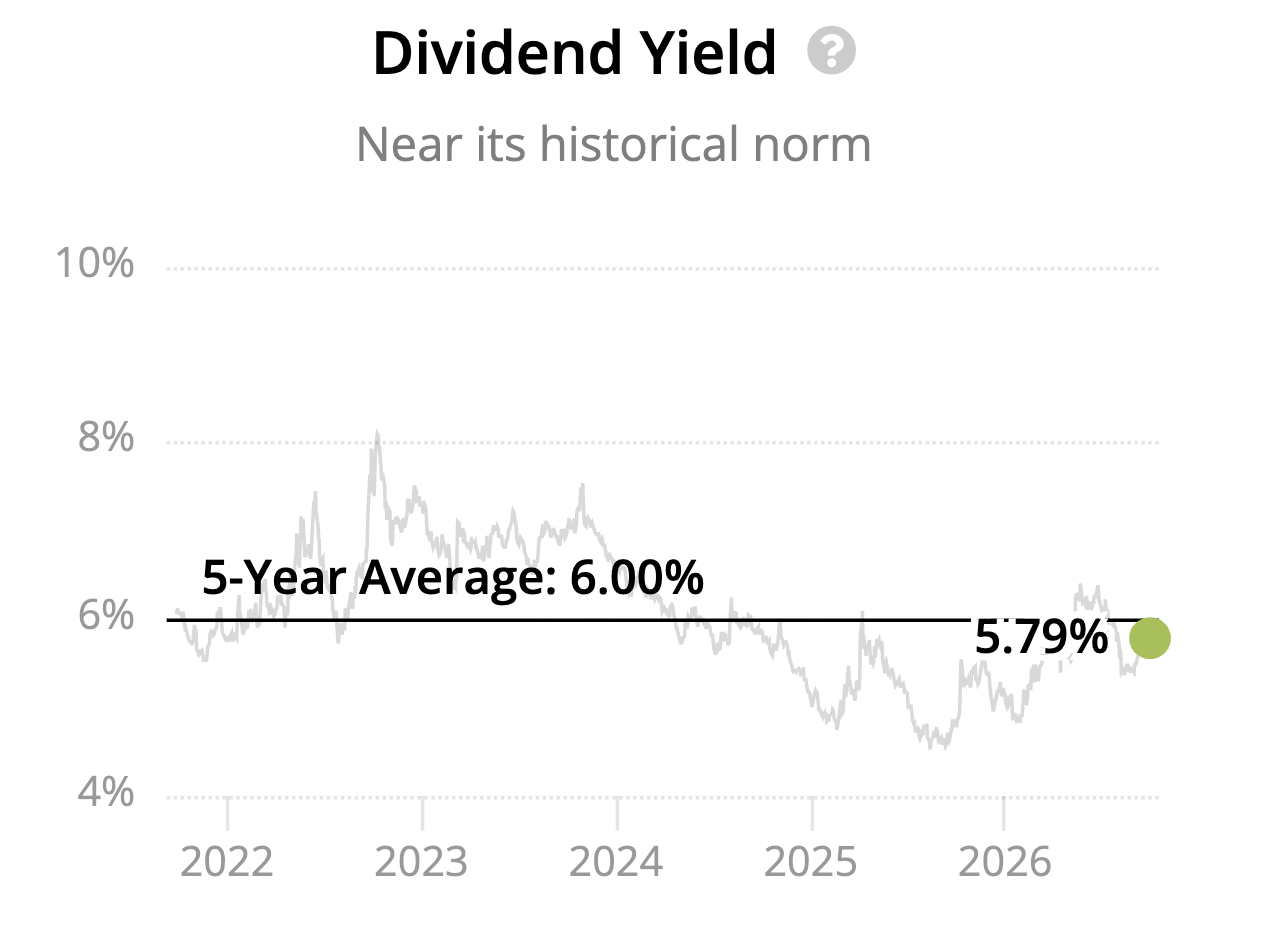
Main Street yields 5.79%, a touch below its five-year average of 6.00%. Source: Simply Safe Dividends.
Prudential Financial (PRU)
Sector: Financials – Life and Health Insurance Dividend Yield: 4.8% Dividend Safety Score: Safe (70) Uninterrupted Dividend Streak: 17 years Credit Rating: A
Prudential Financial's dividend looks safe. The insurer holds an A credit rating and has raised its dividend for 17 consecutive years.
Prudential Financial (PRU) is a major life insurer in the U.S. and Japan that also sells annuities and manages investments.
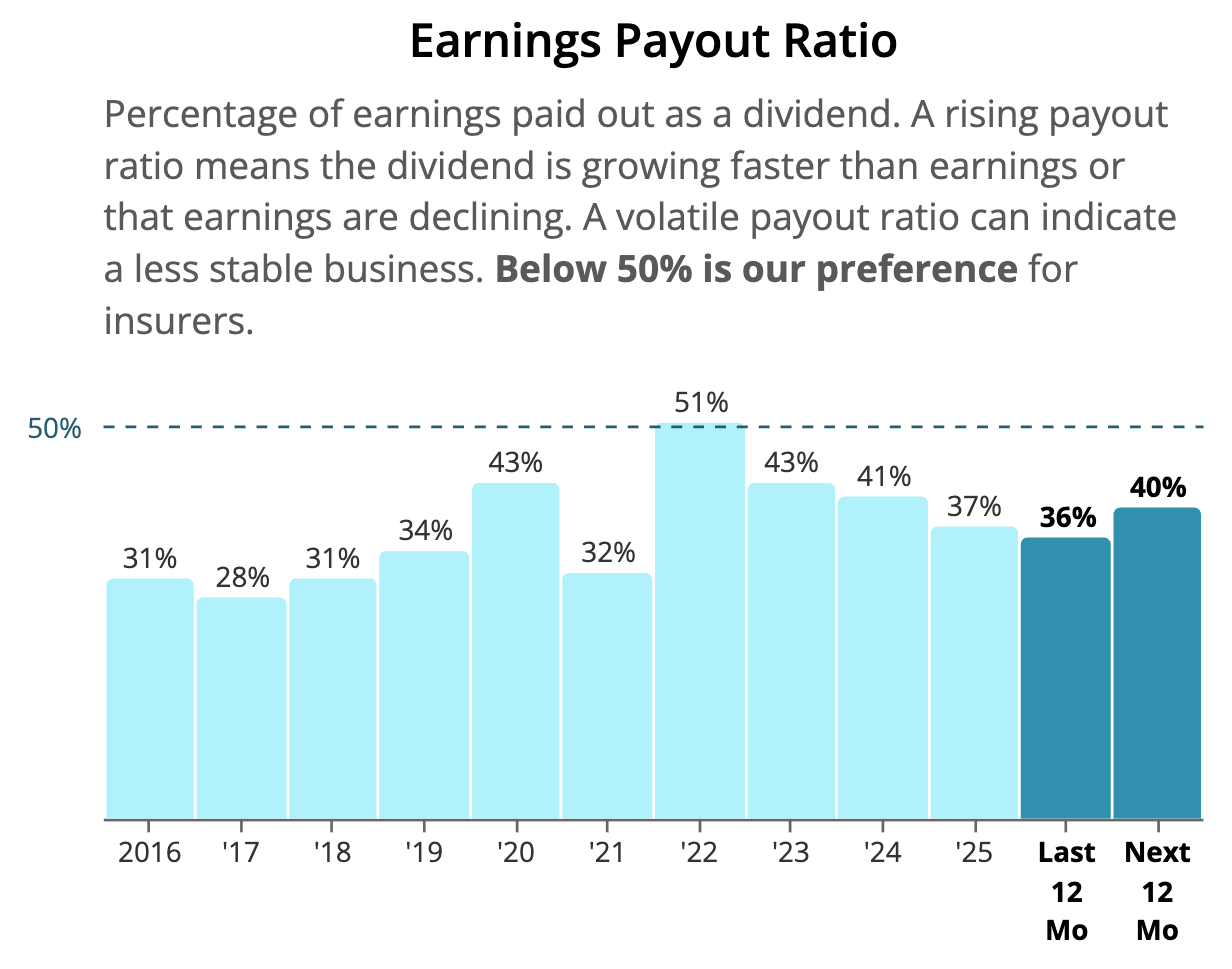
Prudential's payout ratio near 36% is the lowest on this list and well inside our 50% preference for insurers. Source: Simply Safe Dividends.
In 2026, about 100 employees at Prudential of Japan were found to have engaged in improper dealings with customers. The company suspended new sales through that channel, expects a hit of about $1 billion to pretax operating income over two years, and withdrew its earnings growth target.
We lowered Prudential's Dividend Safety Score from 75 to 70, still Safe, in April 2026. Even so, the payout ratio is expected to stay below 50%, and S&P kept Prudential's A credit rating after reviewing the suspension.
Prudential cut its dividend during the 2008 financial crisis, a reminder that life insurers are sensitive to market shocks.
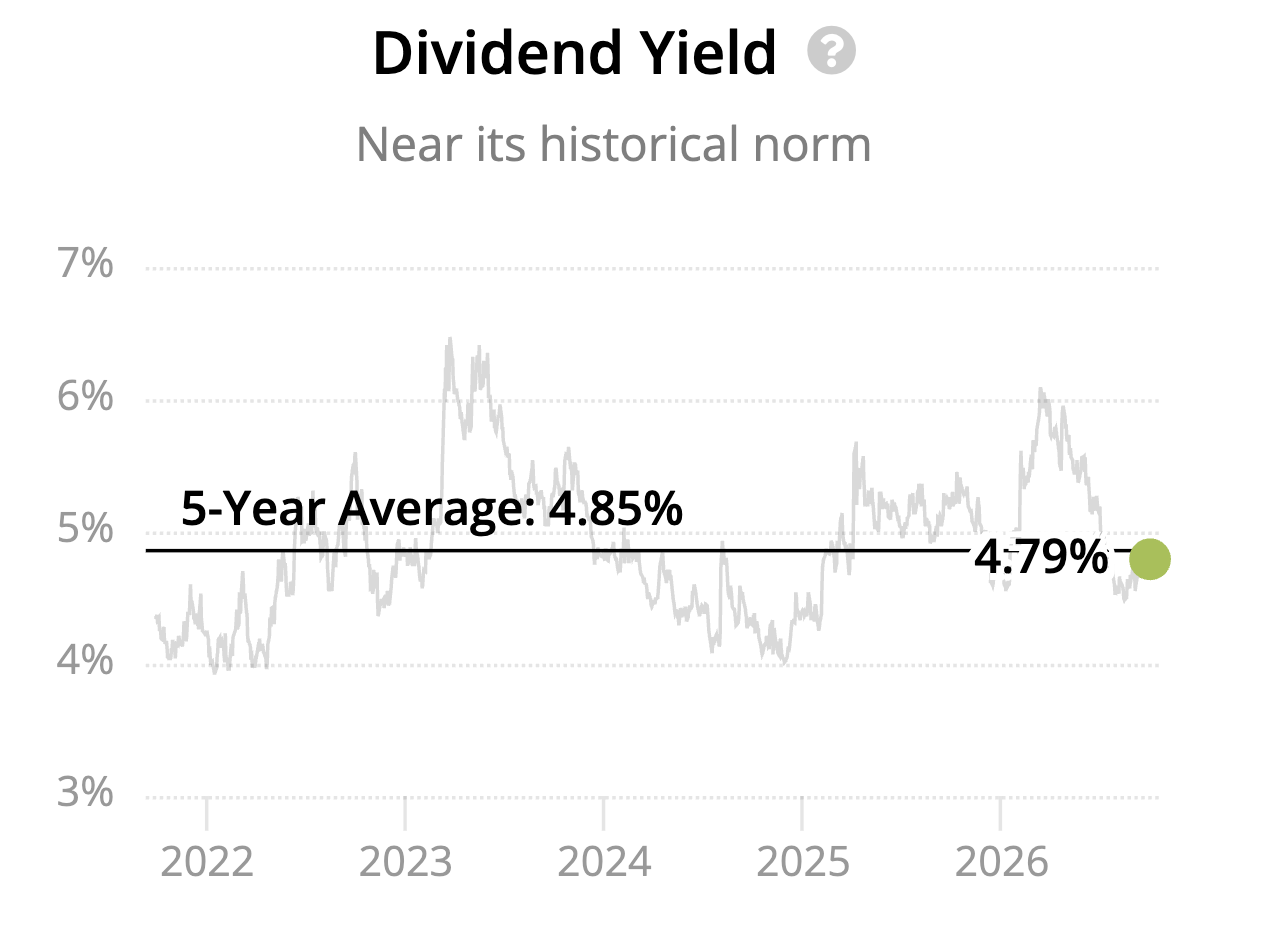
Prudential yields 4.79%, in line with its five-year average of 4.85%. Source: Simply Safe Dividends.
Brookfield Infrastructure's dividend looks safe. The infrastructure owner carries a BBB+ credit rating and a run of payout increases going back to 2008.
Brookfield Infrastructure Corporation (BIPC) owns regulated gas transmission in Brazil, regulated energy distribution in the United Kingdom, and a global intermodal logistics business. It was created in 2020 so investors could own Brookfield Infrastructure Partners' assets through a corporation, which means a 1099 instead of a K-1.
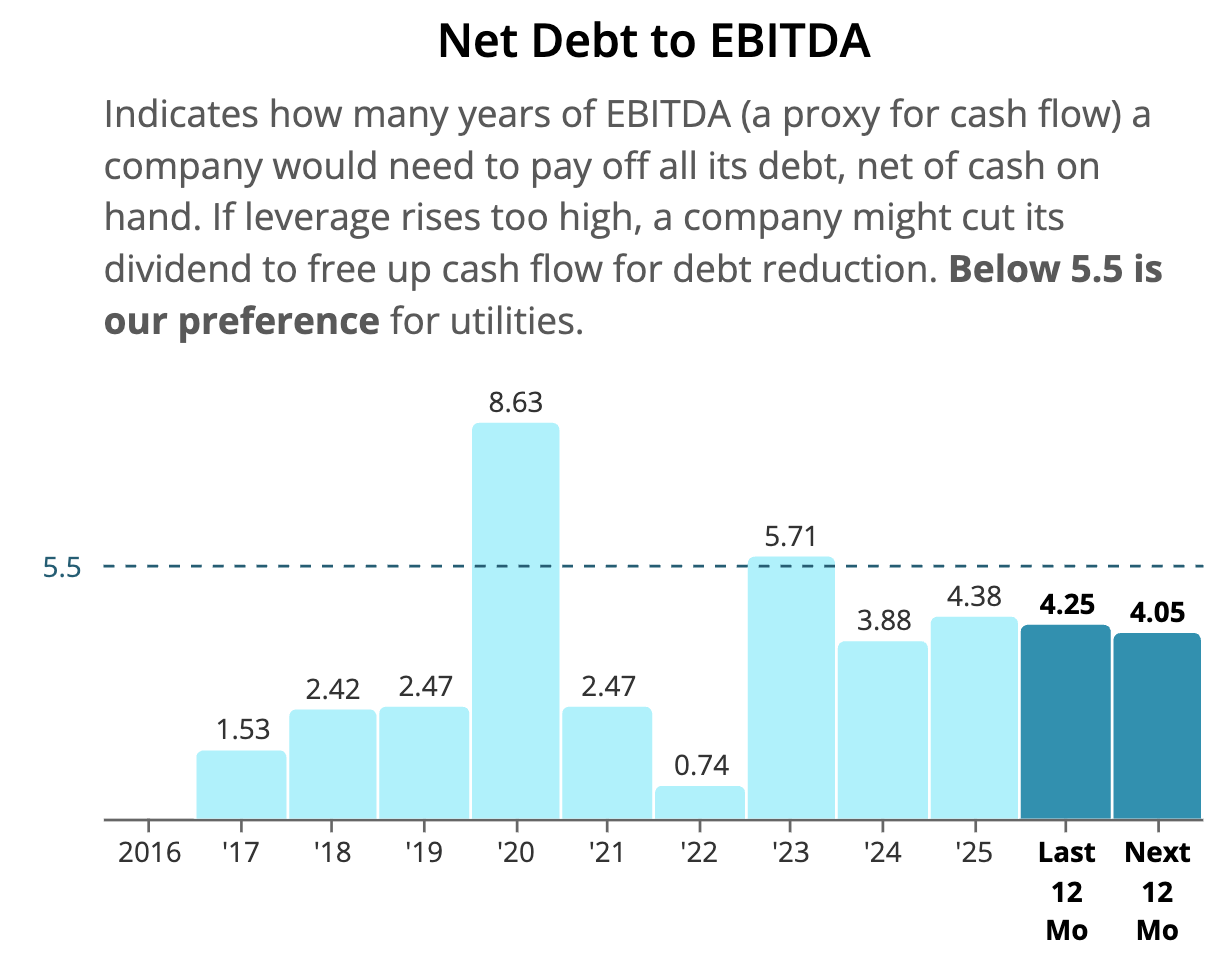
Brookfield Infrastructure's leverage near 4.1 times EBITDA sits inside our 5.5 preference for utilities. Source: Simply Safe Dividends.
About 85% of the group's cash flow is regulated or contracted, roughly 85% is indexed to inflation, and about 75% carries no volume risk. No single customer accounts for more than 10% of sales.
In August 2026 Brookfield announced plans to combine BIPC and its partnership, BIP, into one entity. We reviewed the plan and kept the Safe rating because the payout is not expected to change.
Emerging market exposure and a strategy of selling assets to fund new investments make this a more volatile holding than a domestic utility.
BIPC is a Canadian company, so dividends paid to U.S. investors face a 15% withholding tax outside retirement accounts.
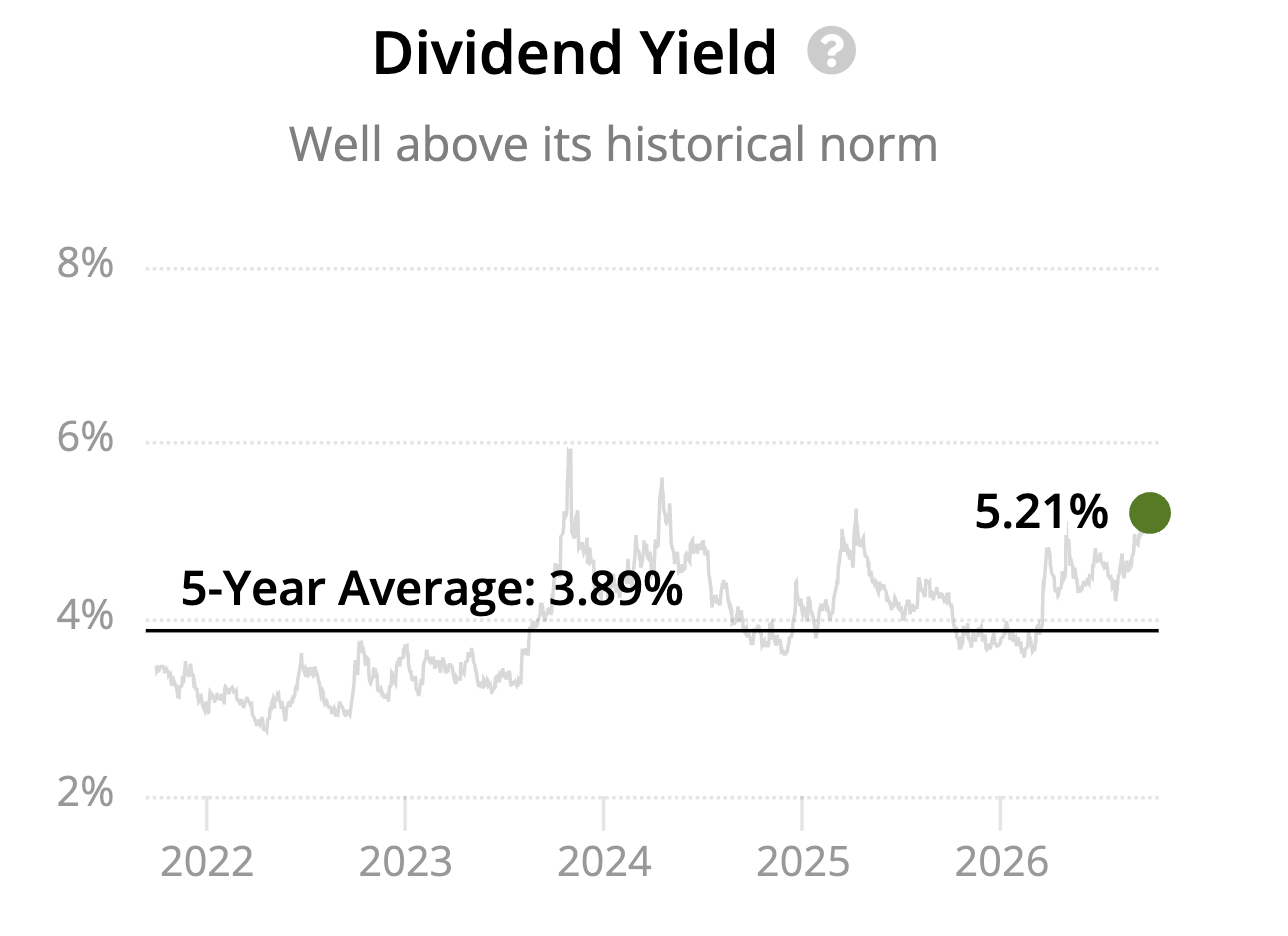
Brookfield Infrastructure yields 5.21% against a five-year average of 3.89%. Source: Simply Safe Dividends.
Fidelity National Financial's dividend looks safe. The title insurer pays out 38% of its earnings and carries almost no net debt.
Tracing its roots to 1847, Fidelity National Financial (FNF) is the largest title insurer in the United States. It verifies that a property's title is free of liens and disputes before a sale closes. It also owns F&G, which sells annuities and life insurance.
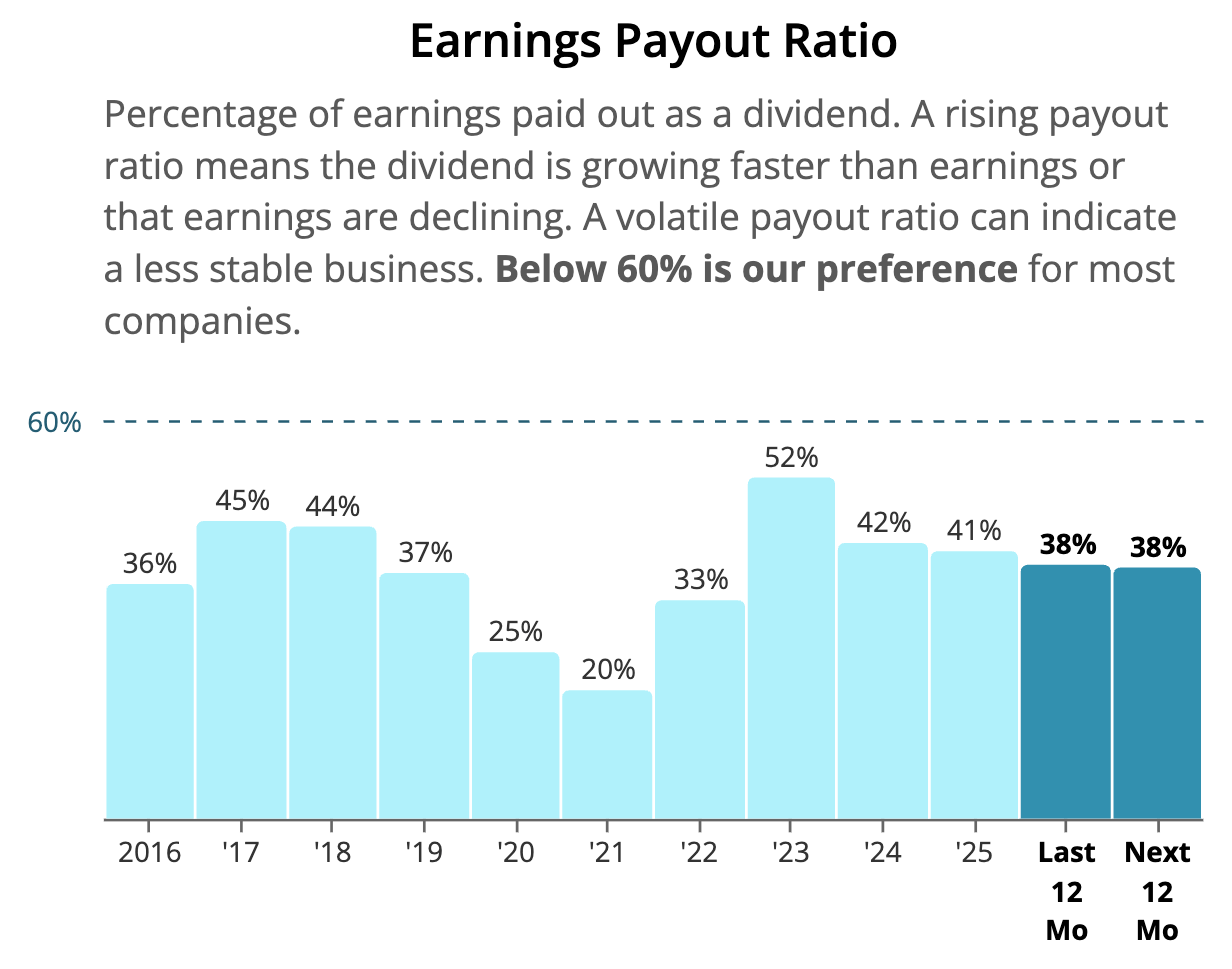
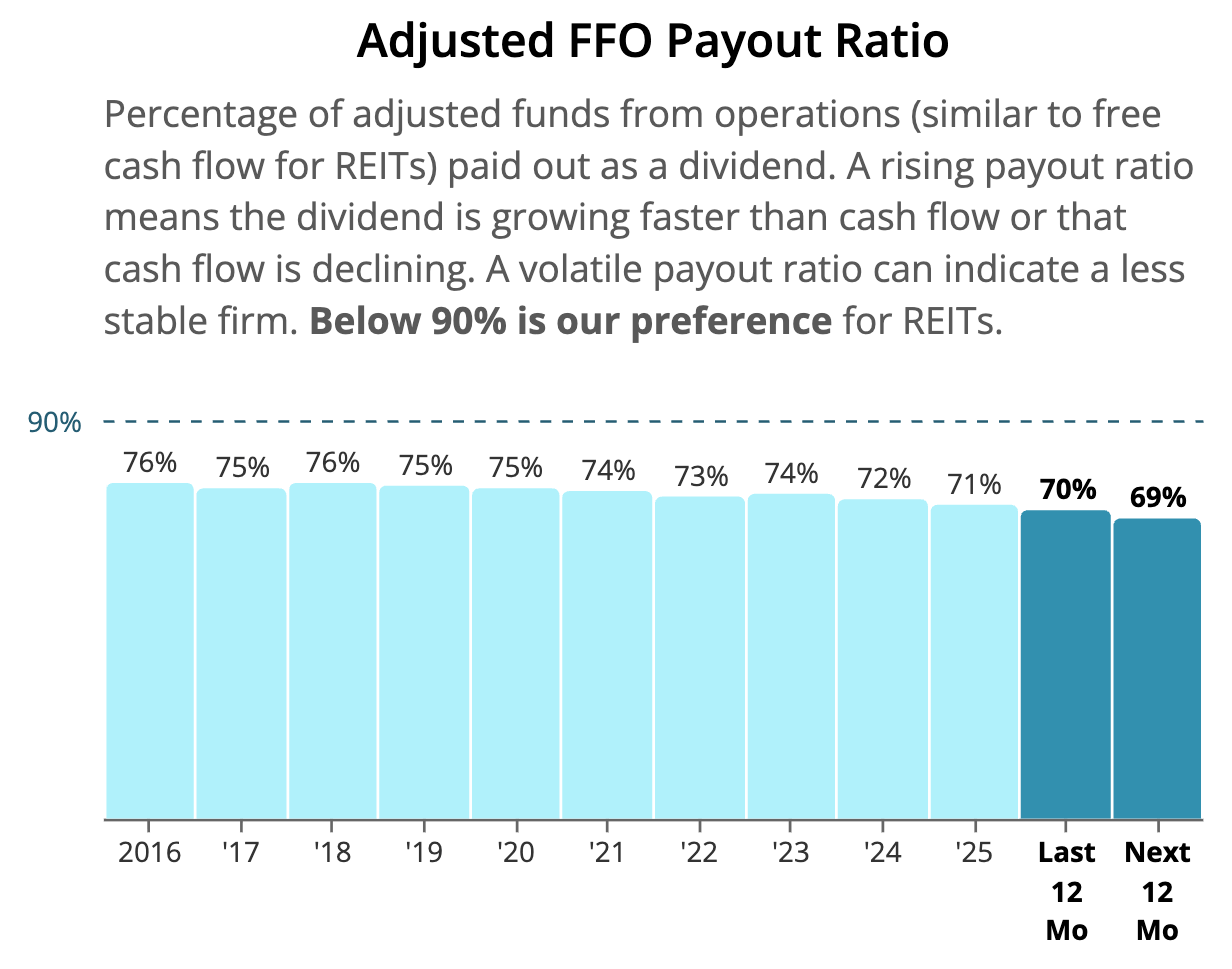
Fidelity National's payout ratio near 38% is one of the lowest on this list. Source: Simply Safe Dividends.
Title insurance moves with home sales and refinancing, and high mortgage rates have held both near multi-decade lows. The retirement products business does not depend on housing, and that diversification is why we upgraded Fidelity National to Safe in December 2024.
That low payout ratio, alongside net debt of just 0.3 times EBITDA, leaves a wide margin.
The caution is history. The company cut its dividend during the 2008 housing crash, so a severe housing downturn is the risk to watch.
We looked at Fidelity National alongside Agree Realty and Brookfield Infrastructure in our note on beaten-down dividend stocks with safe 5% yields.
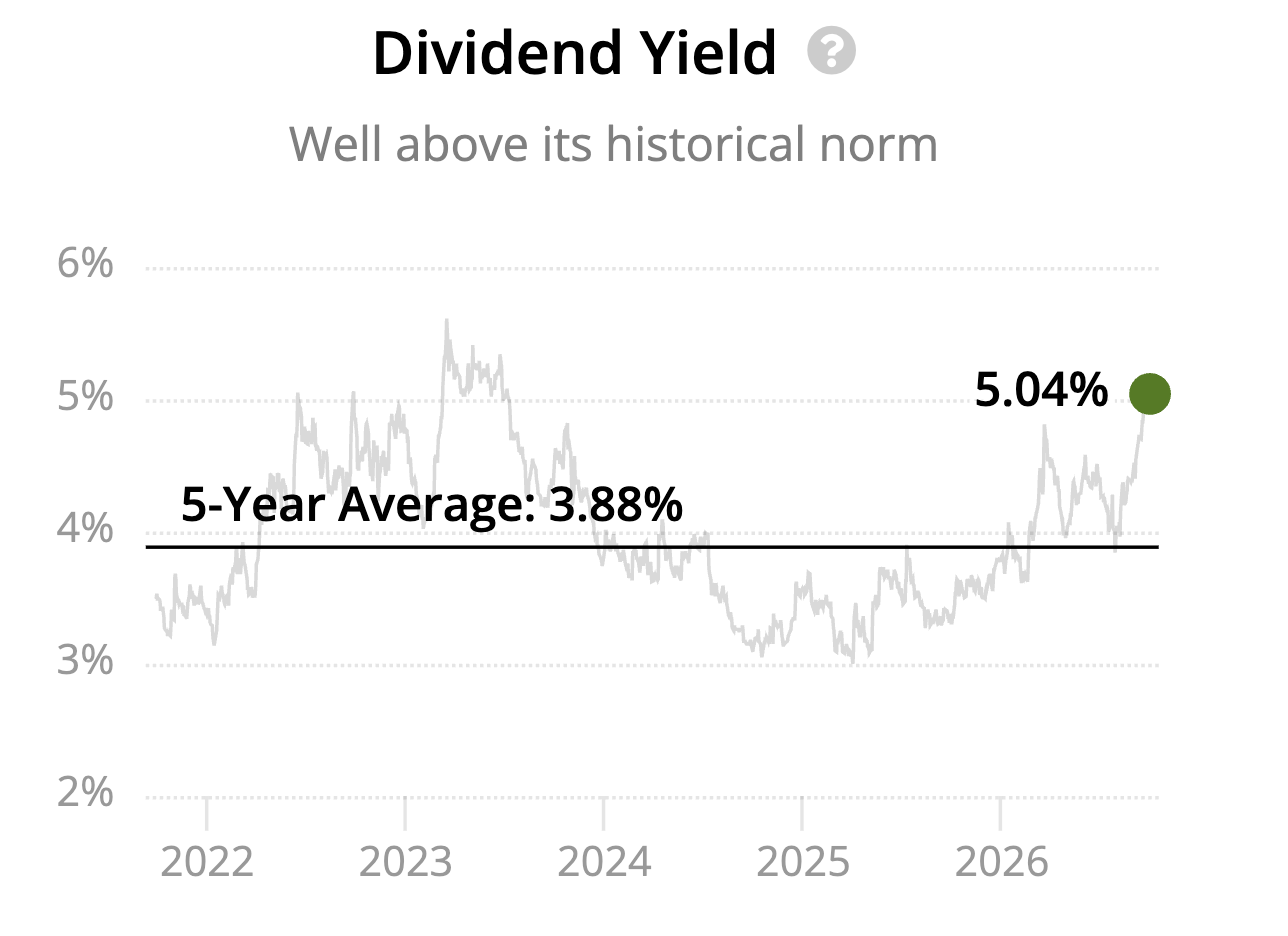
Fidelity National yields 5.04% against a five-year average of 3.88%. Source: Simply Safe Dividends.
Agree Realty's dividend looks safe and is paid monthly. The net lease REIT holds a BBB+ credit rating and has kept its payout ratio in a narrow band for a decade.
Founded in 1971, Agree Realty (ADC) owns freestanding retail properties leased long term to national chains including Walmart, Lowe's, TJX, and Dollar General. Tenants pay the property taxes, insurance, and maintenance.
Agree Realty's payout ratio has stayed between 69% and 76% every year since 2016. Source: Simply Safe Dividends.
That is one of the steadiest records of any REIT we cover, and it sits well inside our 90% preference.
Tenants concentrated in groceries, home improvement, and off-price retail hold up in recessions, and leverage is low for the sector. Agree is one of only three stocks on this list that pay monthly.
Agree cut its dividend during the 2008 financial crisis with a very different portfolio, one concentrated in a handful of tenants. It has raised the payout about 5% a year over the past five years.
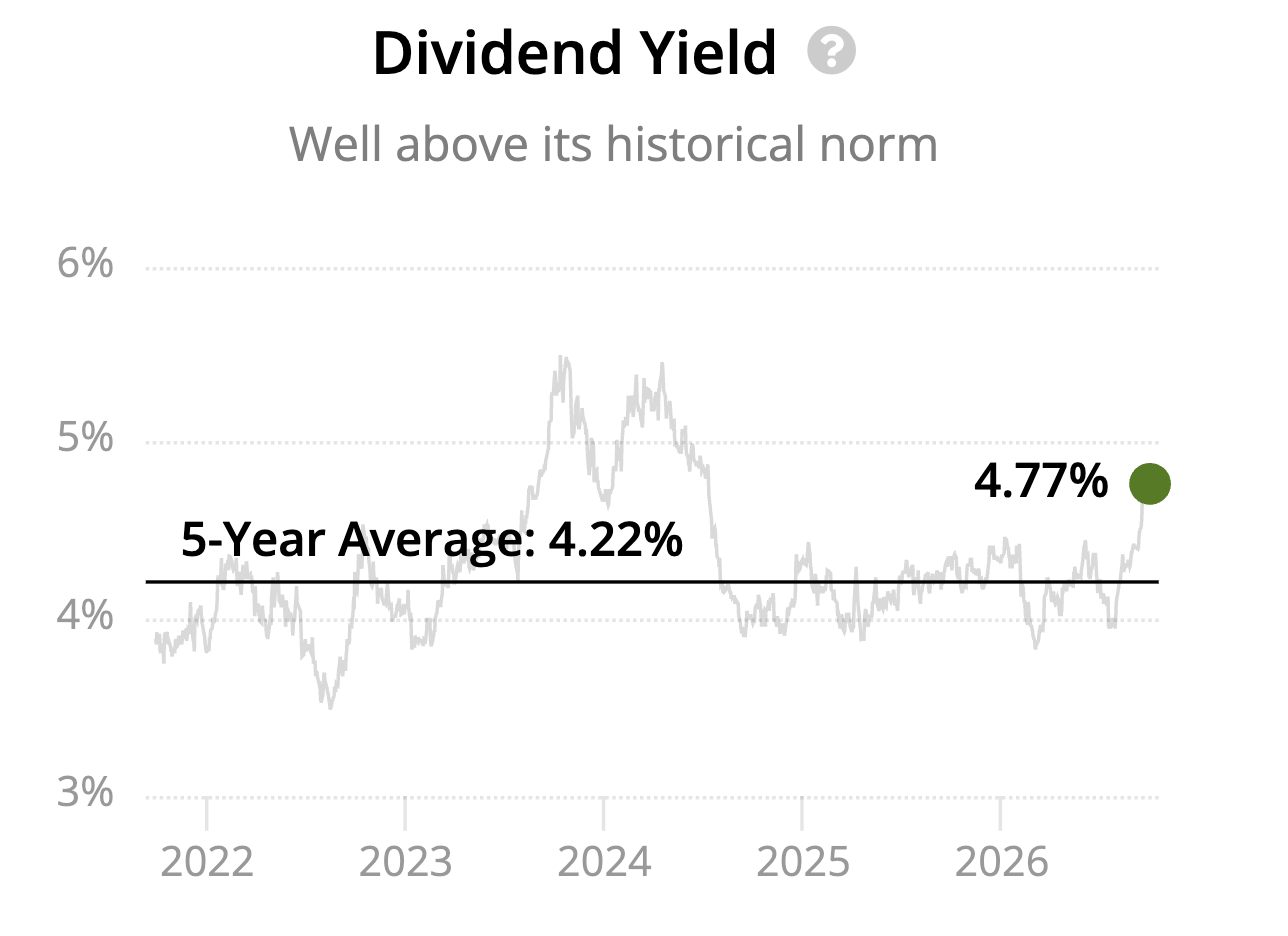
Agree Realty yields 4.77% against a five-year average of 4.22%. Source: Simply Safe Dividends.
Kimco's dividend looks safe, though its streak is short. The shopping center REIT holds an A- credit rating and has raised its dividend every year since resetting it in 2020.
Founded in 1958, Kimco Realty (KIM) owns open-air, grocery-anchored shopping centers and mixed-use properties clustered in Sun Belt and coastal metro areas. Its tenants include grocers, home improvement chains, off-price retailers, banks, and restaurants.
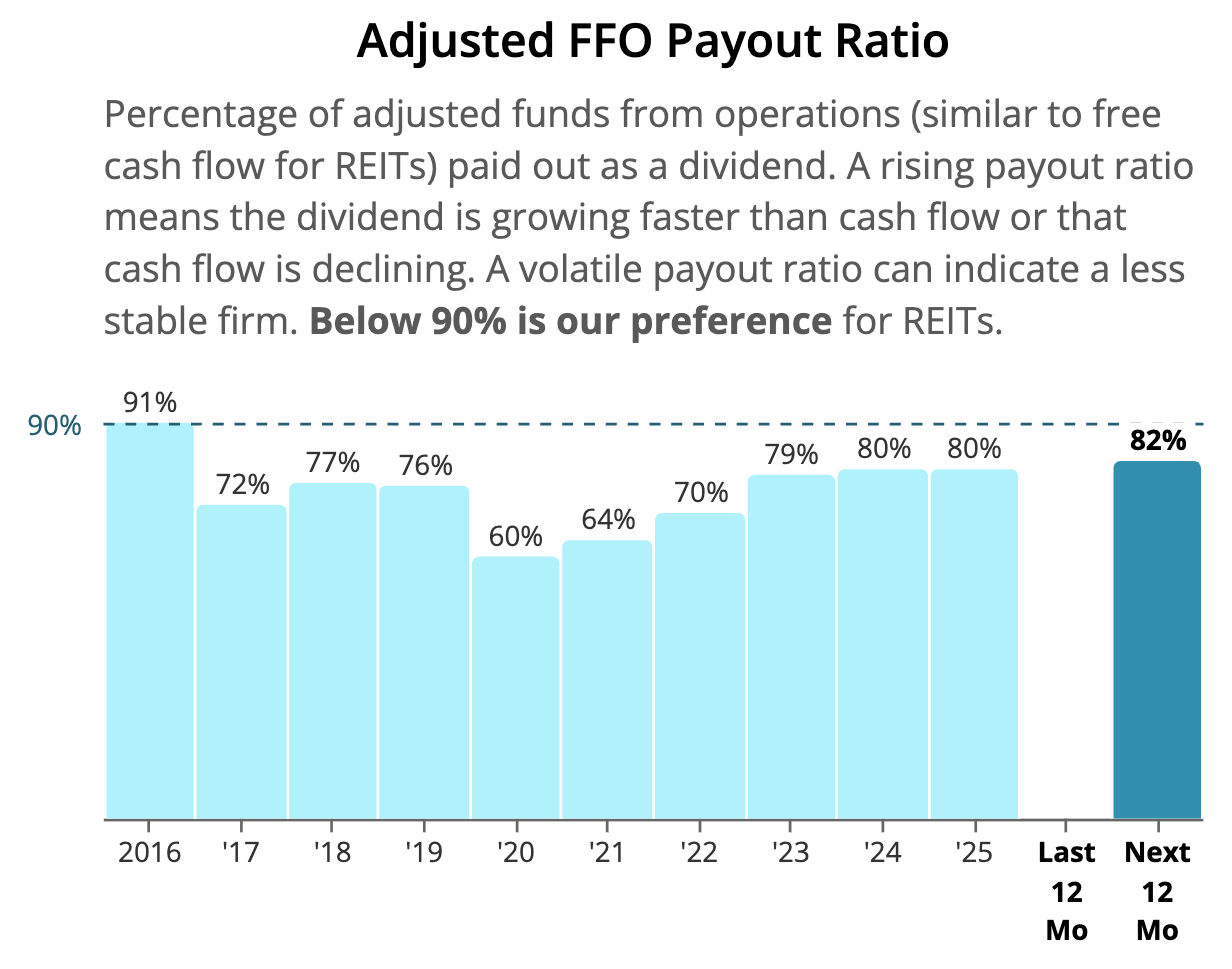
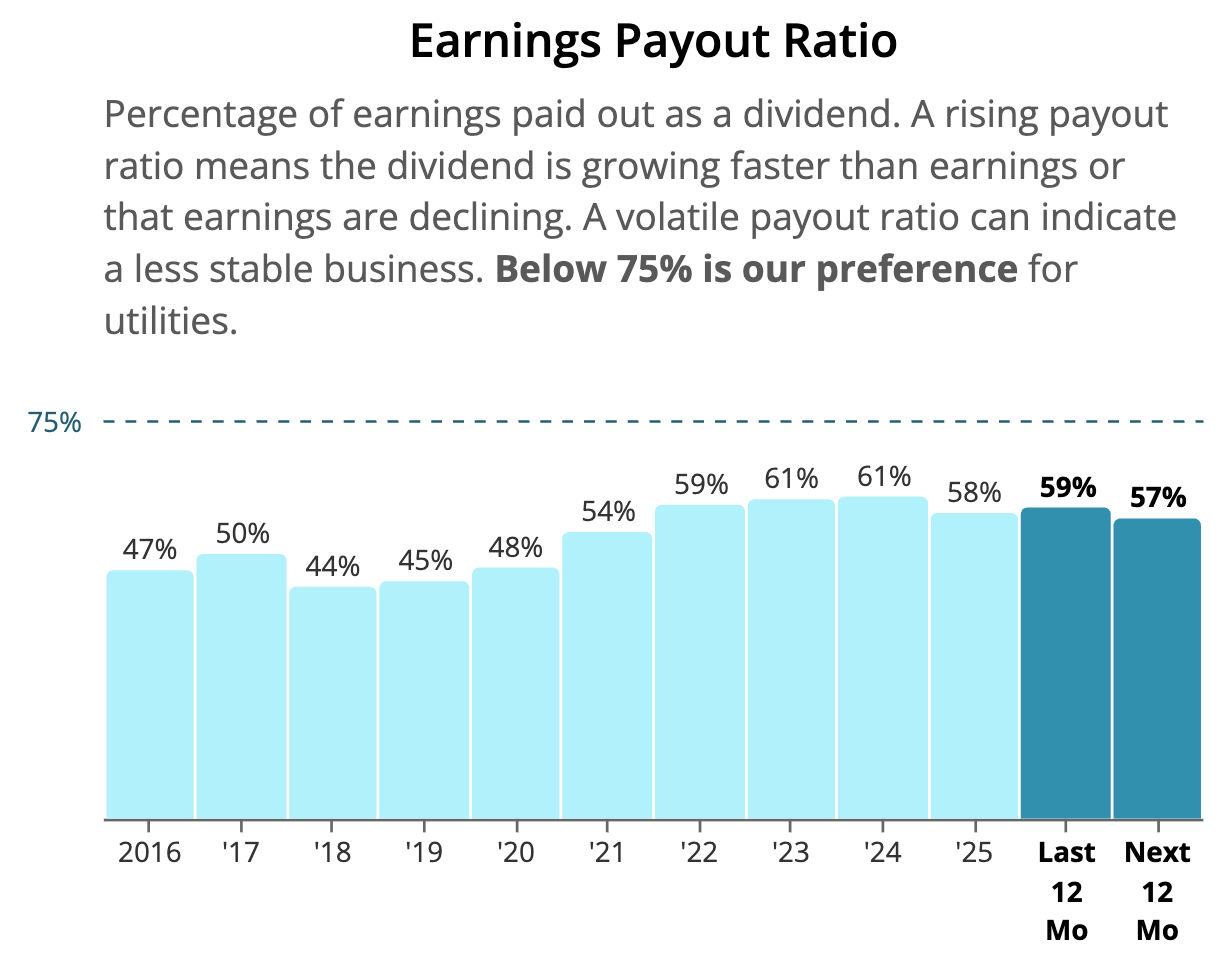
Kimco's payout ratio is expected to reach 82%, inside our 90% preference for REITs. Source: Simply Safe Dividends.
Kimco suspended its dividend in mid-2020 when the pandemic closed its tenants' stores, then reinstated it and has raised it every year since, including a 7.7% increase in August 2026.
An A- credit rating puts Kimco among the strongest balance sheets in retail real estate, and its dividend still consumes less of the REIT's cash flow than our 90% limit allows.
Kimco has cut its dividend twice, in 2009 and 2020, which is why we watch its payout ratio more closely than those of the longer-tenured REITs on this list.
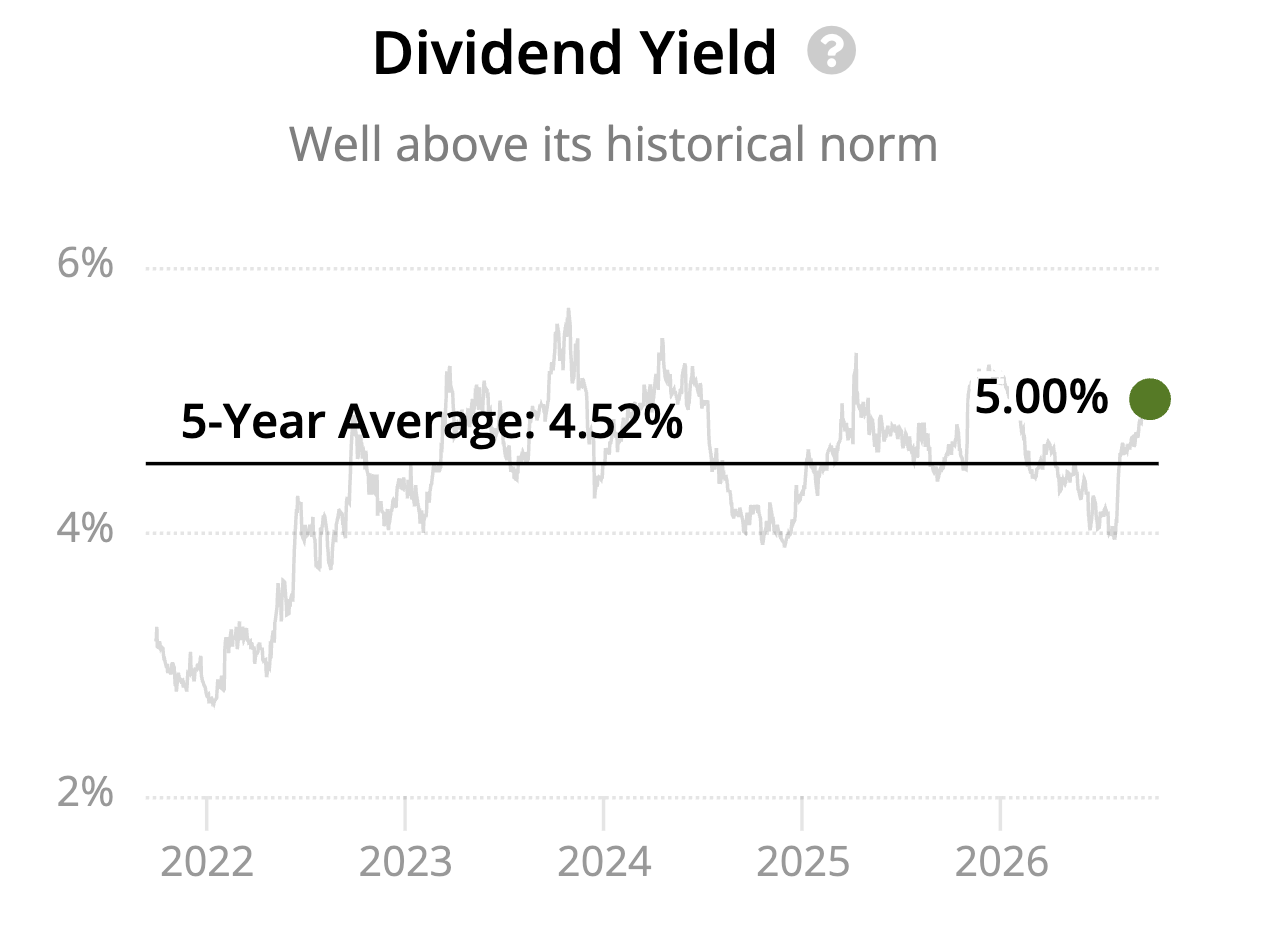
Kimco yields 5.00% against a five-year average of 4.52%. Source: Simply Safe Dividends.
Exelon's dividend looks safe. The utility holds an A- credit rating and pays out less than 60% of its earnings.
Exelon (EXC) delivers electricity and natural gas through six regulated utilities: ComEd in northern Illinois, PECO in southeastern Pennsylvania, BGE in Maryland, Pepco in Washington D.C., Delmarva Power, and Atlantic City Electric.
Exelon's payout ratio near 59% is low for a utility and has been stable since its 2022 spin-off. Source: Simply Safe Dividends.
Exelon spun off its power generation business in February 2022 and lowered the dividend 12% to match the smaller earnings base. That reset is why its uninterrupted streak reads three years. We raised its score to Safe after the split, because a pure-play regulated utility is a steadier business than one exposed to power prices.
Nearly all of its earnings are set by regulators, and no single jurisdiction accounts for much more than a third of its rate base, so its earnings are unusually predictable.
Data center growth in northern Illinois is driving demand on ComEd's system. Leverage at 5.2 times EBITDA is edging high but normal for the sector.
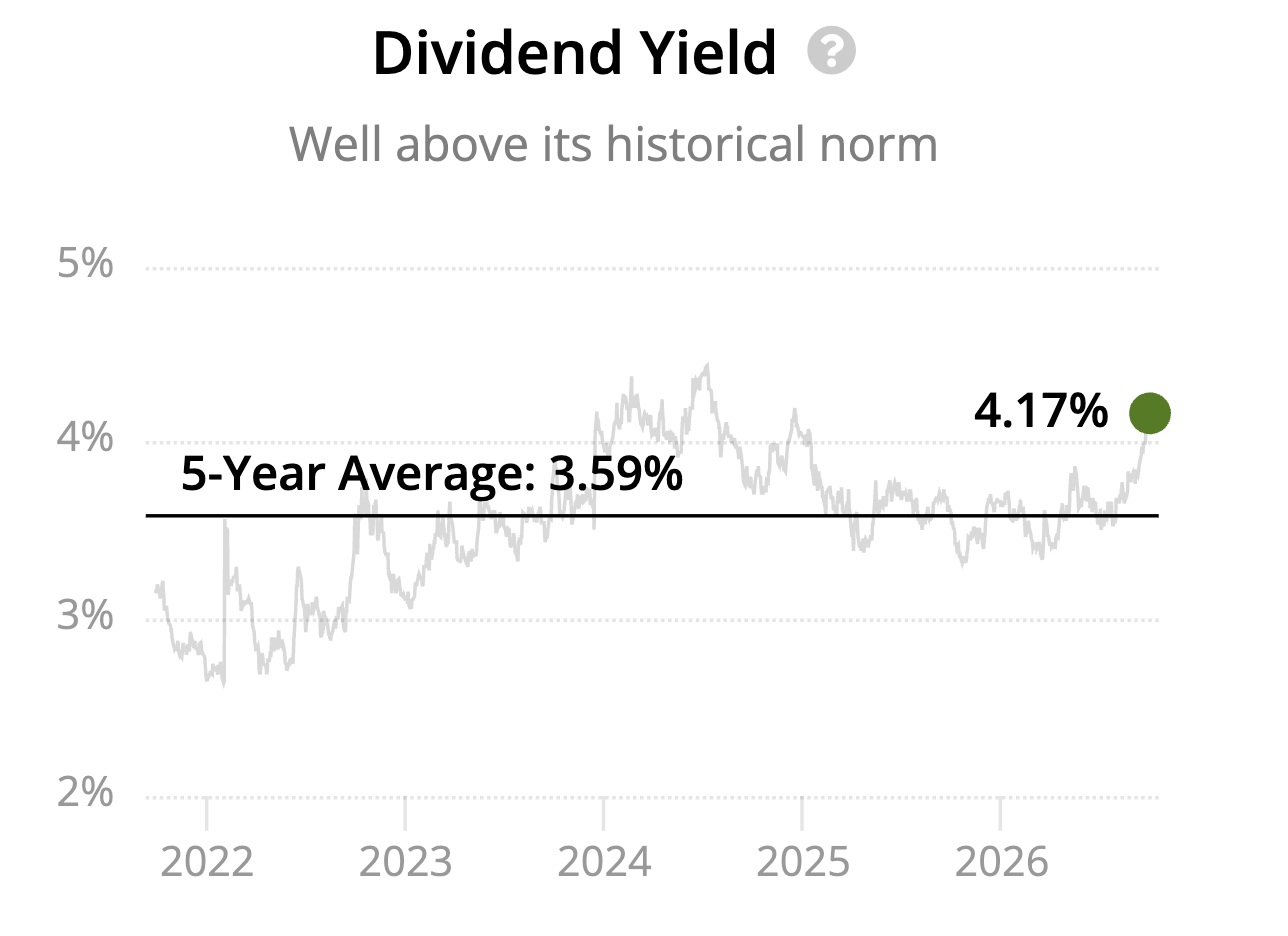
Exelon yields 4.17% against a five-year average of 3.59%. Source: Simply Safe Dividends.
AT&T's dividend looks safe after its 2022 reset. The carrier has cut its debt sharply since spinning off WarnerMedia and holds a BBB credit rating.
AT&T (T) cut its dividend in 2022 after spinning off its media business. It now focuses on core connectivity, with mobile service generating about 70% of sales and wireline connections, including fiber internet, generating about 30%.
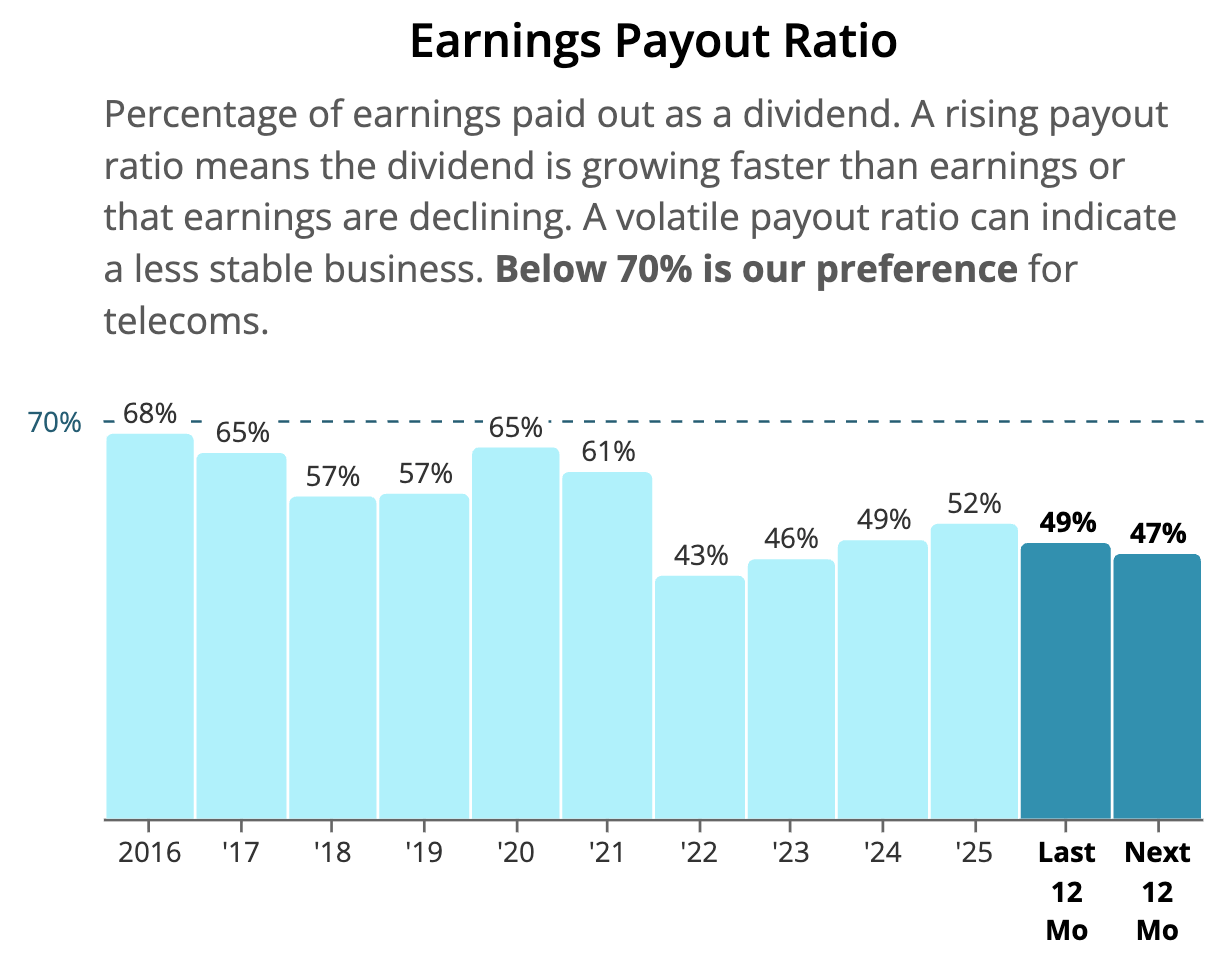
AT&T pays out under half its earnings, far below our 70% preference for telecoms. Source: Simply Safe Dividends.
The company has committed to spending more than $250 billion through 2030 and is acquiring $23 billion of spectrum. Starlink's wireless ambitions have also weighed on the stock, though we view that threat as years away.
A payout ratio below 50% and a BBB credit rating leave plenty of room to fund the dividend and the network. Investors should not expect meaningful dividend growth.
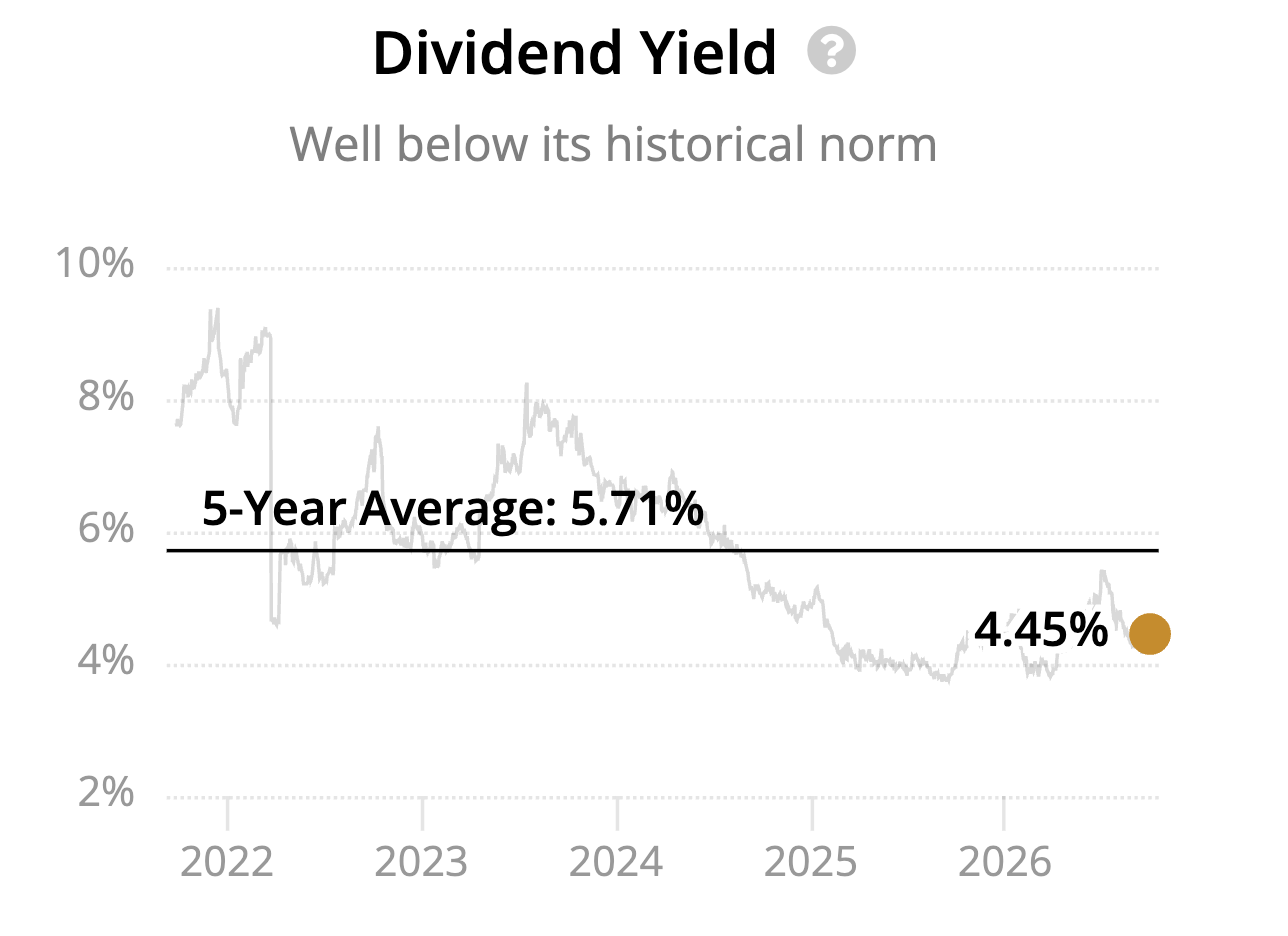
AT&T yields 4.45%, well below its five-year average of 5.71%. Source: Simply Safe Dividends.
W. P. Carey's dividend looks safe after its 2023 reset. The net lease REIT has resumed raising its dividend and has exited the office properties that forced the cut.
W. P. Carey (WPC) owns single-tenant commercial properties, mostly industrial, warehouse, and retail buildings, with over half in the U.S. and most of the rest in Northern and Western Europe. It pioneered the sale-leaseback model.
W. P. Carey's payout ratio has dropped to about 72% since the 2023 dividend reset. Source: Simply Safe Dividends.
W. P. Carey cut its dividend by 20% in December 2023 after spinning off most of its office properties into a separate REIT. That is why its uninterrupted dividend streak is so short.
Without the office exposure, the reset dividend looks well supported. W. P. Carey carries a BBB+ credit rating and a payout ratio near 72%, and it has raised its dividend since the reset.
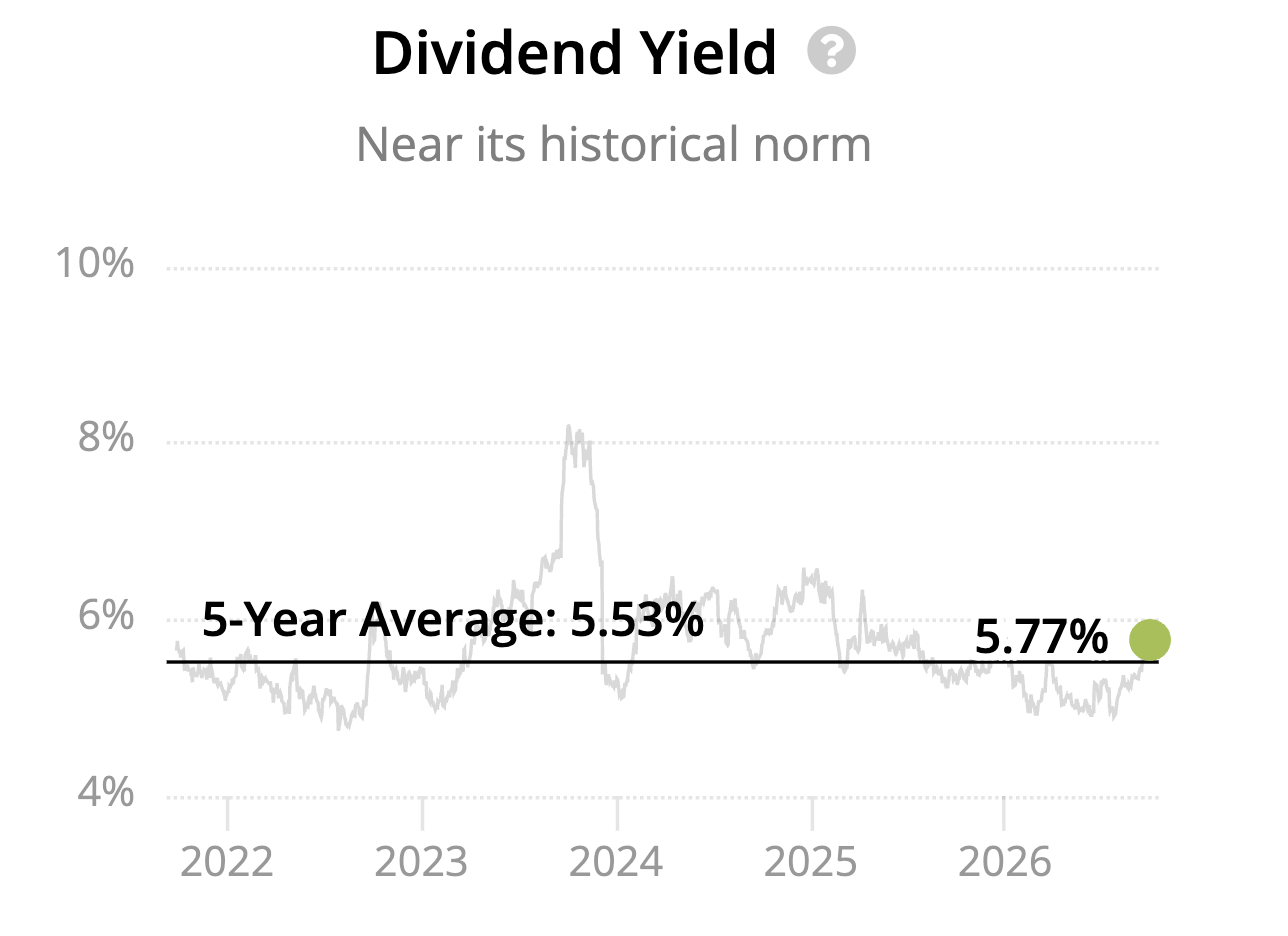
W. P. Carey yields 5.77%, close to its five-year average of 5.53%. Source: Simply Safe Dividends.
How We Score Dividend Safety
Our Dividend Safety Scores rate how likely a company is to cut its dividend, on a scale of 0 to 100. Scores above 60 are Safe.
They weigh the payout ratio, which is the share of profits a company pays out as dividends, along with debt levels, the steadiness of cash flow, and how the dividend held up in past recessions.
The scores are not a quant model left to run on its own. Our analysts oversee every one, reading earnings reports, regulatory filings and conference call transcripts, and watching for acquisitions, guidance changes and shifts in leverage. When something changes the picture we revisit the score and publish a dated note explaining what moved and why.
Since we launched them in 2015, investors who stuck with stocks scoring above 60 would have avoided 97% of the dividend cuts that followed, 925 of 946 in total. You can review every one on our public track record.
Why Safe Dividends Get Scarce Above a 4% Yield
A high yield is often a warning sign rather than a bargain. When investors doubt a dividend, they sell the stock, which pushes its yield higher.
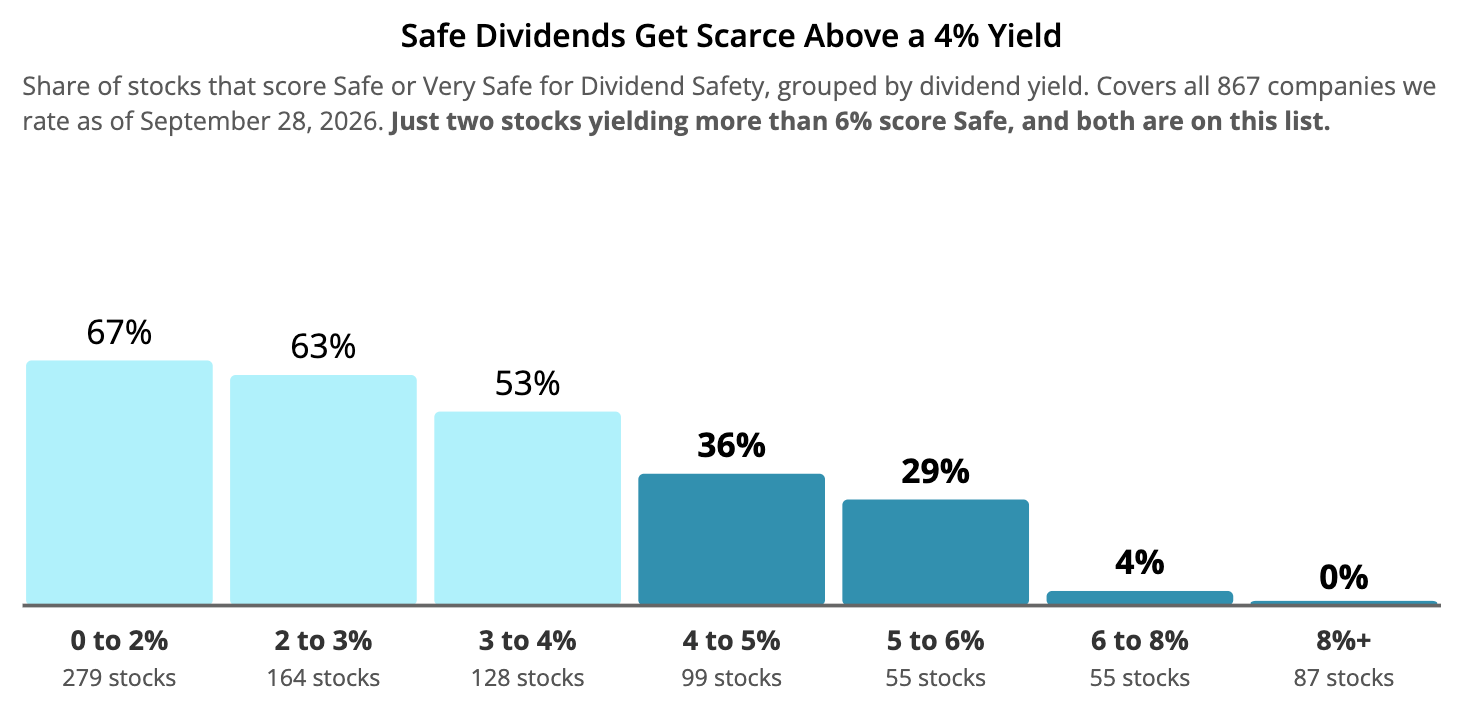
Our data shows how quickly safety falls away as yields rise. About two thirds of stocks yielding under 2% score Safe or Very Safe. That drops to 36% for stocks yielding 4% to 5%, 29% for 5% to 6%, and 4% above 6%.
Only 54 of the 296 stocks we rate that yield 4% or more score Safe or Very Safe. Source: Simply Safe Dividends.
That is why we treat a double-digit yield as a question to investigate rather than an answer. Our guide on where to find high yield stocks covers the sectors where safe high yields tend to cluster.
What About Yields Above 8%?
Searches for high dividend stocks often start at 8% or 10%, so it is worth saying plainly what we find up there. We rate 87 companies yielding 8% or more, and not one of them earns a Safe Dividend Safety Score.
Seventy-seven of them, about 88%, score Unsafe or Very Unsafe. The best of them reach only Borderline Safe, which signals a moderate risk of a cut over a full economic cycle.
The highest scores we can find above 8% belong to Sixth Street Specialty Lending (9.3% yield), Ares Capital (10.1%), Western Midstream (8.3%), CrossAmerica Partners (9.8%), and Hercules Capital (9.5%). Every one of them is a lender or a partnership whose income moves with interest rates, credit losses, or commodity volumes.
That is not bad luck. A yield that high usually means the share price has already fallen because investors expect a cut, and our scores weigh the same evidence those investors are reacting to: a payout ratio the company cannot cover, debt that limits its options, or cash flow that swings with interest rates and commodity prices.
The highest yield on this list is about 6%. We would rather give you 25 dividends we expect to survive the next recession than a longer list of yields that will not.
What Changed in This Update
We tightened the screen this update, and eight names changed as a result.
Removed: Ares Capital, Best Buy, Washington Trust Bancorp, Ennis, T. Rowe Price, Rexford Industrial, Pembina Pipeline, and Dominion Energy.
Added: Northwest Natural, Paychex, Portland General Electric, Brookfield Infrastructure, Fidelity National Financial, Agree Realty, Kimco Realty, and Exelon.
Every stock on the list now scores Safe or Very Safe and carries an investment-grade credit rating. That took off the three Borderline Safe names from our last update, Ares Capital, Best Buy, and Washington Trust Bancorp, along with Ennis and T. Rowe Price, which have no credit rating at all because they borrow almost nothing.
Dominion Energy came off for a different reason. NextEra Energy agreed in May 2026 to acquire it in an all-stock deal, and Dominion holders would see their dividend income fall about 24% when the deal closes, which is not what someone buying an income list is looking for. We also replaced Rexford Industrial, whose payout ratio is set to climb above our 90% preference for REITs, and Pembina Pipeline, which leaves Enbridge as the one Canadian pipeline here.
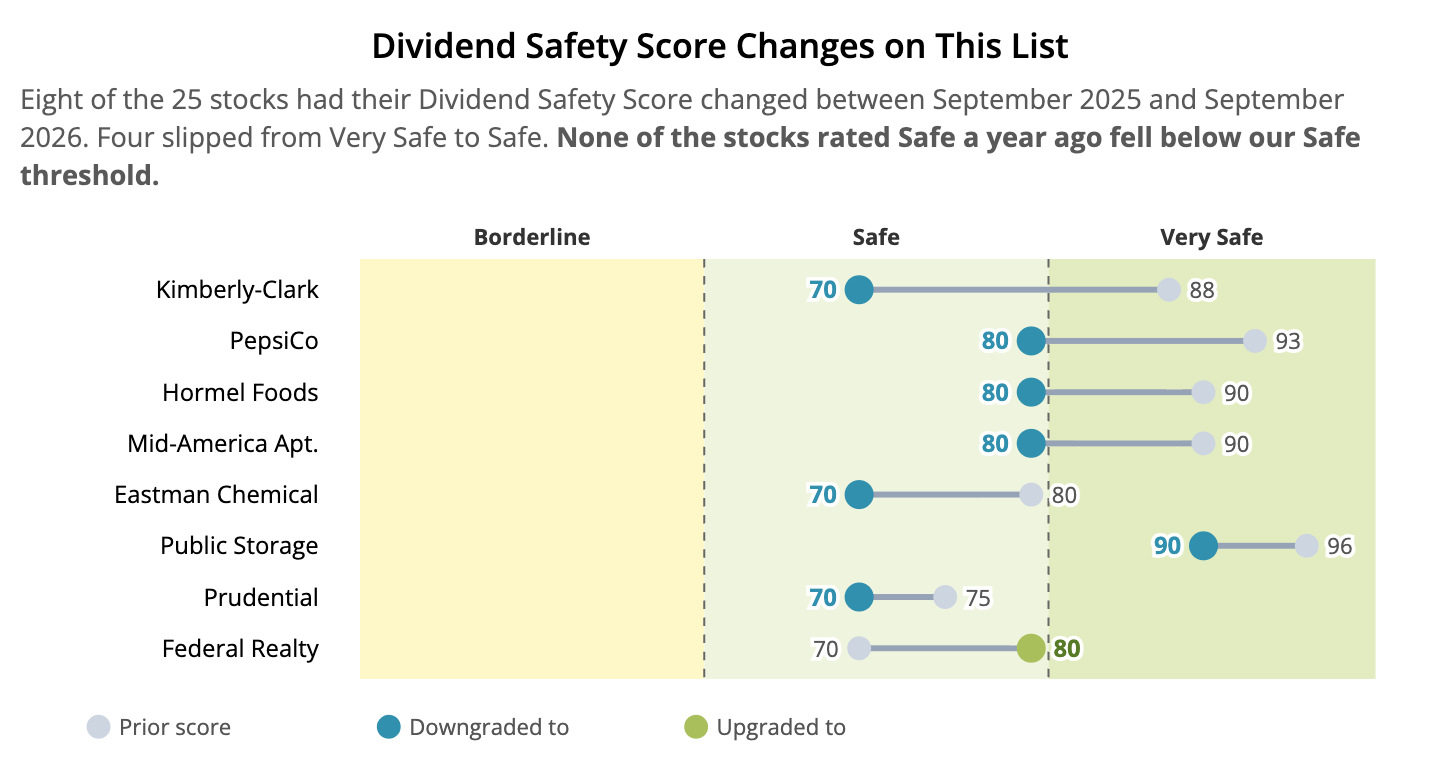
The other story is how many scores moved. Eight of the 25 had their Dividend Safety Score changed over the past year. Seven were downgraded and one, Federal Realty, was upgraded.
Eight of the 25 stocks had their Dividend Safety Score changed over the past year. Source: Simply Safe Dividends.
The downgrades share a pattern. In almost every case, earnings came under pressure while the dividend kept rising or held flat, pushing the payout ratio higher. Weaker consumer demand, Sunbelt apartment oversupply, a chemical industry slump, rising food costs, and two large acquisitions all played a part.
Four slipped from Very Safe to Safe, but none of the stocks rated Safe a year ago fell below our Safe threshold. The margin of safety narrowed, and the dividends remain on solid ground.
Frequently Asked Questions
What is the safest high dividend stock?
Public Storage (PSA) is one of only three stocks in our coverage that yield at least 4% and score Very Safe, with a Dividend Safety Score of 90 as of September 28, 2026. It yields 4.2% and carries an A credit rating.
How many high dividend stocks have safe dividends?
Of the 867 dividend-paying companies we rate, 296 yield 4% or more. Only 54 of those, about 18%, score Safe or Very Safe for Dividend Safety.
Are very high dividend yields safe?
Rarely. None of the 87 companies we rate that yield 8% or more scores Safe, and 77 of them score Unsafe or Very Unsafe. That is why the highest yield on this list is about 6%.
What is a yield trap?
A yield trap is a stock whose high yield reflects a dividend that is likely to be cut. The yield looks attractive only because the share price has fallen as investors lose confidence. Our dividend yield guide explains how to spot one.
Which high dividend stocks pay monthly?
Three stocks on this list pay monthly dividends: Realty Income (5.9% yield, Safe), Main Street Capital (5.8% yield, Safe), and Agree Realty (4.8% yield, Safe). See our monthly dividend stocks list for more.
How accurate are Dividend Safety Scores?
Since 2015, investors who stuck with stocks scoring above 60 would have avoided 97% of dividend cuts, 925 of the 946 cuts we have tracked. Every cut is listed on our public track record.
Do any of these stocks have special tax treatment?
Yes. Enbridge and Brookfield Infrastructure are Canadian, so U.S. investors face a 15% withholding tax outside retirement accounts. Enterprise Products Partners issues a K-1 instead of a 1099. REIT dividends, including those from Realty Income and NNN, are mostly taxed as ordinary income. Our REIT taxation lesson explains why.
Are high dividend stocks good for retirement income?
They can be, as long as the dividends hold up. A retiree who owns a stock that cuts its dividend loses income at the worst possible time, usually alongside a falling share price. That is why we screen for safety first and yield second. Every stock on this list scores Safe or Very Safe.
How much income do these stocks pay on $100,000?
Spread evenly across all 25 names, the average yield of 5.2% would produce about $5,200 of annual dividend income on a $100,000 investment. An S&P 500 index fund yielding near 1% would pay roughly a fifth of that.
Closing Thoughts on High Dividend Stocks
Safe high yields exist, but they are scarce. Only 54 of the 296 stocks we rate that yield 4% or more score Safe or Very Safe today.
The past year also showed that even safe dividends need watching. Eight of these 25 had their Dividend Safety Score changed over the past year, usually because payout ratios crept higher. Diversifying across sectors and checking dividend safety regularly are the best defenses.
If a long record of increases matters more to you than a high yield today, our Dividend Aristocrats list and Dividend Kings list rank the companies with 25 and 50 straight years of raises. Most of them yield less than the names above.
Many investors interested in high dividend stocks are retirees looking to live off dividends. If that sounds like you, try our online portfolio tools to track your income, see the Dividend Safety Score of every stock you own, and get alerts when a score changes.