
Investing in REITs for Income: A Guide for Dividend Investors
Real estate investment trusts (REITs) own income-producing property and must pay out at least 90% of their taxable income as dividends. That rule is why the 92 REITs we rate for dividend safety yield a median 4.9%, nearly double the 2.6% median of the 773 other dividend-paying companies we track.
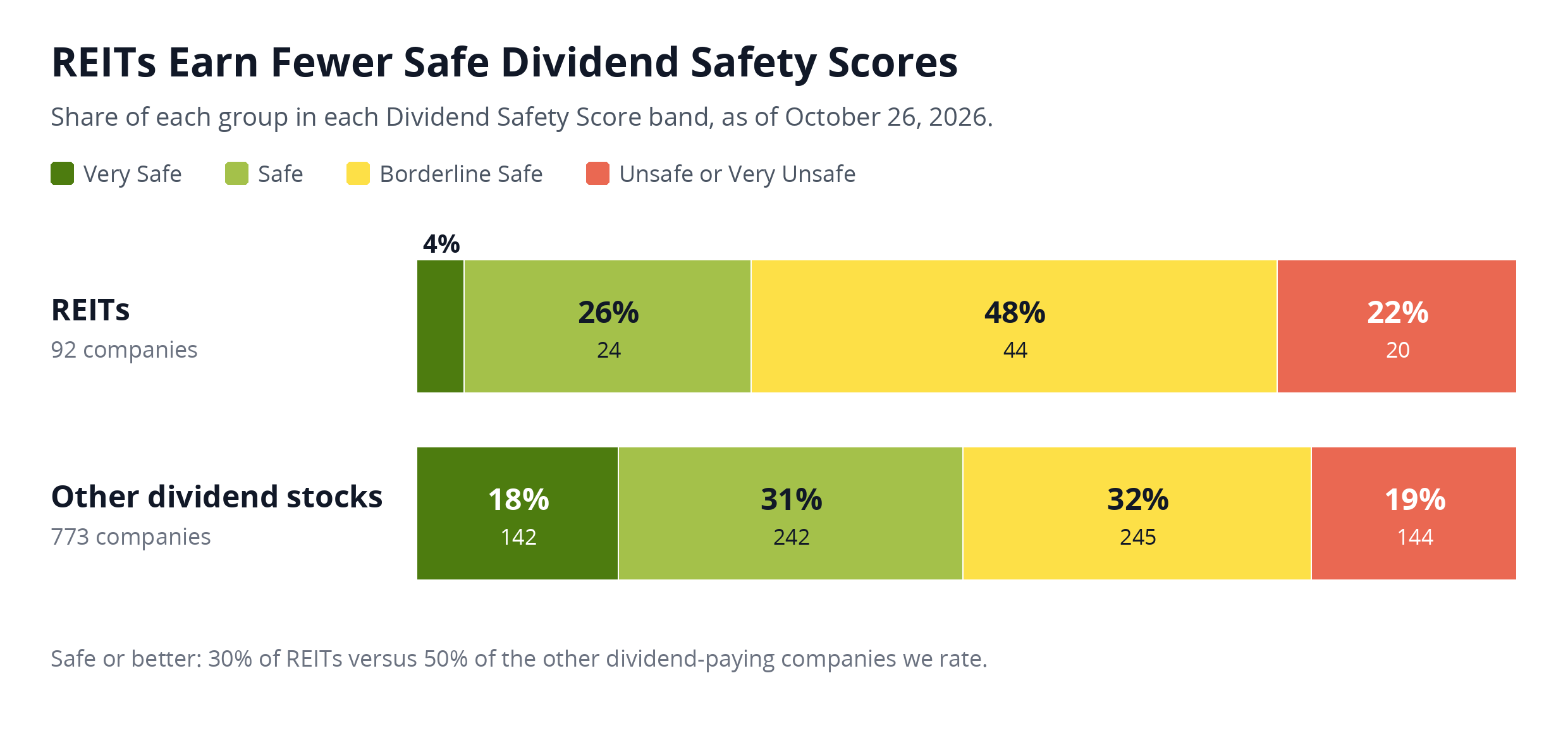
The catch is that fewer REIT dividends are built to withstand a full economic cycle. Only 28 of those 92 REITs, or 30%, earn Safe or Very Safe Dividend Safety Scores, compared with half of the other companies we rate.
This guide explains how REITs work, how their dividends are taxed, which property types tend to carry the safest payouts, how REIT dividends held up in the last deep recession, the checklist we use to rate them, and why rising interest rates have been weighing on REIT stocks.
What Is a REIT?
REITs own income-producing real estate such as shopping centers, apartments, warehouses, office buildings, data centers, cell towers, medical buildings, storage facilities and hotels.
Tenants sign leases to use these properties. Many businesses prefer renting to owning because it ties up less of their capital, which leaves more money for running stores, warehouses or hospitals.
REITs collect rent over terms that range from month-to-month contracts for self-storage units to leases of 20 years or more for freestanding stores and distribution centers.
As long as a REIT's properties stay occupied and its tenants keep paying, this business model produces the kind of predictable, recurring cash flow that is valued in retirement.
A law signed by President Eisenhower in 1960 created the first REITs, giving individual investors a way to own large portfolios of commercial property. The sector took off after the Tax Reform Act of 1986 let REITs manage their own properties, and many of today's largest REITs went public in the 1990s.
How to Invest in REITs
Publicly traded REITs are listed on exchanges such as the NYSE and trade like any other stock. Buying one is as simple as entering its ticker in your brokerage account.
Non-listed and private REITs exist outside of stock exchanges. Most investors should avoid them. They are hard to value and hard to sell, charge high fees, and can have management structures that create conflicts of interest.
REIT funds such as VNQ offer broad exposure in a single holding. Their payouts rise and fall with the dividends of the REITs they own, including the riskiest ones, so the same safety questions apply. This guide focuses on individual REITs, which let you choose the tenants, property types and balance sheets behind your income.
Investing in publicly traded REITs still requires understanding how they differ from regular corporations.
How REITs Differ From Regular Dividend Stocks
Like any stock, a share of a REIT is a stake in a business. The main difference is the payout rule. REITs must distribute at least 90% of their taxable income each year to keep their special tax status, so they retain very little cash.
To fund growth, which means buying or developing properties, REITs rely on borrowing and on selling new shares. That is why most REITs carry more debt than a typical company and see their share counts rise over time. Management creates value only when new properties earn higher cash yields than the REIT's cost of debt and equity.
The key differences at a glance:
- Payout: REITs must pay out at least 90% of taxable income. Regular companies pay whatever their board chooses.
- Cash flow measure: REITs are judged on adjusted funds from operations (AFFO), which works like free cash flow. Regular companies are judged on earnings and free cash flow.
- Funding growth: REITs raise outside debt and equity. Regular companies can reinvest the cash they keep.
- Taxes: Most REIT dividends are taxed as ordinary income. Most regular dividends are qualified and taxed at lower rates.
The dependence on borrowed money shows up in the numbers. The median REIT we rate carries net debt equal to 5.2 times its EBITDA, a common measure of cash flow, versus 1.8 times for the median non-REIT dividend payer.
How REIT Dividends Are Taxed
By paying out at least 90% of their taxable income, REITs avoid paying federal corporate income tax. The tax bill passes through to shareholders instead.
As a result, most REIT dividends are non-qualified and taxed as ordinary income rather than at the lower rates most corporate dividends enjoy.
There is a partial offset. Under Section 199A, individual investors can deduct 20% of their ordinary REIT dividends, which lowers the top effective federal rate on them from 37% to 29.6%. The One Big Beautiful Bill Act, signed in July 2025, made that deduction permanent.
A portion of a REIT's dividend may also be classified as a capital gain distribution, taxed at lower rates, or as a return of capital, which is not taxed when received and instead reduces your cost basis. In most years, ordinary dividends still make up the bulk of the payout, as we explain in our review of REIT taxation.
Many investors prefer to hold REITs in tax-advantaged accounts such as IRAs, where the higher tax rate on non-qualified dividends does not apply. In a taxable account, REIT investors receive a Form 1099-DIV at tax time, with no K-1.
To keep their pass-through status, REITs must also meet tests on what they own and how they earn money, including:
- Investing at least 75% of their assets in qualifying real estate
- Earning at least 75% of their gross income from rents, mortgage interest and other real estate sources
Companies rarely change their tax elections, so investors do not need to monitor these tests themselves.
Types of REITs and Where Safe Dividends Are Found
Some REITs spread their portfolios across many types of property, but most concentrate on one or two. That makes it easy to own the kinds of real estate you believe in, such as data centers for the growth of cloud computing or warehouses for online shopping.
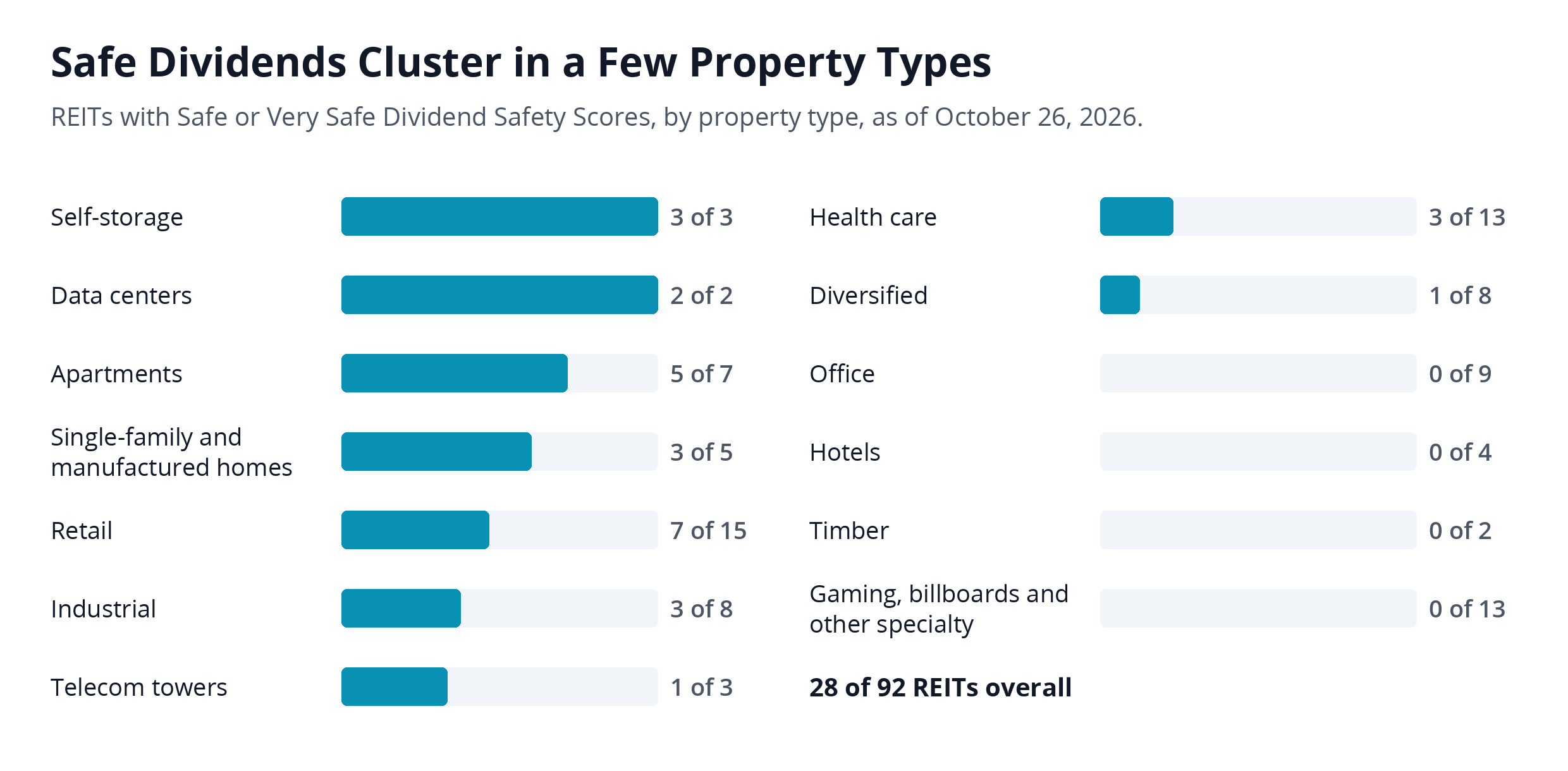
It also means the property type does a lot to determine how safe the dividend is. Every self-storage and data center REIT we rate earns a Safe or Very Safe Dividend Safety Score, and so do five of the seven apartment REITs.
None of the nine office REITs do, and neither do any hotel, timber or specialty REITs, a group that includes casino, billboard, cannabis and farmland landlords. Office owners have struggled with empty floors since the pandemic, and hotel cash flow can swing sharply with the economy.
There is also a separate class known as mortgage REITs. These companies own mortgages and mortgage-backed securities rather than buildings, so their income depends on interest rates rather than rent. Nearly all of them have histories of multiple dividend cuts, which is why we cover them separately in our guide to mortgage REITs. Everything else in this guide refers to property-owning REITs.
Safe REIT Stocks Yielding 4% or More
Popularity is no guarantee of safety. Some of the most widely held high-yield REITs, including Medical Properties Trust and Innovative Industrial Properties, carry Very Unsafe Dividend Safety Scores after serious trouble with their tenants.
Across the 92 REITs we rate, 16 combine a Safe or better Dividend Safety Score with a dividend yield of at least 4%. Here they are by property type, with yields as of October 26, 2026.
Retail
- NNN REIT (NNN): 5.9% yield, raised its dividend for 37 consecutive years
- Realty Income (O): 5.7% yield, pays monthly
- Agree Realty (ADC): 4.8% yield, pays monthly
- Kimco Realty (KIM): 4.7% yield
- Federal Realty (FRT): 4.2% yield, raised its dividend for 59 consecutive years
- Regency Centers (REG): 4.1% yield
Apartments and homes
- Mid-America Apartment Communities (MAA): 5.1% yield
- UDR (UDR): 4.8% yield, pays monthly
- Vivmark Residential (VMRK): 4.5% yield
- Camden Property Trust (CPT): 4.1% yield
- American Homes 4 Rent (AMH): 4.1% yield
Self-storage
- CubeSmart (CUBE): 5.3% yield
- Extra Space Storage (EXR): 4.5% yield
Diversified, industrial and health care
- W. P. Carey (WPC): 5.9% yield
- Rexford Industrial Realty (REXR): 4.6% yield
- CareTrust (CTRE): 4.2% yield
Retail landlords make up the largest group, led by owners of grocery-anchored shopping centers and single-tenant stores. Other well-known REITs earn strong Dividend Safety Scores with lower yields, including Public Storage, which earns a Very Safe Dividend Safety Score.
Are REIT Dividends Safe?
REIT dividends are less secure on average than other dividends, mostly because of the payout rule and the debt that comes with it. A business that pays out most of its cash and borrows to grow has less room for error when tenants struggle or lenders pull back.
That shows up in our ratings. Only 4% of REITs earn Very Safe Dividend Safety Scores, compared with 18% of other dividend payers, and nearly half of REITs sit in the Borderline Safe band.
That does not make REITs a poor choice for income. It means the gap between the best and worst REITs is wide, and picking carefully matters more here than in most sectors.
How REITs Have Performed Over Time
Over the long run, REITs have kept pace with the stock market. From 1972 through August 2026, the FTSE Nareit All Equity REITs index returned 11.0% a year including dividends, close to the S&P 500's 11.3%, according to Nareit.
The last decade has been much weaker. Over the 10 years through August 2026, REITs returned 5.8% a year versus 15.4% for the S&P 500 as rising interest rates and the shift away from offices weighed on the sector.
REITs also tend to fall harder in a severe downturn. The financial crisis showed what happens when credit dries up for a sector that depends on it. Of the 52 REITs we rate with dividend records covering that recession, 27 cut or suspended their dividends. Only about one in five of the other dividend payers did.
REIT stocks fell harder too. The median REIT we rate lost 64% over the 2007-09 recession, versus a 55% loss for the S&P 500.
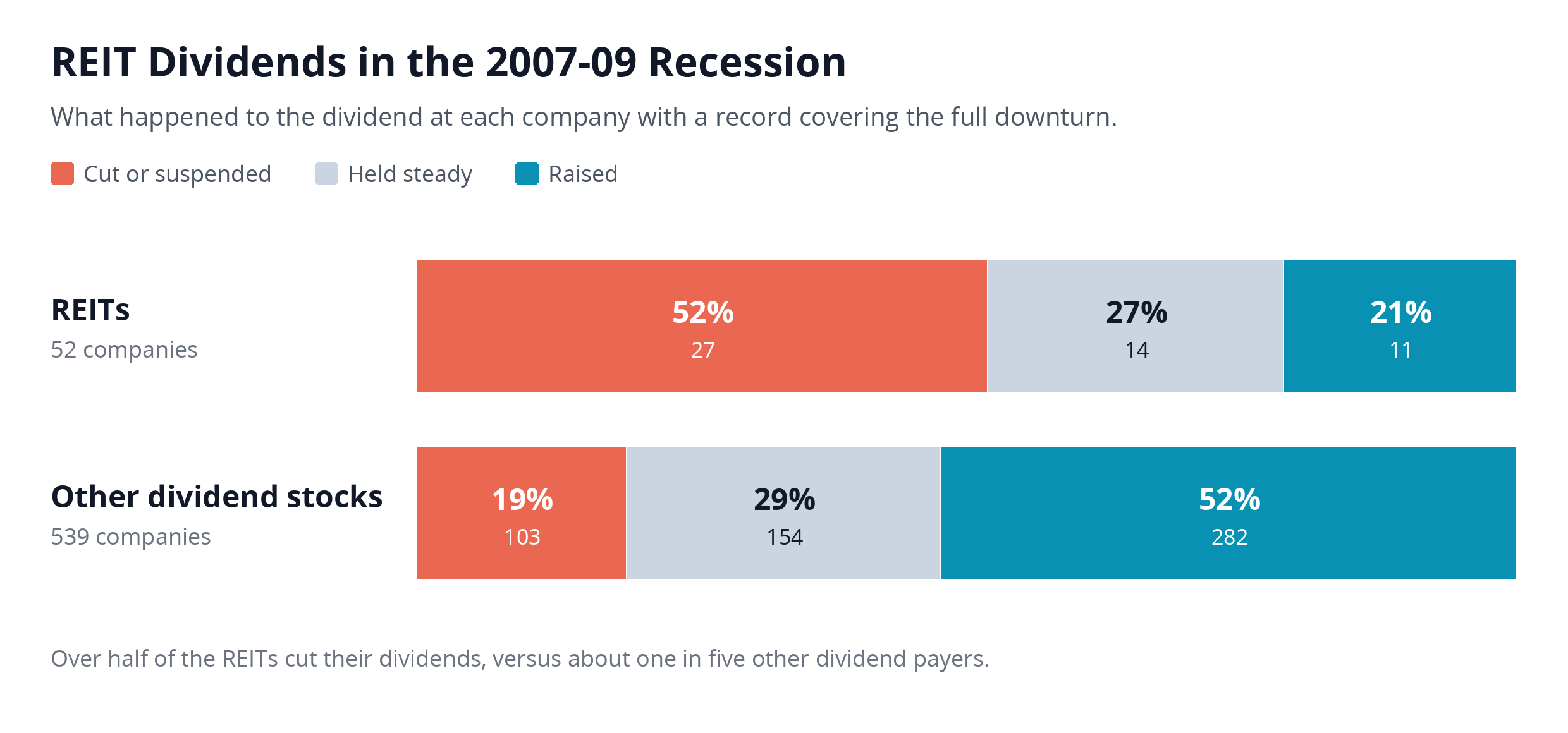
Yet 11 of those REITs raised their dividends straight through the downturn, Realty Income among them. What separated them was usually what our checklist below looks for: dependable tenants, moderate debt and payout ratios that left a margin of safety.
You can read more about how different businesses behave in downturns in our guide to what happens to dividends during recessions.
How We Analyze a REIT's Dividend
Over the years our research notes on REITs have kept returning to the same few causes. When we downgrade a REIT's Dividend Safety Score, the trigger is almost always tenants who cannot pay, buildings that cannot be leased, or debt that has become more expensive to carry. When we upgrade one, it is usually because one of those problems has eased.
Here is the general checklist we use, along with what our ratings say about each test.
Tenant quality and concentration. How large are the biggest tenants as a share of rent, and can they keep paying in a downturn? A REIT leaning on a few weak tenants can lose a large slice of its income at once. Innovative Industrial Properties (IIPR) shows this risk today. All of its tenants are state-licensed cannabis growers, and a handful of them make up much of its rent. Its largest tenant, which paid 17% of its rent, defaulted on all of its leases in December 2024. As defaults have piled up, its payout ratio has climbed above 100%. The REIT has not cut its dividend yet, but its Very Unsafe Dividend Safety Score points to a high risk of a cut.
Property type and demand. Is demand for this kind of real estate likely to grow? Our notes on office landlords such as Brandywine, Highwoods, Kilroy and BXP have described falling occupancy, slow leasing and rising borrowing costs for several years, and none of the nine office REITs we rate scores Safe today.
Lease structure. Long leases with built-in rent increases make cash flow predictable, especially triple-net leases, where tenants pay property taxes, insurance and maintenance. As the interest rate section below shows, long leases also make a REIT's stock behave more like a bond.
Dividend coverage. Has AFFO consistently covered the dividend? We prefer an AFFO payout ratio below 90% for most REITs. None of the nine REITs we rate with payout ratios above 90% earns a Safe Dividend Safety Score, while the median Safe REIT pays out 72%. Our guide to payout ratios explains the measure in more detail.
Balance sheet. REITs carry more debt than most businesses, but some push harder than others. Only 2 of the 34 REITs we rate with high leverage for the sector earn Safe Dividend Safety Scores, compared with 26 of the 58 with moderate or low leverage.
Credit ratings point the same way. Of the 28 REITs with Safe or better Dividend Safety Scores, 25 hold investment-grade credit ratings, which give them cheaper and more reliable access to borrowing. Watch for variable-rate debt as well. Universal Health Realty has raised its dividend for about four decades, yet we have downgraded its Dividend Safety Score three times since 2022 as rising interest costs on its floating-rate borrowing squeezed its coverage.
Dividend track record. Has the REIT paid steady dividends through past downturns, and how fast has the payout grown? Long streaks are rare in this sector. Only five of the REITs we rate have raised their dividends for at least 25 consecutive years: Federal Realty (59 years), Universal Health Realty (about 40), NNN REIT (37), Essex Property Trust (32) and Realty Income (31). Dividend growth also tends to be slower, at a median of 4.3% a year over the last five years versus 6.7% for other dividend payers.
For a closer look at the numbers behind these tests, including funds from operations and valuation measures, see the most important metrics for REIT investing.
Running the Checklist on Realty Income
Realty Income (O) shows how the checklist works in practice. The retail REIT got its start in 1969 with a single Taco Bell and now owns thousands of freestanding, single-tenant properties across the U.S. and Europe.
Retail properties generate most of its rent, with industrial buildings and gaming venues making up nearly all of the rest. Its leases are triple-net and have about nine years remaining on average.
Tenant risk is spread out. No single tenant accounts for more than 5% of rent, and no industry for more than 12%. Its largest tenants include Dollar General, Walgreens and 7-Eleven, and it focuses on businesses with a service, non-discretionary or low-price element that are better insulated from online shopping.
That mix has kept the portfolio nearly 99% occupied, and occupancy has never fallen below 96%, even during the financial crisis and the pandemic.
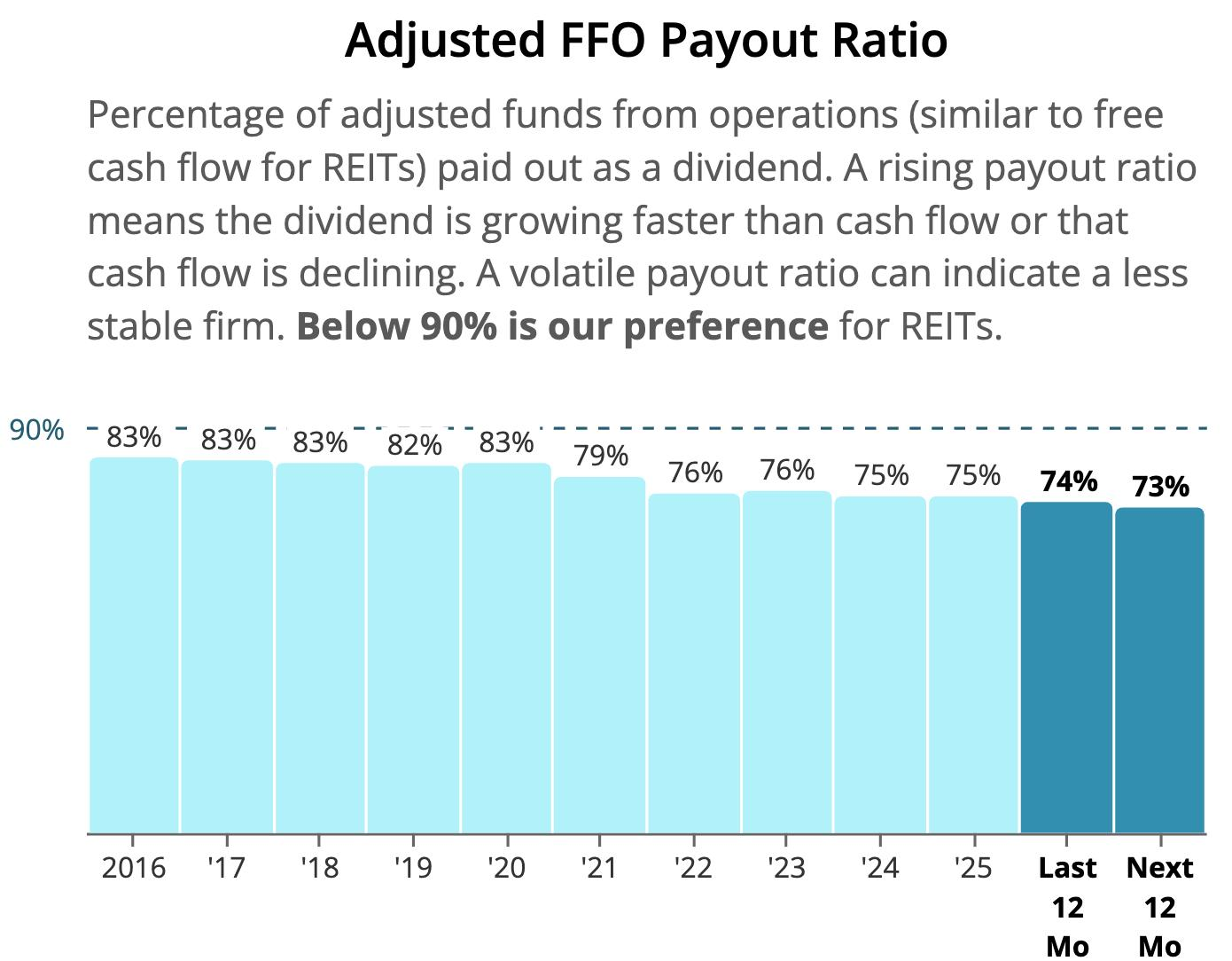
Dividend coverage is comfortable as well. Realty Income's AFFO payout ratio has declined from 83% a decade ago to 74% over the last 12 months, well below our 90% preference.
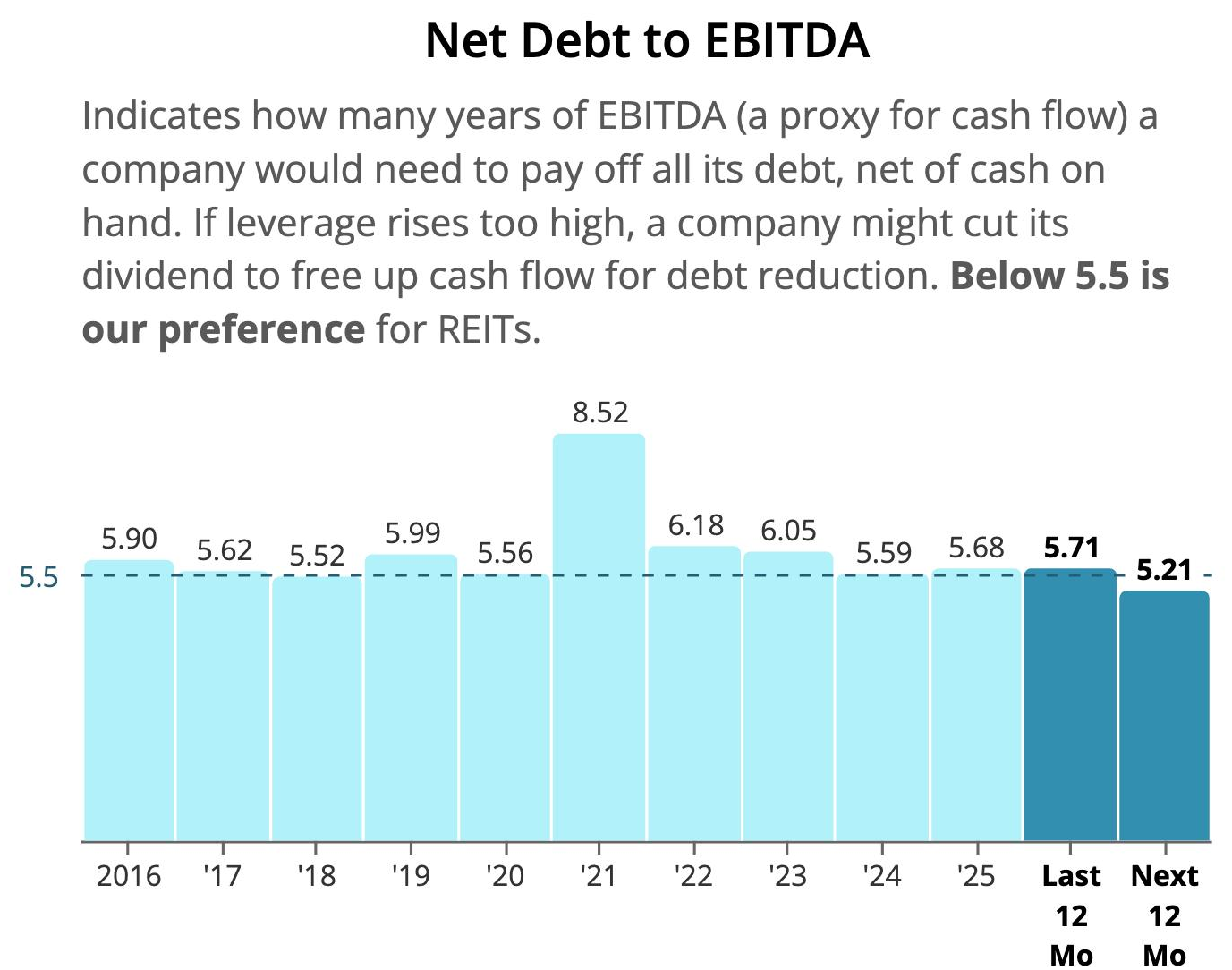
Leverage has stayed in a fairly narrow band for most of the last decade, apart from a jump in 2021 that followed its merger with VEREIT. The REIT holds an A- credit rating, which keeps its borrowing costs low.
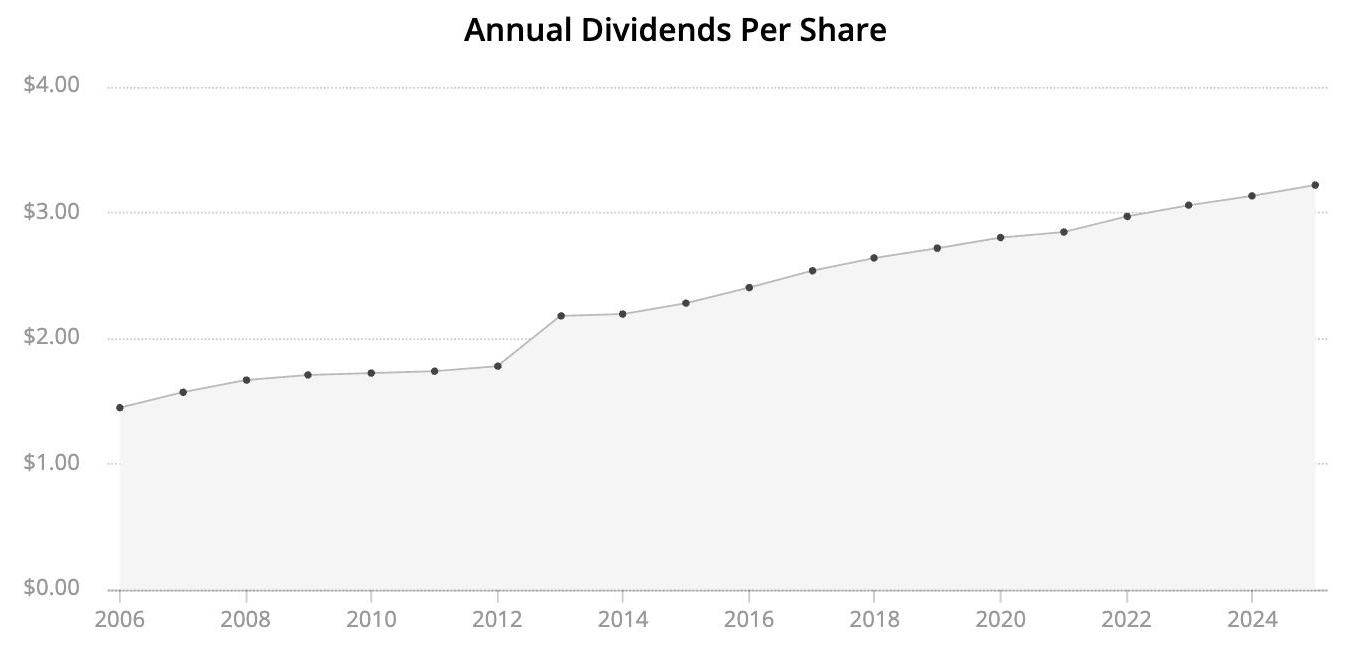
All of this adds up to an outstanding dividend record. Realty Income has paid 675 consecutive monthly dividends, has raised its payout for more than 31 consecutive years, and is a member of the S&P 500 Dividend Aristocrats.
Dividend growth has slowed as the company has grown larger, to 2.8% a year over the last five years. Realty Income earns a Safe Dividend Safety Score, and it looks like a good bet to keep delivering low single-digit raises in good times and bad.
How Interest Rates Affect REITs
A REIT can have a rock-solid dividend and still see its share price fall when interest rates rise. That is especially true of net-lease REITs such as Realty Income, Agree Realty, NNN REIT and W. P. Carey, which rank among the safest and most popular REITs.
Three traits make these REITs trade more like bonds than most stocks:
- Long, fixed leases: Tenants sign for 10 to 15 years or more, often with rent increases of just 1% to 2% a year. That steady, slow-growing cash flow looks a lot like a bond's interest payments.
- Competition from Treasuries: When risk-free Treasuries pay more, income investors demand higher yields from bond-like stocks, and the quickest way for a yield to rise is for the share price to fall.
- Growth that depends on financing: Net-lease REITs grow mainly by buying buildings with borrowed money and new shares. Higher rates shrink the profit on each purchase until property prices adjust, which is one reason Realty Income's dividend growth has slowed to about 1% over the last 12 months.
We saw this play out in 2026. From July 24 to early October, the 10-year Treasury yield rose from about 4.7% to around 5.2%. The median REIT we rate lost about 12% including dividends, while the nine investment-grade net-lease REITs fell about 17%.
Financial strength had little to do with it. REITs with strong credit ratings and Safe Dividend Safety Scores fell about as much as weaker ones, and six of those nine net-lease REITs raised their dividends during the selloff. We break down the numbers in our video, Finally Time to Buy REITs? Or a Falling Knife?
Comparing a REIT's dividend yield with the 10-year Treasury yield shows how this works. On October 8, 2026, Realty Income yielded about 6.0%, just 0.78 percentage points more than the 10-year Treasury, compared with an average premium of 2.12 points since 2001.
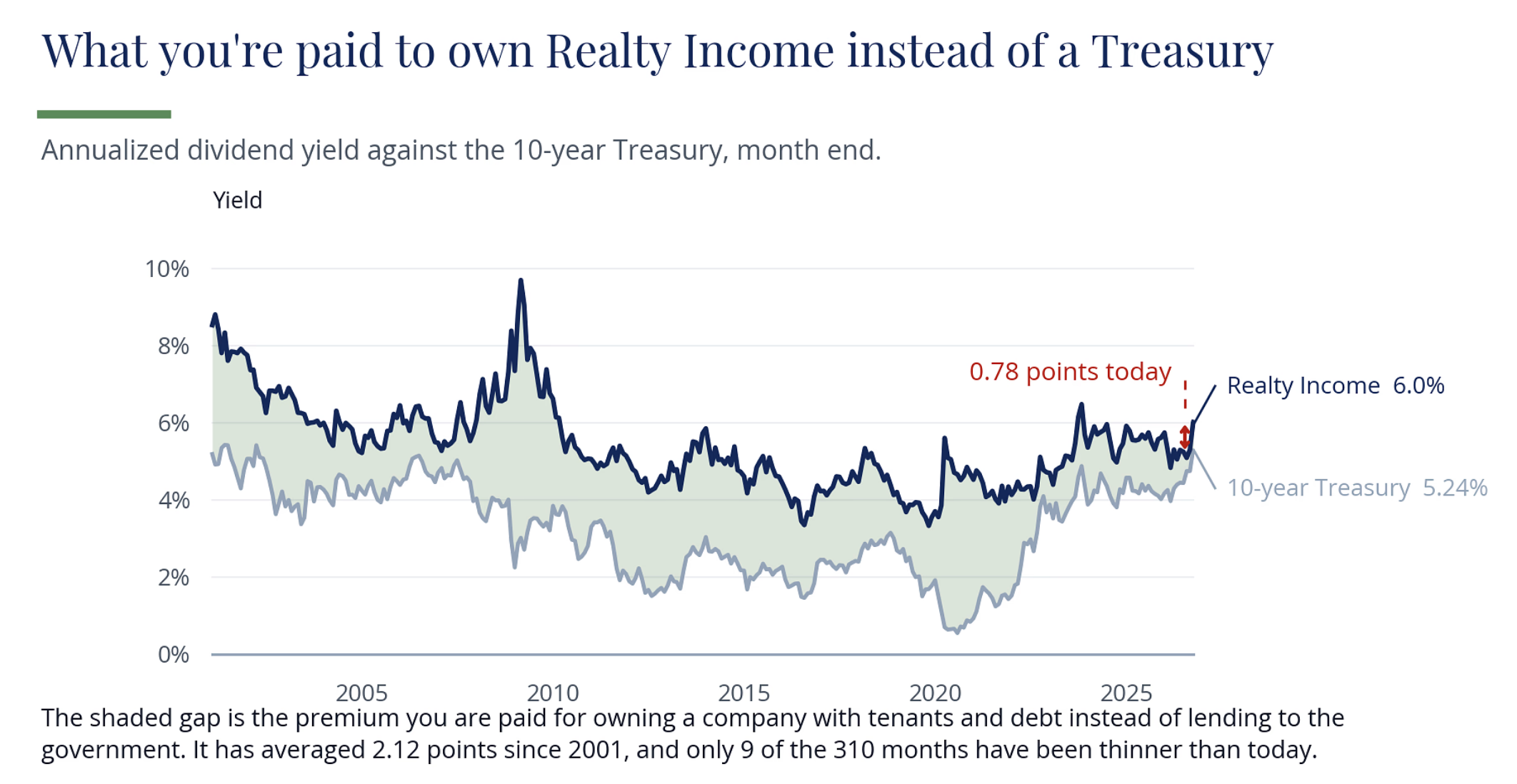
For a high-dividend portfolio, the takeaway is to expect these REITs to move partly with bonds. Their dividends can stay secure while their prices fall as rates climb, and they will not necessarily cushion a portfolio when bonds are also falling.
That is a reason to diversify, not to avoid them. Balance long-lease REITs with property types that reset rents faster, such as self-storage, apartments and cell towers, and keep REITs as one part of a portfolio spread across many sectors.
For more on how different types of REITs respond to rising rates, see our guide to how higher interest rates impact REITs, and our comparison of REITs vs. bonds in retirement.
Key Risks of Investing in REITs
Some REITs are riskier than others, but most have at least some exposure to the factors below.
- Interest rate sensitivity: Rising rates raise borrowing costs and can push down the share prices of bond-like REITs, especially those with long, fixed-rate leases.
- High leverage: Debt magnifies returns in good times and losses in bad ones.
- Dependence on capital markets: REITs need to raise debt and equity to grow. If that access shuts off, as it did in 2008, dividends are often the first thing cut to preserve cash.
- Tenant trouble: A struggling major tenant can wipe out a large slice of rent at once.
- Concentrated operations: Most REITs specialize in one type of property, so a shift in demand, like the move to remote work for office landlords, can hit the whole portfolio.
Investors can reduce these risks by favoring REITs with the traits in our checklist and by keeping REITs as one part of a well-diversified dividend portfolio.
The Pros and Cons of Investing in REITs
REITs offer a mix of advantages and disadvantages to weigh.
Reasons to be cautious about REITs include:
- Non-qualified dividends taxed mostly as ordinary income
- Greater sensitivity to interest rates
- Weaker dividend safety on average because of high payout ratios and leverage
- Deeper declines and more dividend cuts during severe recessions
- Slower dividend growth than many other sectors
In return, the best REITs can provide:
- High dividend yields backed by recurring rent
- Rent increases and property values that can help offset inflation over time
- Exposure to real estate without the work of being a landlord
- Monthly dividends from a handful of REITs, including Realty Income
- Diversification beyond the sectors that dominate most stock portfolios
Overall, REITs can be a solid addition to many income portfolios. Investors just need to be selective about which REITs they own, understand the risks, and stay diversified.
Frequently Asked Questions
Why are REIT dividends so high?
REITs must pay out at least 90% of their taxable income as dividends to avoid corporate income tax. That is why the median REIT we rate yields 4.9%, nearly double the 2.6% median for other dividend-paying companies.
REITs must pay out at least 90% of their taxable income as dividends to avoid corporate income tax. That is why the median REIT we rate yields 4.9%, nearly double the 2.6% median for other dividend-paying companies.
Are REIT dividends qualified dividends?
Mostly no. The bulk of a typical REIT dividend is taxed as ordinary income, though investors can deduct 20% of it under Section 199A, a break made permanent in 2025. That lowers the top federal rate on REIT dividends from 37% to 29.6%.
Mostly no. The bulk of a typical REIT dividend is taxed as ordinary income, though investors can deduct 20% of it under Section 199A, a break made permanent in 2025. That lowers the top federal rate on REIT dividends from 37% to 29.6%.
How often do REITs pay dividends?
Most REITs pay quarterly. Thirteen of the 92 REITs we rate pay monthly, including Realty Income, Agree Realty and EPR Properties. See our list of monthly dividend stocks for more.
Most REITs pay quarterly. Thirteen of the 92 REITs we rate pay monthly, including Realty Income, Agree Realty and EPR Properties. See our list of monthly dividend stocks for more.
What are the safest REITs for dividends?
Four REITs earn Very Safe Dividend Safety Scores today: Public Storage, Essex Property Trust, Sun Communities and Equinix. Another 24 score Safe, for 28 of the 92 REITs we rate.
Four REITs earn Very Safe Dividend Safety Scores today: Public Storage, Essex Property Trust, Sun Communities and Equinix. Another 24 score Safe, for 28 of the 92 REITs we rate.
Are REITs a good investment for retirement income?
They can be, if you choose carefully. REITs offer higher yields than most stocks, but only 30% of the REITs we rate earn Safe or better Dividend Safety Scores, and more than half of the REITs we rate with records from that period cut their dividends during the 2007-09 recession.
They can be, if you choose carefully. REITs offer higher yields than most stocks, but only 30% of the REITs we rate earn Safe or better Dividend Safety Scores, and more than half of the REITs we rate with records from that period cut their dividends during the 2007-09 recession.
Do REITs do well when interest rates fall?
Often, though not always. REITs with long, fixed-rate leases tend to trade like bonds, so their share prices usually benefit when Treasury yields fall. In early October 2026, Realty Income's yield sat just 0.78 percentage points above the 10-year Treasury, versus a 2.12-point average since 2001.
Often, though not always. REITs with long, fixed-rate leases tend to trade like bonds, so their share prices usually benefit when Treasury yields fall. In early October 2026, Realty Income's yield sat just 0.78 percentage points above the 10-year Treasury, versus a 2.12-point average since 2001.
Should I hold REITs in an IRA or a taxable account?
Many investors prefer an IRA or other tax-advantaged account, because most REIT dividends are taxed at ordinary income rates. In a taxable account, the 20% Section 199A deduction cuts the top effective federal rate on those dividends to 29.6%.
Many investors prefer an IRA or other tax-advantaged account, because most REIT dividends are taxed at ordinary income rates. In a taxable account, the 20% Section 199A deduction cuts the top effective federal rate on those dividends to 29.6%.
The Bottom Line on REIT Investing
REITs can deliver some of the highest dividend yields in the market, backed by the steady rent that buildings produce. But only about three in ten REITs we rate earn Safe or better Dividend Safety Scores, so the difference between a good REIT and a risky one matters more than in most sectors.
Focus on dependable tenants, in-demand property types, AFFO payout ratios below 90%, moderate debt and investment-grade credit, and be prepared for share prices that move with bond yields.
If you want to see how the REITs you own measure up, our Dividend Safety Scores cover all 92 REITs we follow, along with hundreds of other dividend stocks. You can see how Simply Safe Dividends works to explore them.