Realty Income (O) Dividend: Is It Safe?
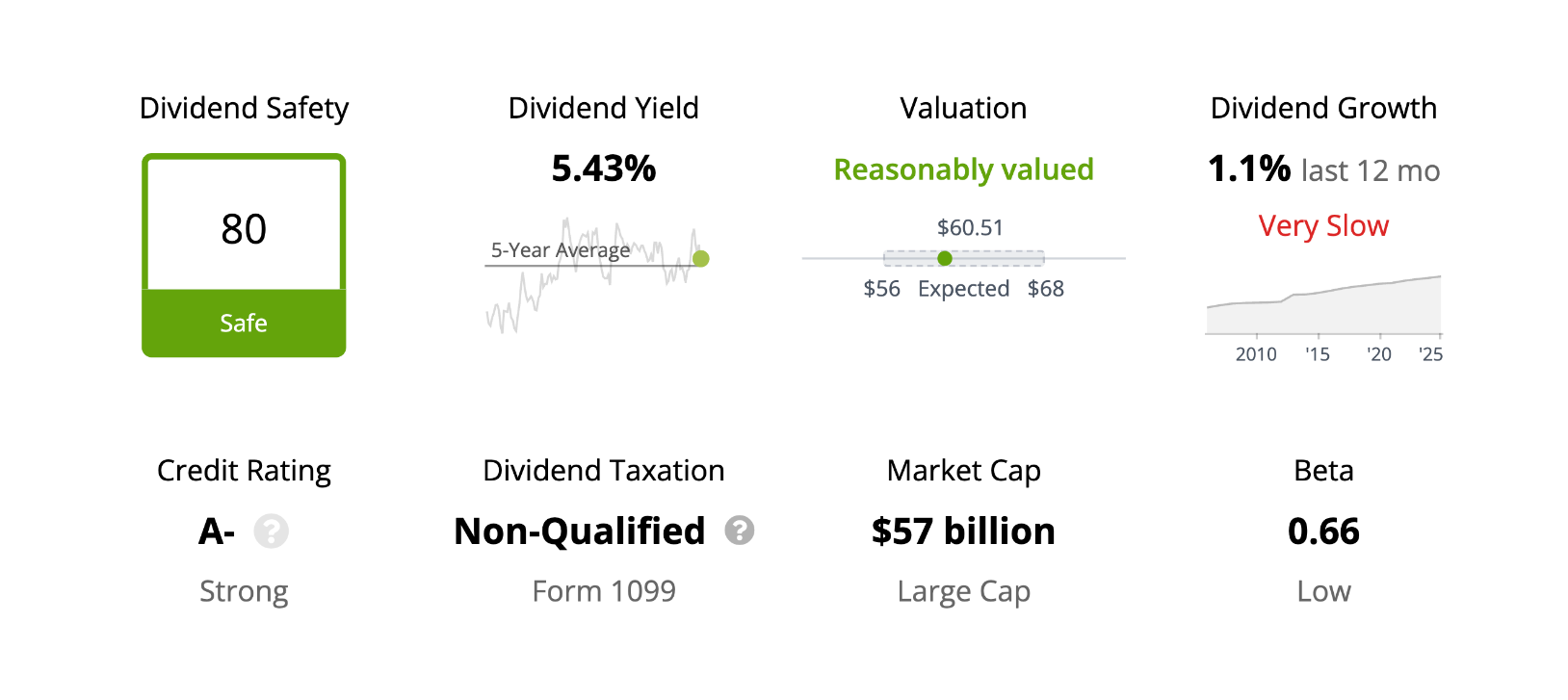
Realty Income's dividend looks safe. We rate it Safe, which means a cut is unlikely because the REIT pays out about 73% of its cash flow, holds an A- credit rating, and collects rent from more than 15,000 properties leased under long contracts.
Realty Income yields about 5.4% and pays $3.288 per share a year, in monthly installments of $0.274. It has paid a monthly dividend without a reduction for 57 years and has raised it 137 times since listing on the New York Stock Exchange in 1994, including 117 quarters in a row.
However, the company's share price isn't as stable. Since its rent is locked in for years, Realty Income trades a lot like a bond, and rising Treasury yields have weighed on the stock this year.
Prefer to watch? Check out our YouTube video Finally Time to Buy REITs? Or a Falling Knife?, where we looked at why Realty Income and other steady net-lease REITs fell the hardest in this fall's REIT selloff.
Here is Realty Income's dividend profile on our site as of November 27, 2026.
Why We Rate Realty Income's Dividend Safe
Realty Income got its start in 1969 with a single Taco Bell. Today it owns or holds interests in 15,536 properties in the U.S., the U.K. and continental Europe, leased to 1,842 tenants in 96 industries.
Almost all of them are single-tenant buildings under net leases. The tenant pays the property taxes, insurance and maintenance, and Realty Income collects the rent. The average lease has about 8.5 years left to run.
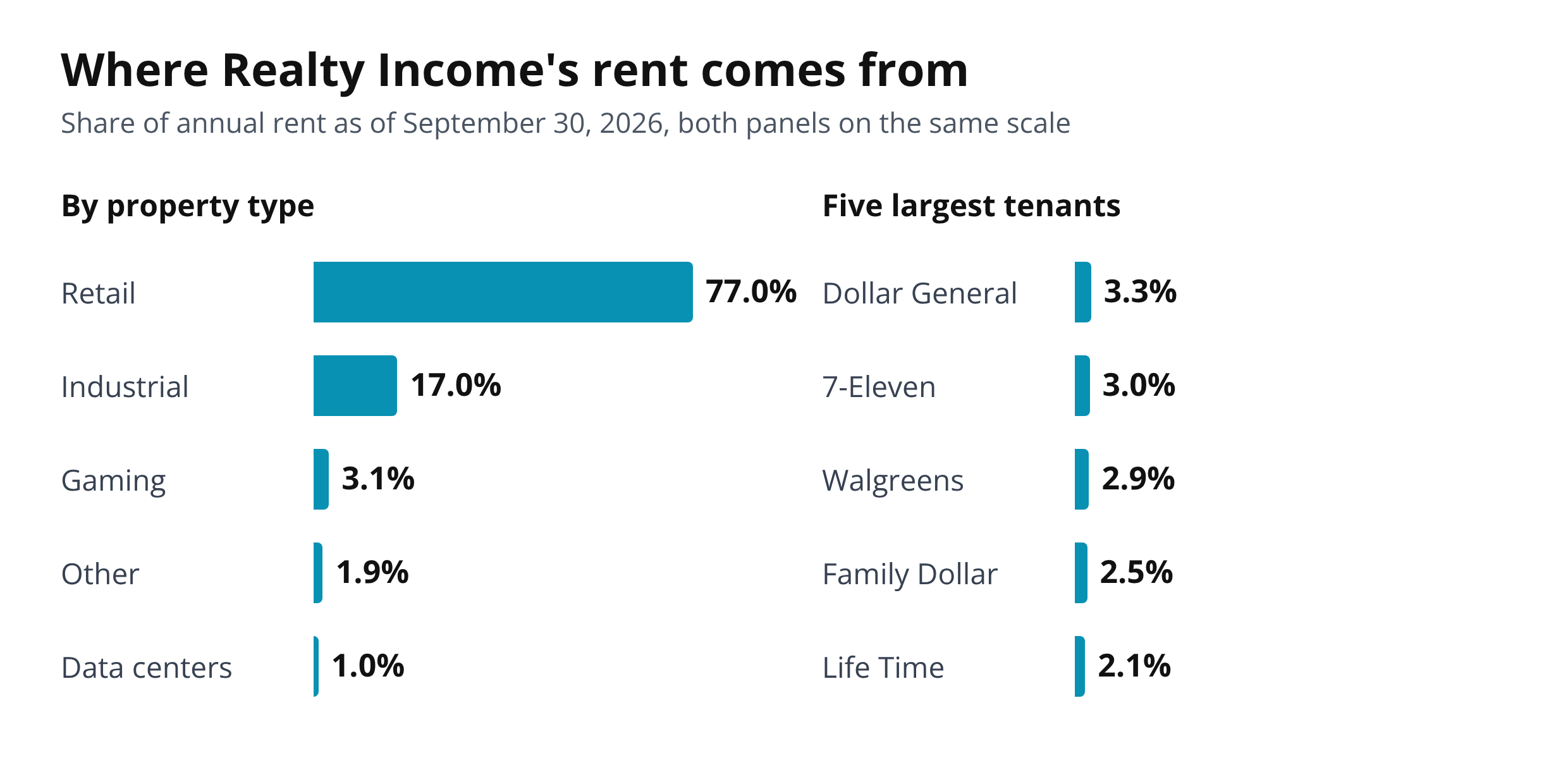
Retail makes up 77% of rent, mostly stores that sell everyday goods or services that are hard to buy online. Industrial buildings add 17%. No single tenant pays more than 3.3% of the rent, and the largest industry, grocery stores, is 10.6%.
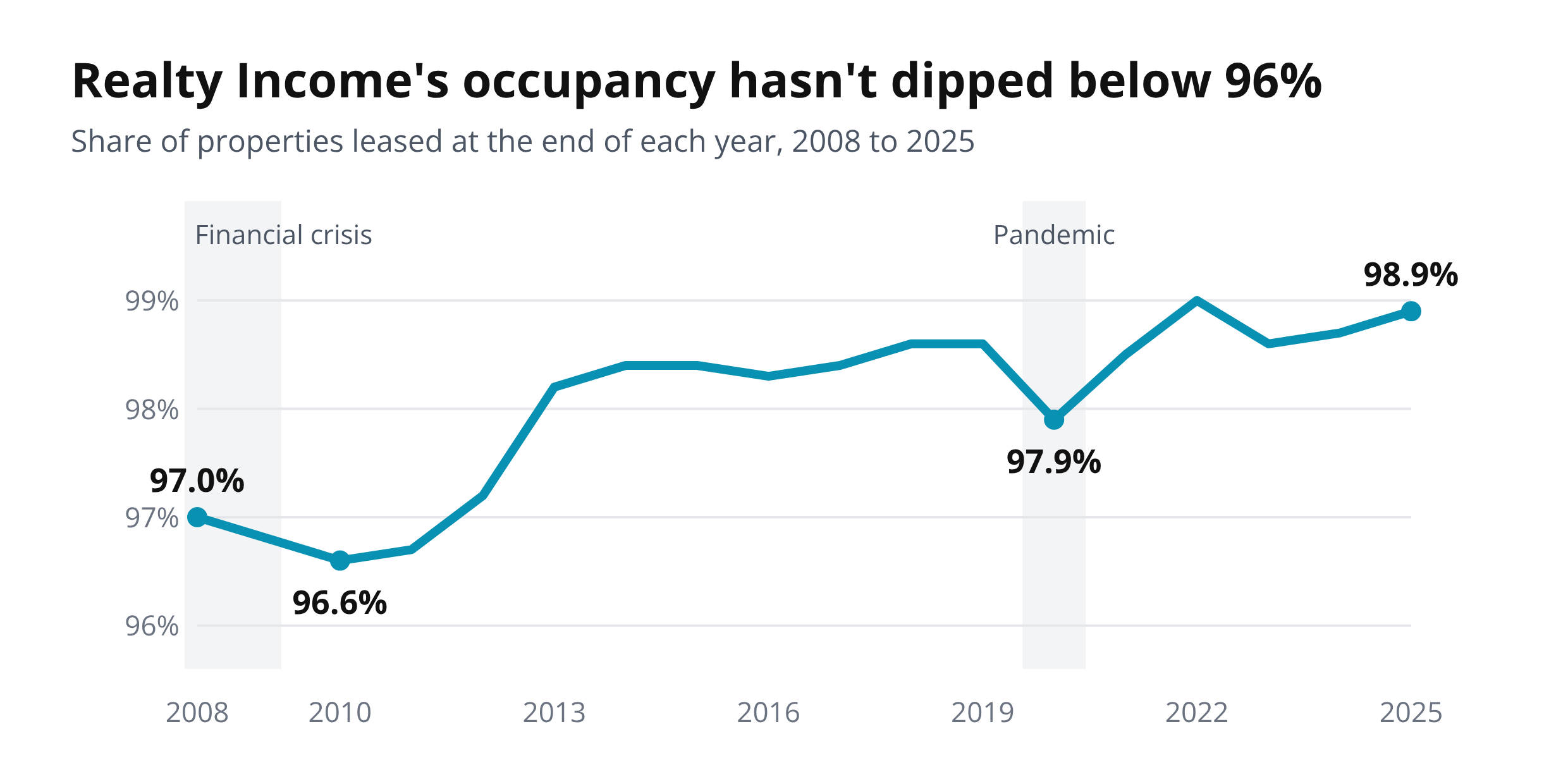
Tenants also tend to stay. Occupancy was 98.8% at the end of September, and Realty Income hasn't ended a year below 96% since 1970. It bottomed at 96.6% at the end of 2010, after the financial crisis, and held at 97.9% through the pandemic.
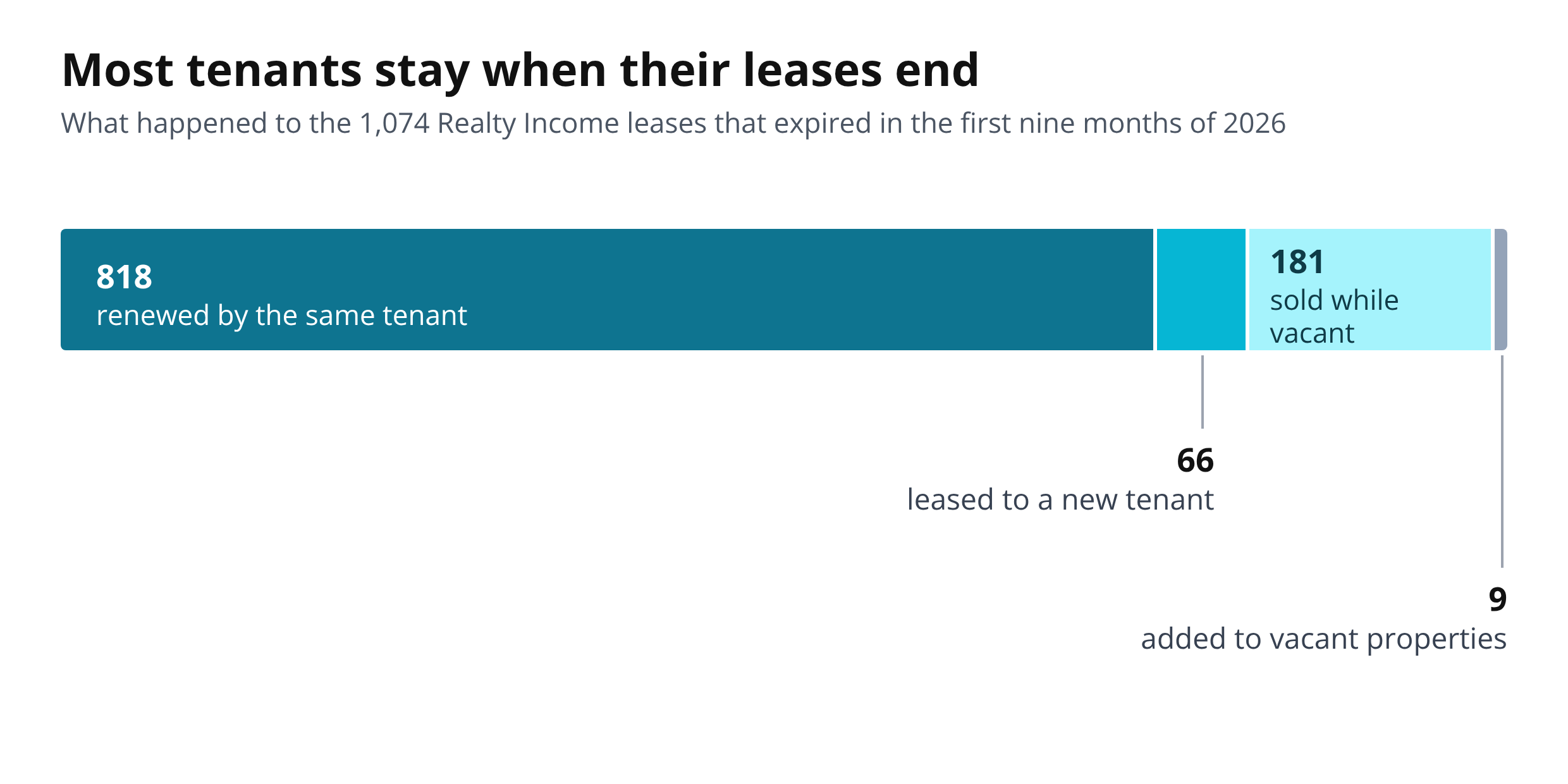
Lease renewals do most of the work to keep the property portfolio full and stable. Of the 1,074 leases that expired in the first nine months of 2026, 818 were renewed by the same tenant. In retail especially, it can be costly to change locations and keep your customer base, adding some stickiness to Realty's properties.
When space was re-leased in the third quarter, the new rent came in about 4% above the old rent. Many retailers would rather pay a little more than move a store their customers already know.
Of the 93 real estate companies we rate, 29 earn a Safe Dividend Safety Score or better. Realty Income is one of them, and one of only five with a dividend growth streak of 30 years or more.
Realty Income's Payout Ratio
REITs are best judged on adjusted funds from operations, or AFFO, a measure of the cash a landlord earns after routine property spending. We explain it in our guide to AFFO and FFO.
Realty Income paid out 73% of its AFFO over the last 12 months, down from 83% as recently as 2020. Cash flow per share has grown faster than the dividend, so the company keeps more of each dollar to buy new properties.
On November 2, management raised its 2026 forecast for AFFO to $4.45 to $4.46 per share. Against the new $3.288 annual dividend rate, that leaves about $1.17 per share of cushion.
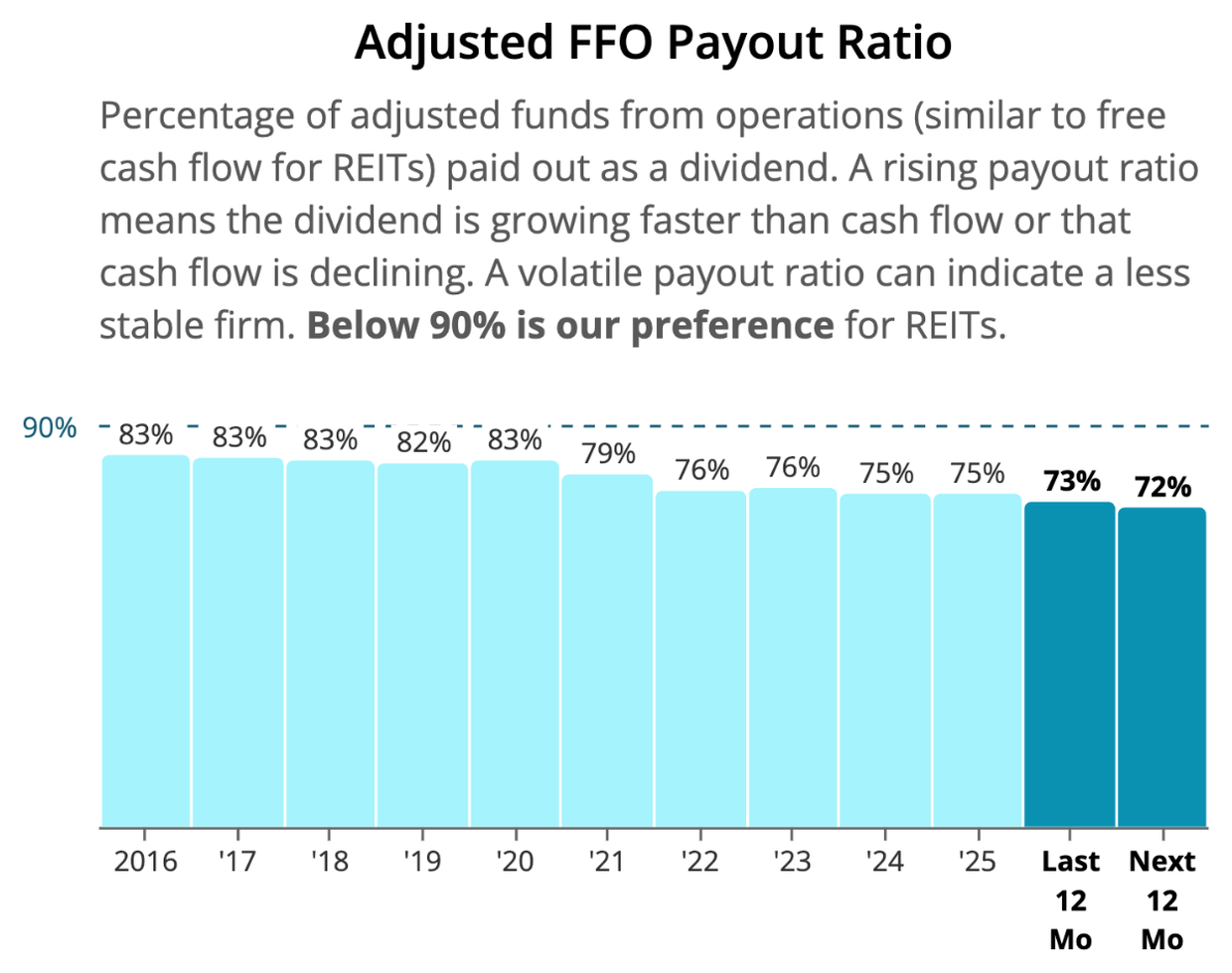
REITs must pay out most of their taxable income, so they keep little cash. A payout in the low 70s gives Realty Income room to absorb a weak year or higher interest costs without touching the dividend.
Realty Income's Debt
Realty Income's net debt is about 5.7 times EBITDA over the past year, and we expect it to ease to about 5.3 over the next 12 months. That is a moderate level for a landlord whose rent is locked in for years, and S&P rates its debt A-, a strong rating for a REIT.
The jump in 2021 came from the VEREIT merger, which closed late that year and added debt before a full year of VEREIT's rent showed up in the results.
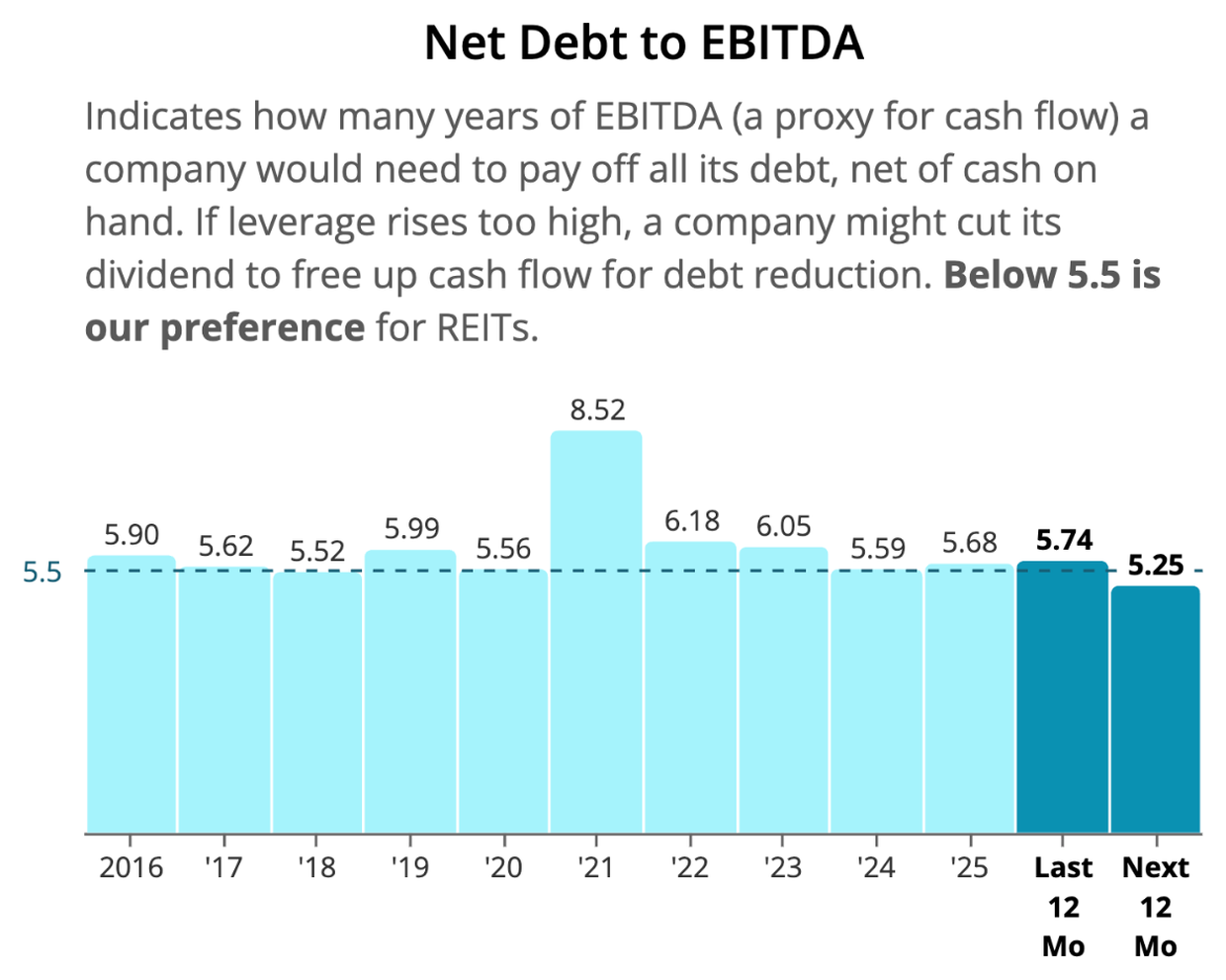
The debt is also well spread out. Realty Income owed $31.7 billion at the end of September, at an average interest rate of 3.9% and an average of 5.1 years to maturity. About 93% of it carries a fixed rate, so higher rates raise its borrowing costs only gradually as old debt is refinanced.
Realty Income's Dividend History
Realty Income calls itself The Monthly Dividend Company, and it has earned the name. It has paid monthly dividends without a reduction for 57 years and has raised the payout every year since its 1994 listing, which puts it among the S&P 500 Dividend Aristocrats.
The record held through the 2007-09 recession, when Realty Income kept raising its dividend while its shares fell 43%, less than the S&P 500's 55% drop.
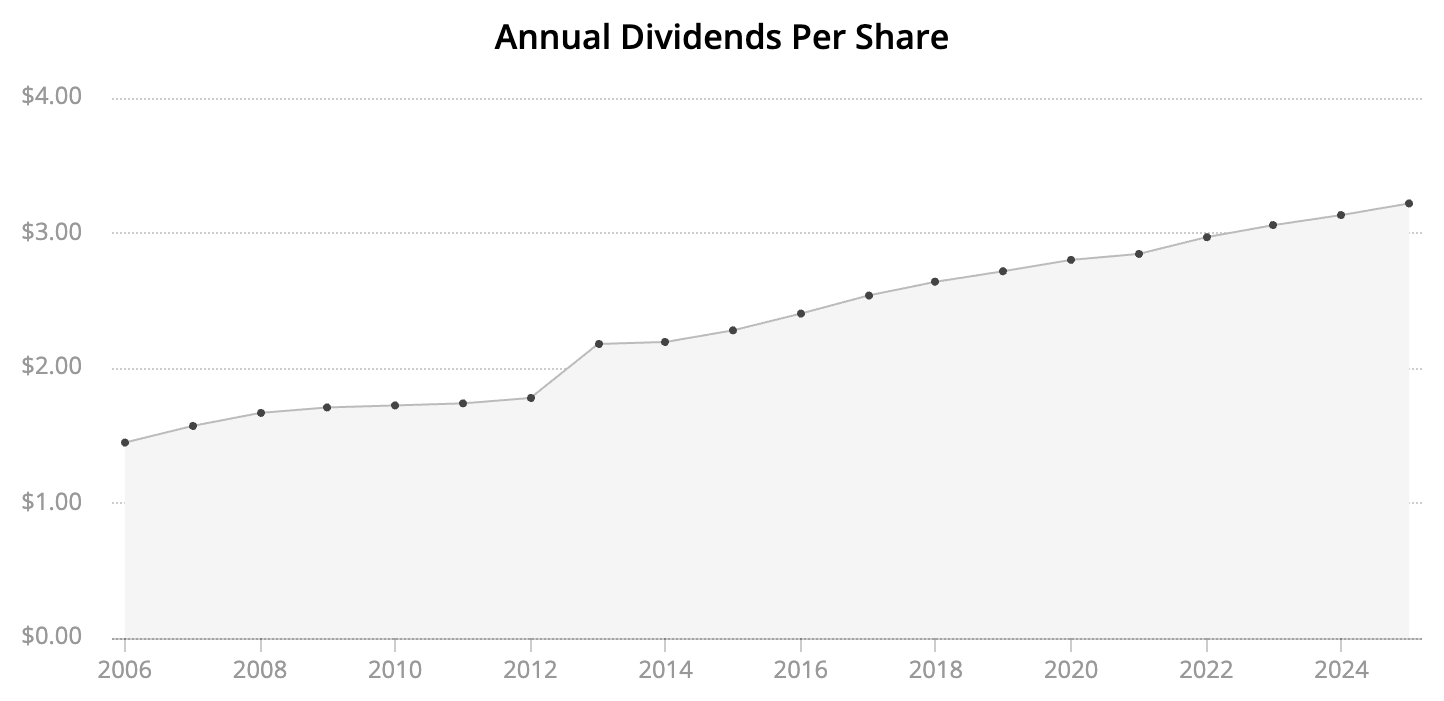
Growth has slowed, though. Realty Income raises its dividend in small steps several times a year, and over the past 12 months those steps added up to 1.1%, against 3.5% a year over the last decade. With 15,536 properties, it takes a lot of new buying to move cash flow per share.
What Could Threaten Realty Income's Dividend
Practically speaking, it's hard to point to any single factor that could threaten Realty Income's dividend. The pandemic was arguably the REIT's biggest test ever, and it maintained its payout throughout even as some of its peers cut or suspended theirs.
However, the company can still face other challenges that slow its dividend growth, including:
Higher bond yields. Long leases with small built-in rent increases make Realty Income's income look a lot like a bond's. When Treasury yields rise, investors demand a higher yield from the stock, so the price falls. In our October 2026 study of the REIT selloff, the REITs with the longest leases fell the hardest.
Higher rates also slow growth because Realty Income buys properties with borrowed money and new shares, which only adds value while the rent beats the cost of that money. See our guide to how higher interest rates impact REITs.
For now that spread is holding. In the third quarter, Realty Income invested $2.6 billion at an initial cash yield of 6.8%, and management estimated it earned about 1.7 percentage points more than its cost of funding. It is also bringing in outside partners to help fund deals, so it can grow without issuing as many new shares.
Store closures. Several of Realty Income's largest tenants, including Dollar General (3.3% of rent), 7-Eleven (3.0%) and Walgreens (2.9%), have announced store closures in recent years. Each closure can mean a vacant building to re-lease or sell. With no tenant above 3.3% and high renewal rates, these closures have so far been small enough to absorb.
Casino exposure. Realty Income's two gaming properties, the Encore Boston Harbor resort and a stake in the Bellagio in Las Vegas, bring in 3.1% of rent. Casinos are among the first businesses to suffer in a recession. But the tenants, not Realty Income, run the properties and bear that swing, and the share is small.
Is Realty Income Stock Cheap at Today's Yield?
Measured against Treasuries, not really. Realty Income yields 5.4% today, and the 10-year Treasury yielded 4.9% on November 25, according to the Treasury Department. That leaves investors only about 0.6 percentage points of extra yield for owning a company with tenants and debt.
Since 2001, that premium has averaged a little over two percentage points. It was already near its thinnest in early October, when we wrote our latest note, and it has narrowed further since because Realty Income's share price has recovered faster than Treasury yields have fallen.
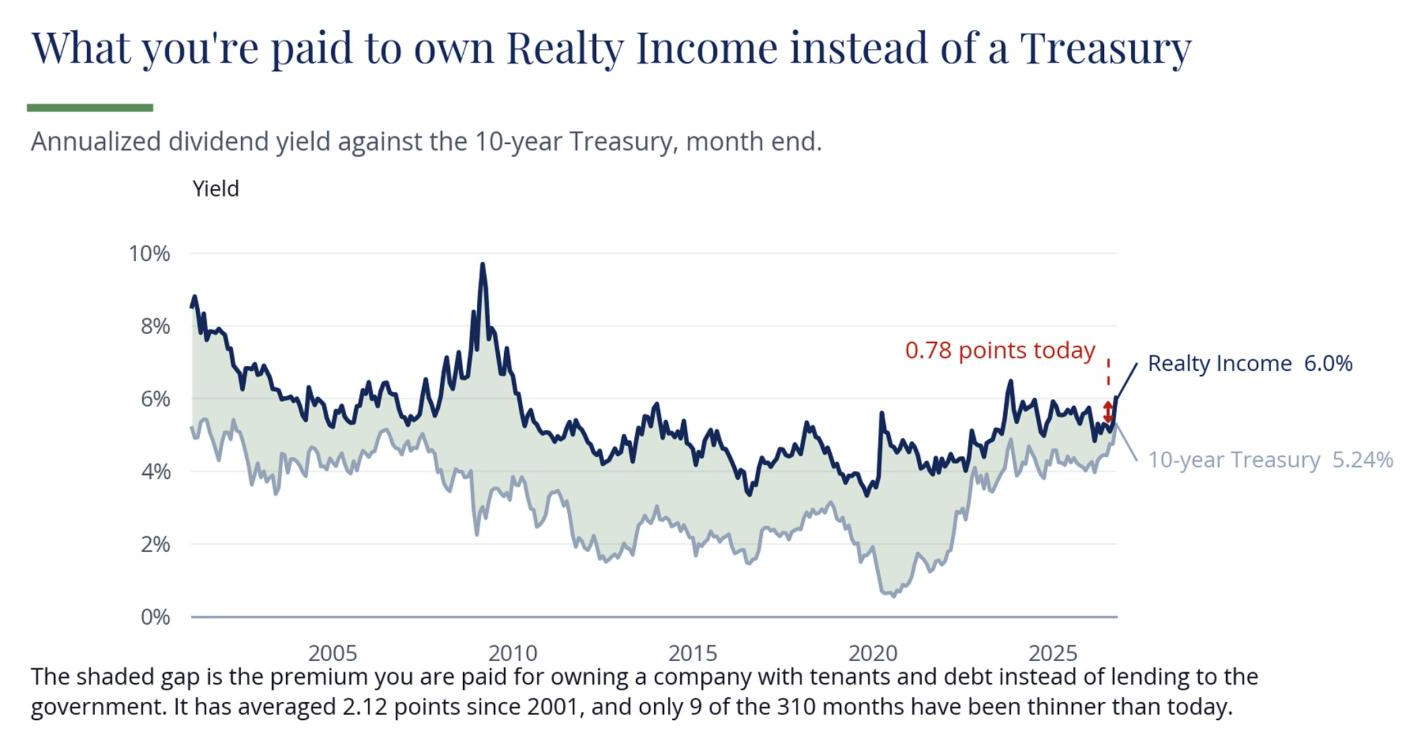
A thin premium doesn't mean the stock has to fall. It means today's yield is less of a bargain than it looks if bond yields stay where they are, and that the shares could get a lift if Treasury yields come down.
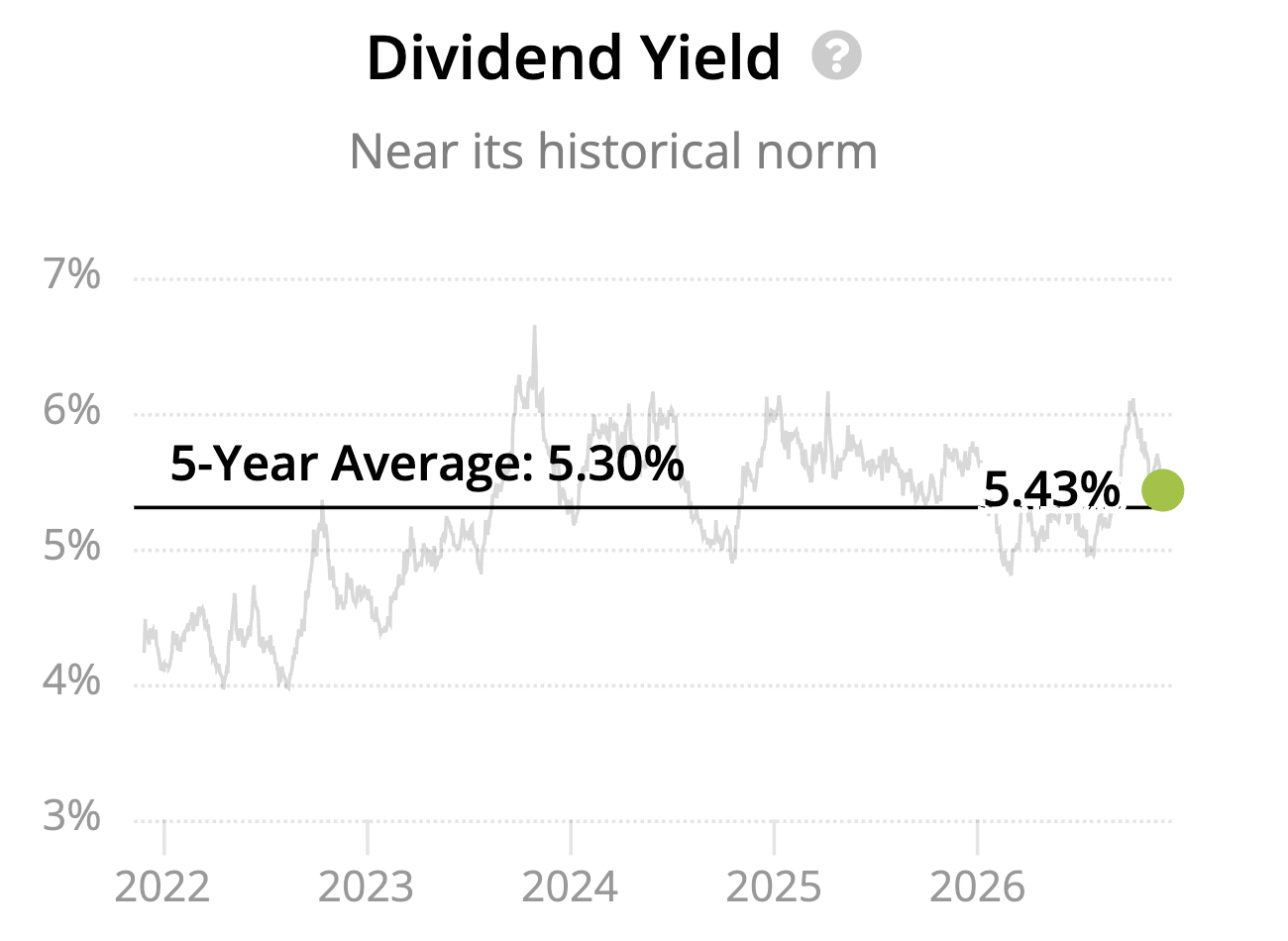
Against its own history, Realty Income looks fairly priced. Its 5.4% yield sits a little above its five-year average of 5.3%, which suggests the stock trades near a normal valuation, an idea we explain in our guide to dividend yield theory.
Frequently Asked Questions
Is Realty Income's dividend safe?
Yes, in our view. We give Realty Income a Safe Dividend Safety Score of 80. It pays out about 73% of its AFFO, holds an A- credit rating, and has kept occupancy at 96% or higher through every downturn.
How much is Realty Income's dividend?
Realty Income pays $0.274 per share each month, or $3.288 a year, after its November 2026 raise. At $60.51 on November 27, that is a yield of about 5.4%.
When does Realty Income pay its dividend?
Every month, usually in the middle of the month. The December payment of $0.274, the first at the new rate, goes to shareholders of record on November 30 and is paid on December 15.
Has Realty Income ever cut its dividend?
No. Realty Income has paid monthly dividends without a reduction for 57 years and has raised the payout 137 times since its 1994 listing, including through the 2007-09 recession and the pandemic.
Why has Realty Income stock fallen?
Mostly because of interest rates. Its long, fixed leases make it trade like a bond, so its price tends to fall when Treasury yields rise, even when the business is doing well.
Looking for more monthly income? See our list of monthly dividend stocks, ranked by Dividend Safety Score. Since 2015, 929 of the 950 dividend cuts in our track record came from companies we rated 60 or below beforehand.
To see the Dividend Safety Score of every stock you own, take a look at our demo.
We update this page each quarter after Realty Income reports earnings, and whenever our Dividend Safety Score changes.