Are Verizon (VZ) and AT&T (T) Dividends Safe From SpaceX?
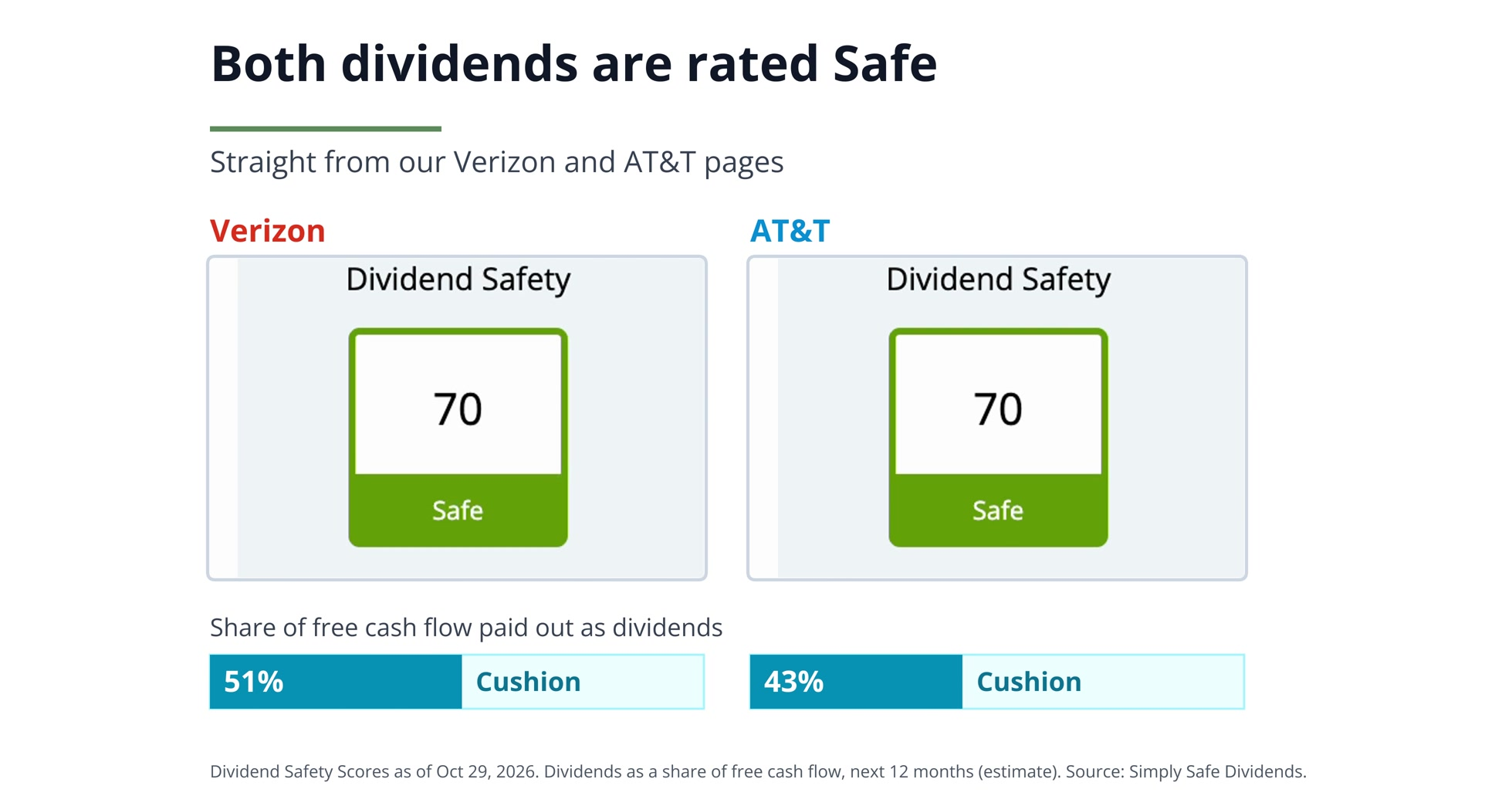
Verizon's and AT&T's dividends look safe for now, even as SpaceX gets ready to compete with them in the cell phone business. Both companies earn Safe Dividend Safety Scores from us, which signal a low risk of a cut over a full economic cycle.
Both also have plenty of cash to cover their payouts. Over the next 12 months, we estimate Verizon will pay out about 51% of its free cash flow as dividends and AT&T about 43%. The bigger risk is next year's government auction of airwaves, which could push both companies to borrow heavily before SpaceX has signed up many customers.
Prefer to watch? Check out our YouTube video, SpaceX Is Coming for Verizon and AT&T. What It Means for the Dividends, where I walk through both companies on Simply Safe Dividends.
Prices, yields and Dividend Safety Scores are as of the October 29, 2026 close.
I own shares of Verizon (VZ) and AT&T (T).
What SpaceX Is Planning in Wireless
SpaceX has agreed to spend about $28 billion on airwaves, the radio frequencies that carry calls and data between your phone and a cell tower. It is also reportedly in talks to put its equipment on more than 80,000 cell towers, roughly as many as Verizon or AT&T each use today.
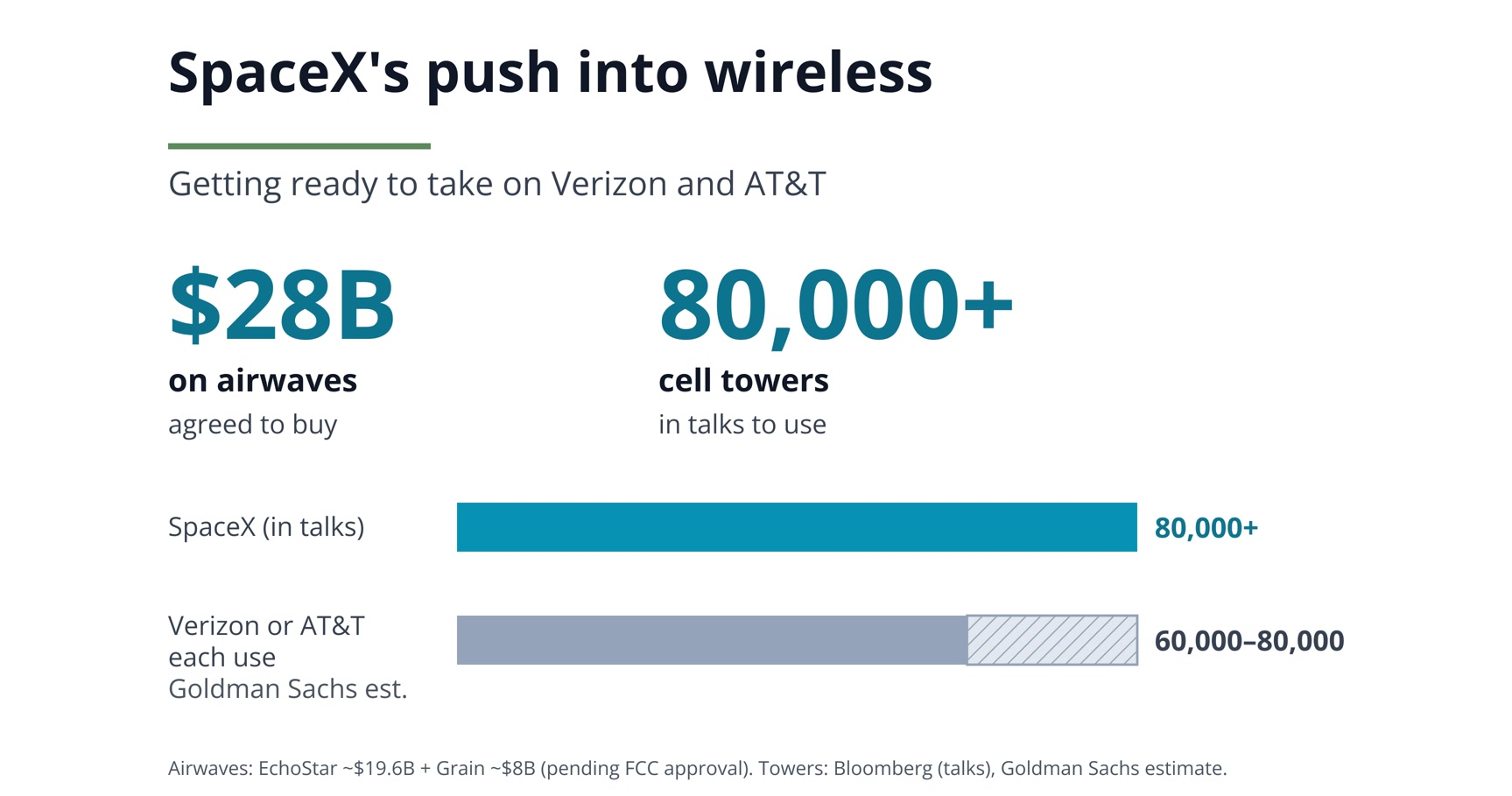
Its Starlink satellites give it a head start in rural areas where cell service is spotty. But satellites can't handle the heavy phone traffic in big cities, so SpaceX would still need a large network on the ground, built on towers owned by companies like Crown Castle. Those talks have not produced a deal yet.
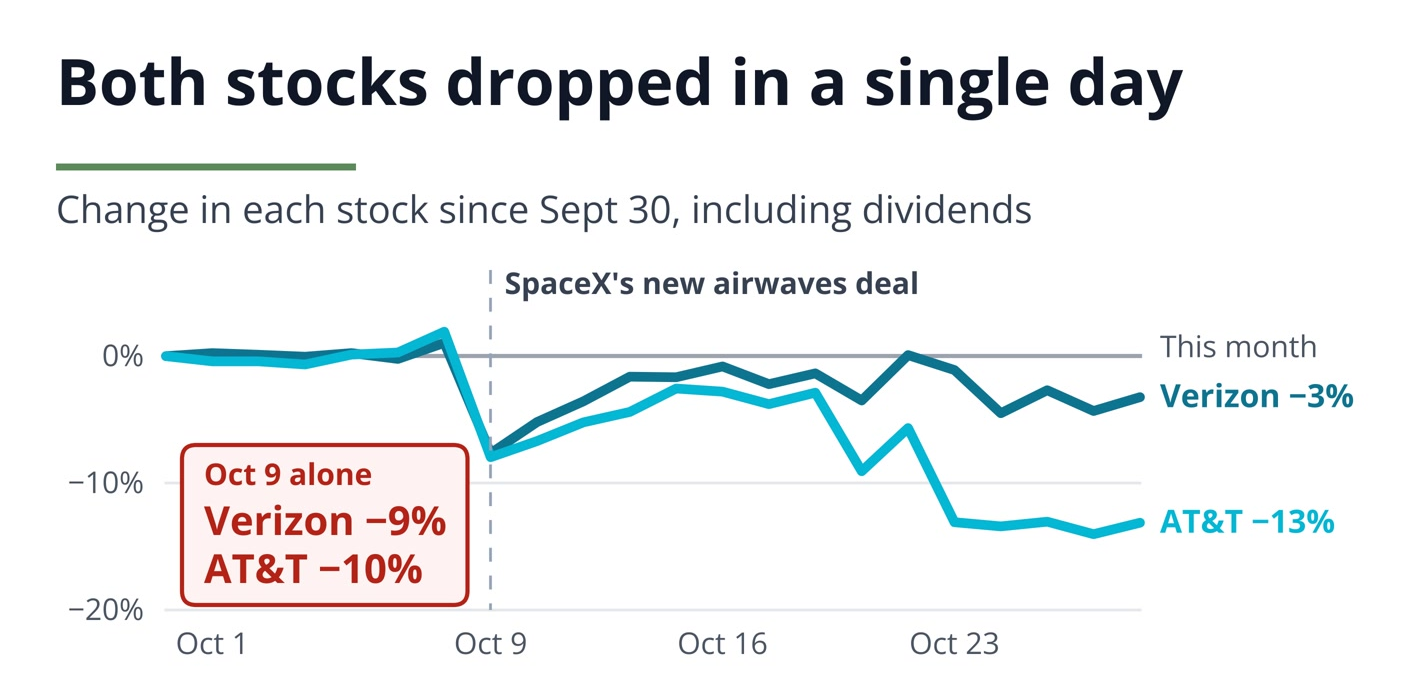
Investors reacted quickly anyway. Verizon fell 9% and AT&T fell 10% on October 9, the day SpaceX's latest airwaves deal hit the news. Including dividends, AT&T was still down 13% for the month through October 29, and Verizon was down 3%.
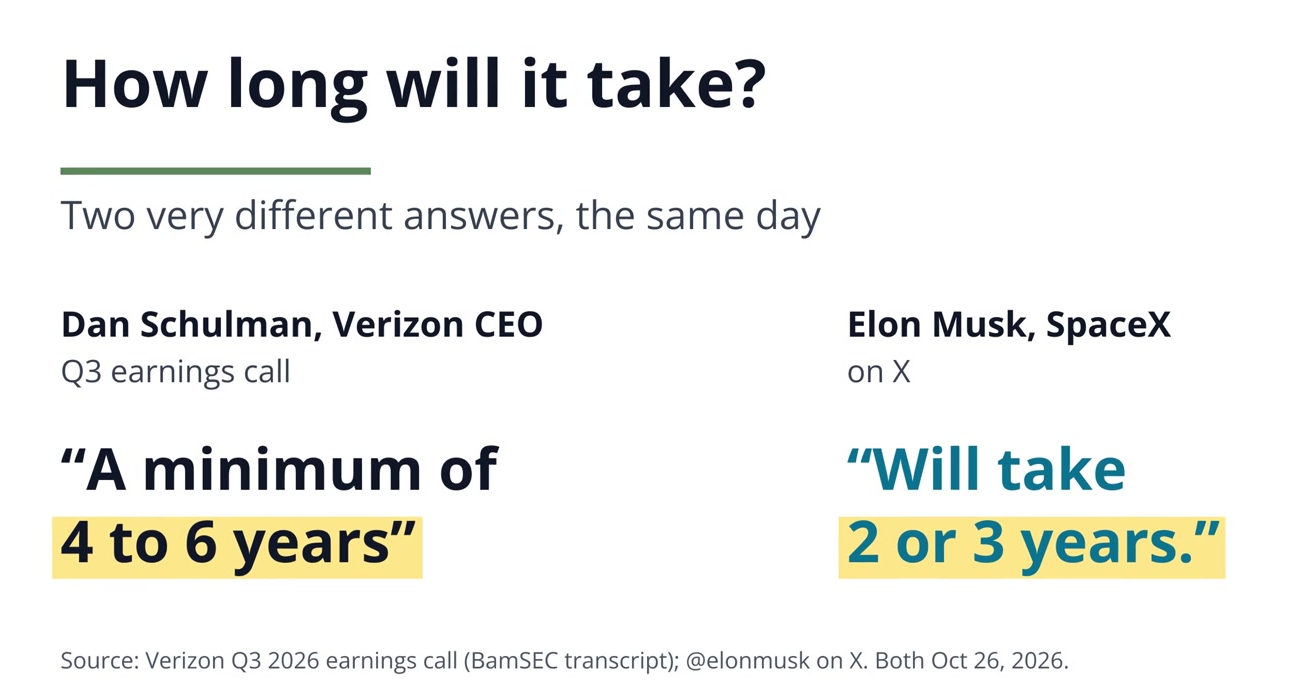
How long SpaceX needs is an open question. On Verizon's October 26 earnings call, CEO Dan Schulman said building a competitive network would take at least four to six years. Elon Musk replied on X the same day that it will take two or three.
I wouldn't take either number at face value. Even if Musk is right, SpaceX is still a few years from being a serious competitor. What worries me more is that it could put pressure on Verizon's and AT&T's finances well before then.
How SpaceX Could Squeeze the Dividends
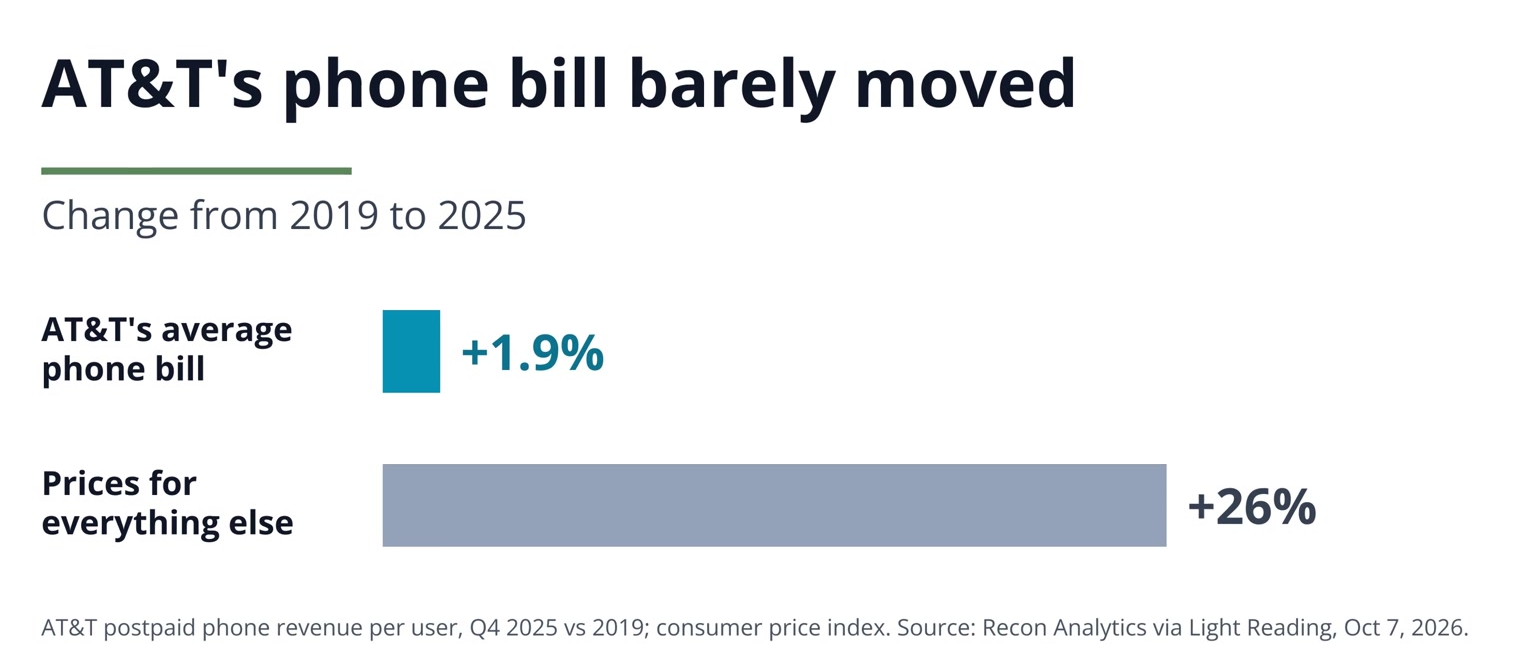
The phone business is already expensive, and raising prices is hard. Verizon and AT&T spend billions of dollars a year keeping their networks current, and their service has become similar enough that neither can push prices up much without losing customers. AT&T's average phone bill rose just 1.9% from 2019 to 2025, while consumer prices rose 26%.
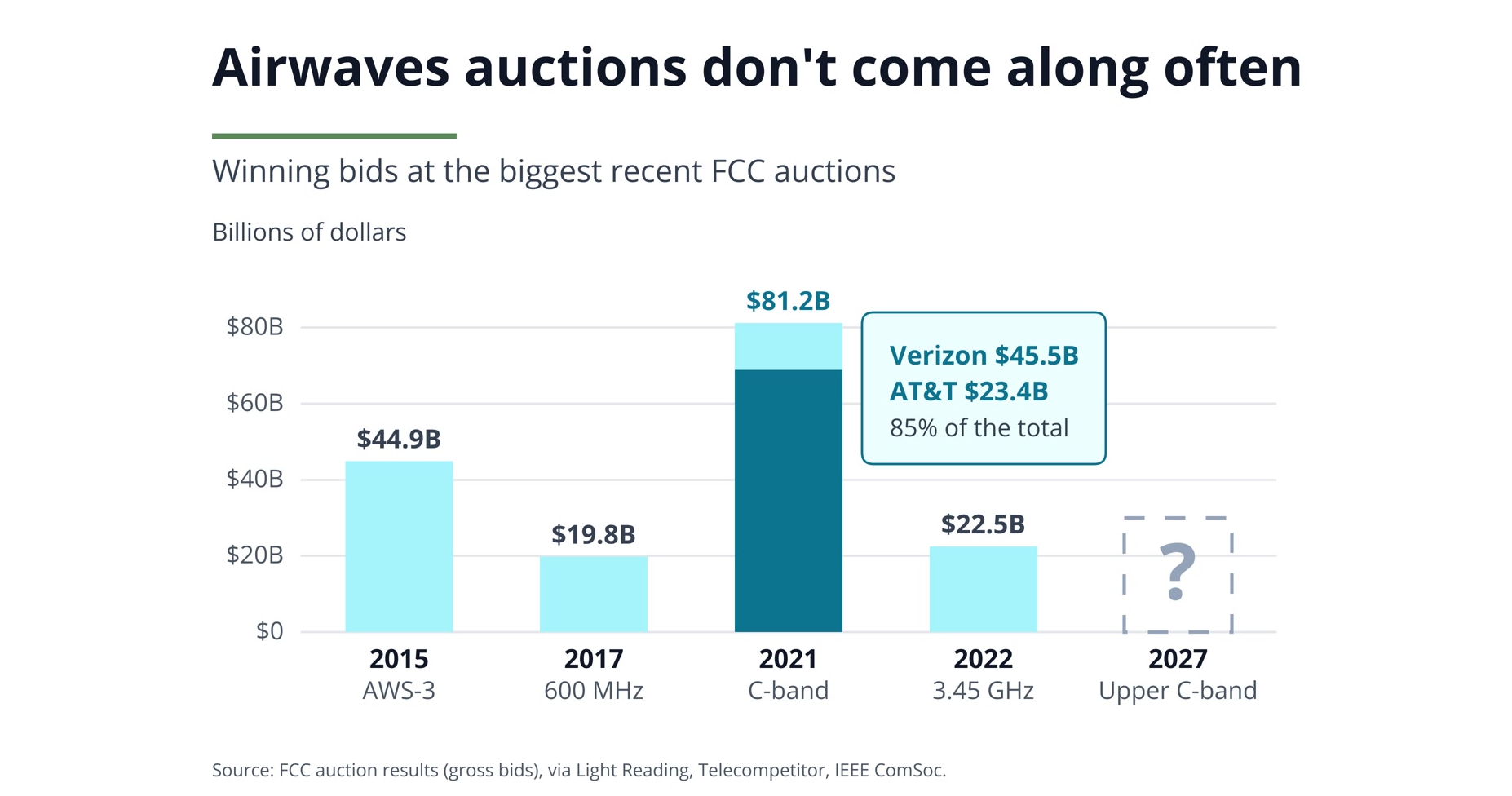
The next big expense could arrive in 2027, when the Federal Communications Commission plans to auction another large block of airwaves. These auctions only come along every few years, and the most useful frequencies are scarce, so bidding can get expensive fast.
In 2021, the C-band auction brought in $81.2 billion, and Verizon and AT&T paid most of it. That came on top of what they were already spending to upgrade their networks for 5G.
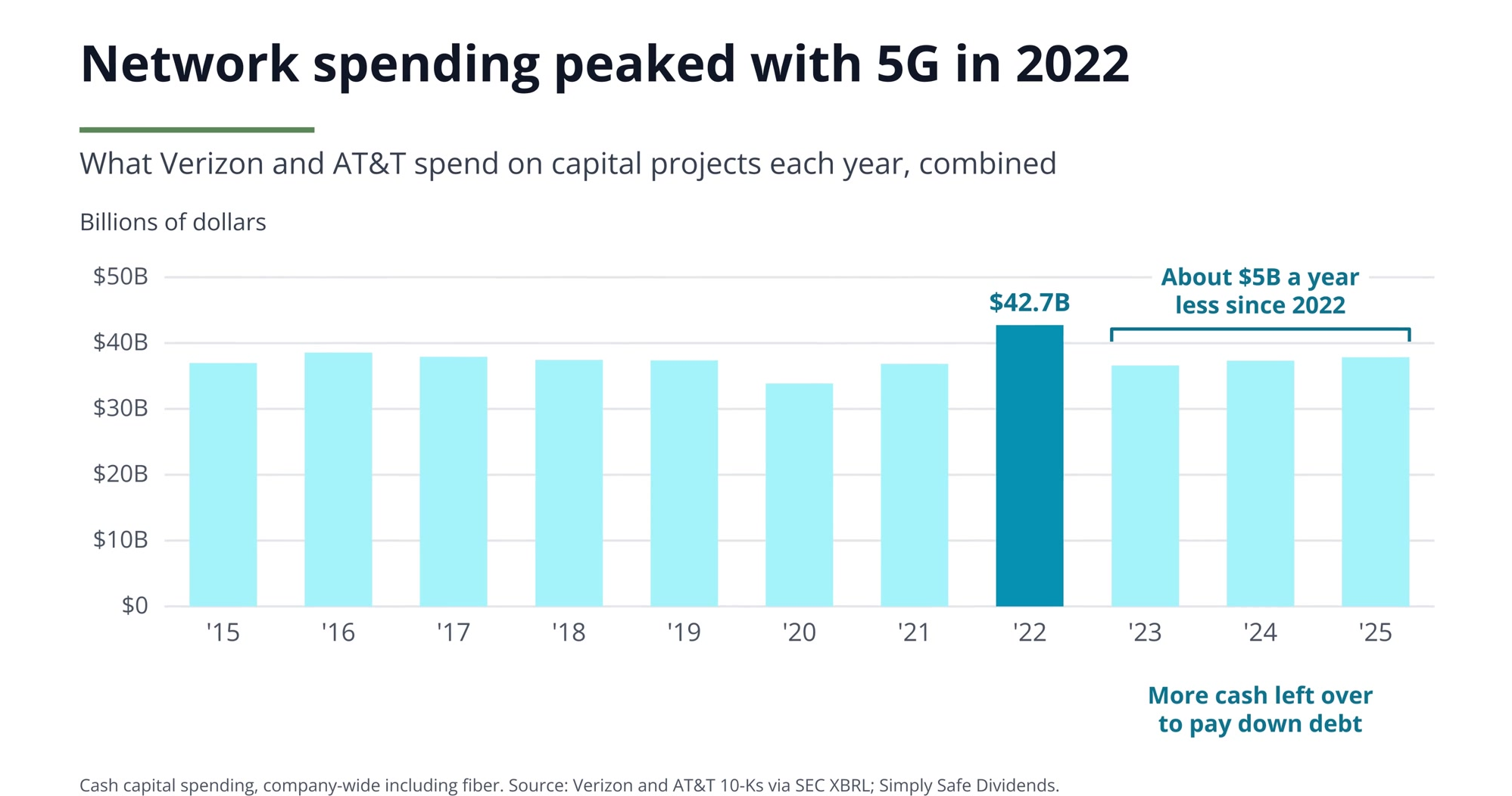
Network spending peaked in 2022. As it has come back down, both companies have had more cash left after paying their dividends to pay down debt.
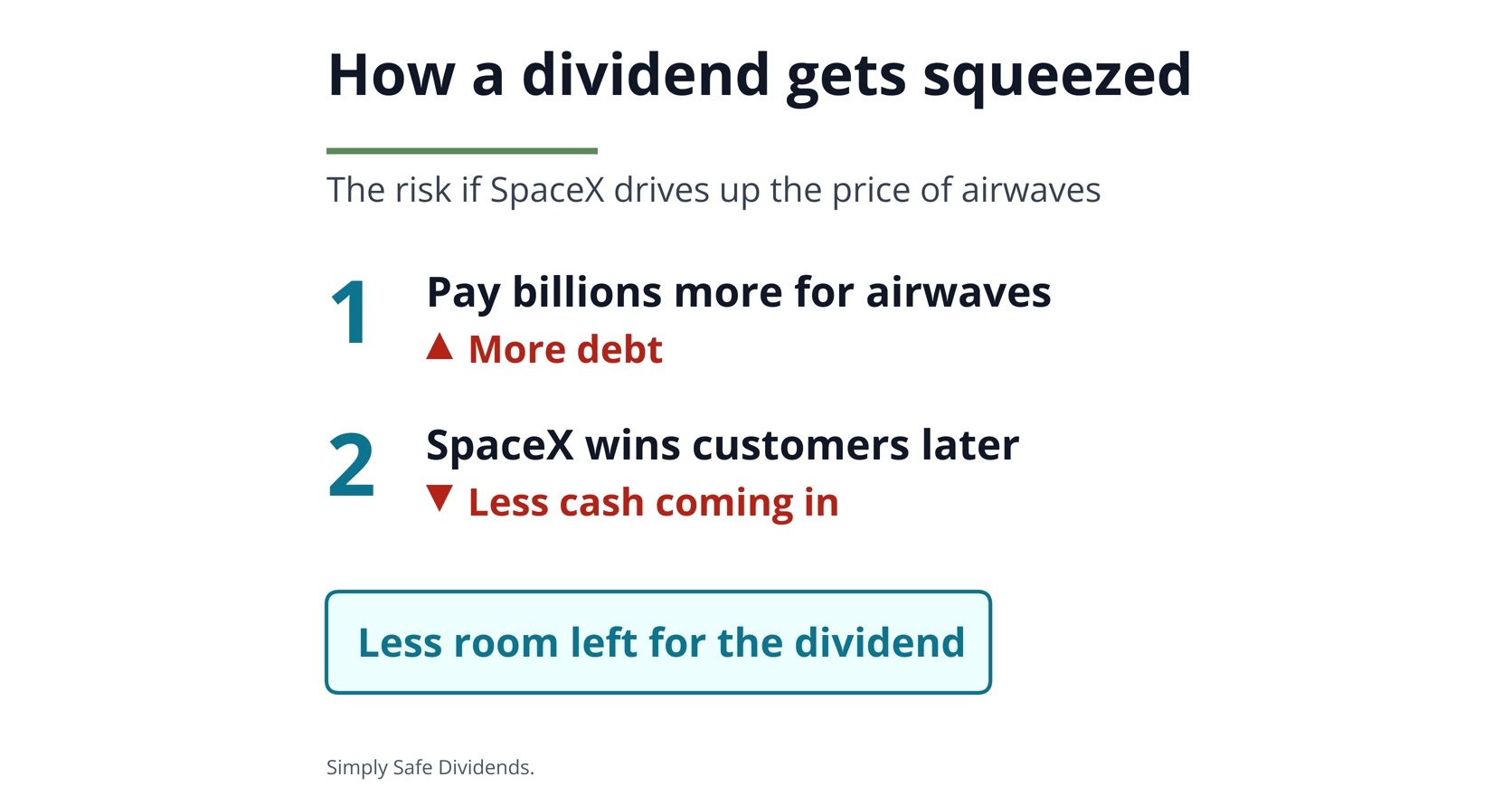
Now imagine SpaceX shows up at next year's auction with a big checkbook. Verizon and AT&T might feel pressure to spend billions more just to keep those airwaves away from a new rival, taking on more debt before SpaceX is a major competitor. If SpaceX then starts winning customers a few years later, they would be bringing in less money while carrying more debt. That is the kind of squeeze that can eventually put a dividend at risk.
Why an Expensive Bidding War Isn't a Given
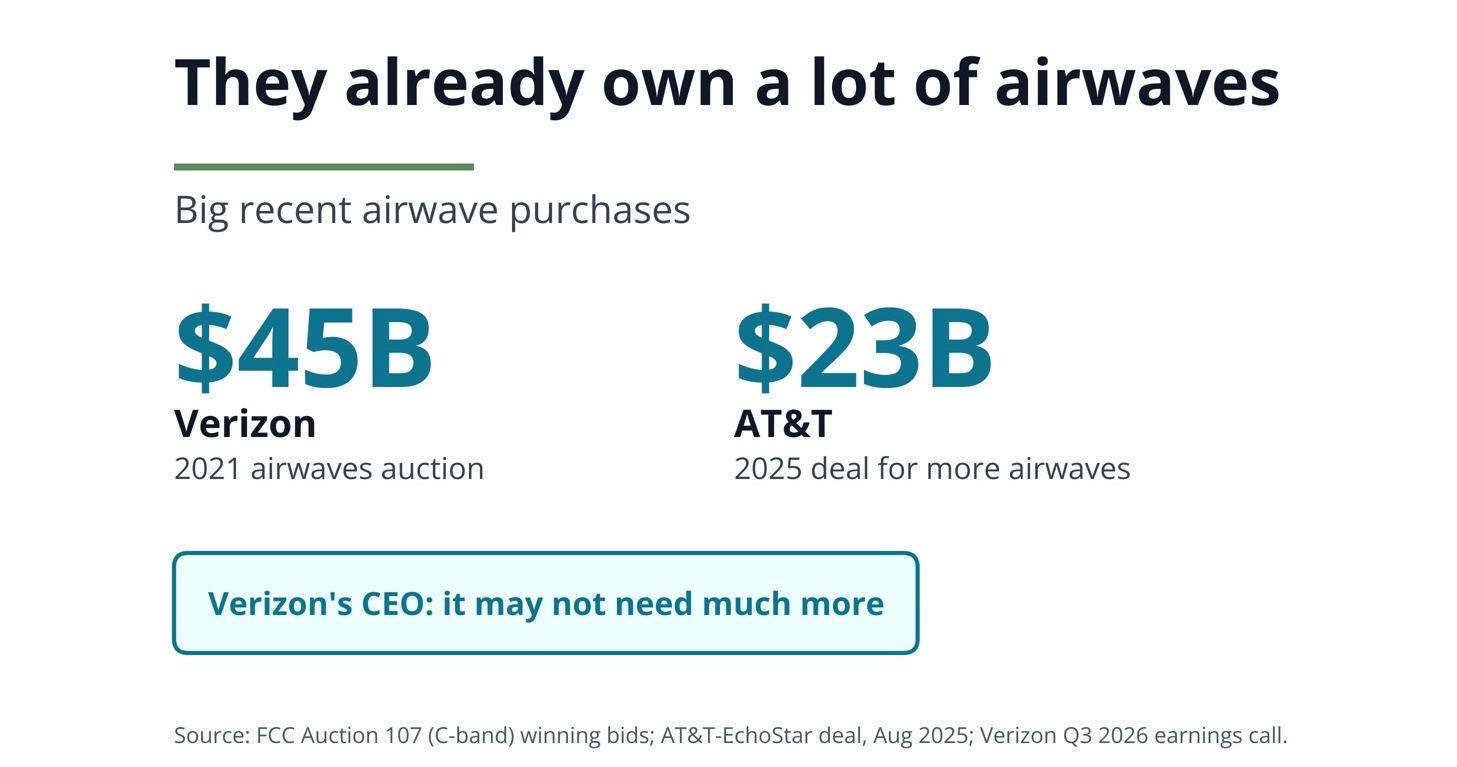
I don't think we should assume it plays out that way. Both companies already own a lot of valuable airwaves. Verizon spent about $45 billion in the 2021 auction, and on its October call its CEO said it may not need to buy much more next year, since it has other ways to get more capacity from the airwaves it already owns. AT&T agreed in 2025 to spend $23 billion on more airwaves, which should give it room to meet demand for years.
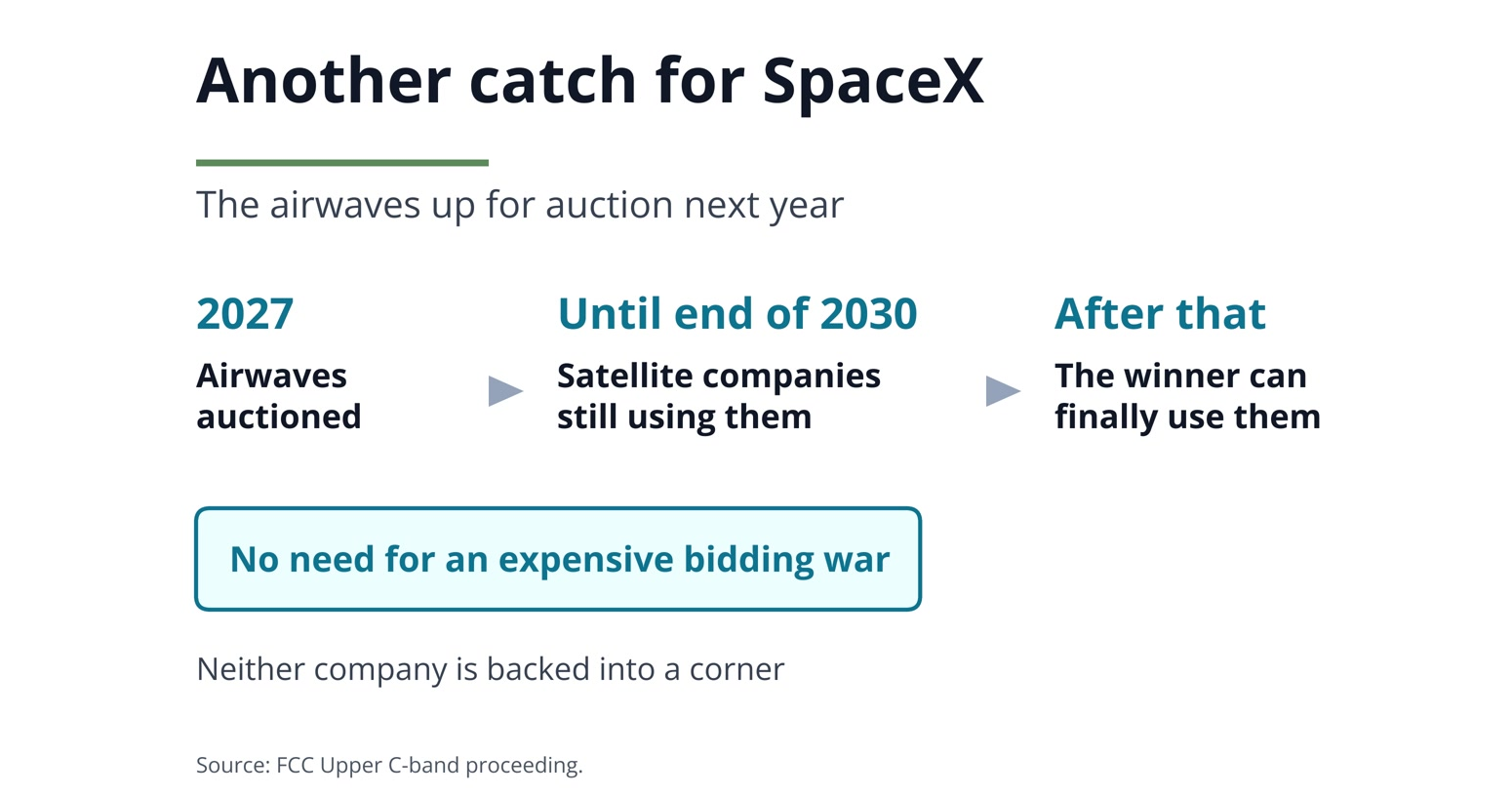
There is another catch for SpaceX. The airwaves going up for auction are used today by satellite companies, which have until the end of 2030 to move off them. Even if SpaceX wins, it could be years before it can put them to work. So Verizon and AT&T can afford to be selective, and I don't think either one is backed into a corner going into the auction.
Competition Was Already Getting Tougher
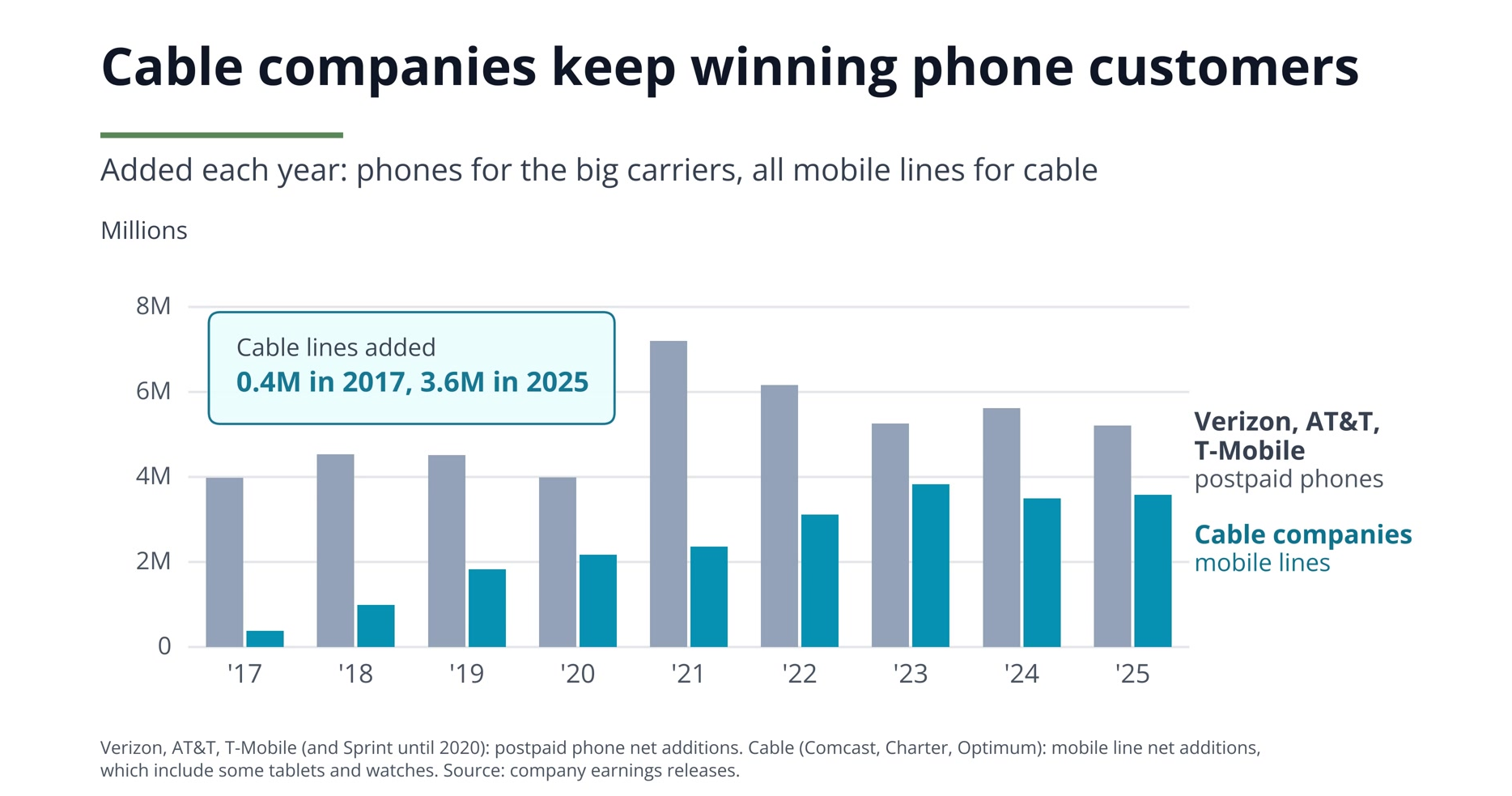
Avoiding a bidding war wouldn't make the longer-term threat go away. Even without SpaceX, cable companies like Comcast and Charter have been winning phone customers by offering cheap plans to people who already buy their home internet. Cable added 3.6 million mobile lines in 2025, up from 0.4 million in 2017.
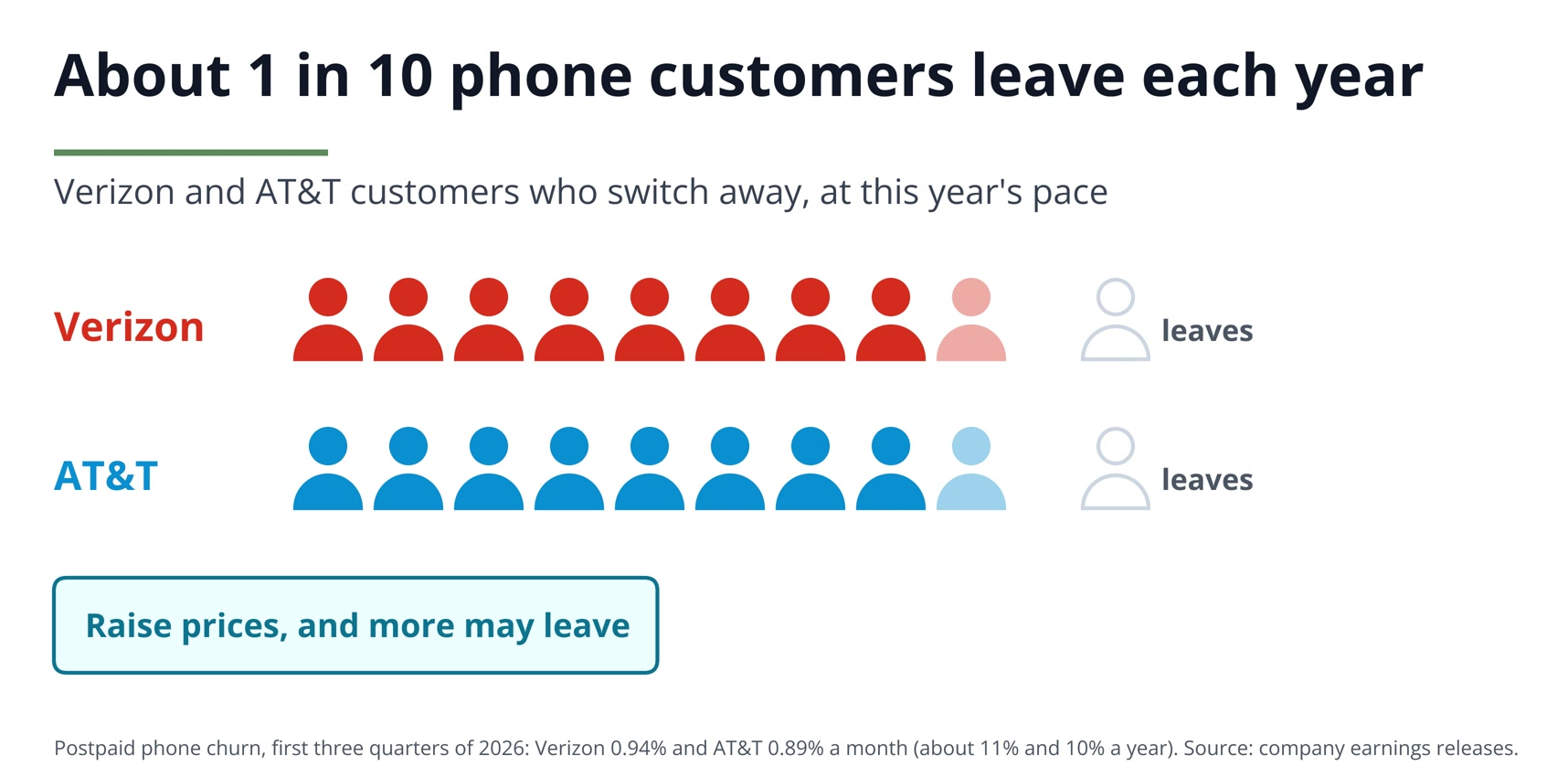
Customers already move around. About 1 in 10 Verizon and AT&T phone customers leave each year, so another attractive offer from SpaceX could make it even harder to raise prices without losing more of them.
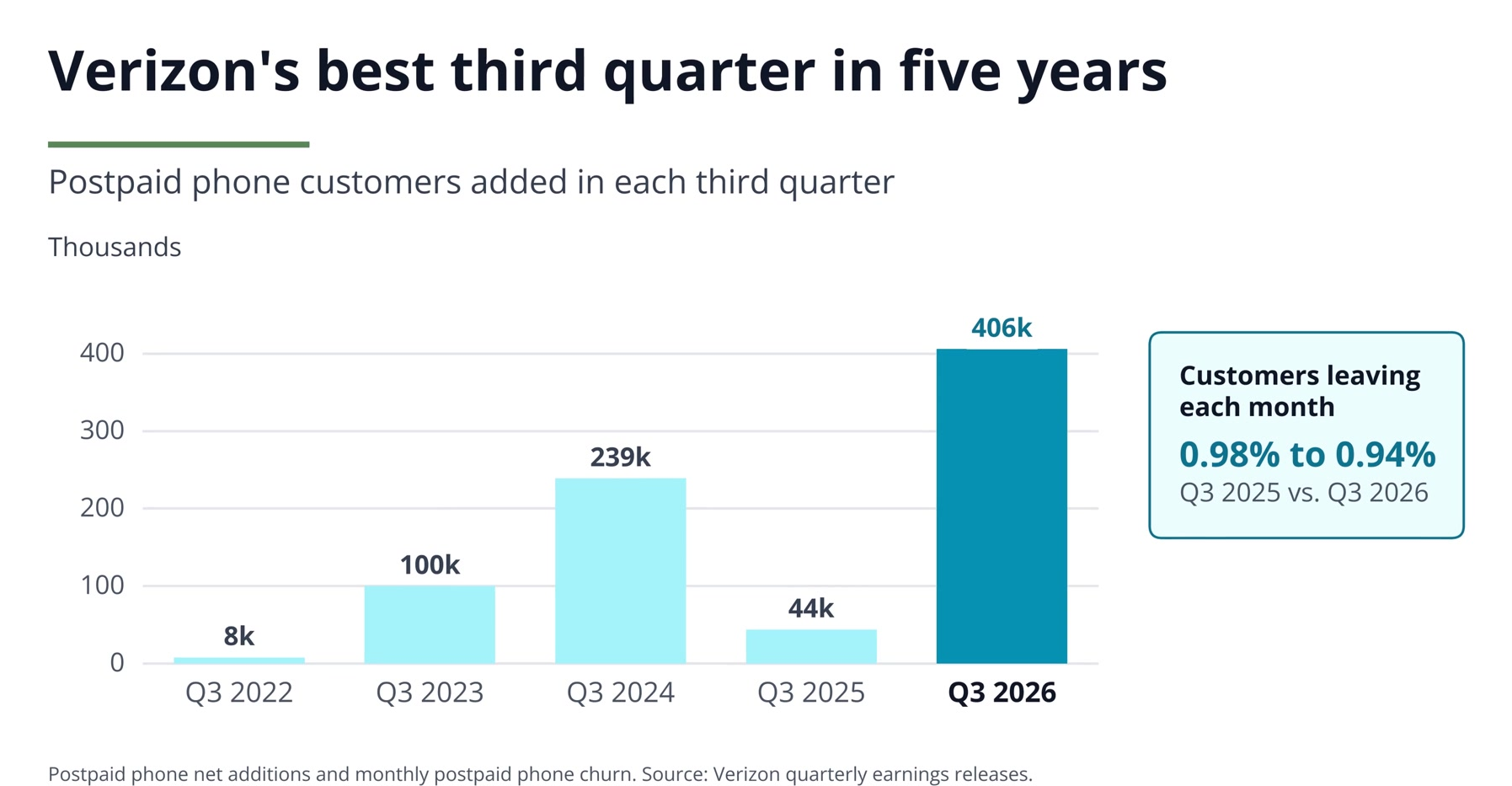
To Verizon's credit, its latest results were solid. It added 406,000 postpaid phone customers in the third quarter, its best third quarter in five years, and fewer customers left. This isn't a business that is suddenly falling apart, but a new competitor could make that momentum harder to keep.
If competition does get tougher, I would expect Verizon and AT&T to spend more defending their businesses, leaving less money to pay down debt and little room to raise their dividends. I think that is a more likely outcome in the next few years than an outright dividend cut.
What Happened to BCE and Telus Dividends in Canada
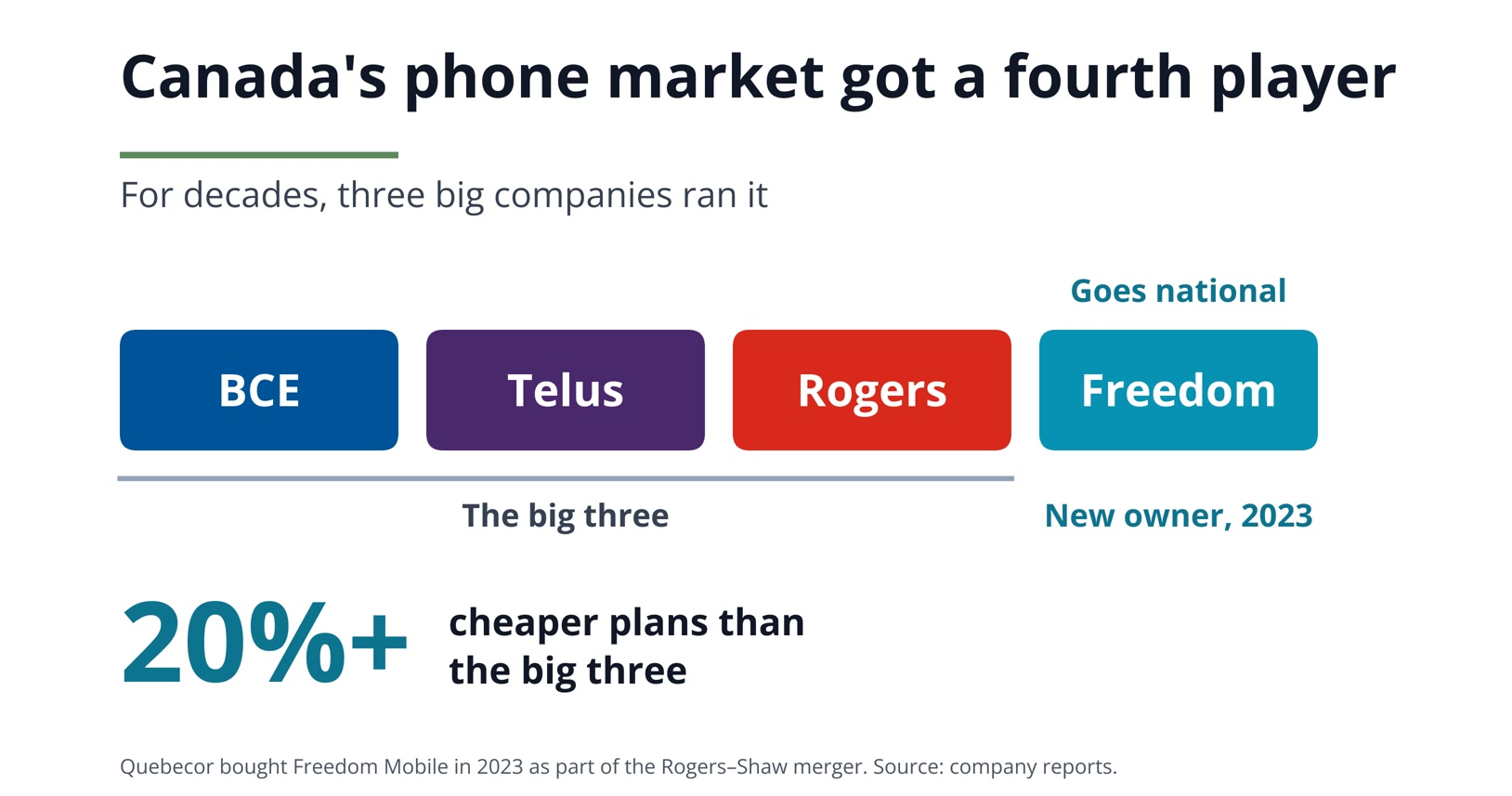
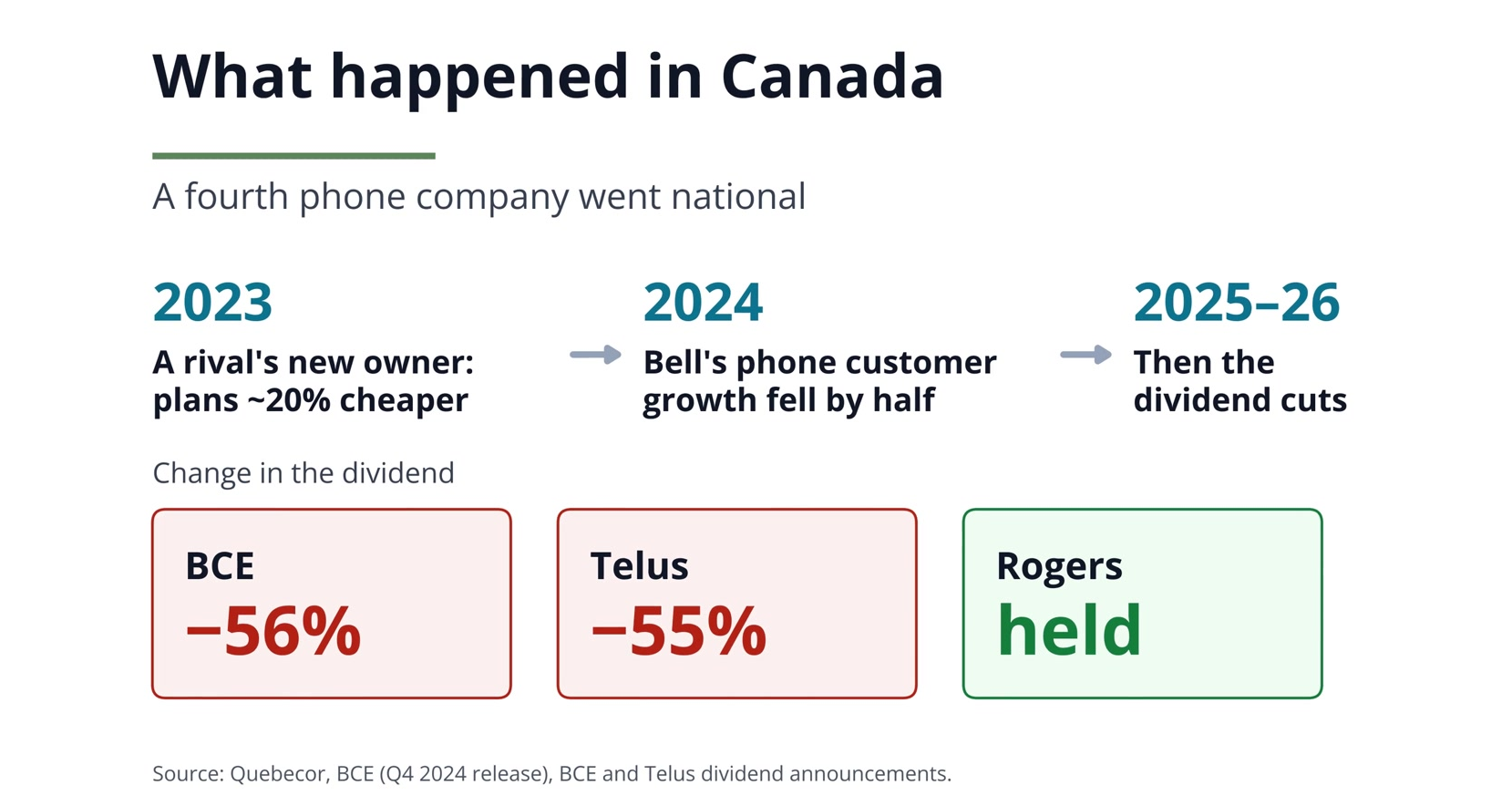
Canada shows how quickly things can turn when phone companies carry a lot of debt and competition heats up. For decades, its cell phone market was dominated by BCE, Telus and Rogers. In 2023, Quebecor bought Freedom Mobile and took it national, with a commitment to the Canadian government to price its plans at least 20% below comparable big-three plans in British Columbia, Alberta and Ontario.
Bell's growth in phone customers fell by half in 2024. That hurt more than it might have, because BCE and Telus had already borrowed heavily to upgrade their networks and had little room for error. BCE cut its dividend by 56% in 2025, and Telus followed with a 55% cut in 2026. Rogers kept paying its dividend.
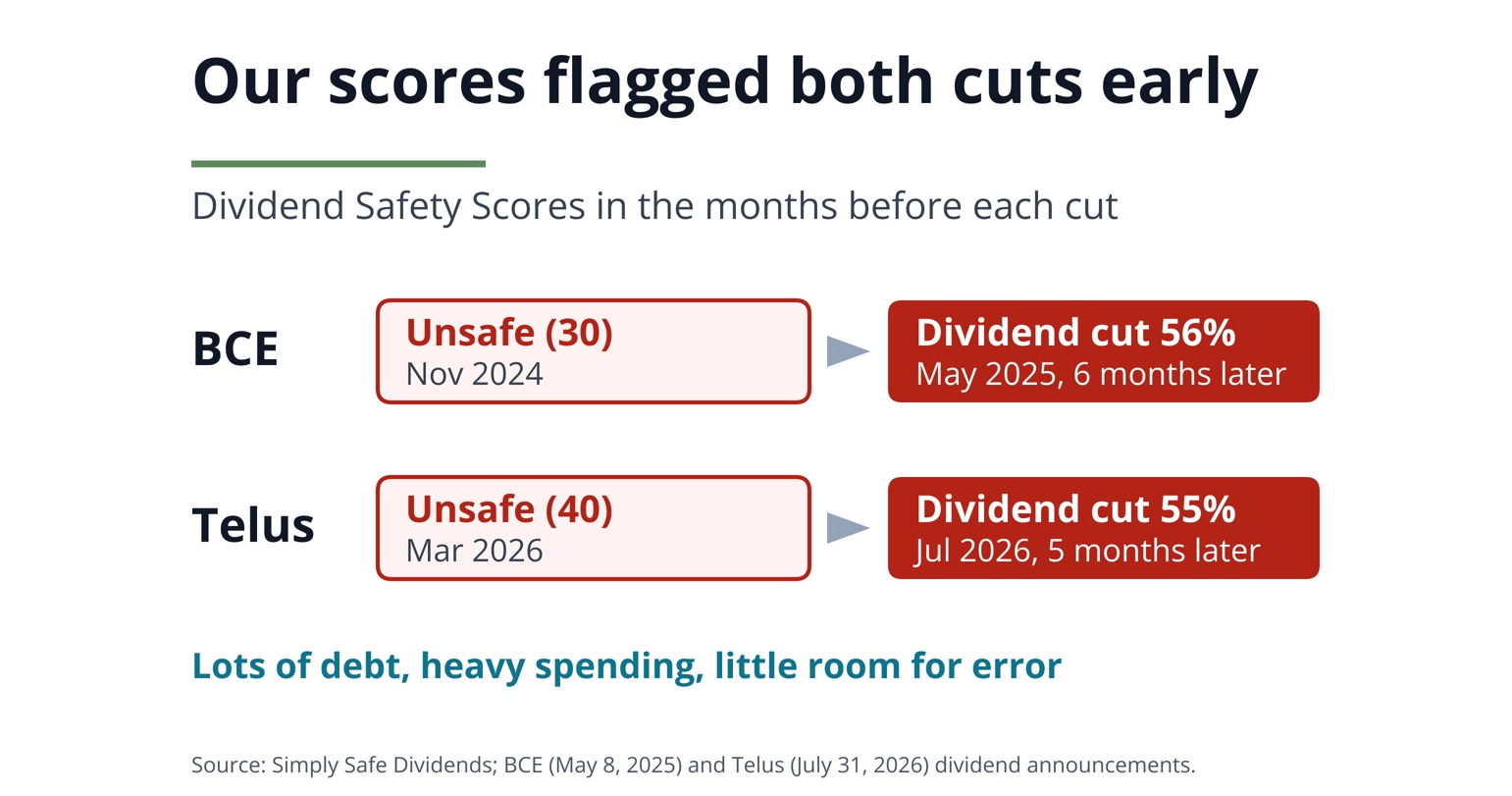
Competition wasn't the only reason for those cuts, but our Dividend Safety Scores rated both BCE and Telus Unsafe months before they cut, as our dividend cut track record shows. The pattern to avoid is lots of debt, heavy spending and little financial breathing room, so the next question is how much margin of safety Verizon and AT&T have today.
Is Verizon's Dividend Safe?
Sector: Communications – Telecom Services
Dividend Yield: 6.5%
Dividend Safety Score: Safe (70)
Annual Dividend: $2.83 per share, paid quarterly
Dividend Growth Streak: 20 consecutive years of increases
Credit Rating: BBB+
Dividend Yield: 6.5%
Dividend Safety Score: Safe (70)
Annual Dividend: $2.83 per share, paid quarterly
Dividend Growth Streak: 20 consecutive years of increases
Credit Rating: BBB+
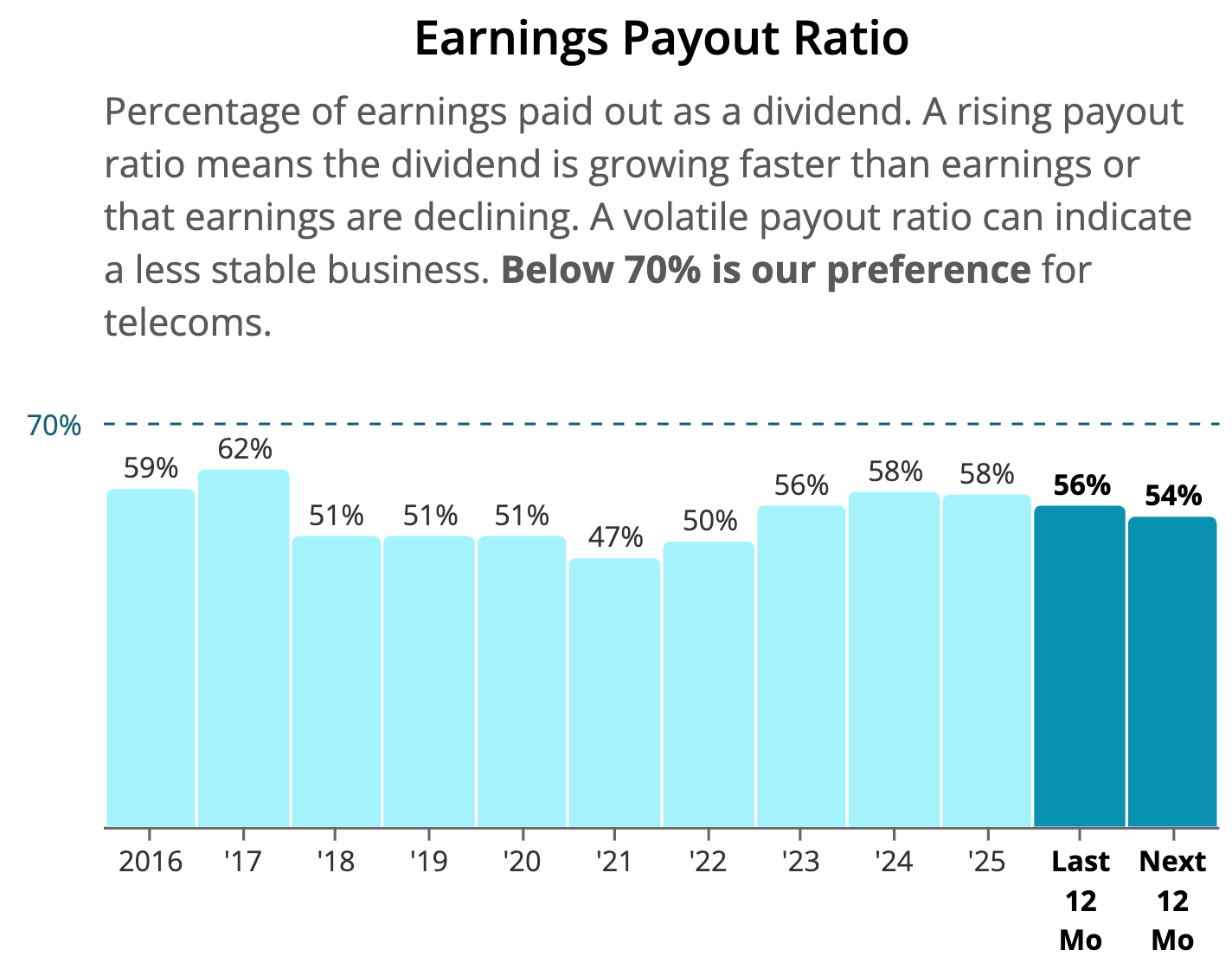
Verizon pays out about 56% of its earnings as dividends, a level that has stayed in a fairly steady range for most of the last decade.
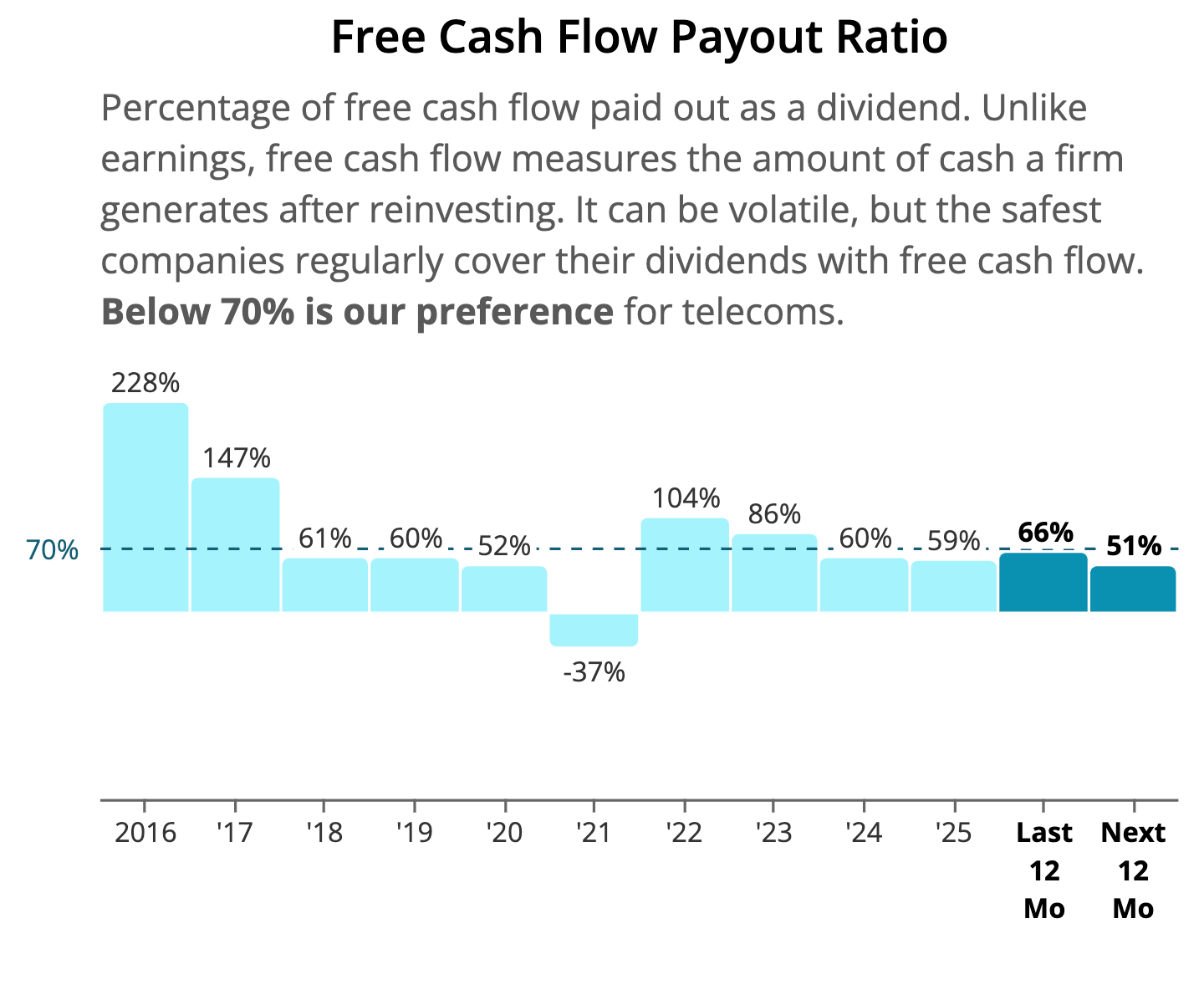
For a phone company, the more telling number is how much of the cash left after paying for its network goes to the dividend, because that is where big network and airwave bills show up. We estimate Verizon will pay out about 51% of its free cash flow as dividends over the next 12 months, which leaves a decent cushion.
The same chart shows what happened the last time Verizon went big at an auction. In 2021, once you count the more than $45 billion it spent on airwaves, its free cash flow was negative, so it had to borrow to cover its dividend that year.
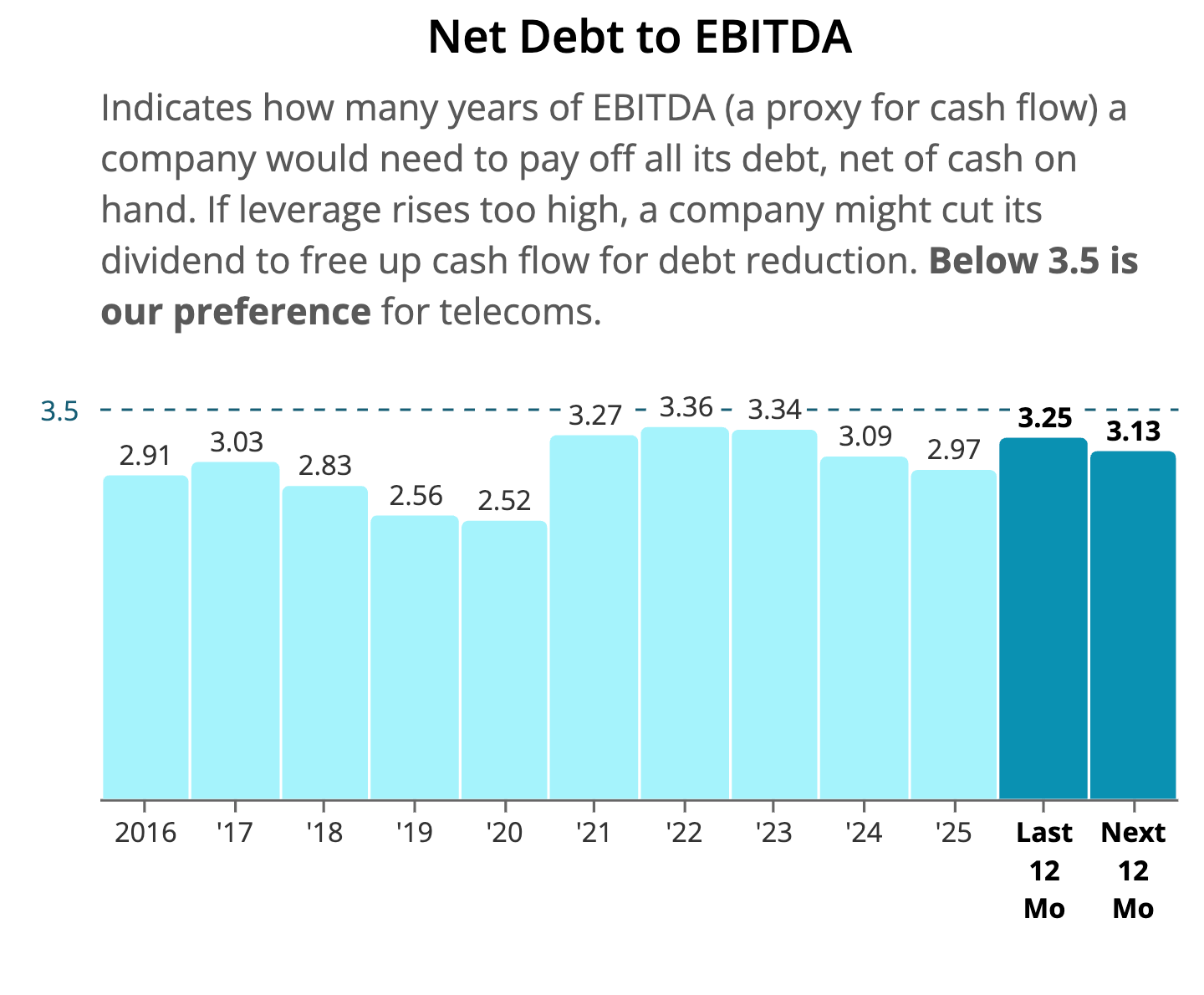
Its net debt rose from about 2.5 times EBITDA (earnings before interest, taxes, depreciation and amortization) in 2020 to more than 3.3 times after the auction. It took until 2025 to get back under 3 times, and the Frontier acquisition has since pushed leverage back up a little above that. With growth this slow, that is more debt than I would like Verizon to carry, even though its BBB+ credit rating is still on solid ground. It is also why I'm watching the auction closely: Verizon has much less room to repeat 2021 than it did back then.
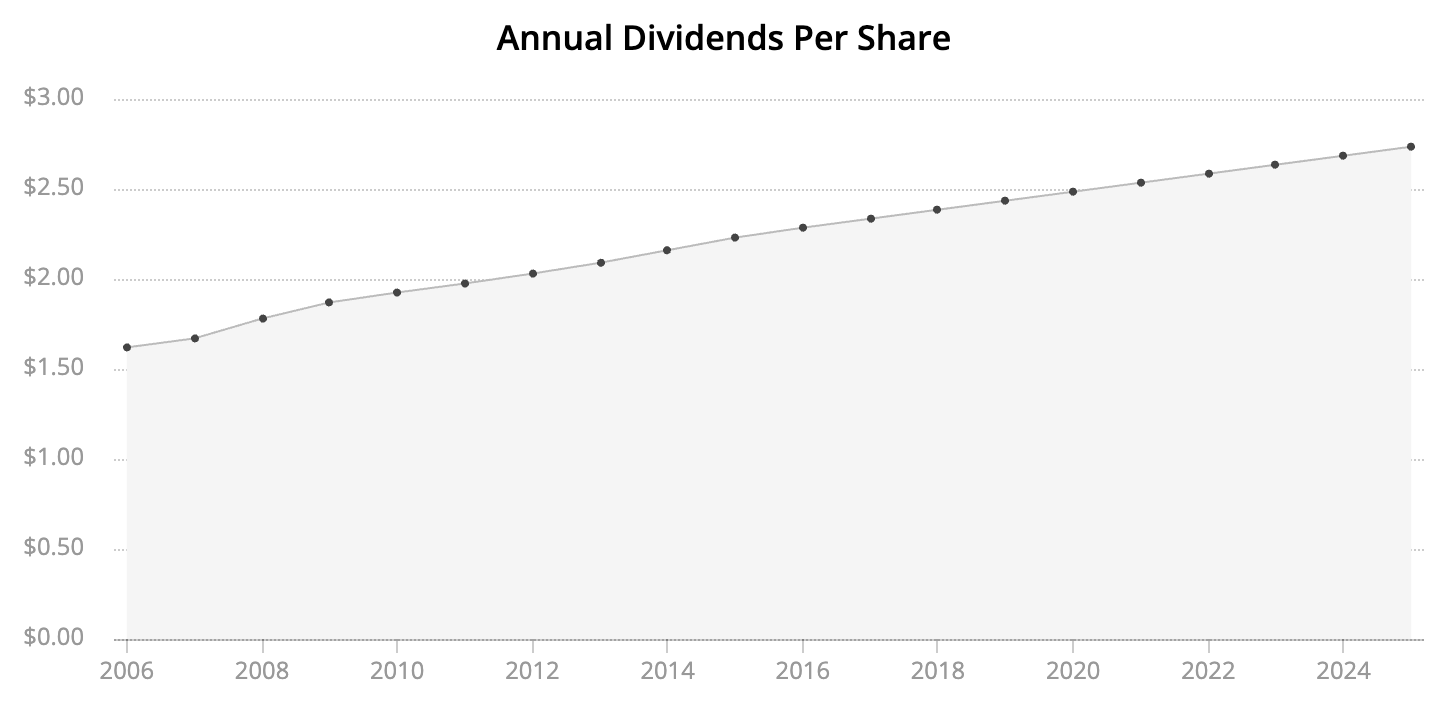
The good news is that Verizon and its predecessors haven't cut the dividend in more than 40 years, and it has raised the payout for 20 consecutive years, including through the financial crisis. Those raises have been small, about 2% a year over the last decade, and with its debt where it is, I wouldn't expect much more than that.
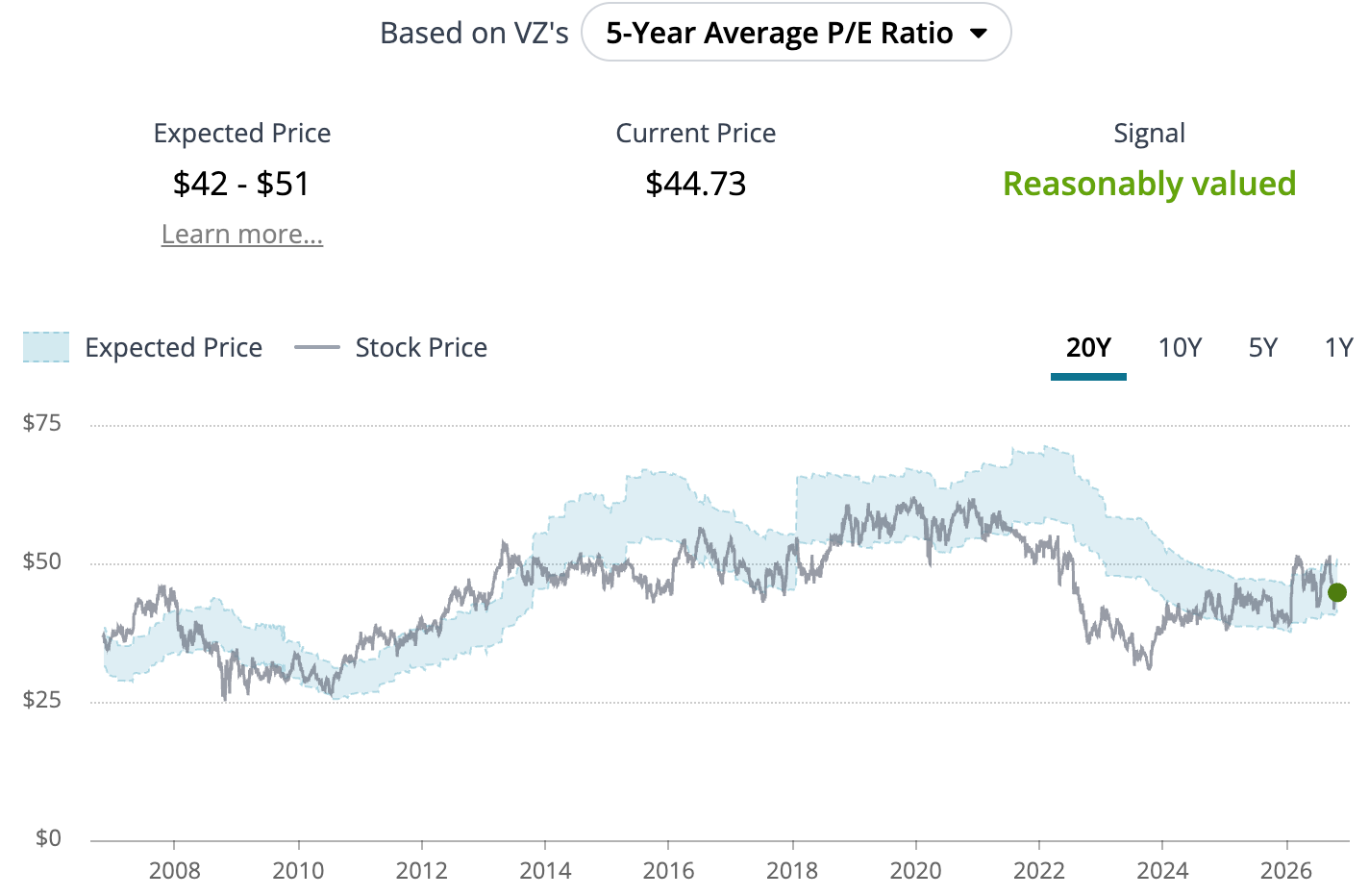
Even after this month's drop, Verizon looks reasonably valued rather than cheap. At its average price-to-earnings ratio of the last five years, the stock would be worth about $42 to $51 a share, and it closed near $44 on October 29, toward the low end of that range. It traded well below that range in 2022 and 2023 when interest rates were rising, so the range is a guide, not a promise.
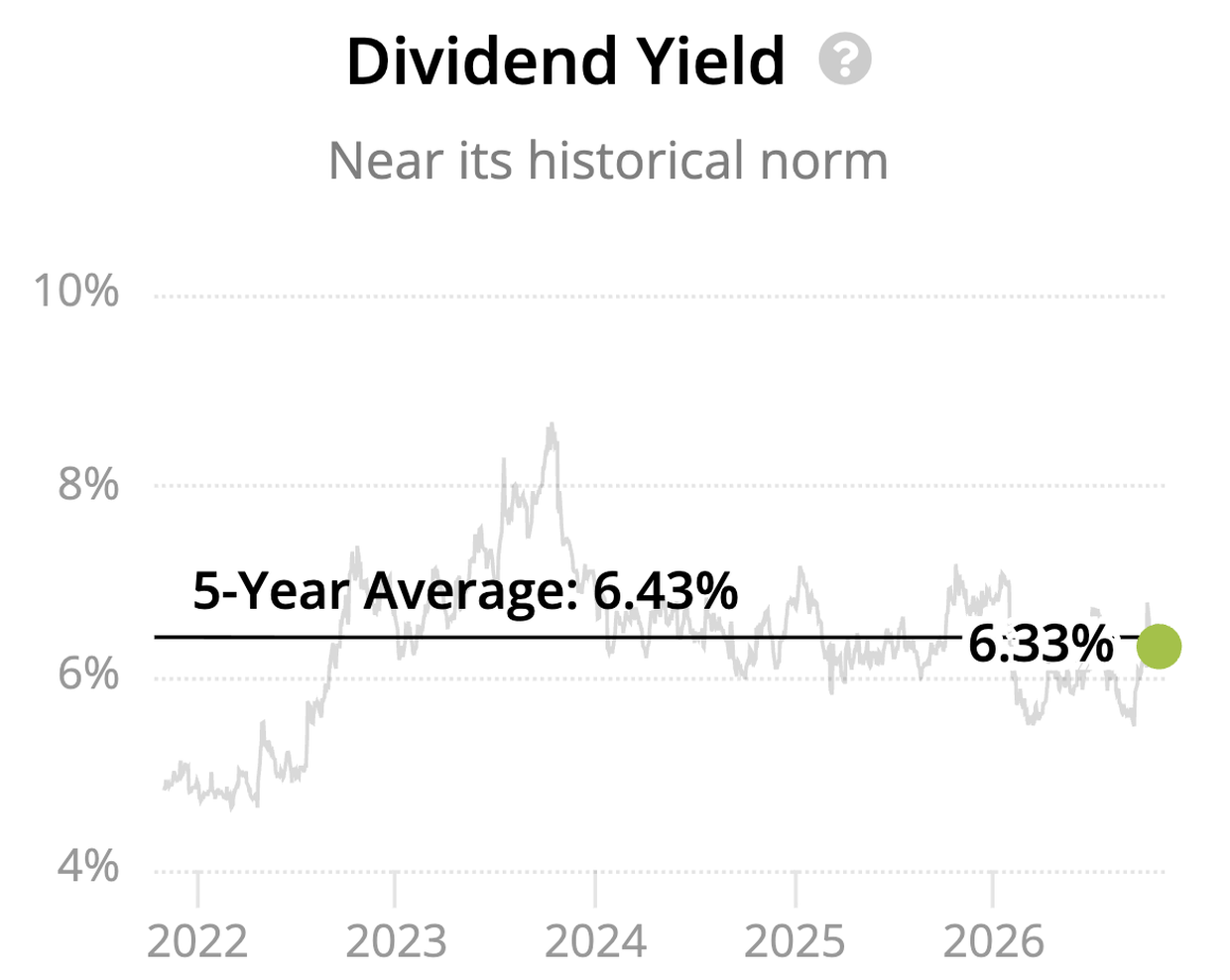
At about 6.5%, Verizon's yield sits right around its five-year average of 6.4%. Investors are not pricing Verizon's dividend like one that is about to be cut.
Is AT&T's Dividend Safe?
Sector: Communications – Telecom Services
Dividend Yield: 5.3%
Dividend Safety Score: Safe (70)
Annual Dividend: $1.11 per share, paid quarterly
Dividend Growth Streak: No increase since its 2022 cut
Credit Rating: BBB
Dividend Yield: 5.3%
Dividend Safety Score: Safe (70)
Annual Dividend: $1.11 per share, paid quarterly
Dividend Growth Streak: No increase since its 2022 cut
Credit Rating: BBB
AT&T's story is different. It cut its dividend by 47% in 2022, when it spun off WarnerMedia after years of piling up debt buying media companies. The payout hasn't grown since.
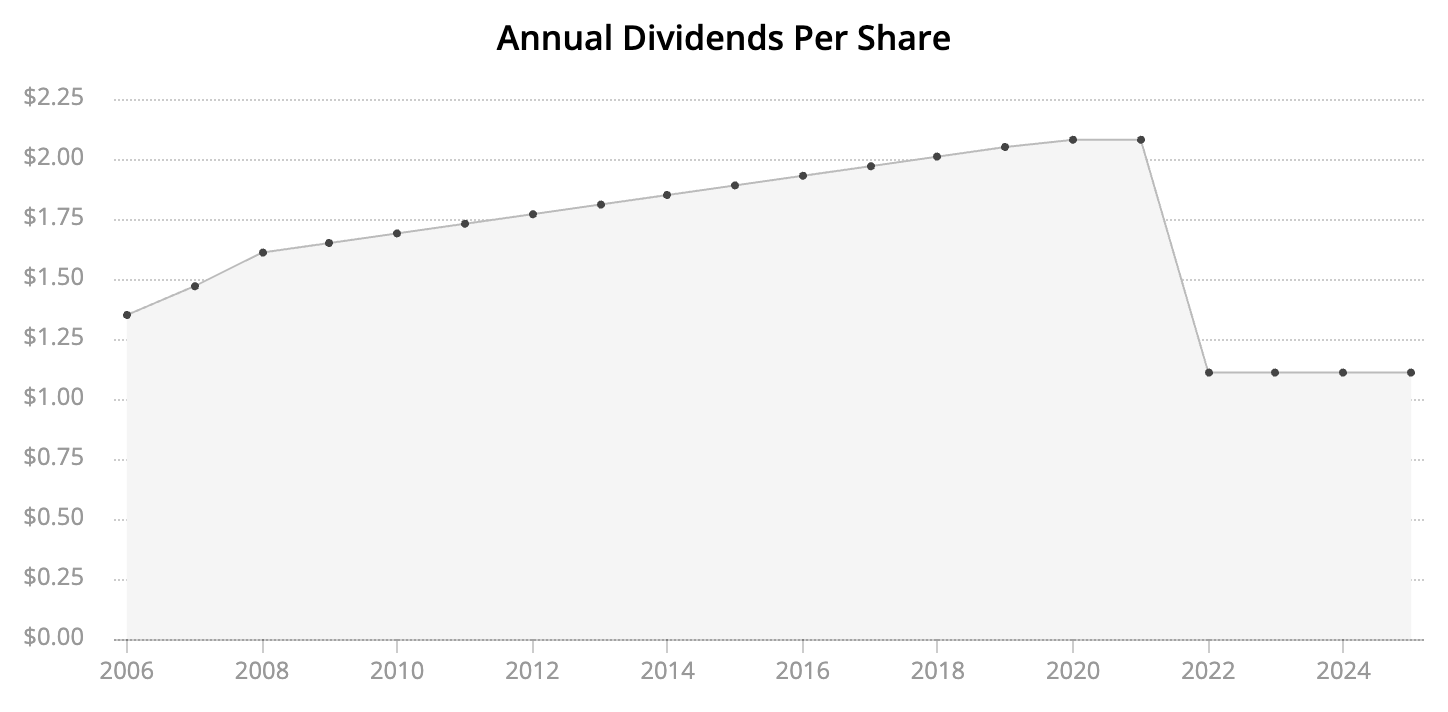
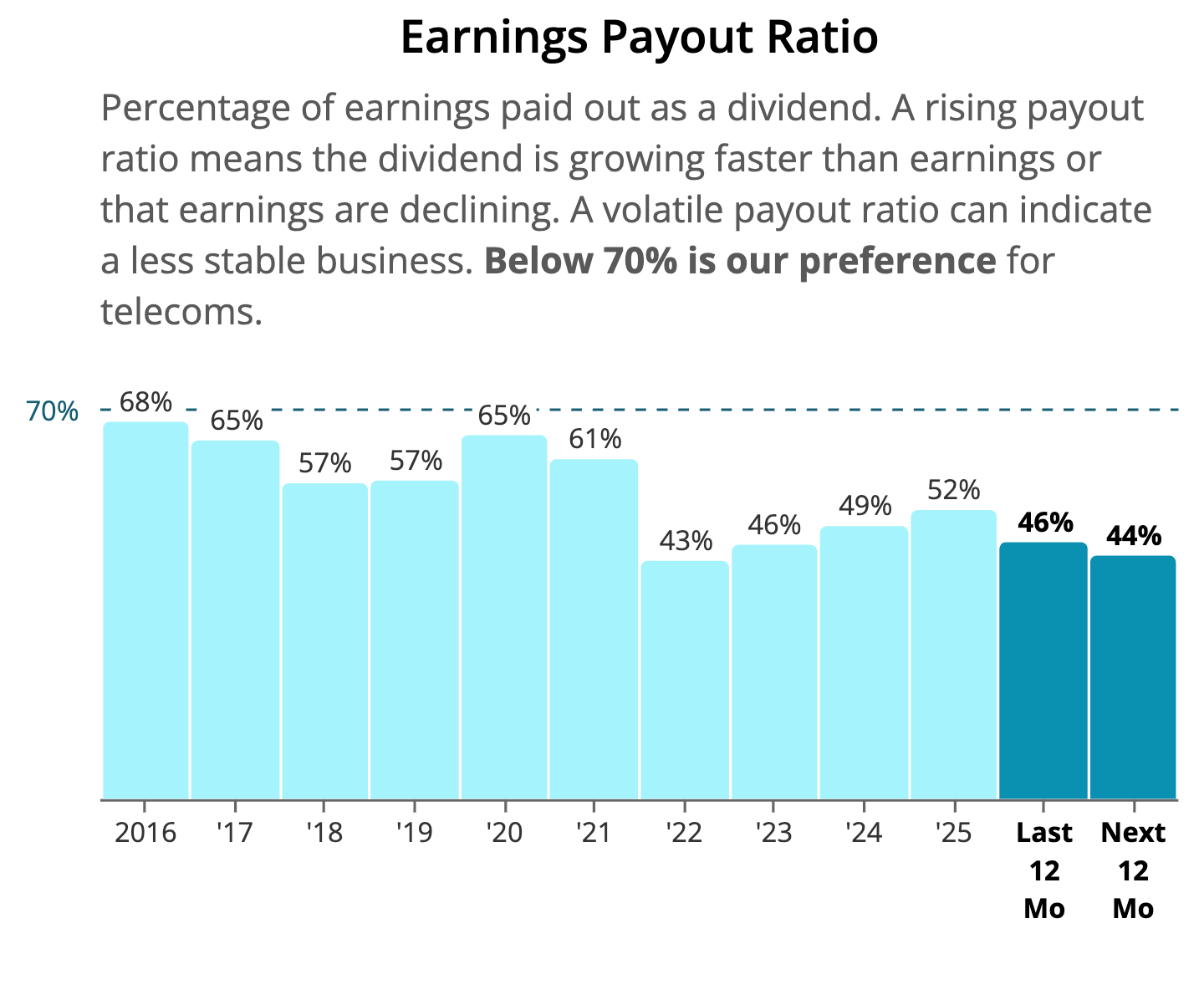
Since then, AT&T has run a more conservative dividend. It pays out about 46% of its earnings.
It also paid out only about 43% of its free cash flow as dividends over the past year, a little more breathing room than Verizon has.
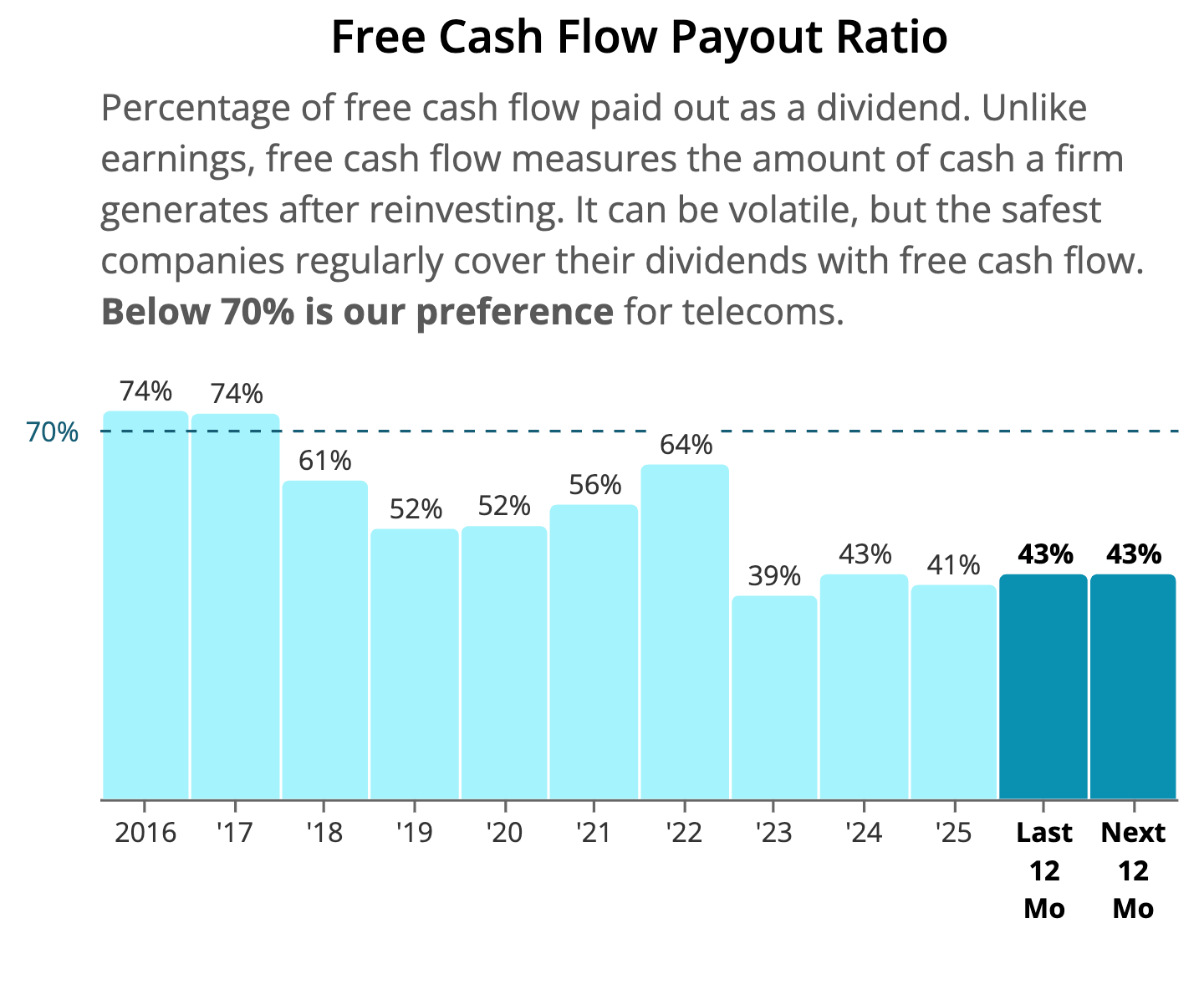
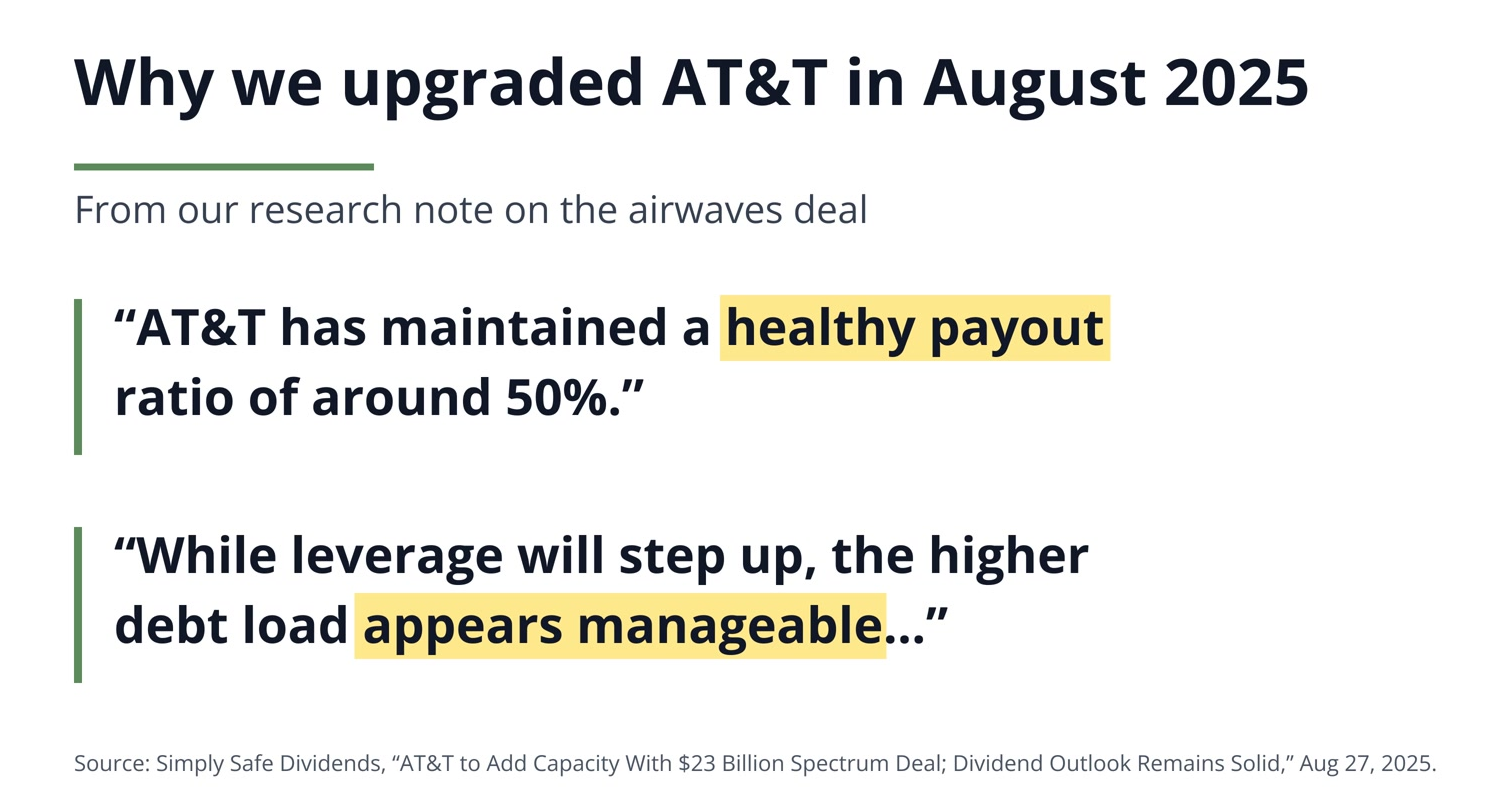
That low payout ratio is one reason we upgraded AT&T's Dividend Safety Score to Safe in August 2025, even though it had just agreed to spend $23 billion on more airwaves. Its plan to bring debt back down looked manageable to us.
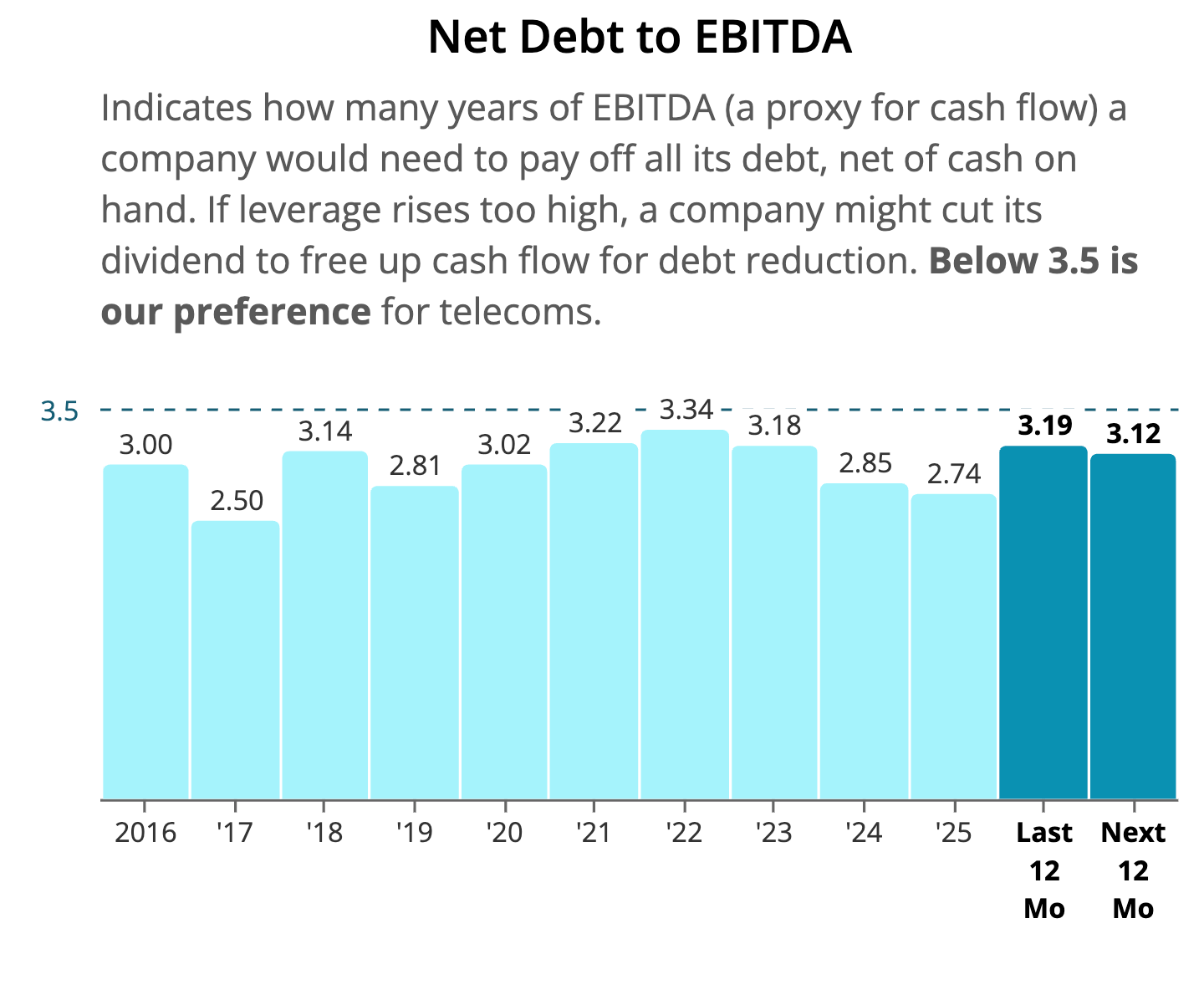
The catch is what that purchase did to its debt. AT&T had worked its net debt down to about 2.7 times EBITDA in 2025, and it is now back above 3 times. Management expects to return to its 2.5x target during 2029, so I wouldn't count on a dividend increase anytime soon.
AT&T also plans to spend about $10 billion buying back its own shares this year. If the industry got tougher, I would expect those buybacks to go long before the dividend was at risk.
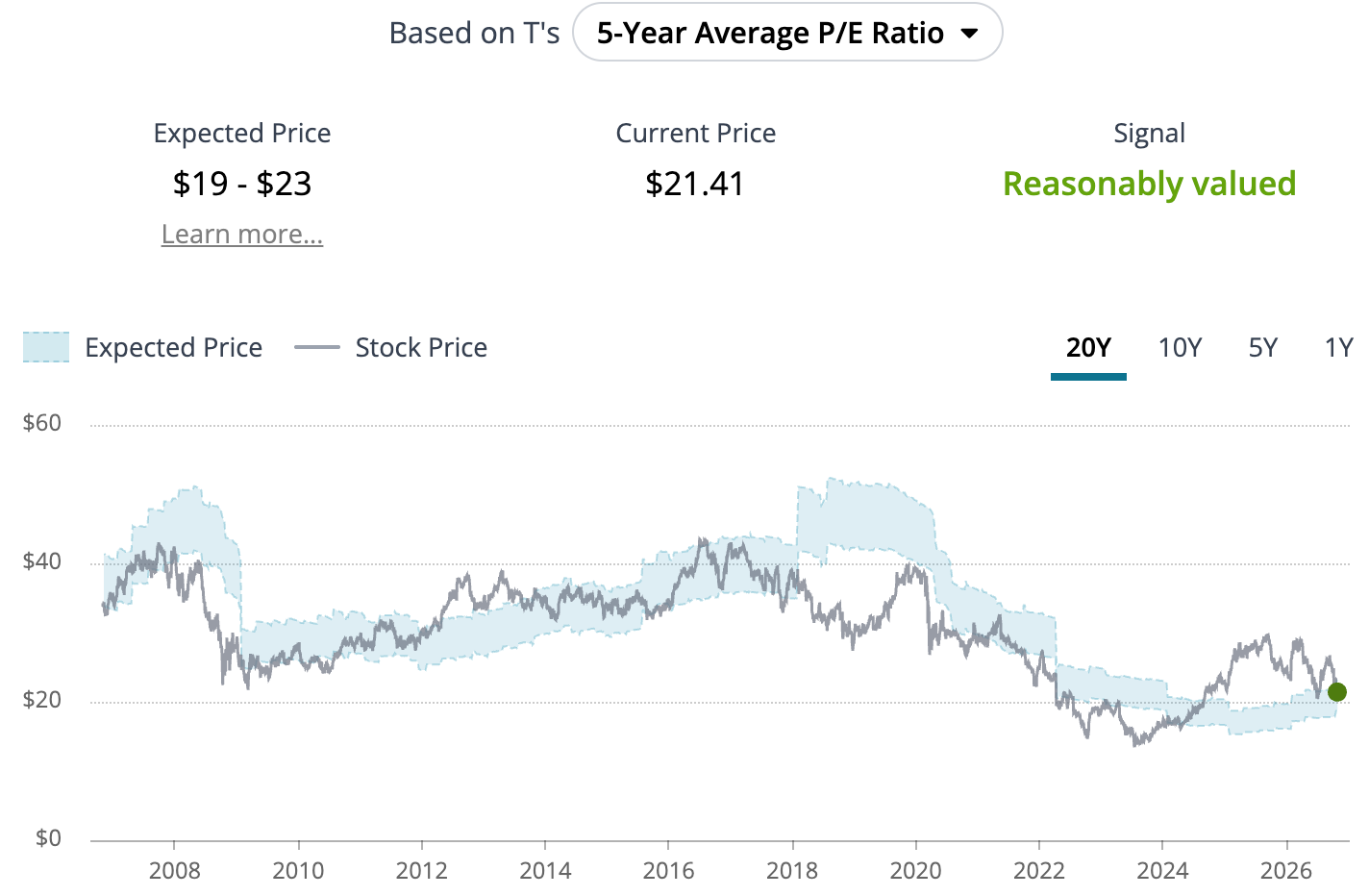
AT&T looks reasonably valued after this month's drop. At its average price-to-earnings ratio of the last five years, the stock would be worth about $19 to $23 a share, compared with a close near $21 on October 29. It is back inside that range after trading above it for most of the last two years.
Neither company is paying out nearly everything it brings in, so both have room to absorb some pressure before their dividends would be in serious trouble. That matters because I'm not convinced SpaceX will suddenly take a big share of the market. If it succeeds, it will probably take several years, which gives Verizon and AT&T time to adjust.
What Could Change Our View on Verizon and AT&T
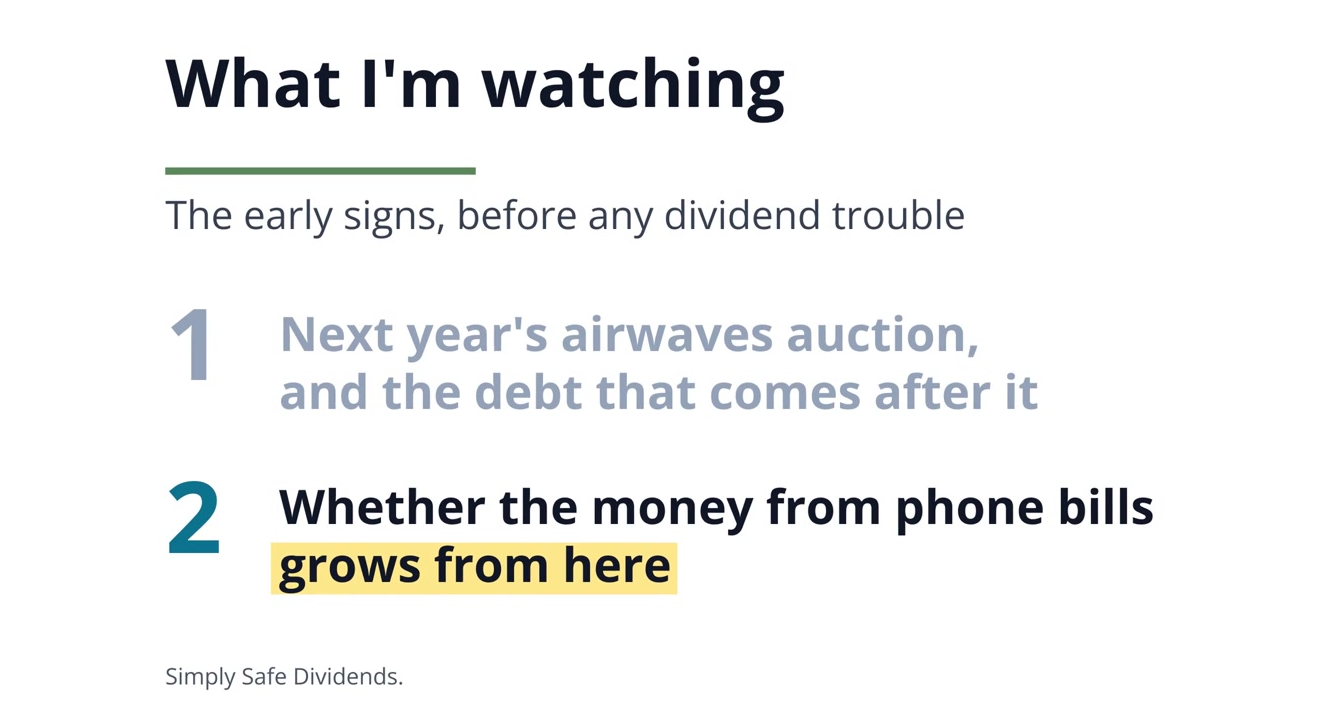
For now I'm holding both stocks. I think investors are more worried about what SpaceX might do than about anything going wrong with these businesses today. But SpaceX has the money and the ambition to change this industry, so there are two things that could change my mind over the next few years.
The first is how much Verizon and AT&T spend at next year's auction. Neither needs to outbid SpaceX at any price. But if either one spends another $10 billion to $20 billion or more and takes on a lot more debt to keep airwaves away from a competitor, that would likely lead us to downgrade its Dividend Safety Score until its balance sheet recovers.
The second is whether they can grow the revenue they bring in from phone customers. Verizon's recent customer growth is encouraging, but I want to see it turn into more revenue, not just more customers on cheaper plans or discounts. If competition forces either company to cut prices or spend heavily just to hold on to customers, that would be another warning sign. I'd expect to see signs like these well before either dividend got close to real trouble.
A Safe Dividend Isn't the Same as a Good Investment
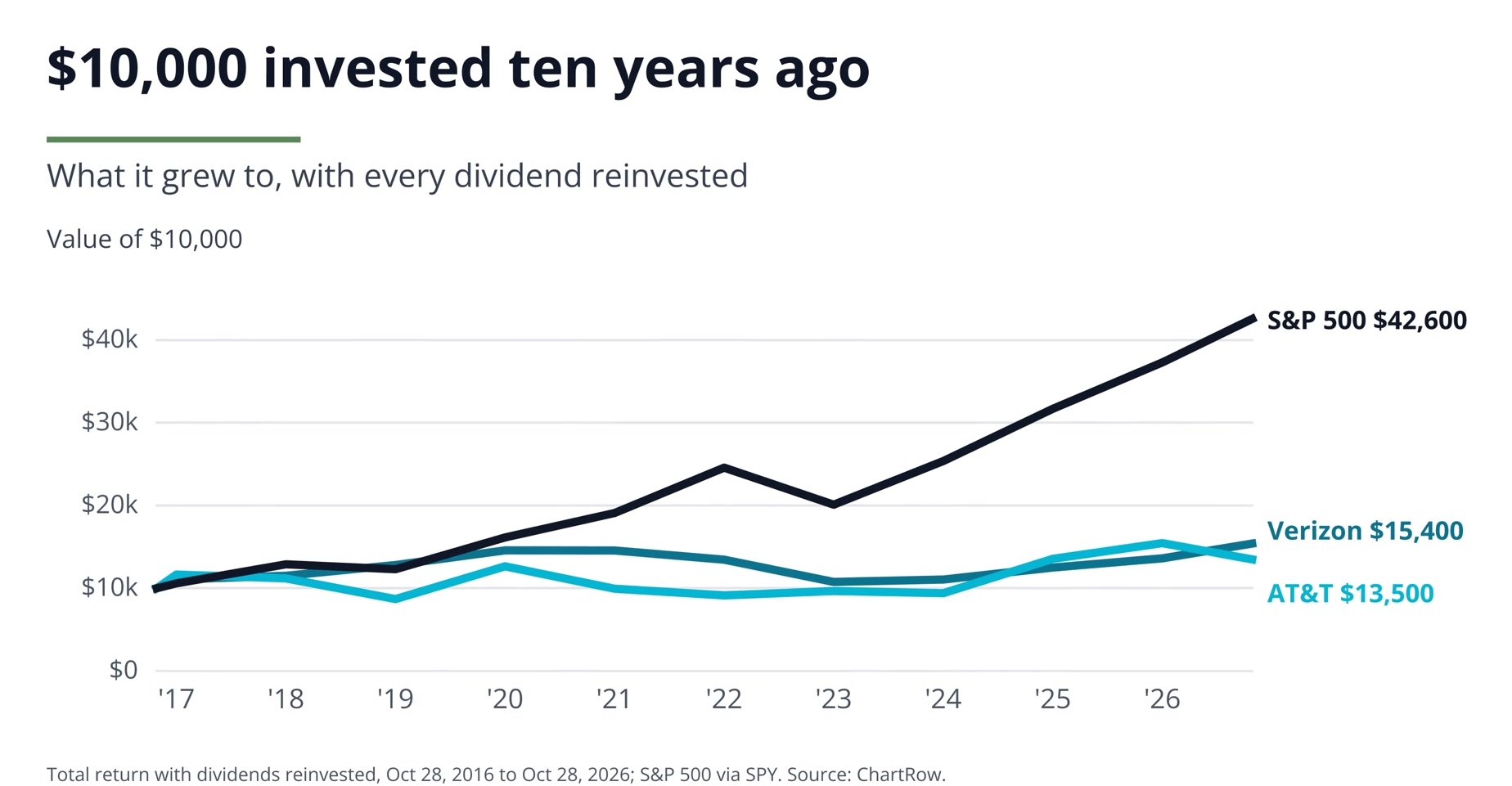
A safe dividend doesn't make a stock a good investment, and Verizon and AT&T are good examples. $10,000 invested in either company 10 years ago would have grown far less than the same money in the S&P 500, even with every dividend reinvested.
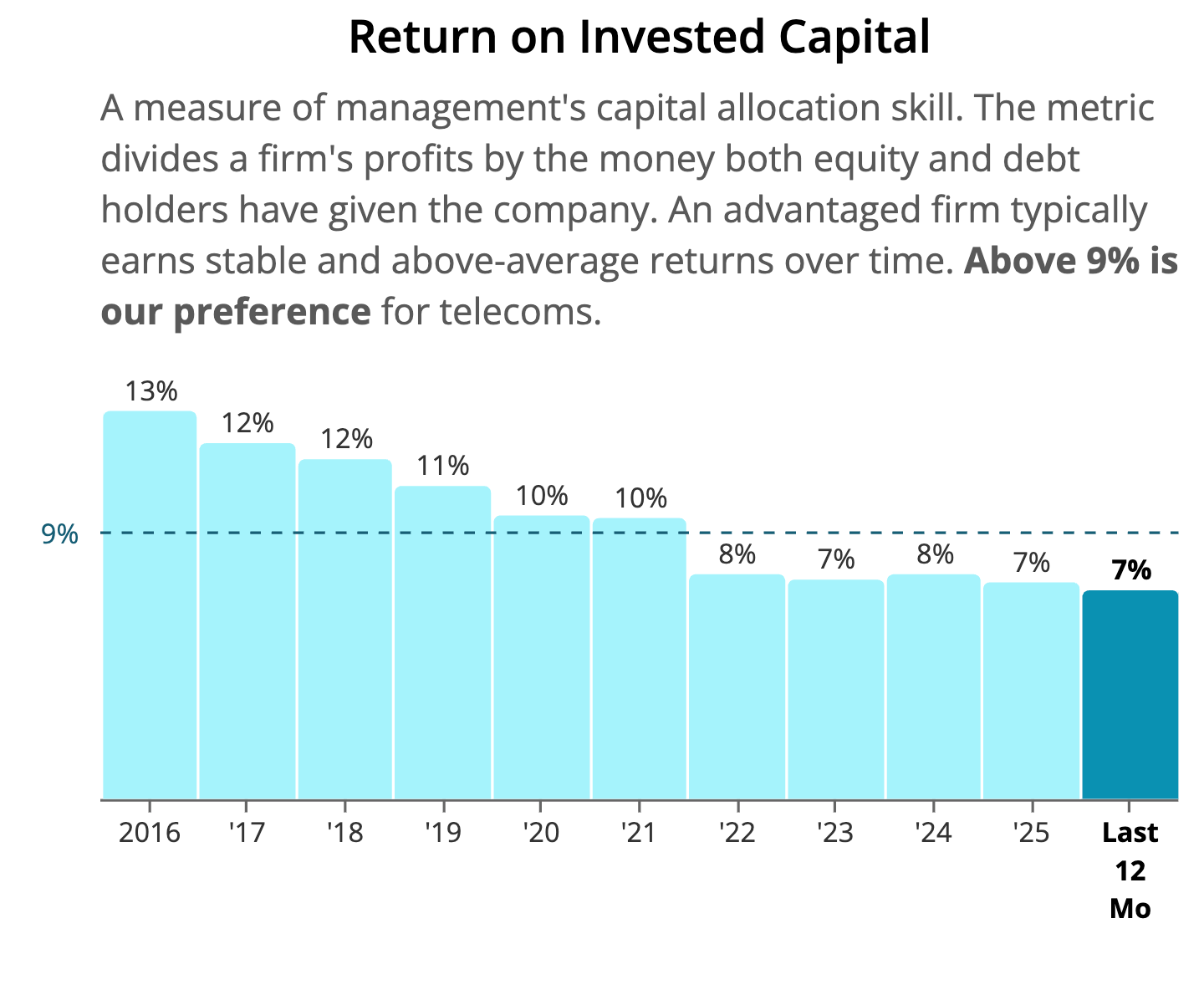
These businesses need heavy spending just to keep up. Verizon now earns about 7% a year on the money its shareholders and lenders have put into the business, down from 13% a decade ago.
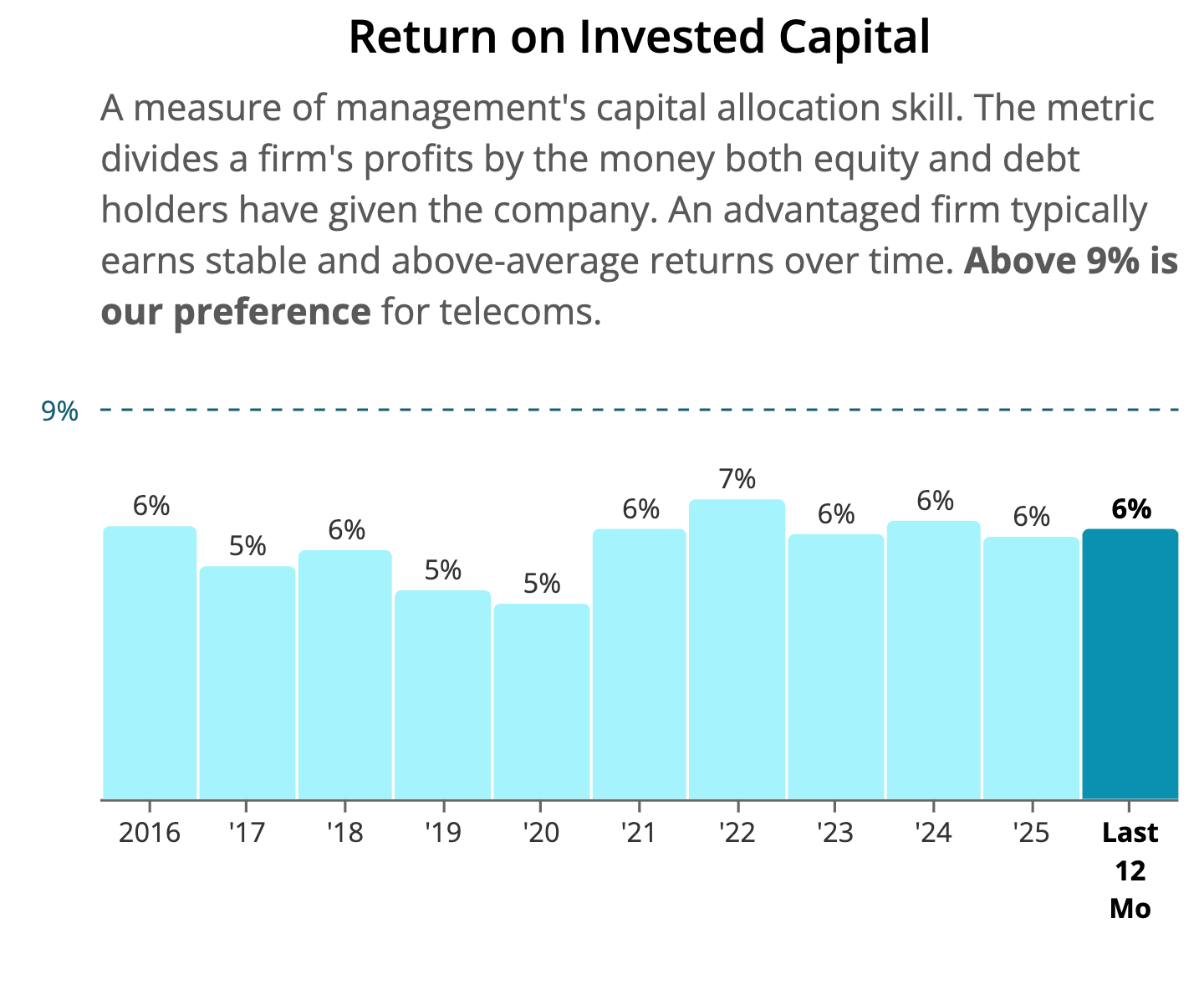
AT&T has been stuck between about 5% and 7% the whole time, which isn't much for a business that has to keep spending this heavily.
I wouldn't own either stock expecting great long-term returns. I own them for income and stability. Their dividends look dependable for now, and both stocks have very low betas, so they don't tend to rise and fall with the rest of the market. That helps balance out faster-growing companies in a portfolio.
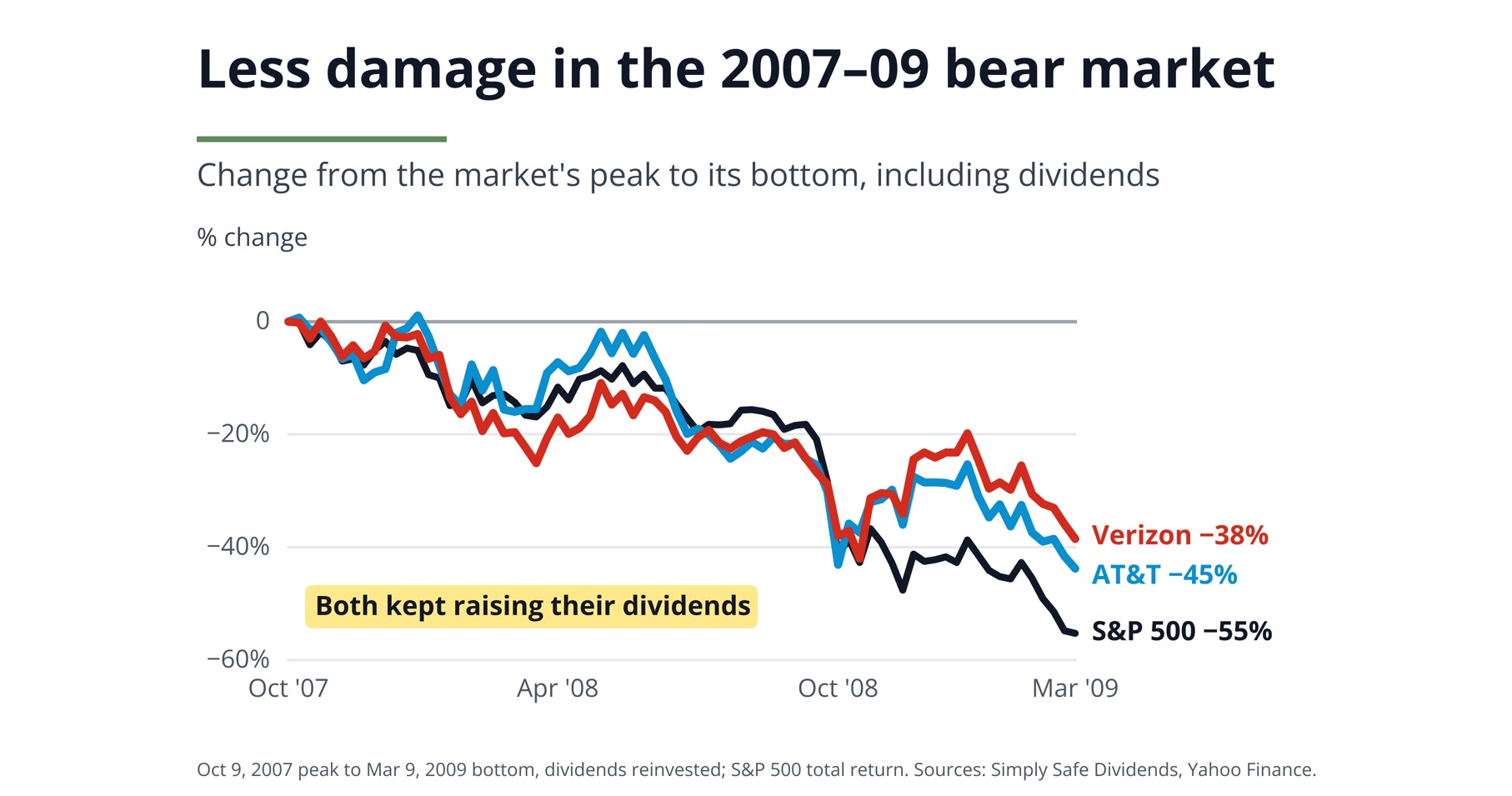
In the 2007-09 financial crisis, when the S&P 500 lost about 55% including dividends, Verizon fell about 38% and AT&T about 45%. Both kept raising their dividends throughout.
Frequently Asked Questions
Is Verizon's dividend safe?
Yes, for now. Verizon earns a Safe Dividend Safety Score, and we estimate it will pay out about 51% of its free cash flow as dividends over the next 12 months. Its net debt, a little above 3 times EBITDA, is the main thing to watch.
Yes, for now. Verizon earns a Safe Dividend Safety Score, and we estimate it will pay out about 51% of its free cash flow as dividends over the next 12 months. Its net debt, a little above 3 times EBITDA, is the main thing to watch.
Is AT&T's dividend safe?
Yes, for now. AT&T earns a Safe Dividend Safety Score and pays out about 46% of its earnings and 43% of its free cash flow as dividends. It doesn't expect to bring its debt back to its target until 2029, so a dividend raise looks unlikely before then.
Yes, for now. AT&T earns a Safe Dividend Safety Score and pays out about 46% of its earnings and 43% of its free cash flow as dividends. It doesn't expect to bring its debt back to its target until 2029, so a dividend raise looks unlikely before then.
Is SpaceX a threat to Verizon and AT&T?
Over time, it could be. SpaceX has agreed to buy about $28 billion of airwaves and is reportedly in talks to use more than 80,000 cell towers. The nearer-term risk for the dividends is that Verizon and AT&T borrow heavily to outbid SpaceX at the 2027 airwaves auction.
Over time, it could be. SpaceX has agreed to buy about $28 billion of airwaves and is reportedly in talks to use more than 80,000 cell towers. The nearer-term risk for the dividends is that Verizon and AT&T borrow heavily to outbid SpaceX at the 2027 airwaves auction.
When is the next FCC spectrum auction?
The FCC plans to auction upper C-band airwaves in 2027. The satellite companies using those airwaves have until the end of 2030 to move off them, so the winners may wait years to use them.
The FCC plans to auction upper C-band airwaves in 2027. The satellite companies using those airwaves have until the end of 2030 to move off them, so the winners may wait years to use them.
Has AT&T ever cut its dividend?
Yes. AT&T cut its dividend by 47% in 2022 when it spun off WarnerMedia, and it has paid $1.11 per share a year since.
Yes. AT&T cut its dividend by 47% in 2022 when it spun off WarnerMedia, and it has paid $1.11 per share a year since.
How much does Verizon pay in dividends?
Verizon pays $2.83 per share a year in quarterly installments, for a yield of about 6.5% as of October 29, 2026. It has raised its dividend for 20 consecutive years.
Verizon pays $2.83 per share a year in quarterly installments, for a yield of about 6.5% as of October 29, 2026. It has raised its dividend for 20 consecutive years.
Closing Thoughts on Verizon and AT&T's Dividends
Verizon's and AT&T's dividends look safe today. Both companies have room to absorb some pressure, and SpaceX is likely years from being a serious competitor. Next year's airwaves auction, and the debt that could follow it, is the first real test.
If you want a wider set of income ideas, our list of high dividend stocks yielding 4% to 10% includes other names with strong Dividend Safety Scores.
Our online tools show the Dividend Safety Score of every stock you own and alert you when one changes, so you can see trouble coming before a cut is announced. You can see how it works here. Thanks for reading!