BDC Stocks: The Complete List, Ranked by Dividend Safety
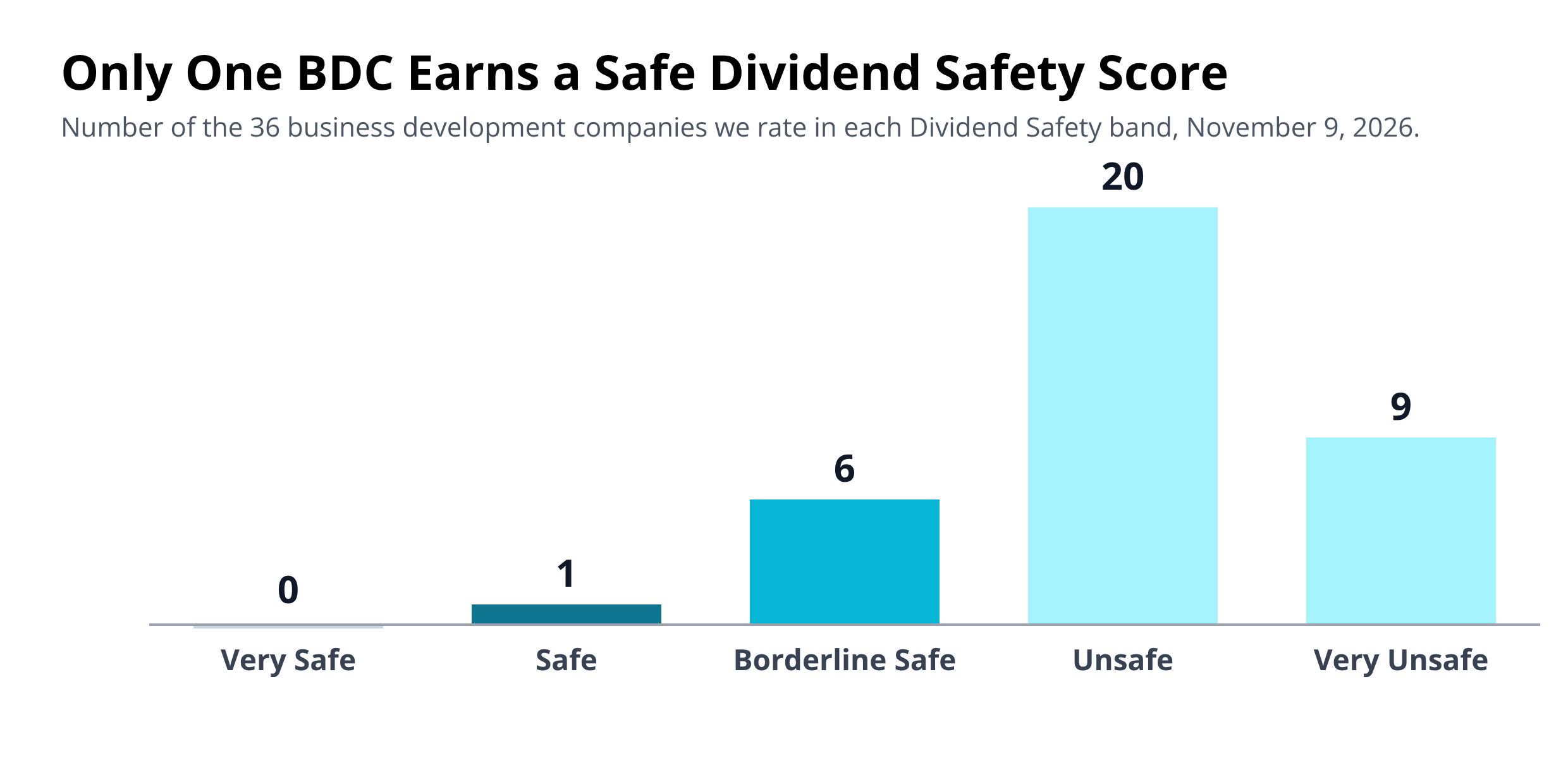
We rate 36 business development companies (BDCs) for dividend safety, and only one, Main Street Capital (MAIN), earns a Safe Dividend Safety Score. Six more rate Borderline Safe: Sixth Street Specialty Lending (TSLX), Ares Capital (ARCC), Capital Southwest (CSWC), SLR Investment (SLRC), Hercules Capital (HTGC), and Gladstone Investment (GAIN). The other 29 score Unsafe or Very Unsafe.
BDCs still pay some of the highest yields in the market. Their median yield is 13.1%, and 27 of the 36 yield 10% or more. Only one of those 27, SLR Investment, scores better than Unsafe, which tells you most of these yields are pricing in a cut.
The cuts are already happening. Nineteen of the 36 have reduced their dividends in 2026, as the Fed's rate cuts in 2024 and 2025 shrank the income on their floating-rate loans.
Prefer to watch? Our January 2026 video, We Analyzed All 44 BDCs. Here's Who Might Cut Dividends, explains the lending risks behind these scores. Several scores have changed since it was recorded. The ratings below are current.
BDC Stocks List
A BDC is a publicly traded company that lends to and invests in small and midsize private businesses. A BDC can elect to be taxed as a regulated investment company, which spares it corporate income tax as long as it pays out at least 90% of its taxable investment income, according to the IRS. That is why yields run so high. Our guide to investing in BDCs explains how they work.
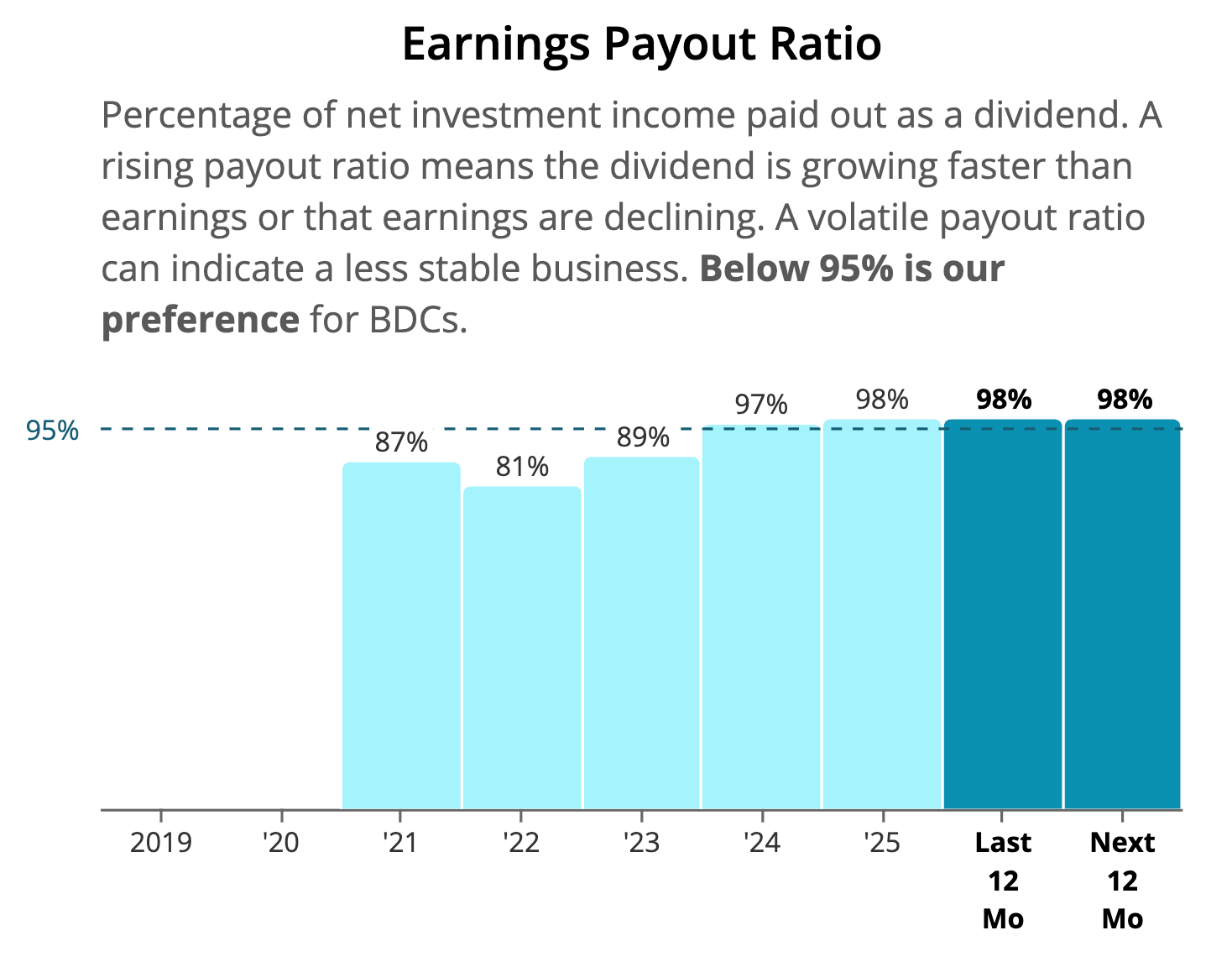
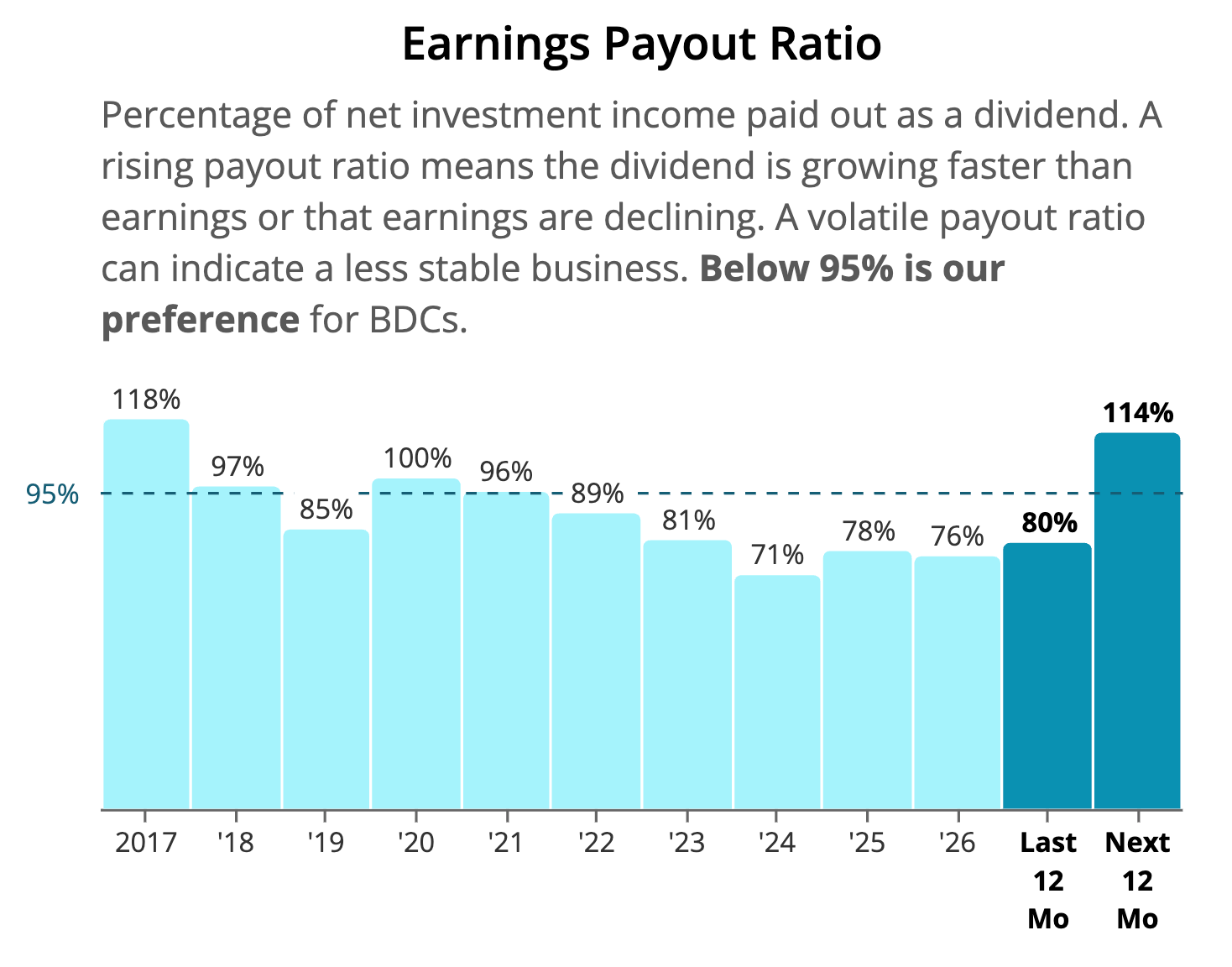
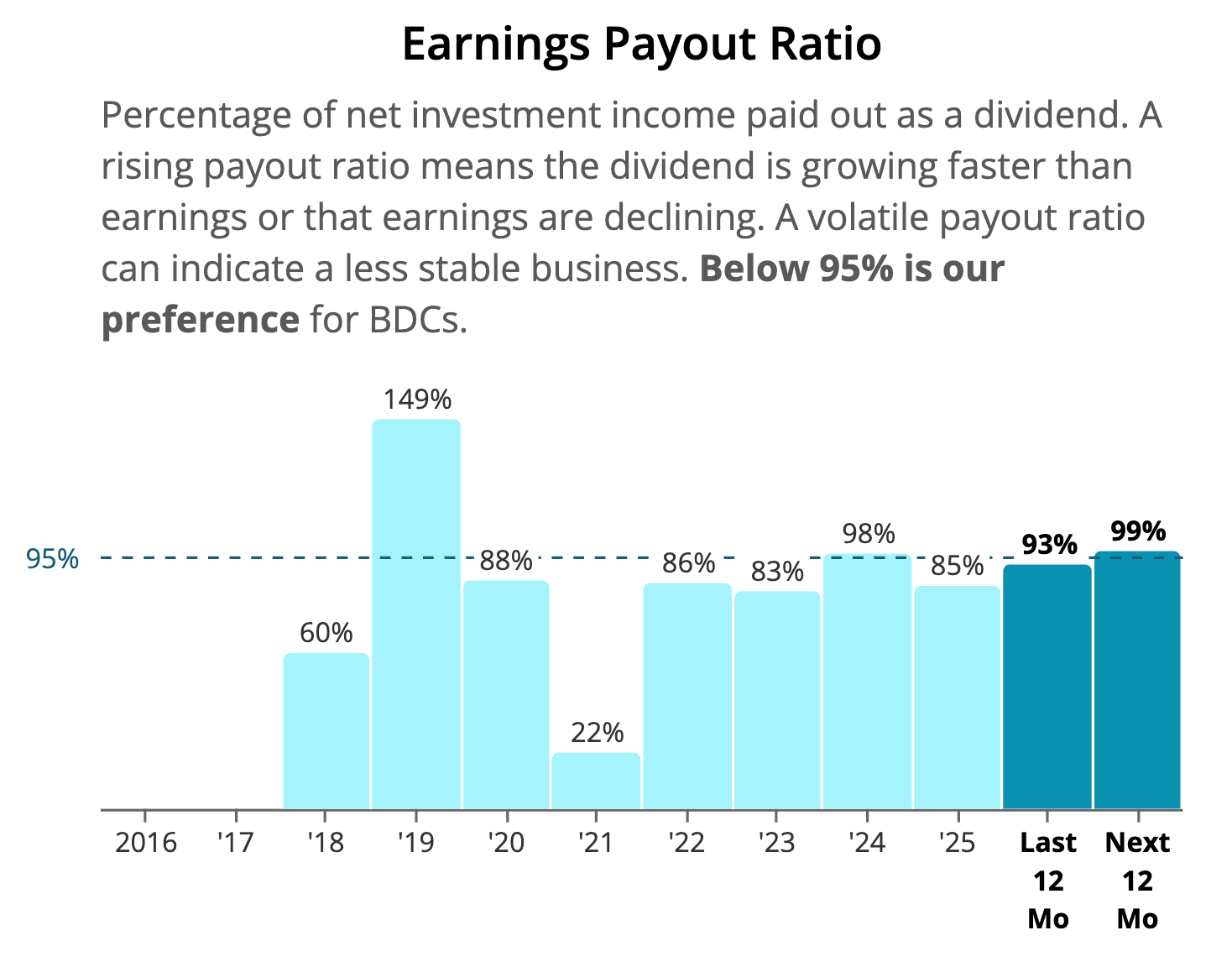
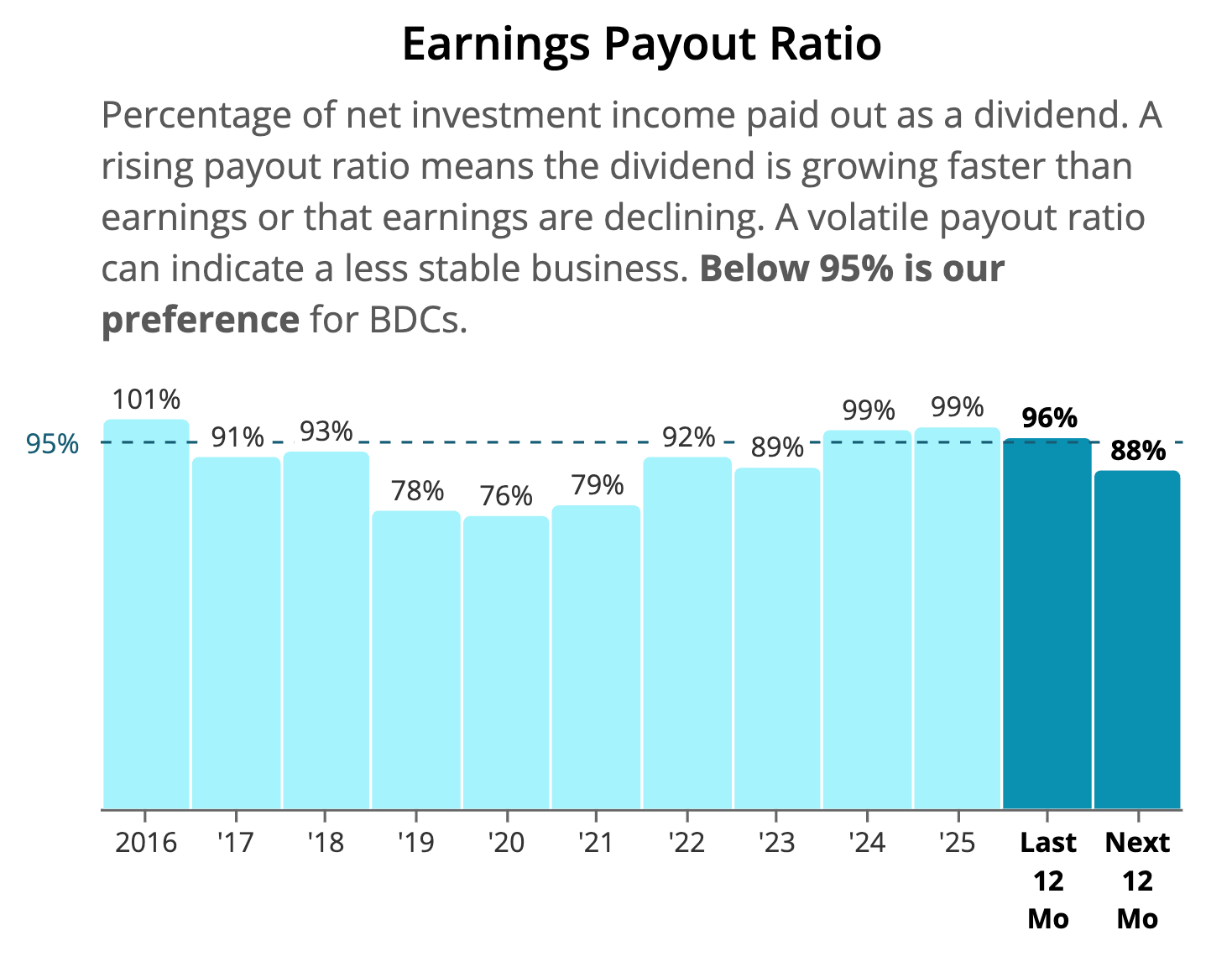
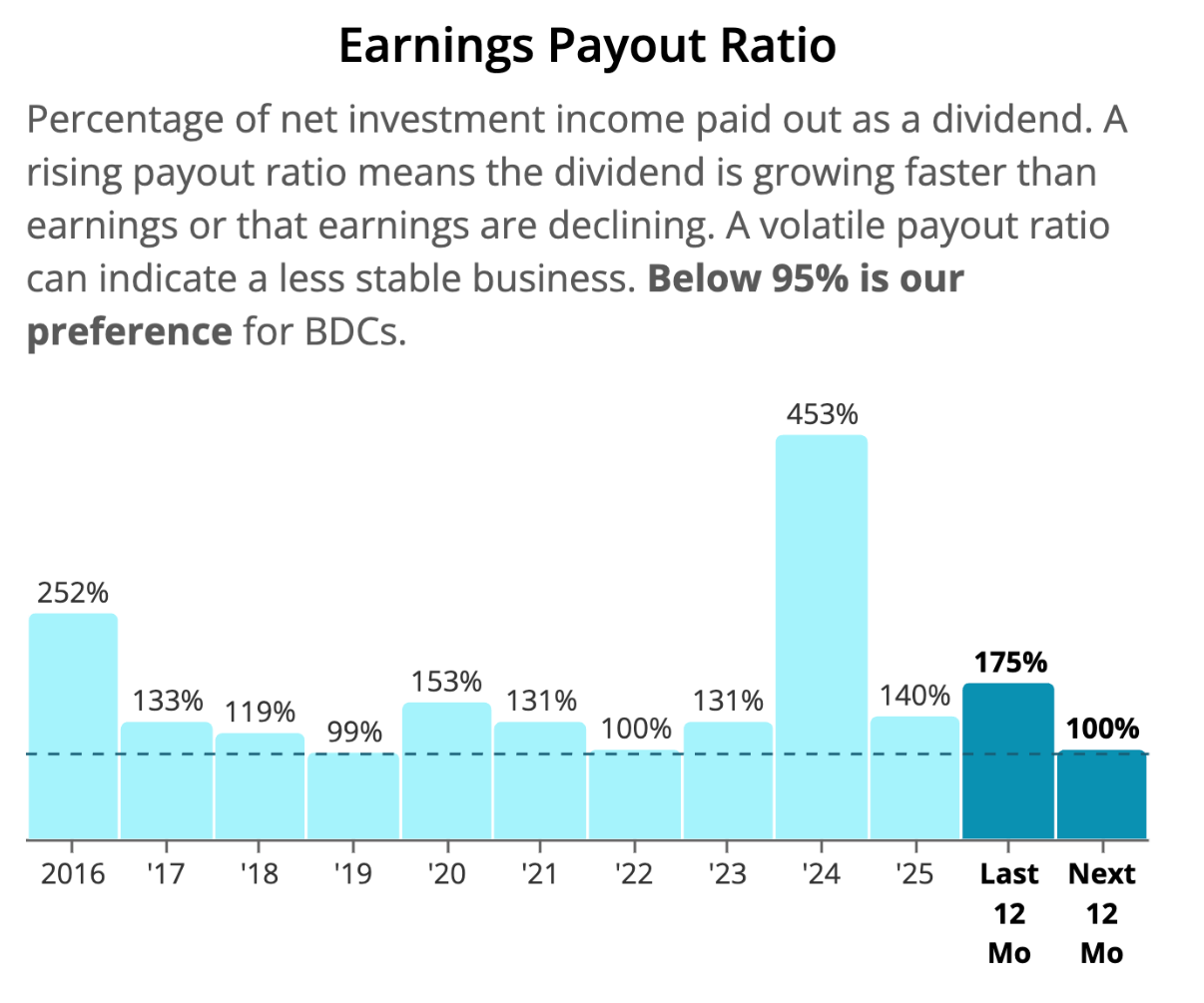
Below, we cover every BDC we rate, ranked from safest to riskiest by Dividend Safety Score. Ties are broken by the length of each company's uninterrupted dividend streak, then by yield. We go into detail on the seven rated Safe or Borderline Safe and keep the rest brief. As you read the payout charts, keep one rule of thumb in mind: BDC dividend cuts tend to come once payout ratios approach 110% of net investment income.
Main Street Capital (MAIN)
Dividend Yield: 5.7%
Dividend Safety Score: Safe (62)
Uninterrupted Dividend Streak: 18 years
Credit Rating: BBB-
Payment Frequency: Monthly
Dividend Safety Score: Safe (62)
Uninterrupted Dividend Streak: 18 years
Credit Rating: BBB-
Payment Frequency: Monthly
Main Street is the only BDC we rate Safe, though at 62 it clears that threshold by just two points. It has never reduced its regular monthly dividend since its first payment in 2007, a stretch that includes two recessions.
Main Street manages itself rather than paying an outside adviser, which keeps its costs down. More than half of its portfolio sits in small, lower middle market businesses, where it often supplies both a loan and an equity stake. It earns interest on the loan and shares in the gain when the business grows or is sold.
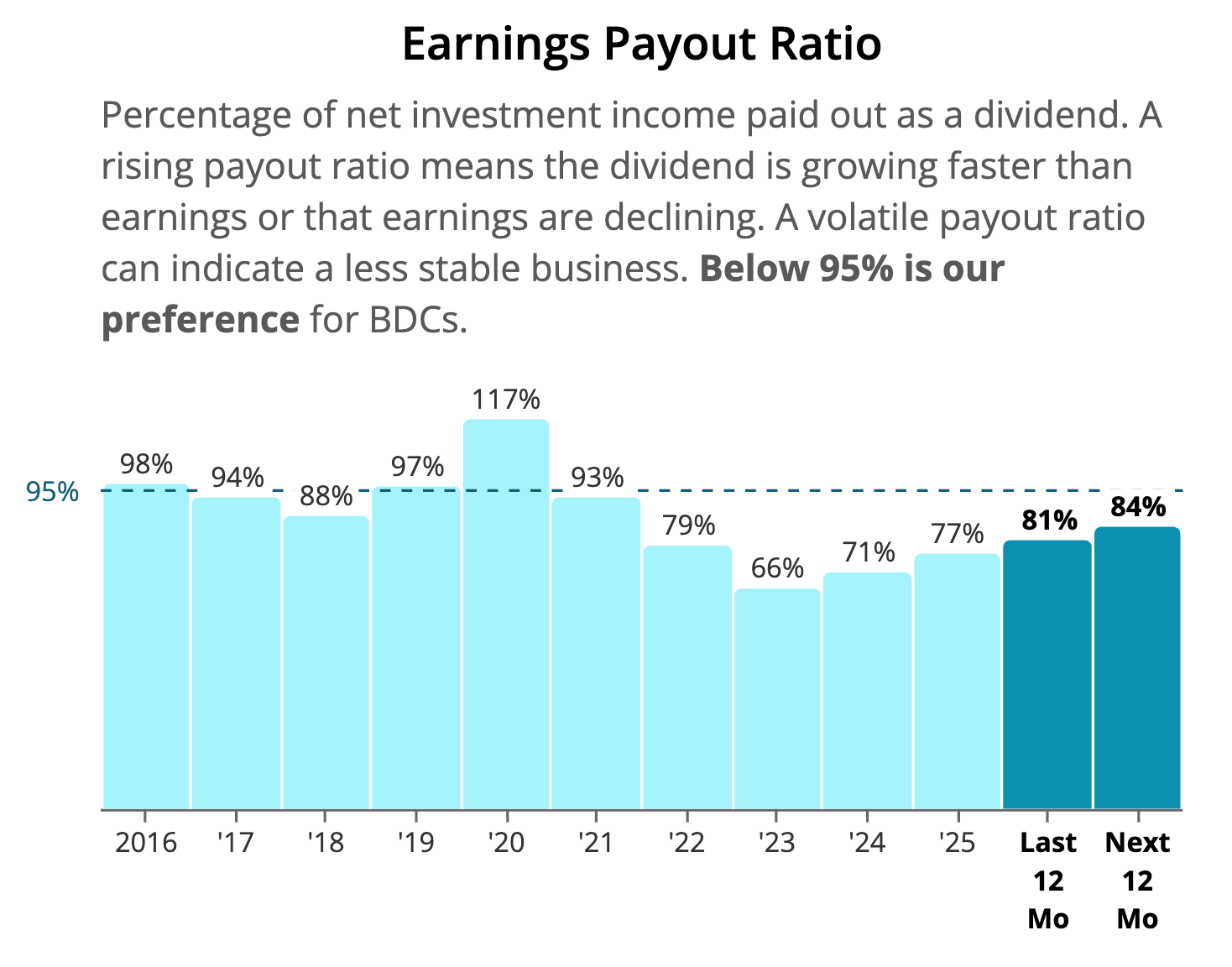
It pays out 81% of its net investment income, the profit left from interest and fees after expenses, among the lowest ratios in the industry, and it holds a reserve of past gains, called spillover, that could help cover the dividend in a bad year.
Credit has held up well. Less than 3% of Main Street's loans have gone bad in any year since 2008, most are first-lien loans that get repaid first, and only about 15% of the portfolio sits in software and professional services, the areas most exposed to worries about AI.
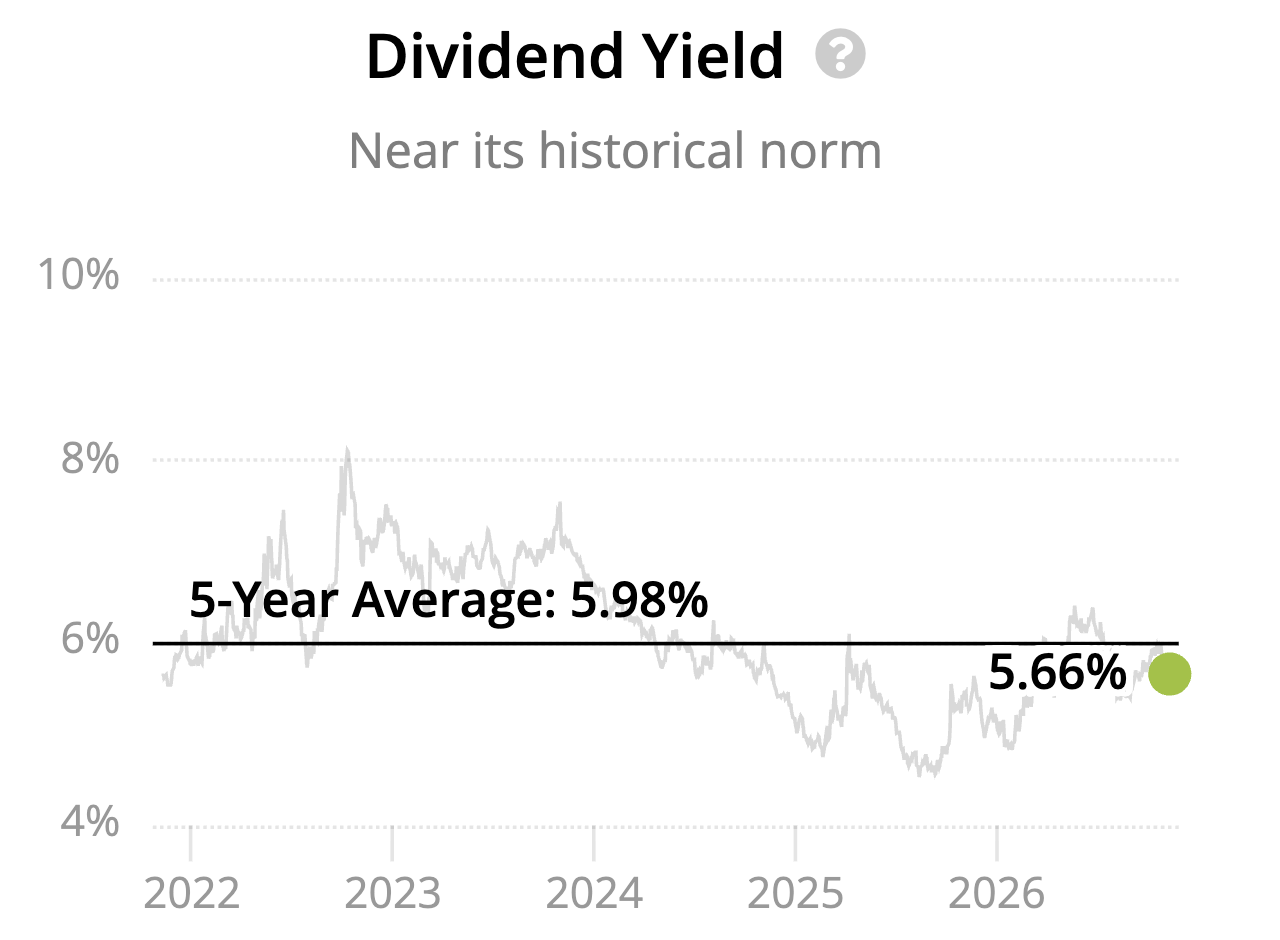
Its debt relative to equity is about half the level of its peers. Main Street's 5.7% yield is the lowest on this list, a reflection of how much more investors trust its dividend.
Its debt relative to equity is about half the level of its peers. Main Street's 5.7% yield is the lowest on this list, a reflection of how much more investors trust its dividend.
Sixth Street Specialty Lending (TSLX)
Dividend Yield: 9.4%
Dividend Safety Score: Borderline Safe (52)
Uninterrupted Dividend Streak: 0 years
Credit Rating: BBB-
Payment Frequency: Quarterly
Dividend Safety Score: Borderline Safe (52)
Uninterrupted Dividend Streak: 0 years
Credit Rating: BBB-
Payment Frequency: Quarterly
Sixth Street cut its dividend by nearly 9% in May 2026 as falling rates reduced its income and credit started to soften. It still looks like one of the stronger BDCs.
Founded in 2010, Sixth Street lends directly to midsize U.S. companies, mostly through first-lien loans, and holds an investment-grade credit rating. Its leverage remains within management's target range.
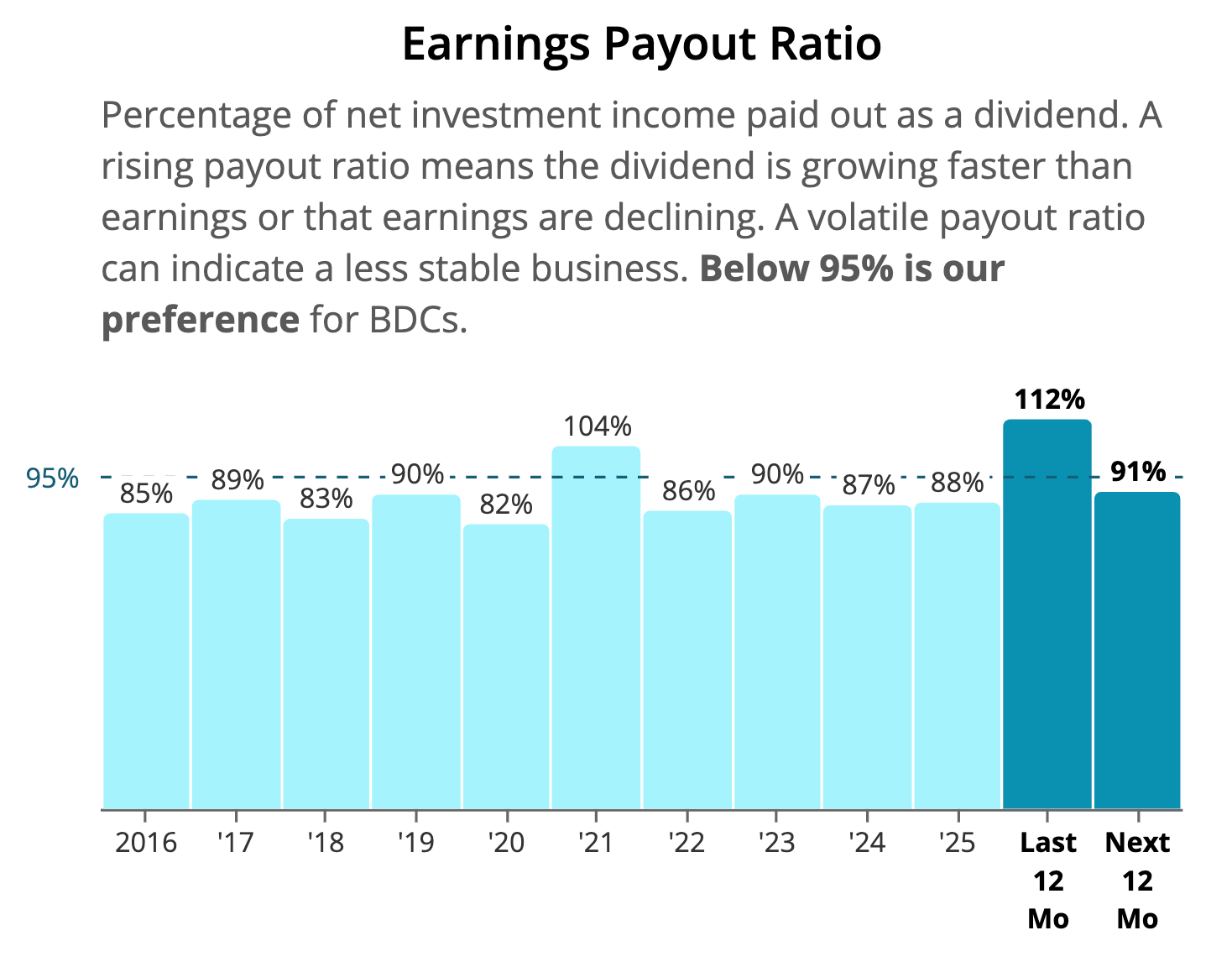
The smaller dividend should bring the payout ratio back under 100% of net investment income.
Founded in 2010, Sixth Street lends directly to midsize U.S. companies, mostly through first-lien loans, and holds an investment-grade credit rating. Its leverage remains within management's target range.
The smaller dividend should bring the payout ratio back under 100% of net investment income.
The watch item is software. Around 40% of the portfolio is tied to enterprise software companies, a group investors worry AI could disrupt. Management says those borrowers are still growing revenue and improving margins.
Loans that stopped paying rose from 0.6% to 1.4% of the portfolio in the first quarter of 2026, and interest paid with more debt instead of cash rose to nearly 8% of income. Neither level suggests widespread problems yet.
Loans that stopped paying rose from 0.6% to 1.4% of the portfolio in the first quarter of 2026, and interest paid with more debt instead of cash rose to nearly 8% of income. Neither level suggests widespread problems yet.
Ares Capital (ARCC)
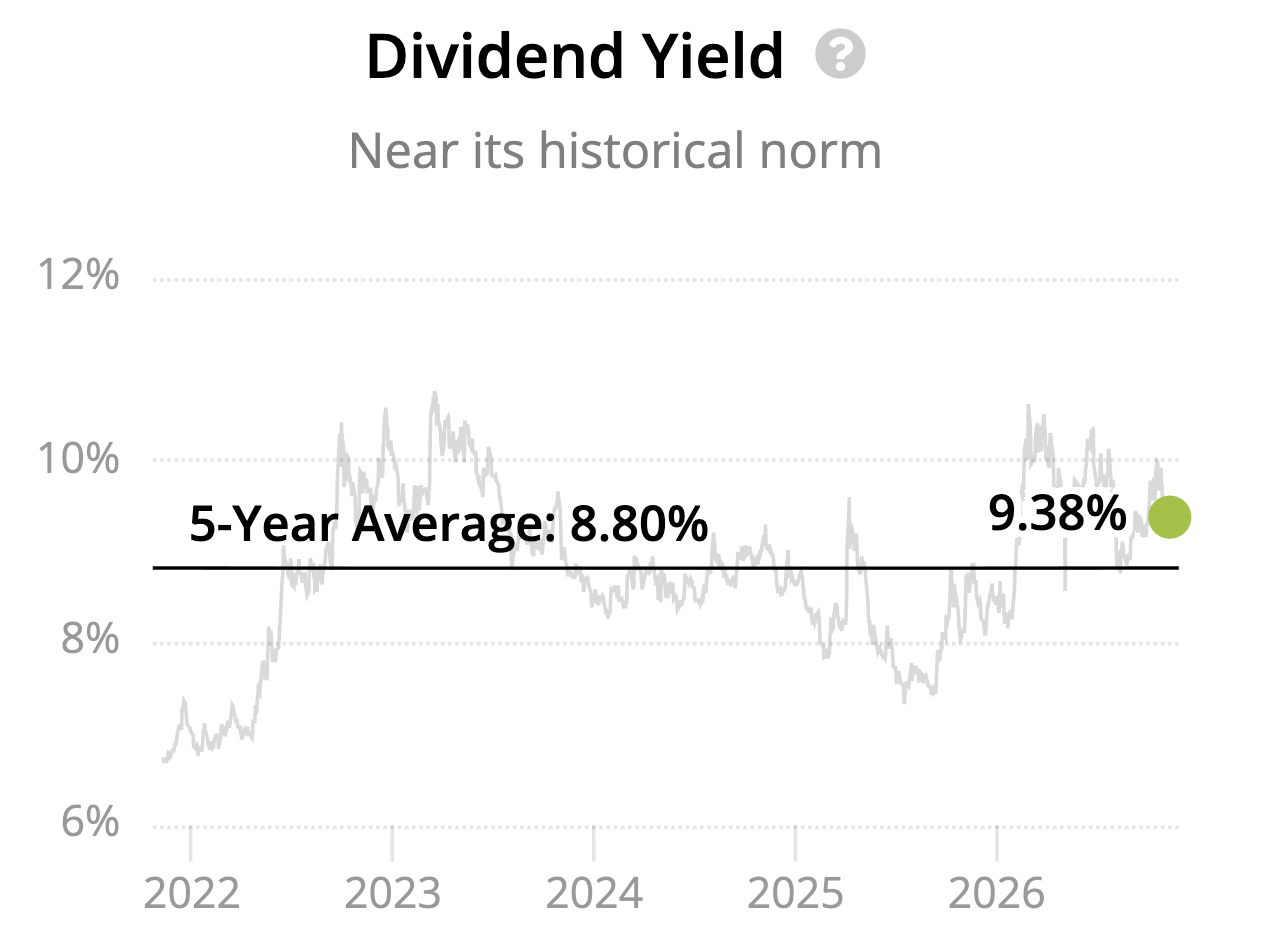
Dividend Yield: 9.9%
Dividend Safety Score: Borderline Safe (50)
Uninterrupted Dividend Streak: 15 years
Credit Rating: BBB
Payment Frequency: Quarterly
Dividend Safety Score: Borderline Safe (50)
Uninterrupted Dividend Streak: 15 years
Credit Rating: BBB
Payment Frequency: Quarterly
Ares Capital is the largest publicly traded BDC, and its dividend has less room for error than it used to. We lowered its Dividend Safety Score from 59 to 50, within the Borderline Safe range, in June 2026.
Founded in 2004 and managed by alternative asset manager Ares, the company lends to more than 600 midsize private businesses. In November 2026 it agreed to buy MidCap Financial (MFIC) for about $2.6 billion, a deal that should modestly lift its earnings next year.
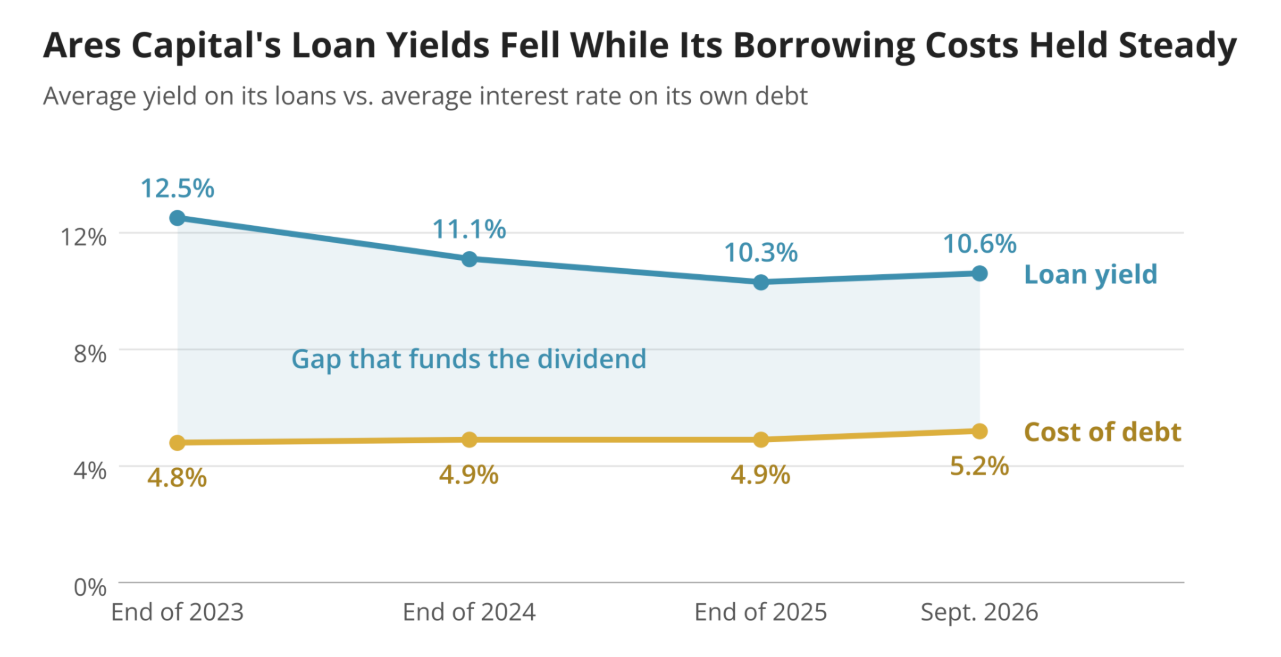
Rate cuts in 2024 and 2025 reduced the yield on its floating-rate loans from about 12.5% to 10% while its own borrowing costs stayed flat. That pushed its payout ratio to its highest level since 2017.
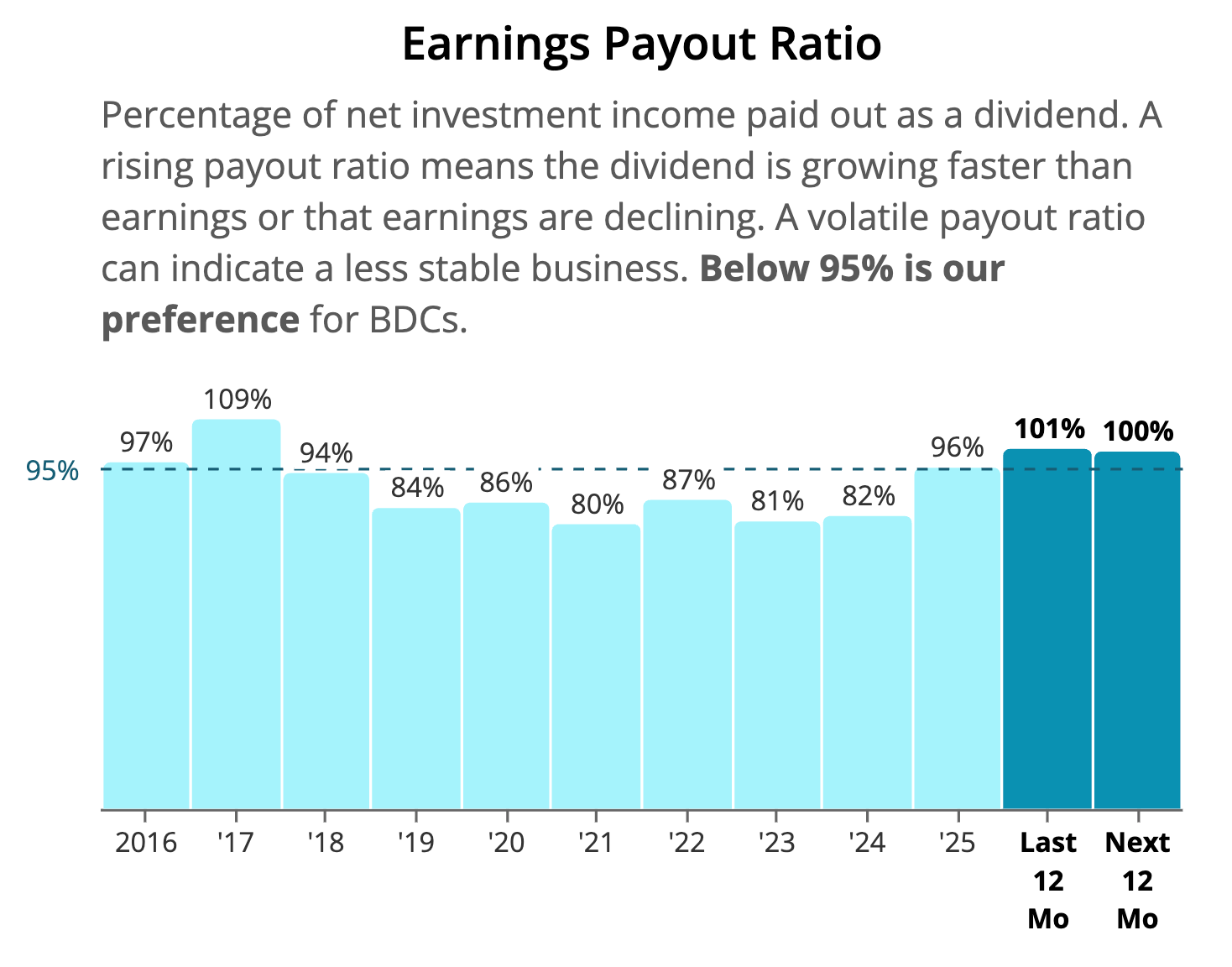
Spillover is the cushion. Ares Capital entered 2026 with about $1.37 per share of past profits it can still pay out, enough to cover a small shortfall for years.
The risks are software, which makes up about a fifth of its portfolio, and a recession that pushes more borrowers into default. Ares Capital cut its dividend by 17% in the 2008 financial crisis before rebuilding it.
The risks are software, which makes up about a fifth of its portfolio, and a recession that pushes more borrowers into default. Ares Capital cut its dividend by 17% in the 2008 financial crisis before rebuilding it.
Capital Southwest (CSWC)
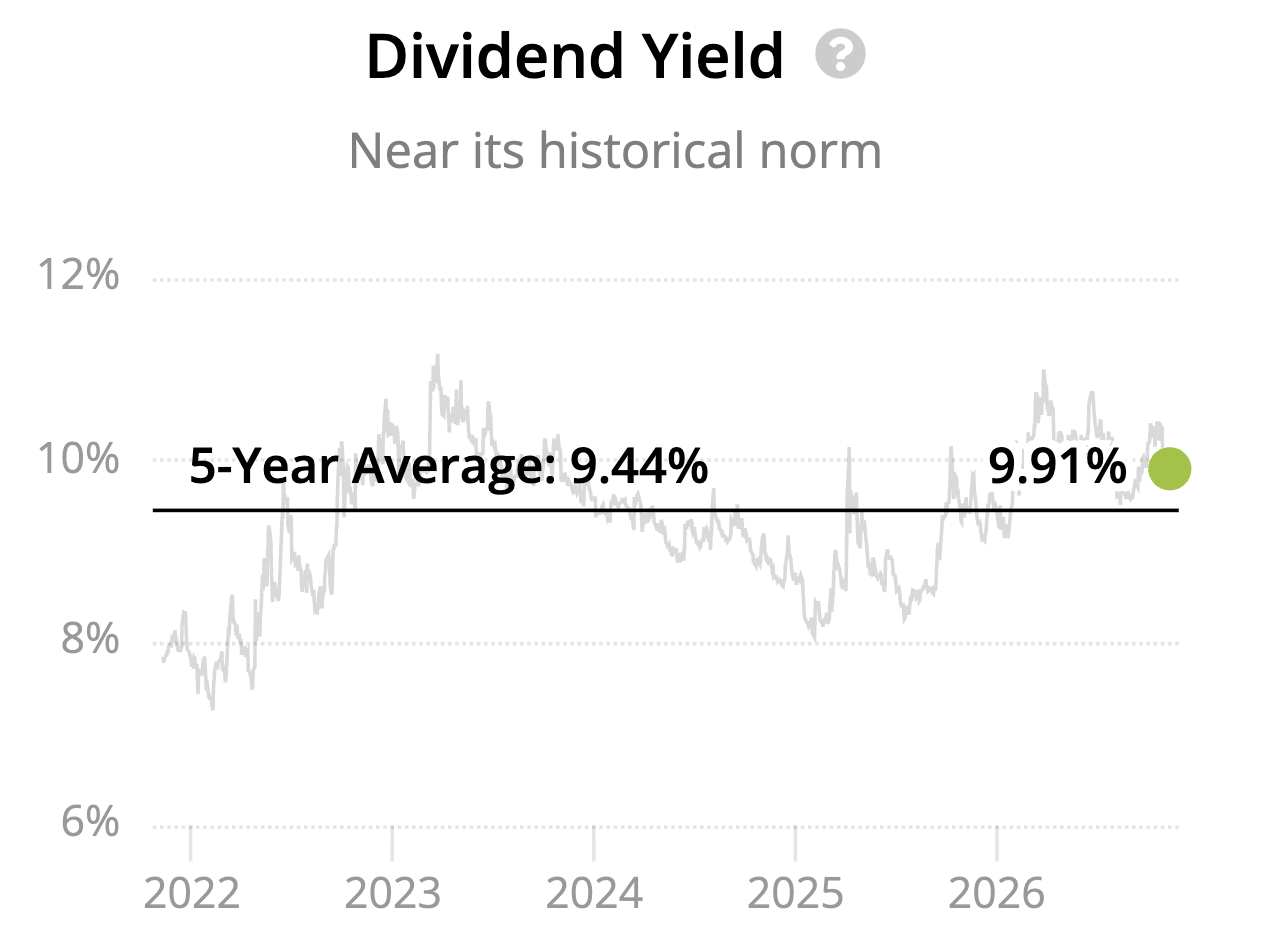
Dividend Yield: 9.8%
Dividend Safety Score: Borderline Safe (50)
Uninterrupted Dividend Streak: 10 years
Credit Rating: Not rated by S&P
Payment Frequency: Monthly
Dividend Safety Score: Borderline Safe (50)
Uninterrupted Dividend Streak: 10 years
Credit Rating: Not rated by S&P
Payment Frequency: Monthly
Capital Southwest manages itself and lends mostly to small, lower middle market companies. It switched from quarterly to monthly dividends in July 2025 without changing the annual amount.
About 90% of its loans are first lien, and it holds investment-grade ratings from Moody's and Fitch. Its net asset value per share has slipped only about 4% over the past decade, a better record than most BDCs.
Coverage is tight, with net investment income running just below the regular dividend.
About 90% of its loans are first lien, and it holds investment-grade ratings from Moody's and Fitch. Its net asset value per share has slipped only about 4% over the past decade, a better record than most BDCs.
Coverage is tight, with net investment income running just below the regular dividend.
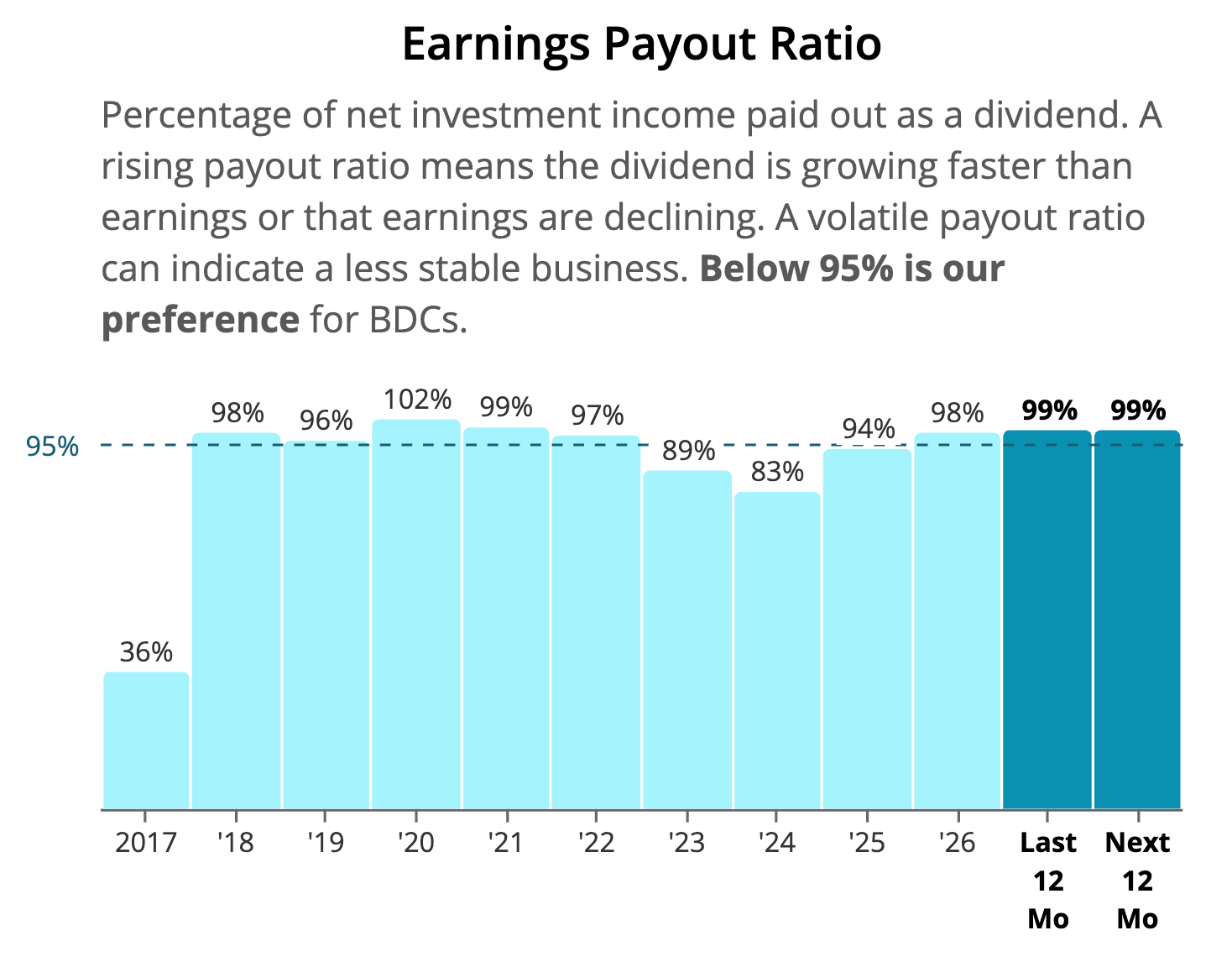
Management has said it will use spillover from past gains to help support the dividend, and it expects pending sales of stakes in its borrowers to add to that reserve. Only about 1.1% of its portfolio is in loans that have stopped paying.
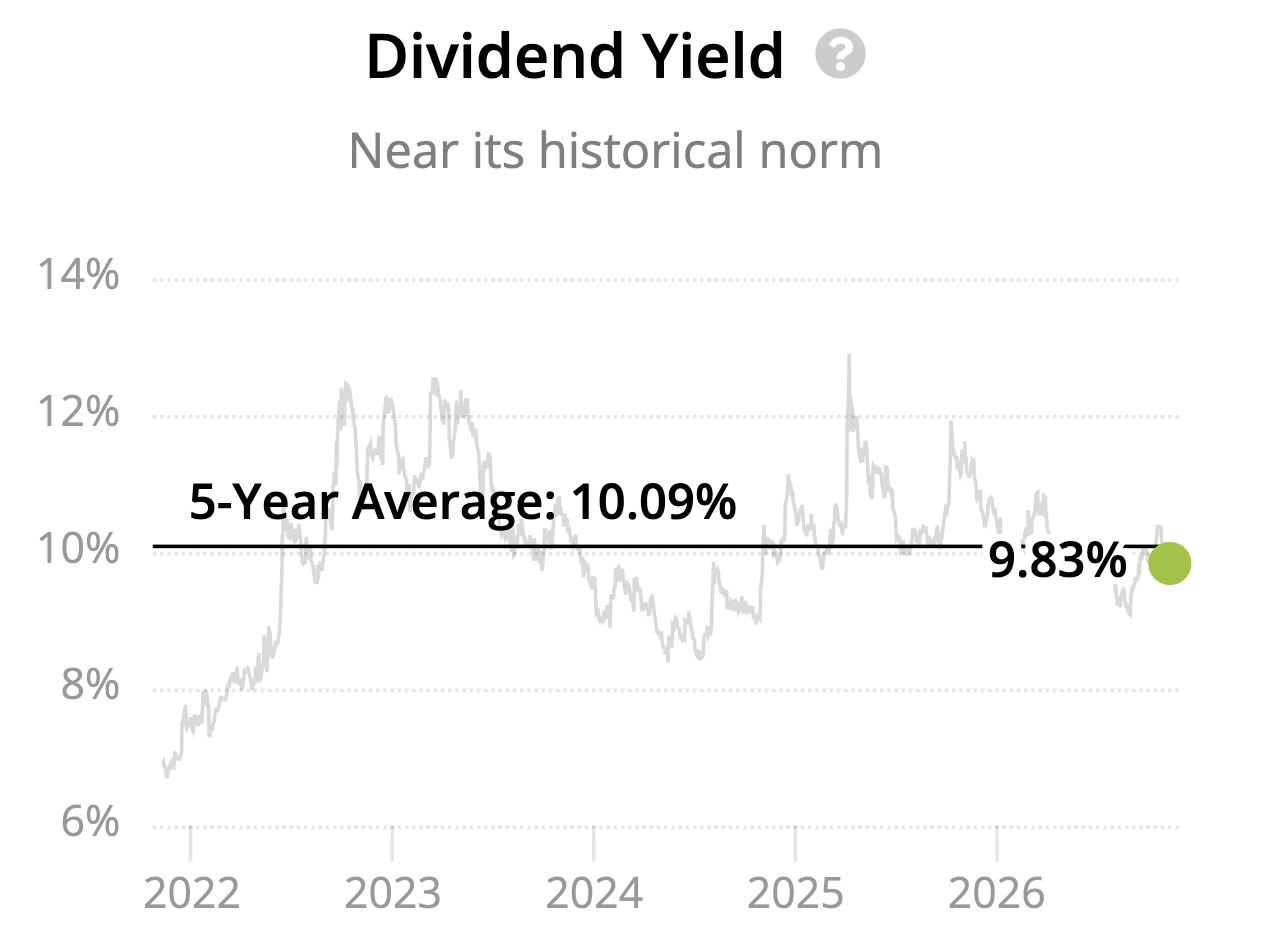
SLR Investment (SLRC)
Dividend Yield: 10.5%
Dividend Safety Score: Borderline Safe (49)
Uninterrupted Dividend Streak: 0 years
Credit Rating: Not rated by S&P
Payment Frequency: Quarterly
Dividend Safety Score: Borderline Safe (49)
Uninterrupted Dividend Streak: 0 years
Credit Rating: Not rated by S&P
Payment Frequency: Quarterly
SLR Investment cut its dividend by 24% in May 2026 as lower rates and slower deal activity reduced its income. It is the only BDC yielding 10% or more that scores better than Unsafe.
SLR leans on loans backed by specific collateral, such as receivables, inventory, or equipment. About 85% of its portfolio is collateral-backed and around 95% is first lien, and software makes up only about 2%.
None of its loans had stopped paying at the time of its cut, but interest paid with more debt instead of cash doubled to about 11% of investment income, a sign some borrowers are under strain.
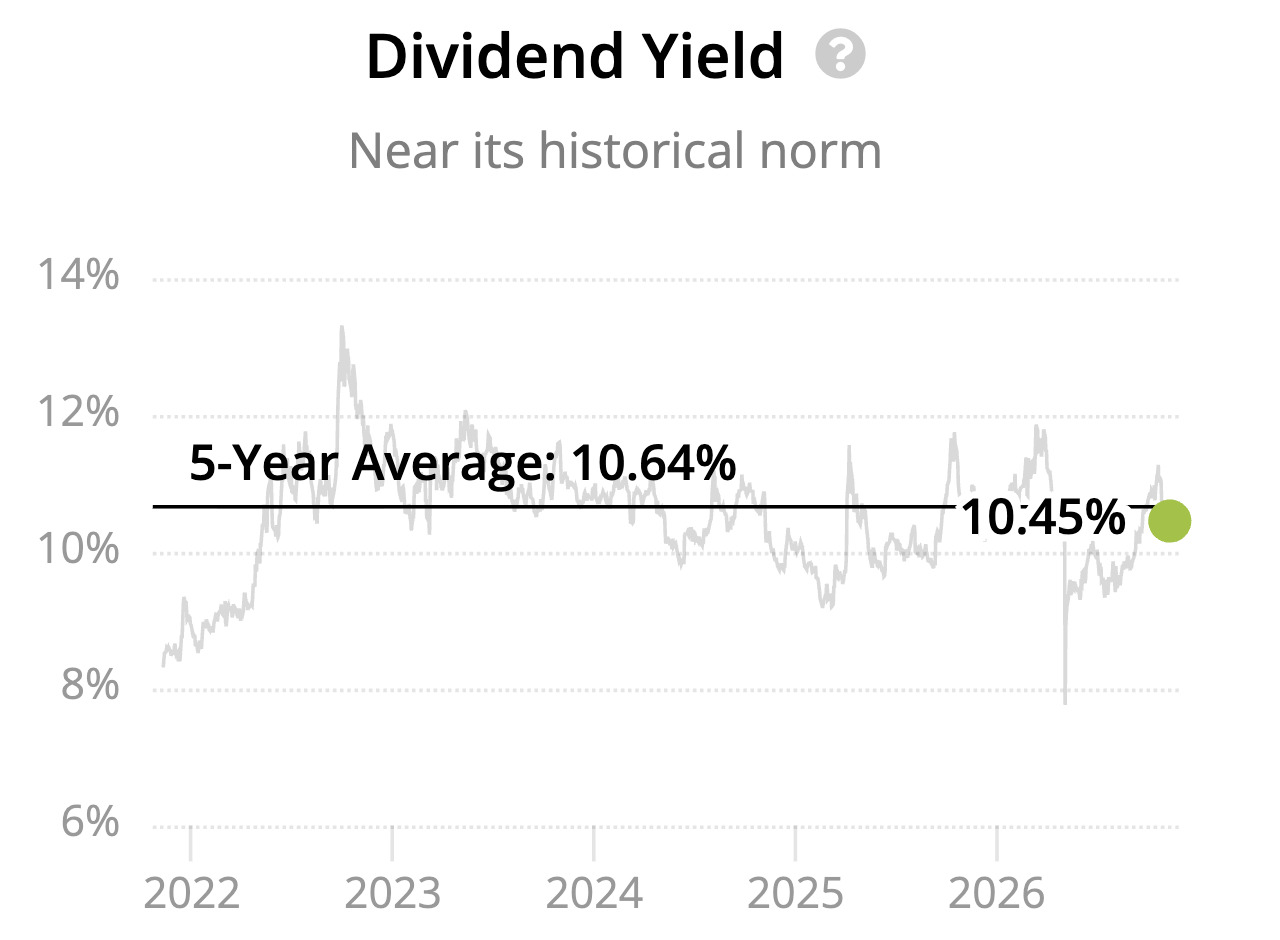
Hercules Capital (HTGC)
Dividend Yield: 9.8%
Dividend Safety Score: Borderline Safe (45)
Uninterrupted Dividend Streak: 15 years
Credit Rating: Not rated by S&P
Payment Frequency: Quarterly
Dividend Safety Score: Borderline Safe (45)
Uninterrupted Dividend Streak: 15 years
Credit Rating: Not rated by S&P
Payment Frequency: Quarterly
Hercules lends to venture-backed technology and life sciences companies, a riskier group of borrowers that it has managed well. We upgraded it to Borderline Safe in 2019 as dividend coverage improved.
Formed in 2003, Hercules provides structured debt and some equity to companies funding growth, acquisitions, or the run-up to an IPO. It also earns fees by managing investment funds for outside investors.
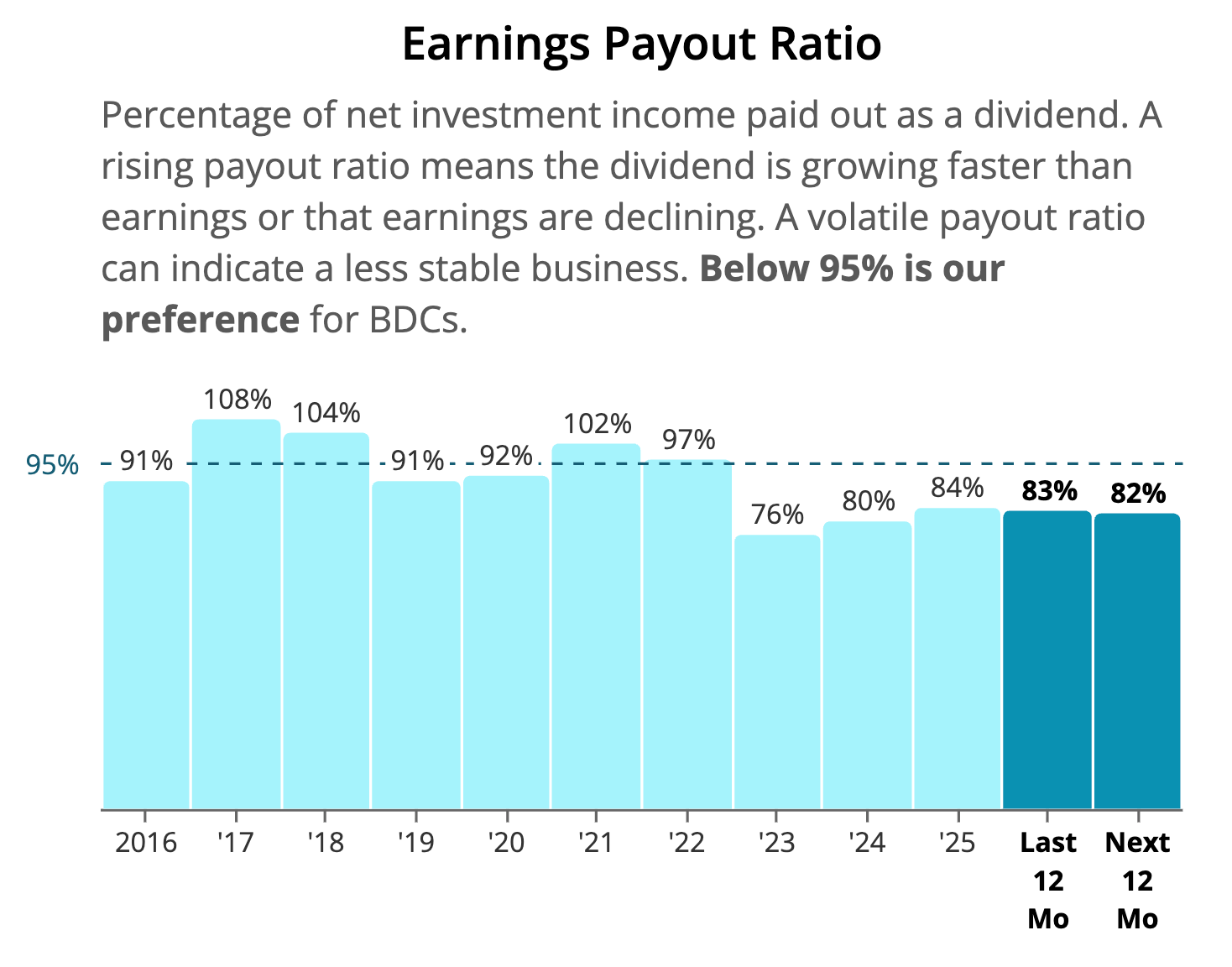
Its regular dividend has been flat since 2023, and coverage remains comfortable.
Formed in 2003, Hercules provides structured debt and some equity to companies funding growth, acquisitions, or the run-up to an IPO. It also earns fees by managing investment funds for outside investors.
Its regular dividend has been flat since 2023, and coverage remains comfortable.
The risk is in the borrowers. Young companies that burn cash can run into trouble together when venture funding dries up, which is what keeps Hercules below Safe despite its coverage.
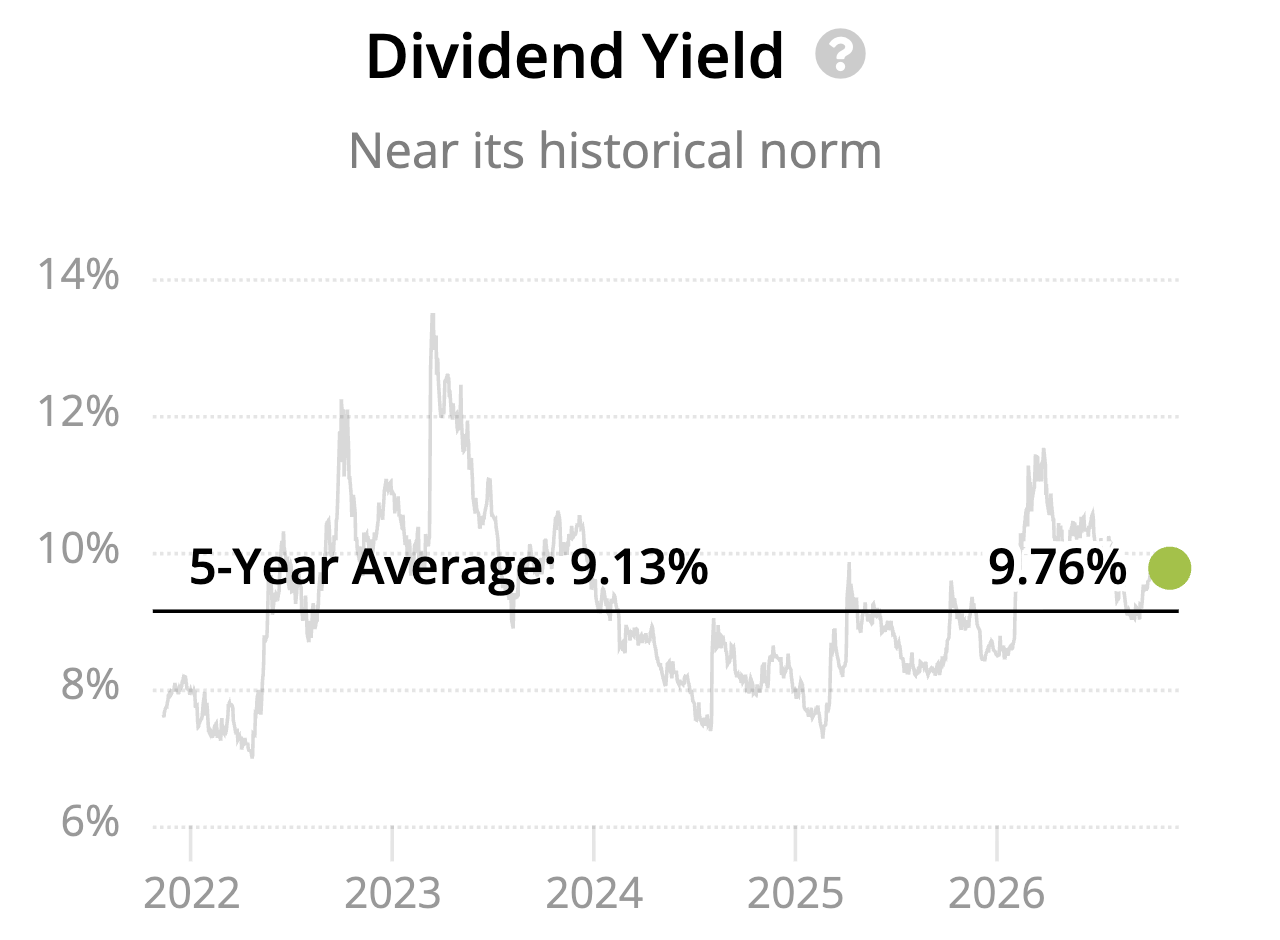
Gladstone Investment (GAIN)
Dividend Yield: 6.4%
Dividend Safety Score: Borderline Safe (41)
Uninterrupted Dividend Streak: 16 years
Credit Rating: Not rated by S&P
Payment Frequency: Monthly
Dividend Safety Score: Borderline Safe (41)
Uninterrupted Dividend Streak: 16 years
Credit Rating: Not rated by S&P
Payment Frequency: Monthly
Gladstone Investment sits one point above Unsafe. It both lends to and buys stakes in profitable lower middle market businesses, so much of its profit comes from gains when it sells a company, and those arrive unevenly.
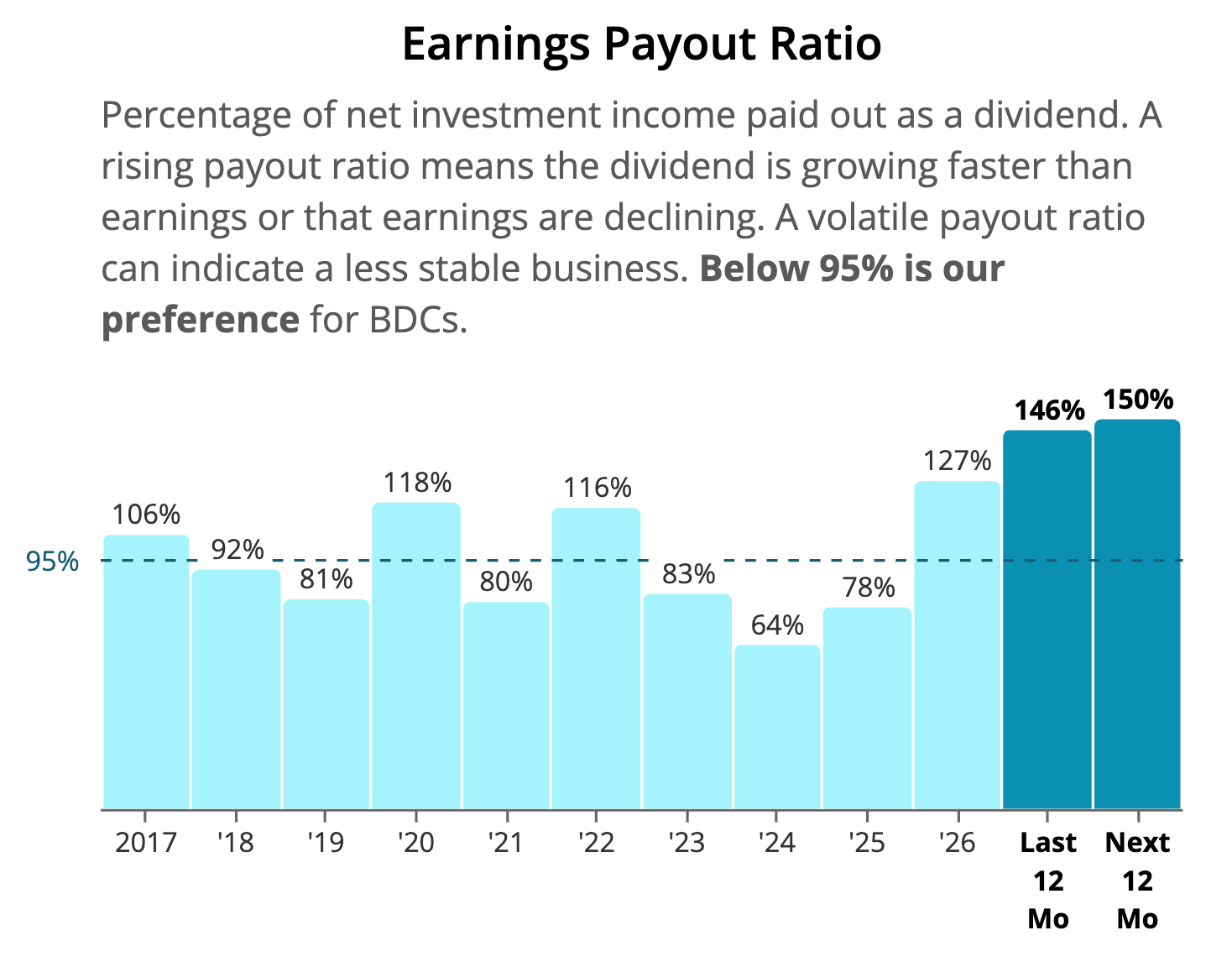
That makes its payout ratio on net investment income alone swing too widely to be useful. Gladstone pays its regular monthly dividend mainly from loan interest and uses gains from exits mostly for supplemental payouts.
The regular dividend has been flat since 2022. Gladstone cut it in the 2008 financial crisis, then raised it steadily for over a decade.
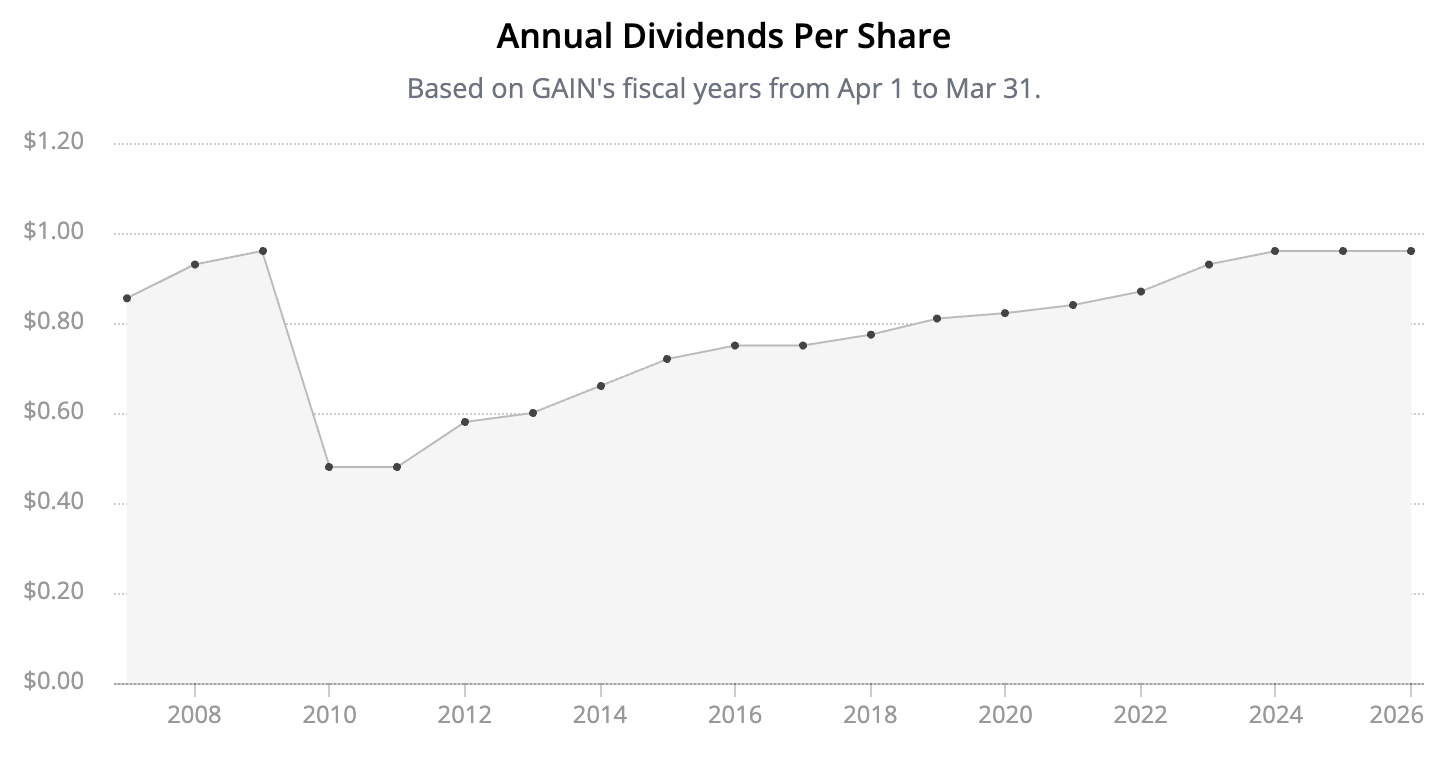
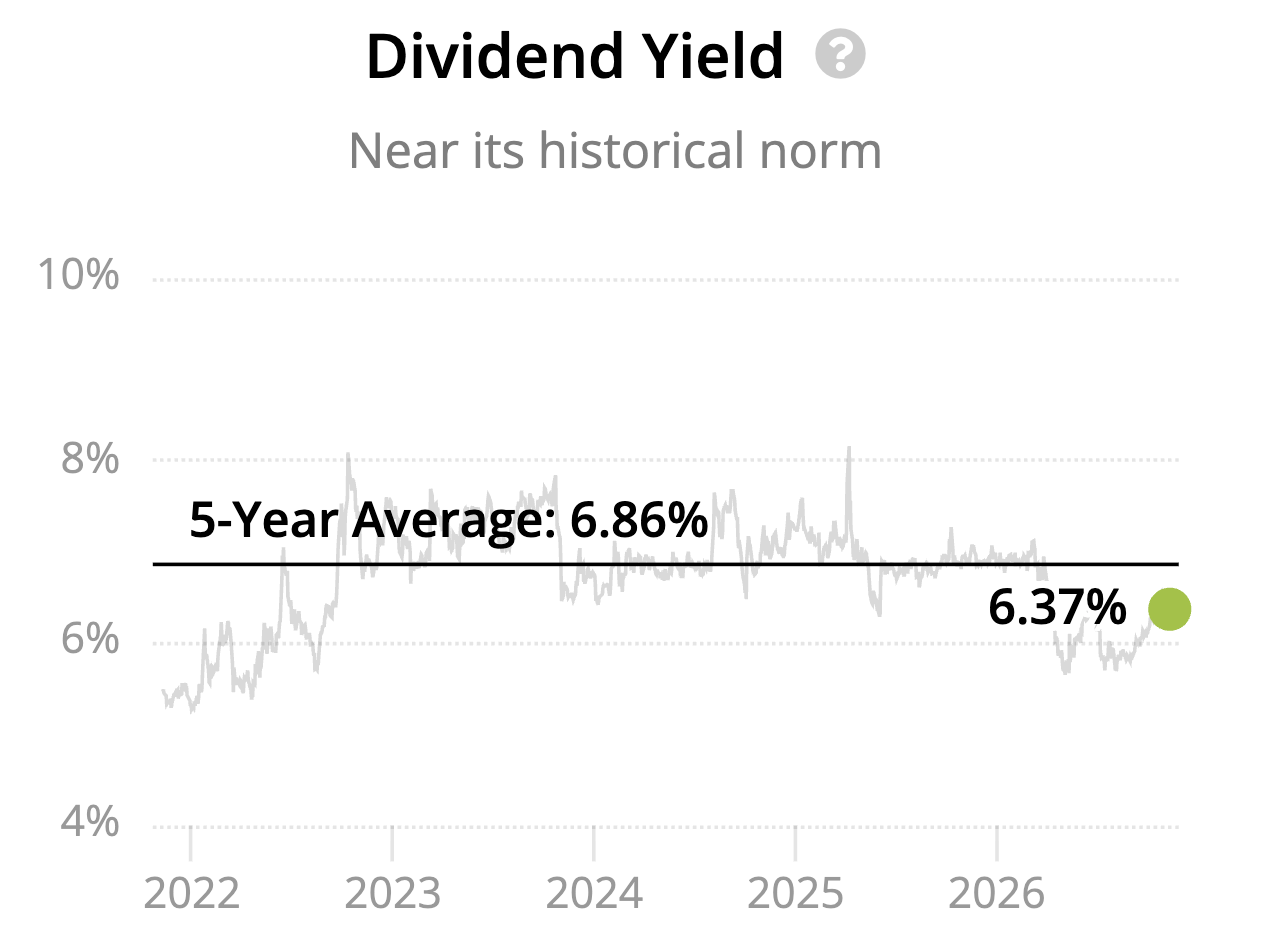
At 6.4%, its yield is among the lowest on this list, closer to Main Street's than to most BDCs.
Saratoga Investment (SAR)
Dividend Yield: 22.9%
Dividend Safety Score: Unsafe (40)
Uninterrupted Dividend Streak: 5 years
Credit Rating: Not rated by S&P
Payment Frequency: Monthly
Dividend Safety Score: Unsafe (40)
Uninterrupted Dividend Streak: 5 years
Credit Rating: Not rated by S&P
Payment Frequency: Monthly
Saratoga pays out far more than it earns, and its yield is almost double its five-year average, a sign the market expects a cut. The dividend has been flat since 2024.
Fidus Investment (FDUS)
Dividend Yield: 8.7%
Dividend Safety Score: Unsafe (40)
Uninterrupted Dividend Streak: 4 years
Credit Rating: Not rated by S&P
Payment Frequency: Quarterly
Dividend Safety Score: Unsafe (40)
Uninterrupted Dividend Streak: 4 years
Credit Rating: Not rated by S&P
Payment Frequency: Quarterly
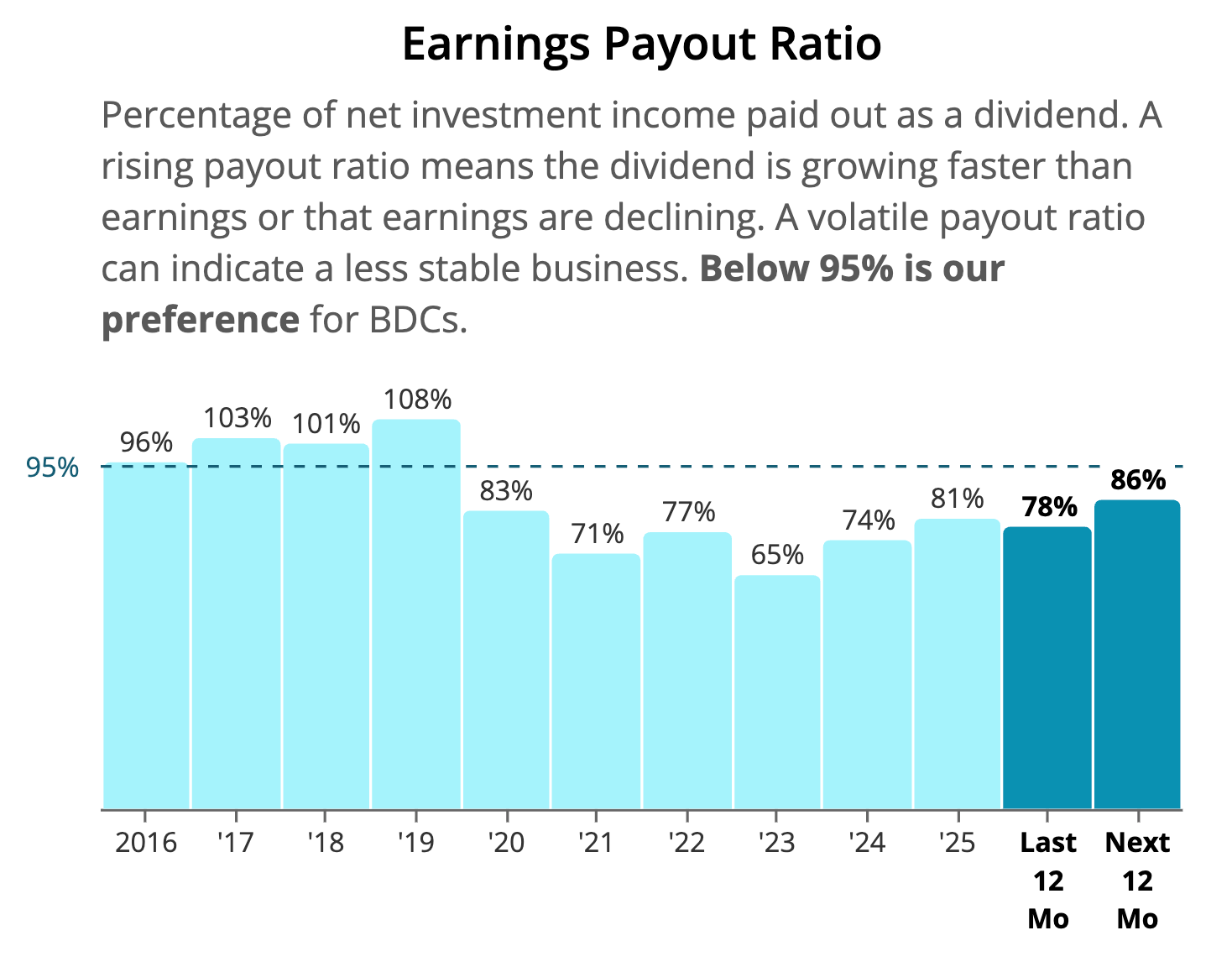
Fidus covers its dividend comfortably today, with a payout ratio below 90%. It scores Unsafe because its smaller, lower middle market borrowers carry more risk over a full economic cycle, and it cut its dividend by 23% at the start of the pandemic in 2020.
Horizon Technology Finance (HRZN)
Dividend Yield: 18.6%
Dividend Safety Score: Unsafe (40)
Uninterrupted Dividend Streak: 0 years
Credit Rating: Not rated by S&P
Payment Frequency: Monthly
Dividend Safety Score: Unsafe (40)
Uninterrupted Dividend Streak: 0 years
Credit Rating: Not rated by S&P
Payment Frequency: Monthly
Horizon cut its dividend by 45% in March 2026, and it scored Unsafe before the cut. It lends to young, venture-backed companies and merged with fellow BDC Monroe Capital Corporation in 2026.
BCP Investment (BCIC)
Dividend Yield: 16.0%
Dividend Safety Score: Unsafe (40)
Uninterrupted Dividend Streak: 0 years
Credit Rating: Not rated by S&P
Payment Frequency: Monthly
Dividend Safety Score: Unsafe (40)
Uninterrupted Dividend Streak: 0 years
Credit Rating: Not rated by S&P
Payment Frequency: Monthly
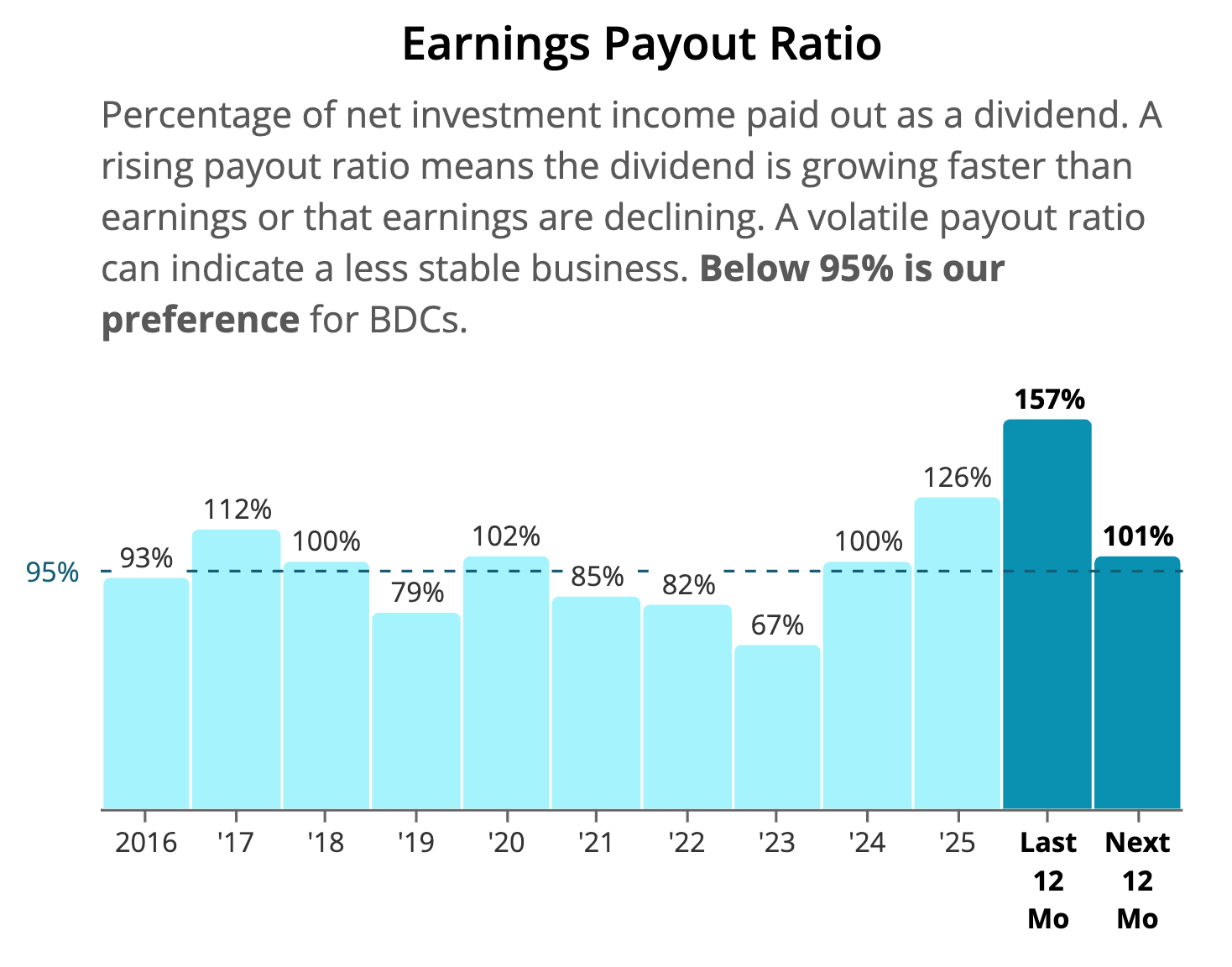
BCP Investment cut its dividend by 43% in March 2026 and switched from quarterly to monthly payments. The smaller dividend is covered for now, and at about $76 million in market value it is one of the smallest companies here.
Blue Owl Capital Corporation (OBDC)
Dividend Yield: 11.1%
Dividend Safety Score: Unsafe (40)
Uninterrupted Dividend Streak: 0 years
Credit Rating: BBB-
Payment Frequency: Quarterly
Dividend Safety Score: Unsafe (40)
Uninterrupted Dividend Streak: 0 years
Credit Rating: BBB-
Payment Frequency: Quarterly
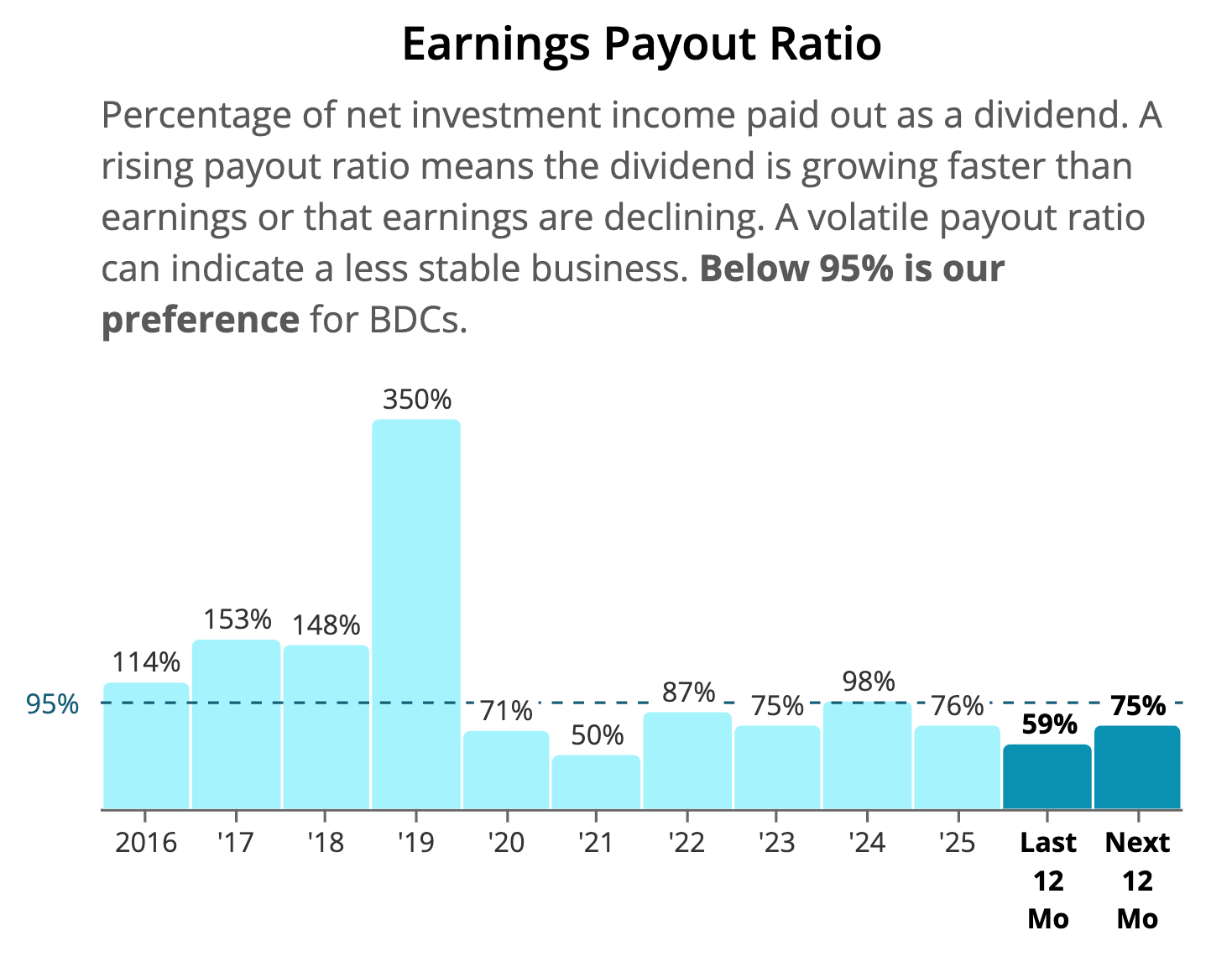
We downgraded OBDC to Unsafe in March 2026, and it cut its dividend by 16% in May. More than 95% of its loans carry floating rates, and a flood of money into private credit has forced lenders to accept thinner spreads.
Blackstone Secured Lending (BXSL)
Dividend Yield: 10.0%
Dividend Safety Score: Unsafe (40)
Uninterrupted Dividend Streak: 0 years
Credit Rating: BBB-
Payment Frequency: Quarterly
Dividend Safety Score: Unsafe (40)
Uninterrupted Dividend Streak: 0 years
Credit Rating: BBB-
Payment Frequency: Quarterly
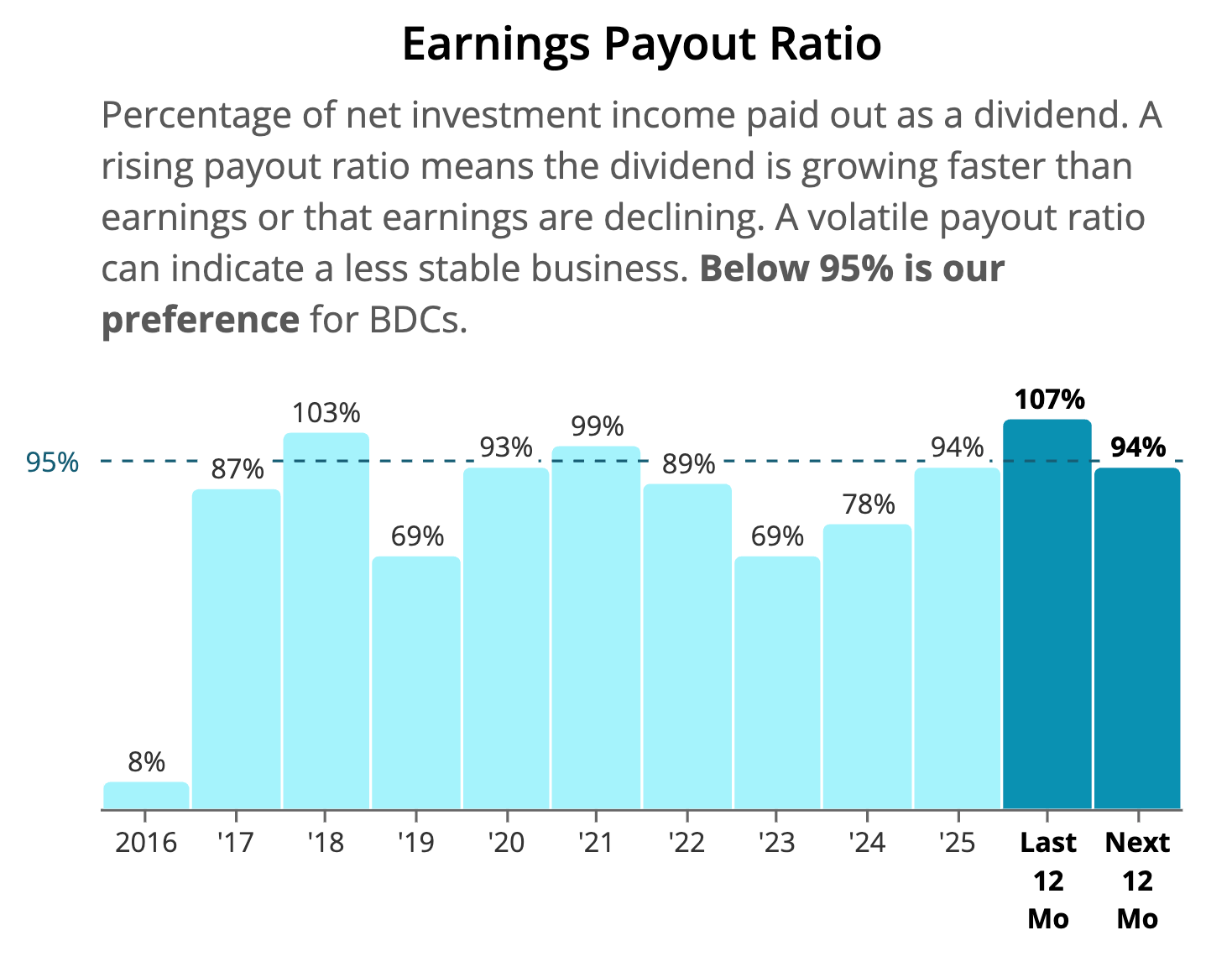
BXSL is one of the highest-quality BDCs, with about 98% of its portfolio in first-lien loans and an investment-grade rating. We downgraded it to Unsafe in March 2026 as falling loan yields and costlier debt refinancing squeezed coverage, and it cut its dividend by about 22% in November.
TriplePoint Venture Growth (TPVG)
Dividend Yield: 21.4%
Dividend Safety Score: Unsafe (31)
Uninterrupted Dividend Streak: 0 years
Credit Rating: Not rated by S&P
Payment Frequency: Quarterly
Dividend Safety Score: Unsafe (31)
Uninterrupted Dividend Streak: 0 years
Credit Rating: Not rated by S&P
Payment Frequency: Quarterly
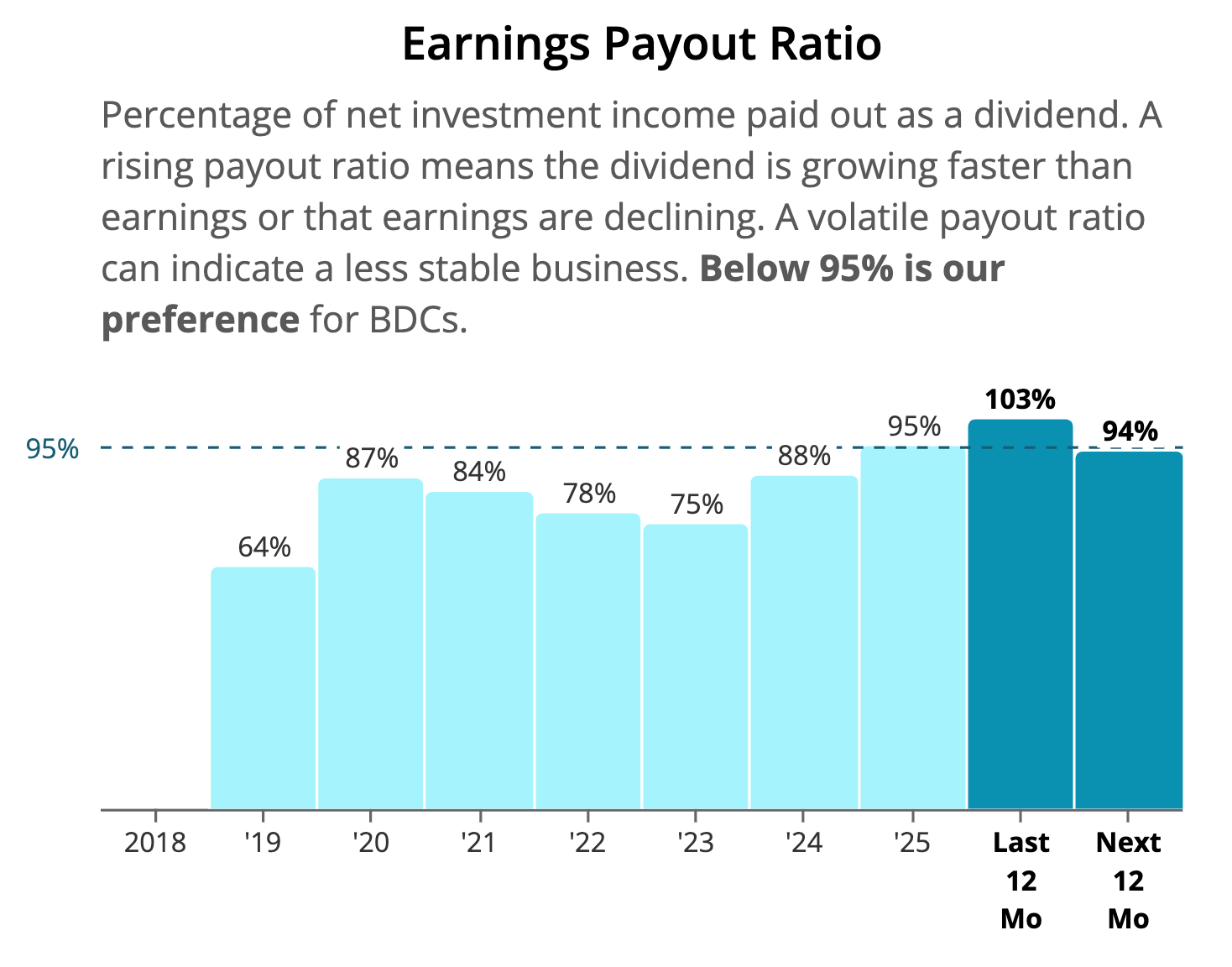
TriplePoint lends to venture-backed growth companies in technology and other fast-growing industries. We expect it to pay out about 121% of its net investment income over the next 12 months, and its yield sits far above its five-year average of 15.1%.
Trinity Capital (TRIN)
Dividend Yield: 11.3%
Dividend Safety Score: Unsafe (30)
Uninterrupted Dividend Streak: 4 years
Credit Rating: Not rated by S&P
Payment Frequency: Monthly
Dividend Safety Score: Unsafe (30)
Uninterrupted Dividend Streak: 4 years
Credit Rating: Not rated by S&P
Payment Frequency: Monthly
Trinity manages itself, an advantage most BDCs lack, but it pays out 98% of its net investment income. Its borrowers are younger, growth-stage companies, which adds credit risk if the economy slows.
Prospect Capital (PSEC)
Dividend Yield: 27.4%
Dividend Safety Score: Unsafe (30)
Uninterrupted Dividend Streak: 0 years
Credit Rating: BB+
Payment Frequency: Monthly
Dividend Safety Score: Unsafe (30)
Uninterrupted Dividend Streak: 0 years
Credit Rating: BB+
Payment Frequency: Monthly
Prospect cut its dividend by 22% in May 2026. The smaller payout still isn't expected to be covered over the next year, and years of share issuance have worn down its net asset value.
Runway Growth Finance (RWAY)
Dividend Yield: 19.8%
Dividend Safety Score: Unsafe (30)
Uninterrupted Dividend Streak: 0 years
Credit Rating: Not rated by S&P
Payment Frequency: Quarterly
Dividend Safety Score: Unsafe (30)
Uninterrupted Dividend Streak: 0 years
Credit Rating: Not rated by S&P
Payment Frequency: Quarterly
Runway makes senior secured loans to venture-backed companies in technology, healthcare, and other growth industries. It pays out nearly all of its net investment income, and its yield is far above its five-year average of 13.2%.
CION Investment (CION)
Dividend Yield: 17.1%
Dividend Safety Score: Unsafe (30)
Uninterrupted Dividend Streak: 0 years
Credit Rating: Not rated by S&P
Payment Frequency: Monthly
Dividend Safety Score: Unsafe (30)
Uninterrupted Dividend Streak: 0 years
Credit Rating: Not rated by S&P
Payment Frequency: Monthly
CION cut its regular dividend by about 17% in January 2026, when it switched to monthly payments. It lends to midsize companies, mostly through senior secured loans, and its yield sits well above its five-year average of 12.7%.
Oaktree Specialty Lending (OCSL)
Dividend Yield: 9.6%
Dividend Safety Score: Unsafe (30)
Uninterrupted Dividend Streak: 0 years
Credit Rating: Not rated by S&P
Payment Frequency: Quarterly
Dividend Safety Score: Unsafe (30)
Uninterrupted Dividend Streak: 0 years
Credit Rating: Not rated by S&P
Payment Frequency: Quarterly
We have downgraded Oaktree twice since 2024, first over rising bad loans and again in March 2026 as coverage tightened. It cut its dividend by 25% in May.
WhiteHorse Finance (WHF)
Dividend Yield: 12.3%
Dividend Safety Score: Unsafe (28)
Uninterrupted Dividend Streak: 0 years
Credit Rating: Not rated by S&P
Payment Frequency: Quarterly
Dividend Safety Score: Unsafe (28)
Uninterrupted Dividend Streak: 0 years
Credit Rating: Not rated by S&P
Payment Frequency: Quarterly
WhiteHorse cut its dividend by 35% in November 2025 and still pays out all of its net investment income. An adviser affiliated with private equity firm H.I.G. Capital manages it.
Goldman Sachs BDC (GSBD)
Dividend Yield: 14.9%
Dividend Safety Score: Unsafe (26)
Uninterrupted Dividend Streak: 0 years
Credit Rating: Not rated by S&P
Payment Frequency: Quarterly
Dividend Safety Score: Unsafe (26)
Uninterrupted Dividend Streak: 0 years
Credit Rating: Not rated by S&P
Payment Frequency: Quarterly
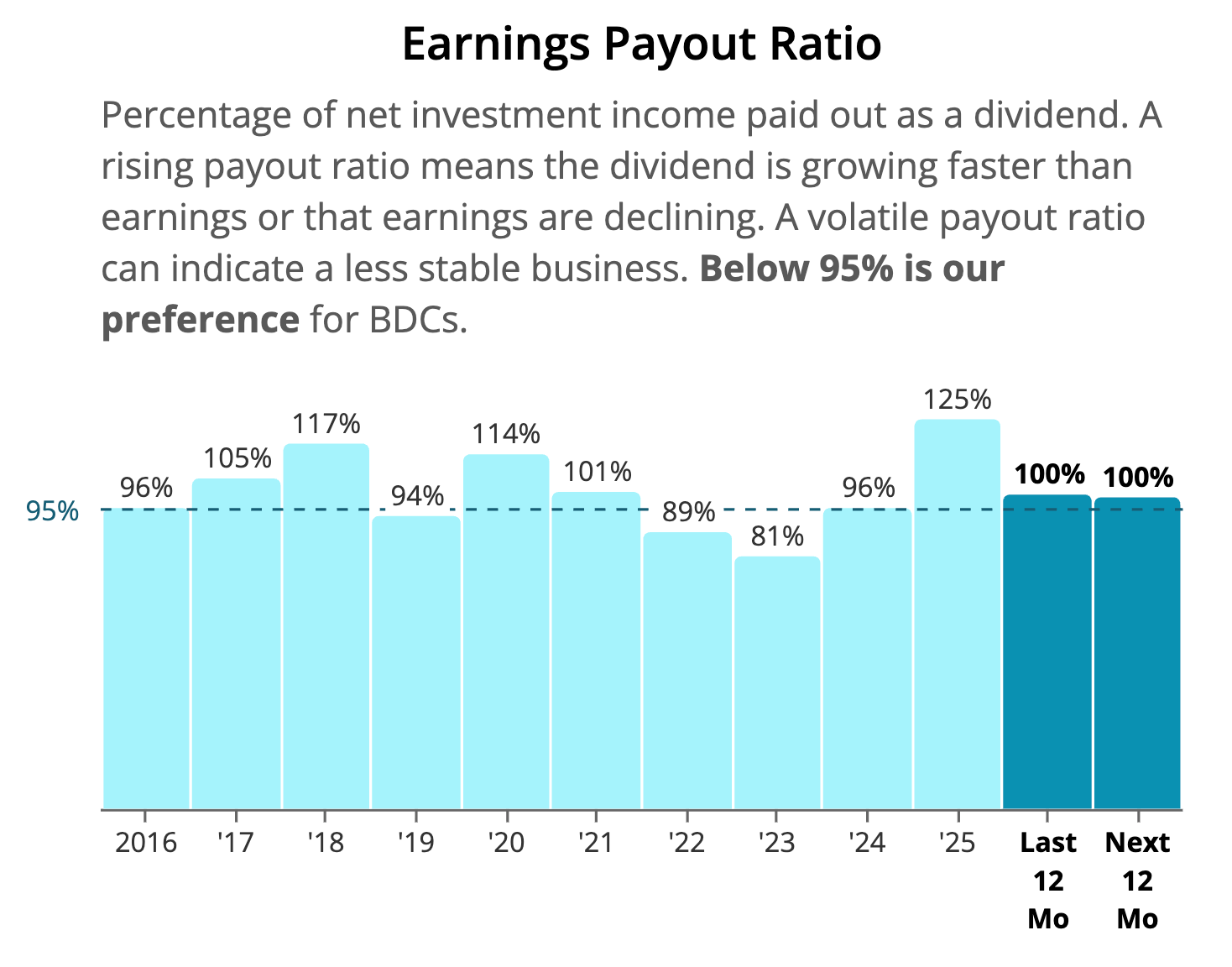
Goldman Sachs BDC benefits from the deal flow of the wider Goldman platform, but its earnings no longer cover the dividend. We expect it to pay out about 106% of its net investment income over the next 12 months.
FS KKR Capital (FSK)
Dividend Yield: 14.8%
Dividend Safety Score: Unsafe (25)
Uninterrupted Dividend Streak: 3 years
Credit Rating: Not rated by S&P
Payment Frequency: Quarterly
Dividend Safety Score: Unsafe (25)
Uninterrupted Dividend Streak: 3 years
Credit Rating: Not rated by S&P
Payment Frequency: Quarterly
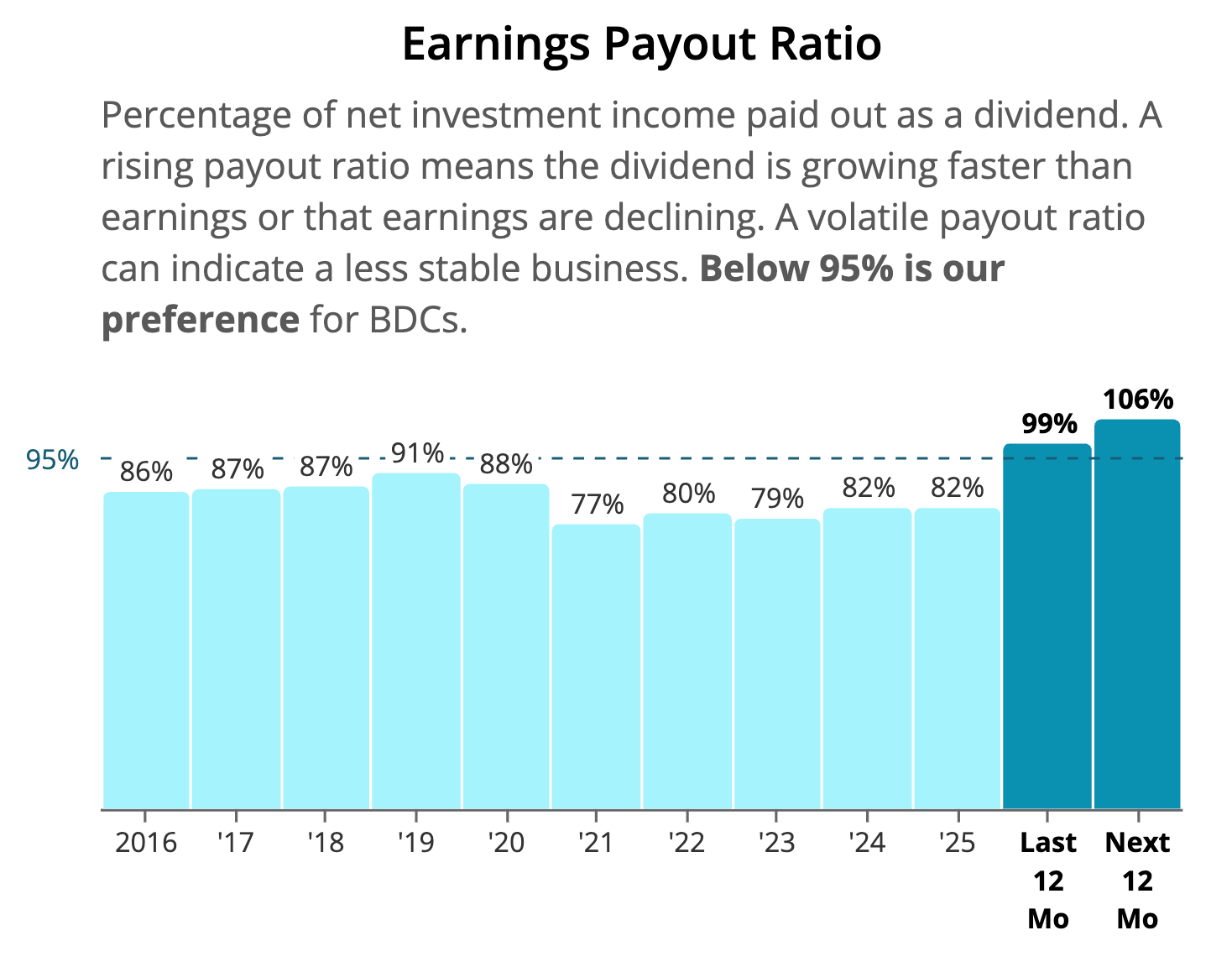
FS KKR is one of the largest BDCs. It cut its dividend in February and again in May 2026, then raised it slightly in August, leaving its regular quarterly payout about 31% below its 2025 level.
Golub Capital BDC (GBDC)
Dividend Yield: 10.4%
Dividend Safety Score: Unsafe (25)
Uninterrupted Dividend Streak: 0 years
Credit Rating: BBB-
Payment Frequency: Quarterly
Dividend Safety Score: Unsafe (25)
Uninterrupted Dividend Streak: 0 years
Credit Rating: BBB-
Payment Frequency: Quarterly
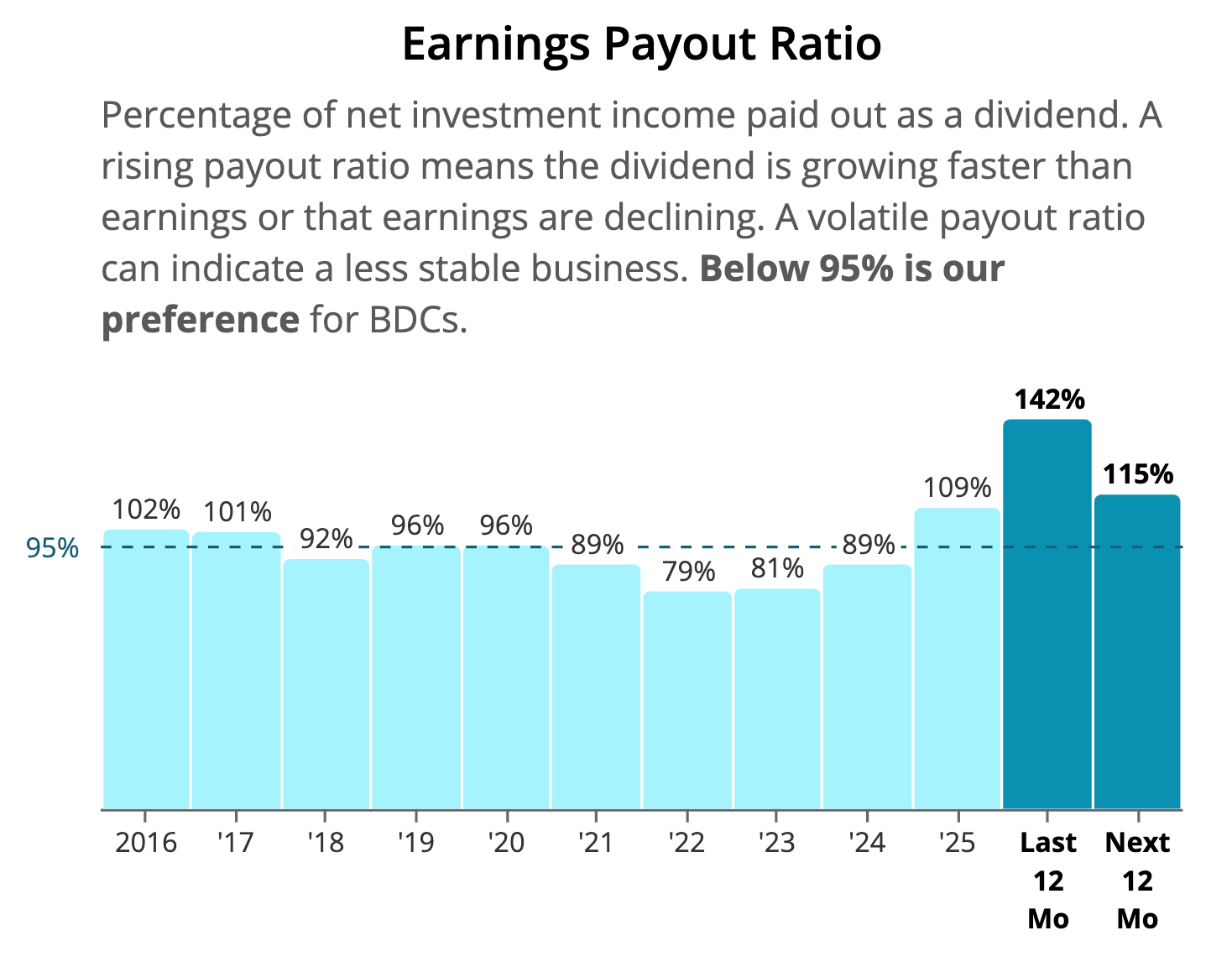
Golub lends to midsize companies owned by private equity firms and holds an investment-grade rating. It cut its dividend by about 15% in February 2026 and still pays out slightly more than it earns.
New Mountain Finance (NMFC)
Dividend Yield: 14.5%
Dividend Safety Score: Unsafe (23)
Uninterrupted Dividend Streak: 0 years
Credit Rating: Not rated by S&P
Payment Frequency: Quarterly
Dividend Safety Score: Unsafe (23)
Uninterrupted Dividend Streak: 0 years
Credit Rating: Not rated by S&P
Payment Frequency: Quarterly
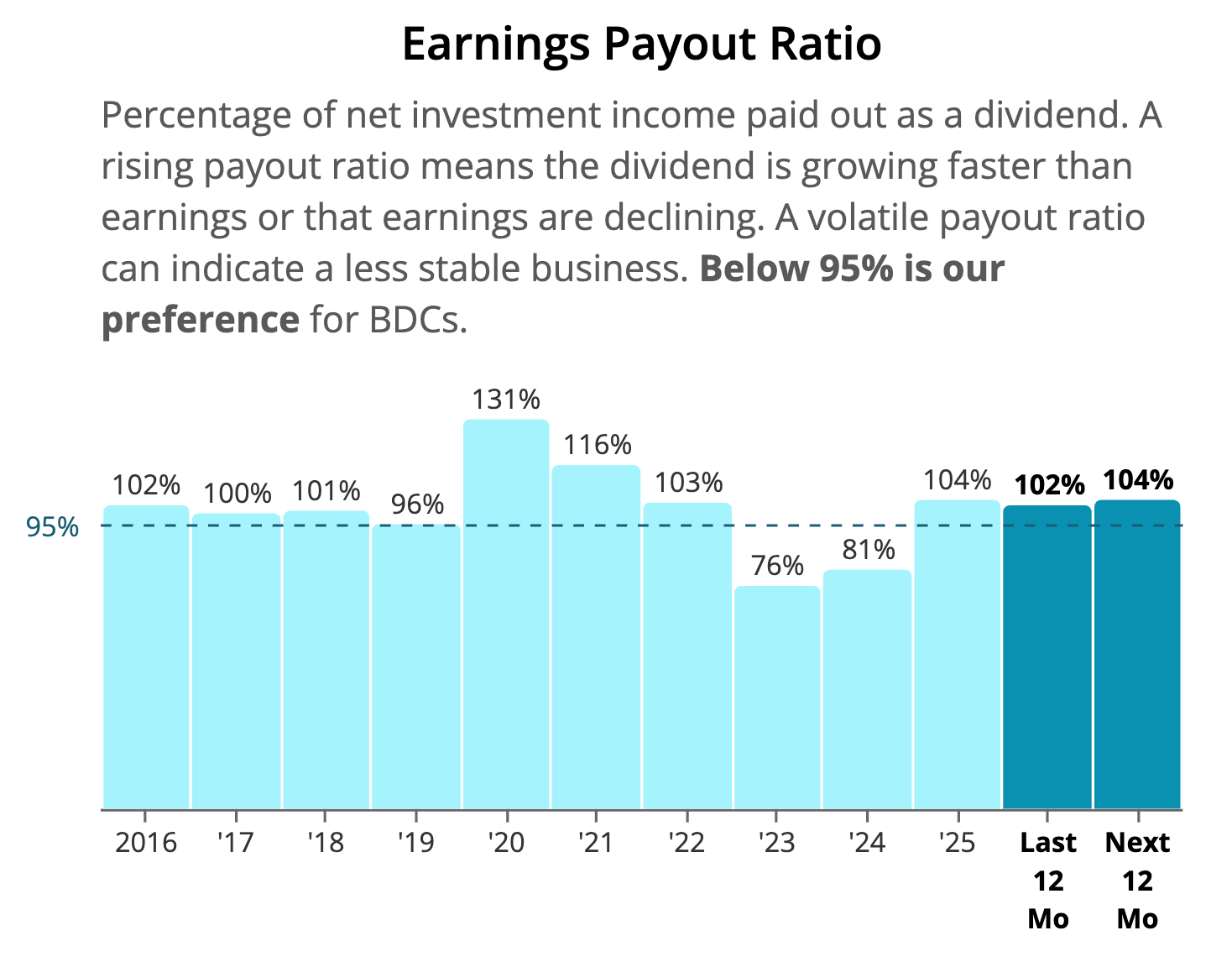
New Mountain targets industries it considers defensive, such as healthcare, software, and business services. It cut its dividend by about 22% in March 2026, and the smaller payout remains barely covered.
PennantPark Floating Rate Capital (PFLT)
Dividend Yield: 13.9%
Dividend Safety Score: Unsafe (23)
Uninterrupted Dividend Streak: 0 years
Credit Rating: Not rated by S&P
Payment Frequency: Monthly
Dividend Safety Score: Unsafe (23)
Uninterrupted Dividend Streak: 0 years
Credit Rating: Not rated by S&P
Payment Frequency: Monthly
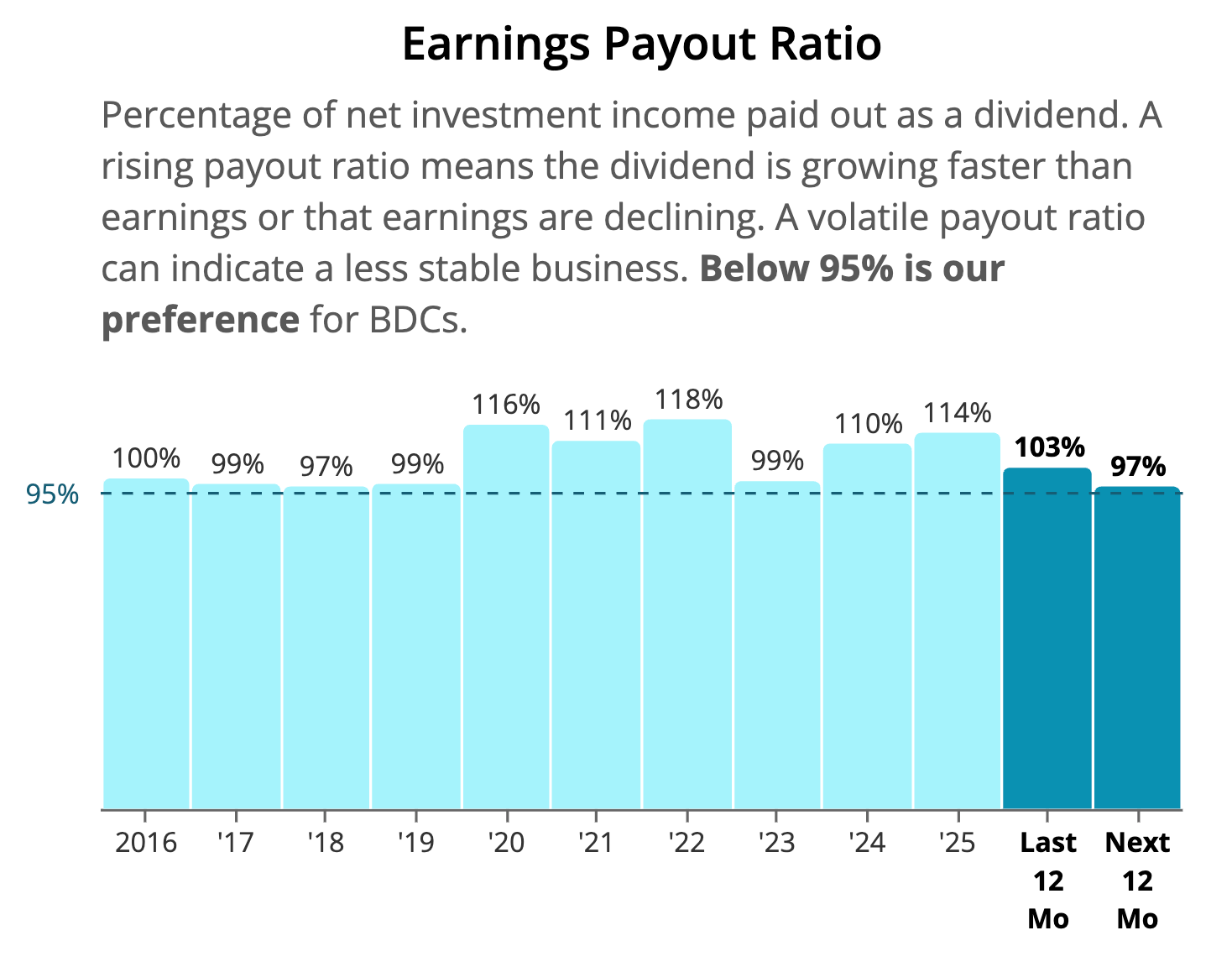
PennantPark Floating Rate cut its monthly dividend by 22% in 2026 after lower rates pushed its payout above 100%. Its loans carry floating rates, so its income falls whenever the Fed cuts.
MidCap Financial Investment (MFIC)
Dividend Yield: 12.1%
Dividend Safety Score: Unsafe (22)
Uninterrupted Dividend Streak: 0 years
Credit Rating: Not rated by S&P
Payment Frequency: Quarterly
Dividend Safety Score: Unsafe (22)
Uninterrupted Dividend Streak: 0 years
Credit Rating: Not rated by S&P
Payment Frequency: Quarterly
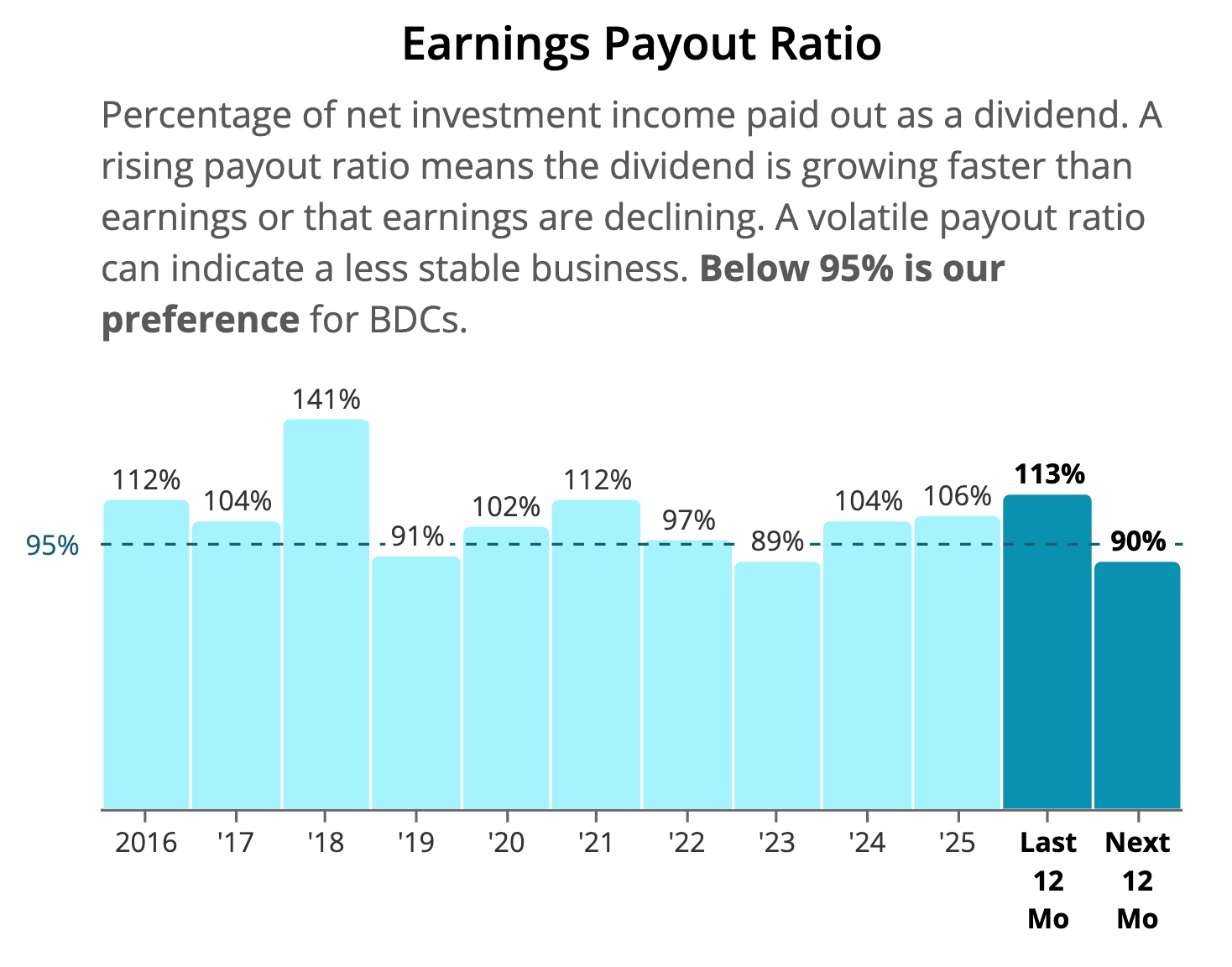
Ares Capital agreed in November 2026 to acquire MidCap Financial for about $2.6 billion. MidCap cut its dividend by about 18% in February 2026 and pays out roughly all of its net investment income.
Gladstone Capital (GLAD)
Dividend Yield: 9.2%
Dividend Safety Score: Unsafe (21)
Uninterrupted Dividend Streak: 3 years
Credit Rating: Not rated by S&P
Payment Frequency: Monthly
Dividend Safety Score: Unsafe (21)
Uninterrupted Dividend Streak: 3 years
Credit Rating: Not rated by S&P
Payment Frequency: Monthly
Gladstone Capital cut its dividend by 9% in October 2025. It lends to small private businesses, mostly through first-lien loans, and steers clear of cyclical industries.
Bain Capital Specialty Finance (BCSF)
Dividend Yield: 15.3%
Dividend Safety Score: Very Unsafe (20)
Uninterrupted Dividend Streak: 4 years
Credit Rating: Not rated by S&P
Payment Frequency: Quarterly
Dividend Safety Score: Very Unsafe (20)
Uninterrupted Dividend Streak: 4 years
Credit Rating: Not rated by S&P
Payment Frequency: Quarterly
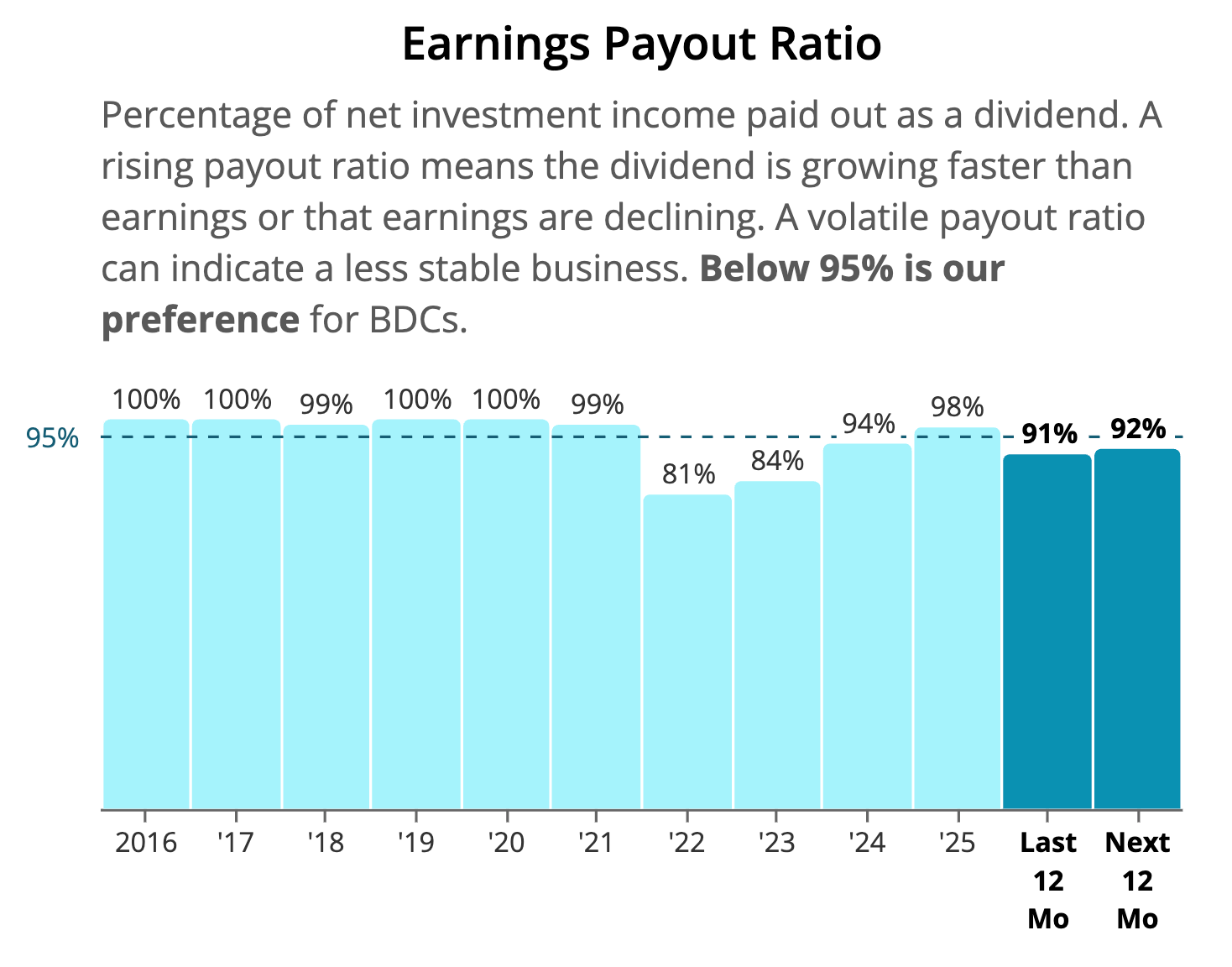
We downgraded BCSF to Very Unsafe in October 2026. Its income is expected to fall short of the dividend next year, bad loans rose to 2.2% of the portfolio, and management has said it plans to reevaluate the dividend. We think a cut of 20% to 30% is likely.
OFS Capital (OFS)
Dividend Yield: 17.7%
Dividend Safety Score: Very Unsafe (20)
Uninterrupted Dividend Streak: 0 years
Credit Rating: Not rated by S&P
Payment Frequency: Quarterly
Dividend Safety Score: Very Unsafe (20)
Uninterrupted Dividend Streak: 0 years
Credit Rating: Not rated by S&P
Payment Frequency: Quarterly
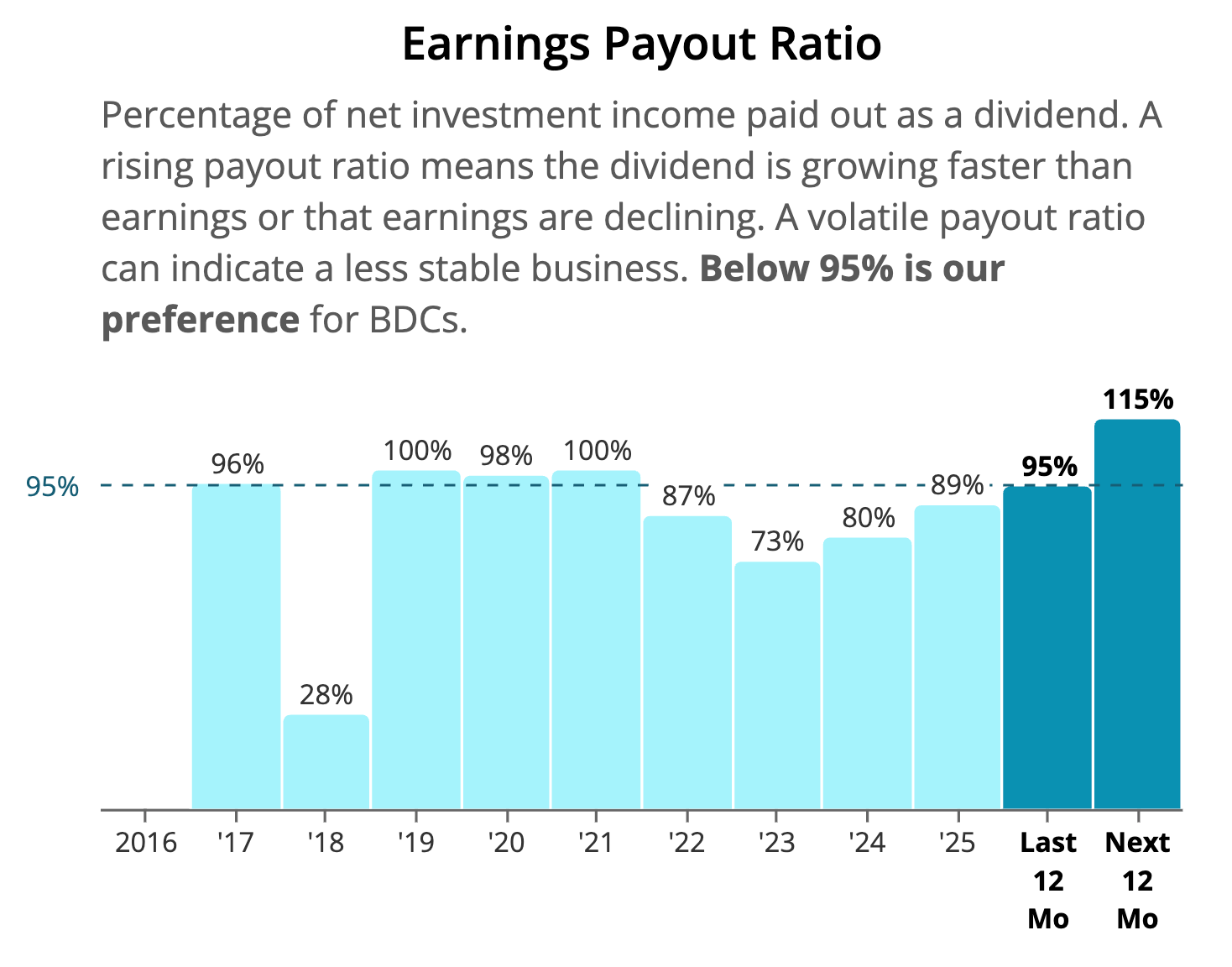
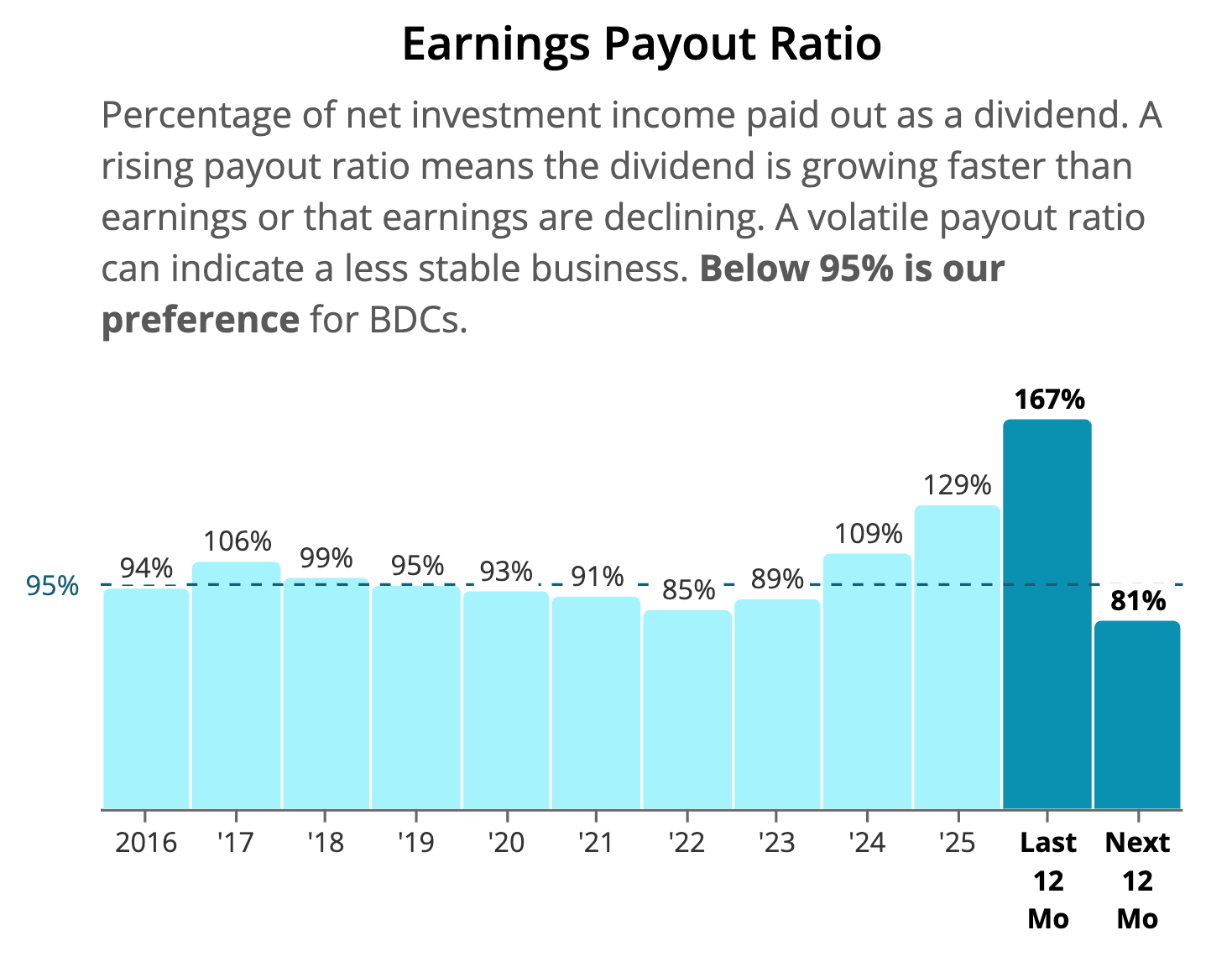
At about $51 million in market value, OFS is the smallest BDC we rate. It paid out 167% of its net investment income over the past year, though we expect that to fall to about 81% over the next 12 months.
BlackRock TCP Capital (TCPC)
Dividend Yield: 16.5%
Dividend Safety Score: Very Unsafe (20)
Uninterrupted Dividend Streak: 0 years
Credit Rating: Not rated by S&P
Payment Frequency: Quarterly
Dividend Safety Score: Very Unsafe (20)
Uninterrupted Dividend Streak: 0 years
Credit Rating: Not rated by S&P
Payment Frequency: Quarterly
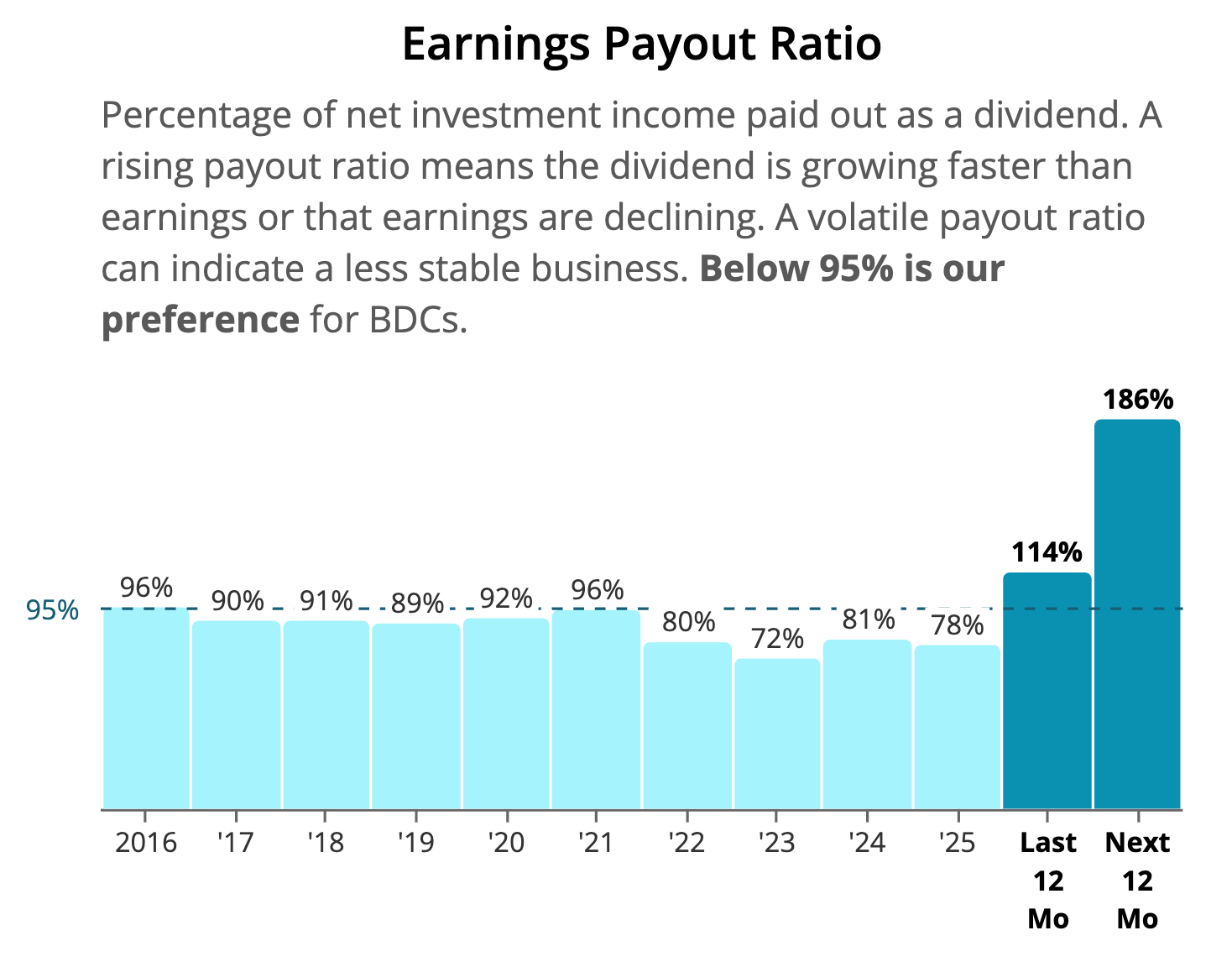
We downgraded TCPC in January 2026 after a new round of write-downs, and it cut its dividend by 32% in February. Even after the cut, we expect it to pay out far more than it earns over the next year.
Crescent Capital BDC (CCAP)
Dividend Yield: 14.6%
Dividend Safety Score: Very Unsafe (20)
Uninterrupted Dividend Streak: 0 years
Credit Rating: Not rated by S&P
Payment Frequency: Quarterly
Dividend Safety Score: Very Unsafe (20)
Uninterrupted Dividend Streak: 0 years
Credit Rating: Not rated by S&P
Payment Frequency: Quarterly
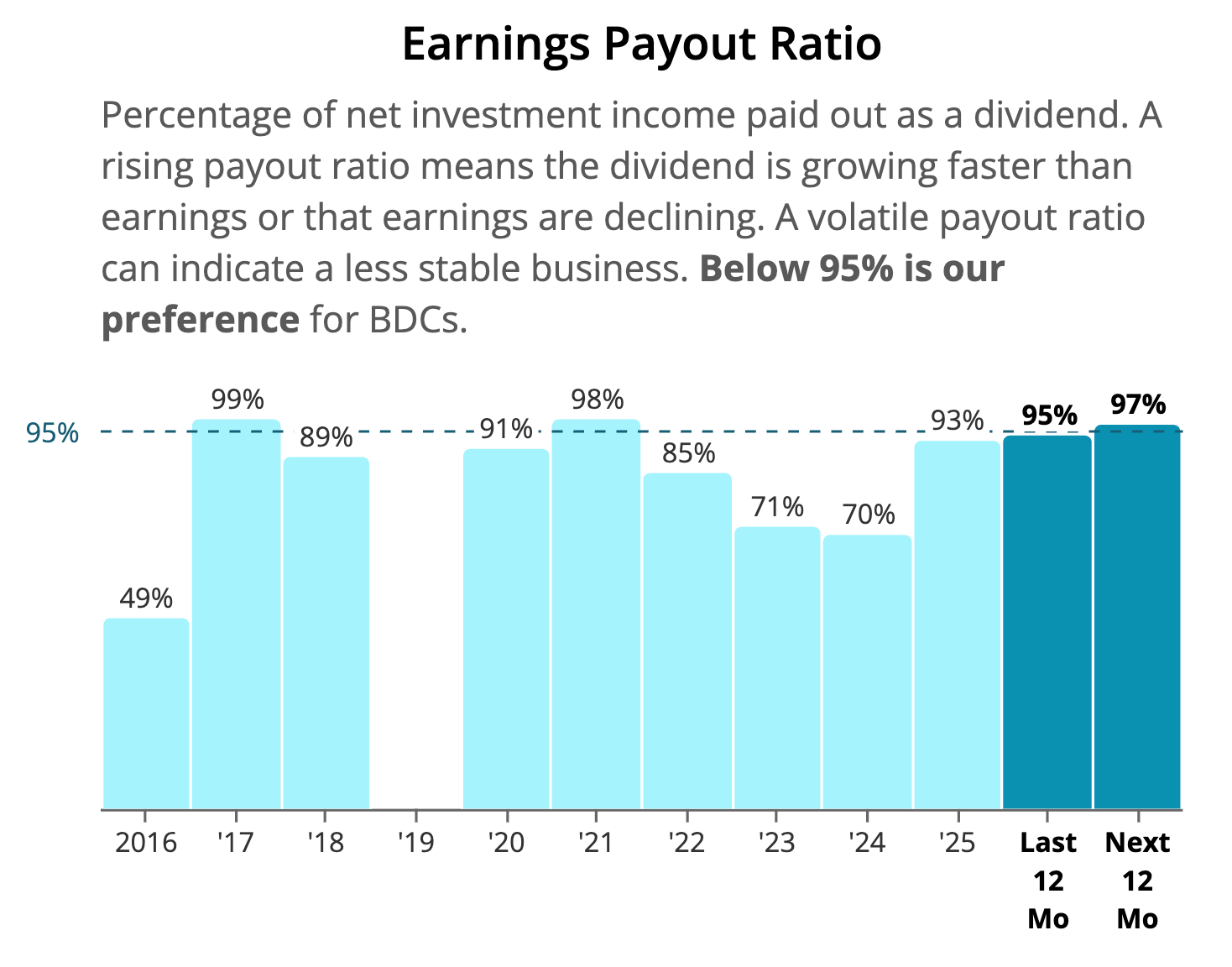
We downgraded Crescent in March 2026 as tighter loan spreads squeezed its income and management hinted at a cut. It reduced its dividend by about 19% in May.
Barings BDC (BBDC)
Dividend Yield: 11.8%
Dividend Safety Score: Very Unsafe (13)
Uninterrupted Dividend Streak: 7 years
Credit Rating: Not rated by S&P
Payment Frequency: Quarterly
Dividend Safety Score: Very Unsafe (13)
Uninterrupted Dividend Streak: 7 years
Credit Rating: Not rated by S&P
Payment Frequency: Quarterly
Barings has held its dividend flat since 2023, but we expect its payout ratio to rise from about 84% to roughly 101% of net investment income over the next year. It is managed by Barings LLC, which is also a large shareholder.
Stellus Capital (SCM)
Dividend Yield: 13.7%
Dividend Safety Score: Very Unsafe (11)
Uninterrupted Dividend Streak: 0 years
Credit Rating: Not rated by S&P
Payment Frequency: Monthly
Dividend Safety Score: Very Unsafe (11)
Uninterrupted Dividend Streak: 0 years
Credit Rating: Not rated by S&P
Payment Frequency: Monthly
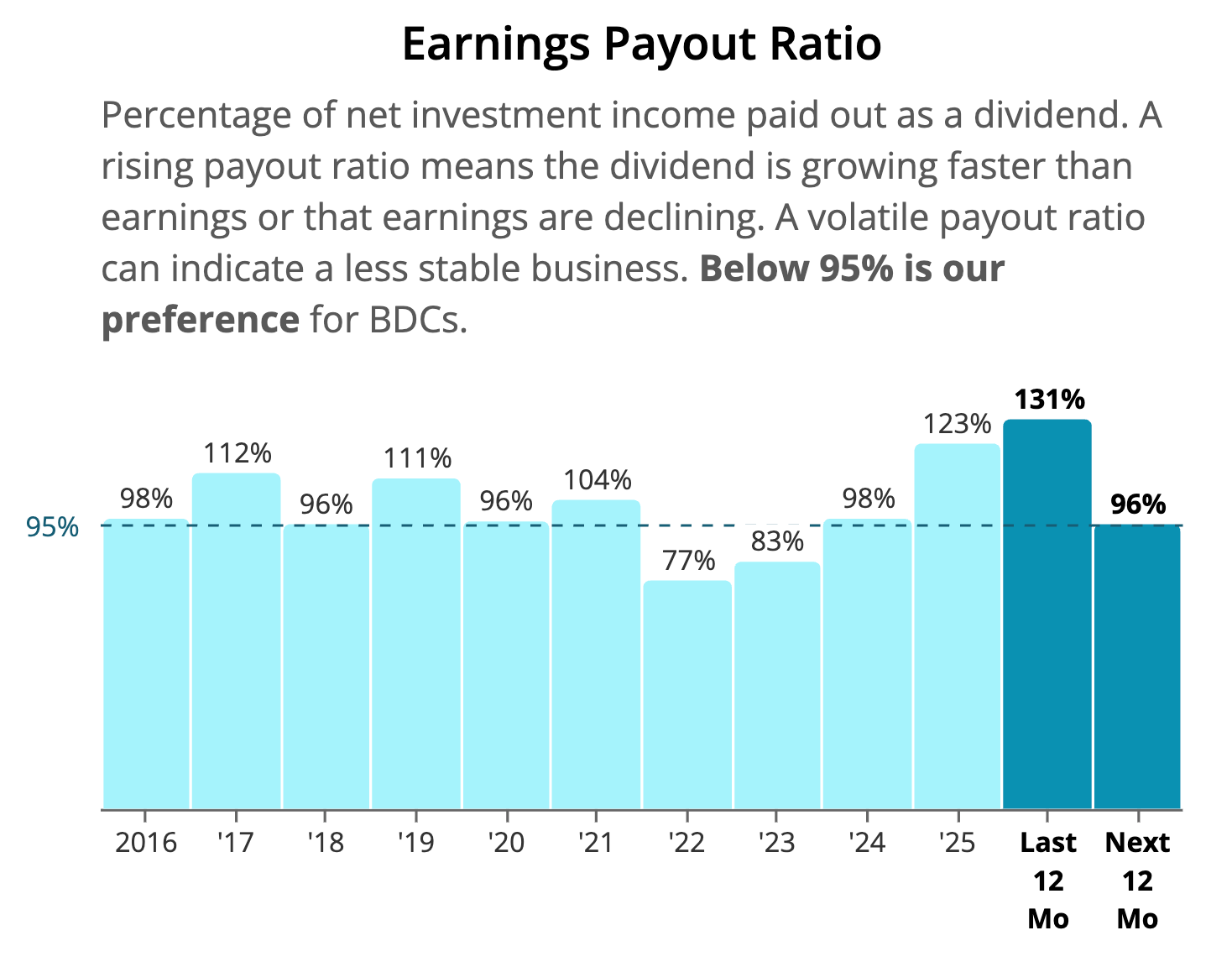
Stellus cut its dividend twice in 2026, by 15% in January and 27% in July, and it scored Very Unsafe before both cuts.
PennantPark Investment (PNNT)
Dividend Yield: 28.7%
Dividend Safety Score: Very Unsafe (10)
Uninterrupted Dividend Streak: 4 years
Credit Rating: Not rated by S&P
Payment Frequency: Monthly
Dividend Safety Score: Very Unsafe (10)
Uninterrupted Dividend Streak: 4 years
Credit Rating: Not rated by S&P
Payment Frequency: Monthly
PennantPark Investment has the highest yield of any BDC we rate. Half of its $0.08 monthly dividend is a supplemental payment funded by past income that management expects to continue only through December 2026.
Carlyle Secured Lending (CGBD)
Dividend Yield: 12.5%
Dividend Safety Score: Very Unsafe (9)
Uninterrupted Dividend Streak: 0 years
Credit Rating: Not rated by S&P
Payment Frequency: Quarterly
Dividend Safety Score: Very Unsafe (9)
Uninterrupted Dividend Streak: 0 years
Credit Rating: Not rated by S&P
Payment Frequency: Quarterly
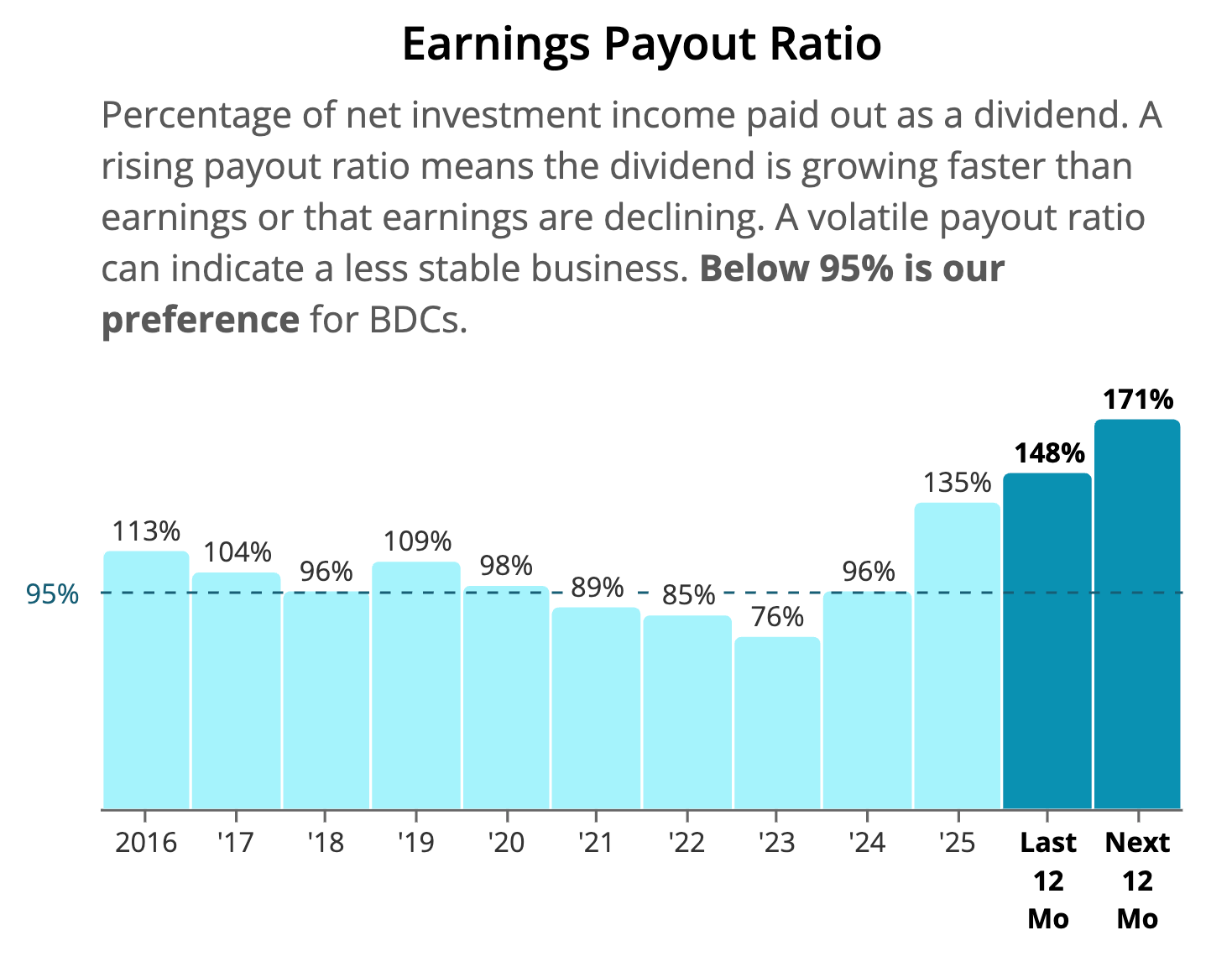
Carlyle Secured Lending cut its dividend by 12.5% in May 2026. It lends mainly through senior secured loans, but its earnings have fallen short of the dividend over the past year.
Oxford Square Capital (OXSQ)
Dividend Yield: 21.6%
Dividend Safety Score: Very Unsafe (8)
Uninterrupted Dividend Streak: 0 years
Credit Rating: Not rated by S&P
Payment Frequency: Monthly
Dividend Safety Score: Very Unsafe (8)
Uninterrupted Dividend Streak: 0 years
Credit Rating: Not rated by S&P
Payment Frequency: Monthly
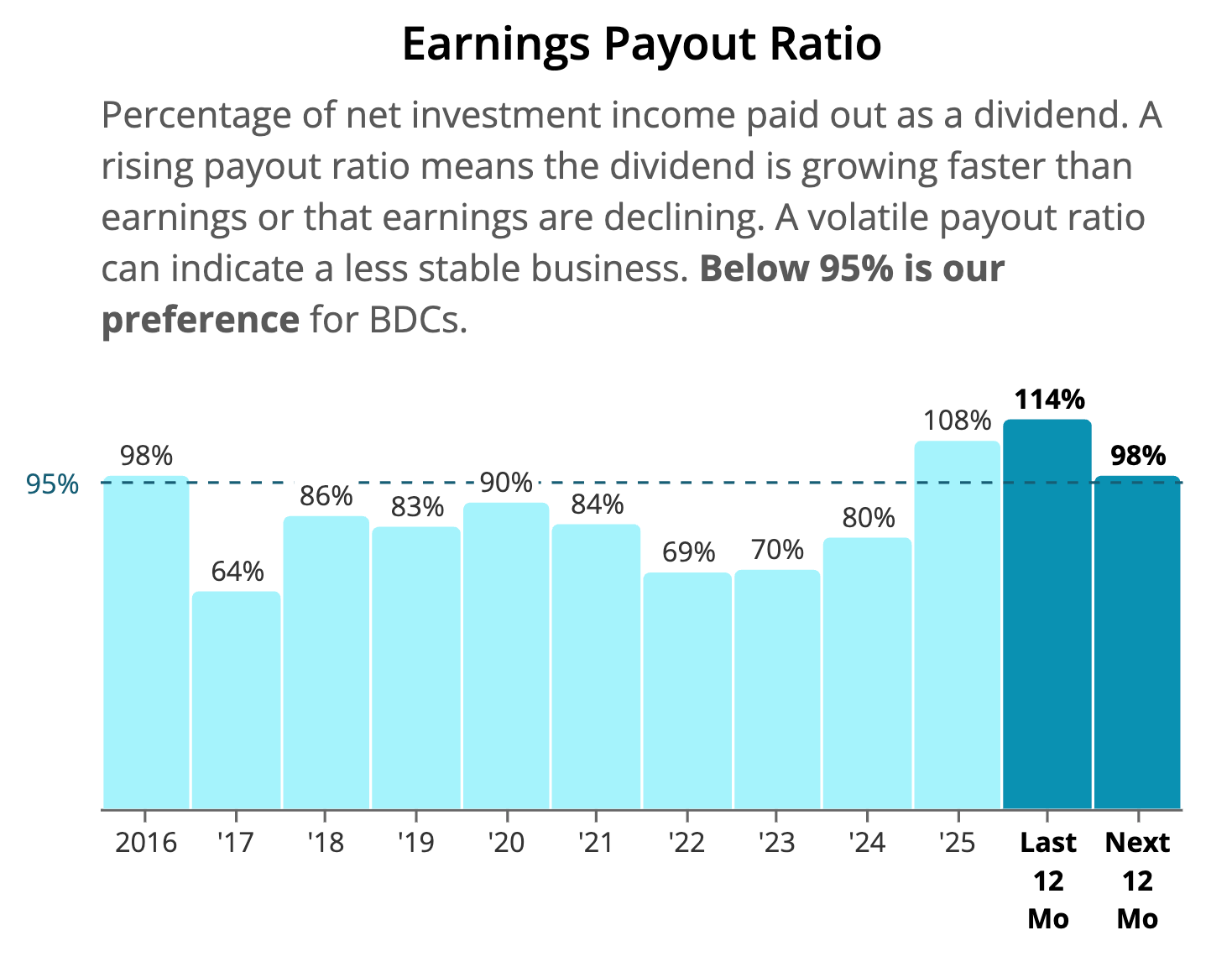
Oxford Square cut its dividend by 57% in November 2026, and it scored Very Unsafe before the cut. It invests in below-investment-grade loans and the riskiest slices of pools of loans packaged into securities.
Unrated BDCs
We don't rate these nine BDCs, most of which listed their shares in the past few years. Without a Dividend Safety Score, we describe each business without a verdict.
- MSC Income Fund (MSIF) is advised by an affiliate of Main Street Capital and invests in lower middle market and private loans. It switched to monthly dividends in July 2026.
- Kayne Anderson BDC (KBDC) makes first-lien loans to privately held middle-market companies.
- Morgan Stanley Direct Lending Fund (MSDL) makes senior secured loans to middle-market companies, many backed by private equity firms.
- Nuveen Churchill Direct Lending (NCDL) lends to middle-market companies owned by private equity firms.
- Palmer Square Capital BDC (PSBD) invests in corporate loans and in pools of loans packaged into securities.
- Blue Owl Technology Finance (OTF) lends to and invests in upper middle-market technology and software companies.
- Chicago Atlantic BDC (LIEN), formerly Silver Spike Investment, lends to cannabis companies.
- Great Elm Capital (GECC) invests in the debt of middle-market companies, with an emphasis on specialty finance.
- Rand Capital (RAND) provides loans that rank behind other lenders, plus equity, to lower middle market companies.
Why BDC Dividends Are Falling
Nineteen of the 36 BDCs we rate have cut their regular dividends so far in 2026, from Sixth Street's 9% trim to Oxford Square's 57% cut. Stellus and FS KKR have each cut twice.
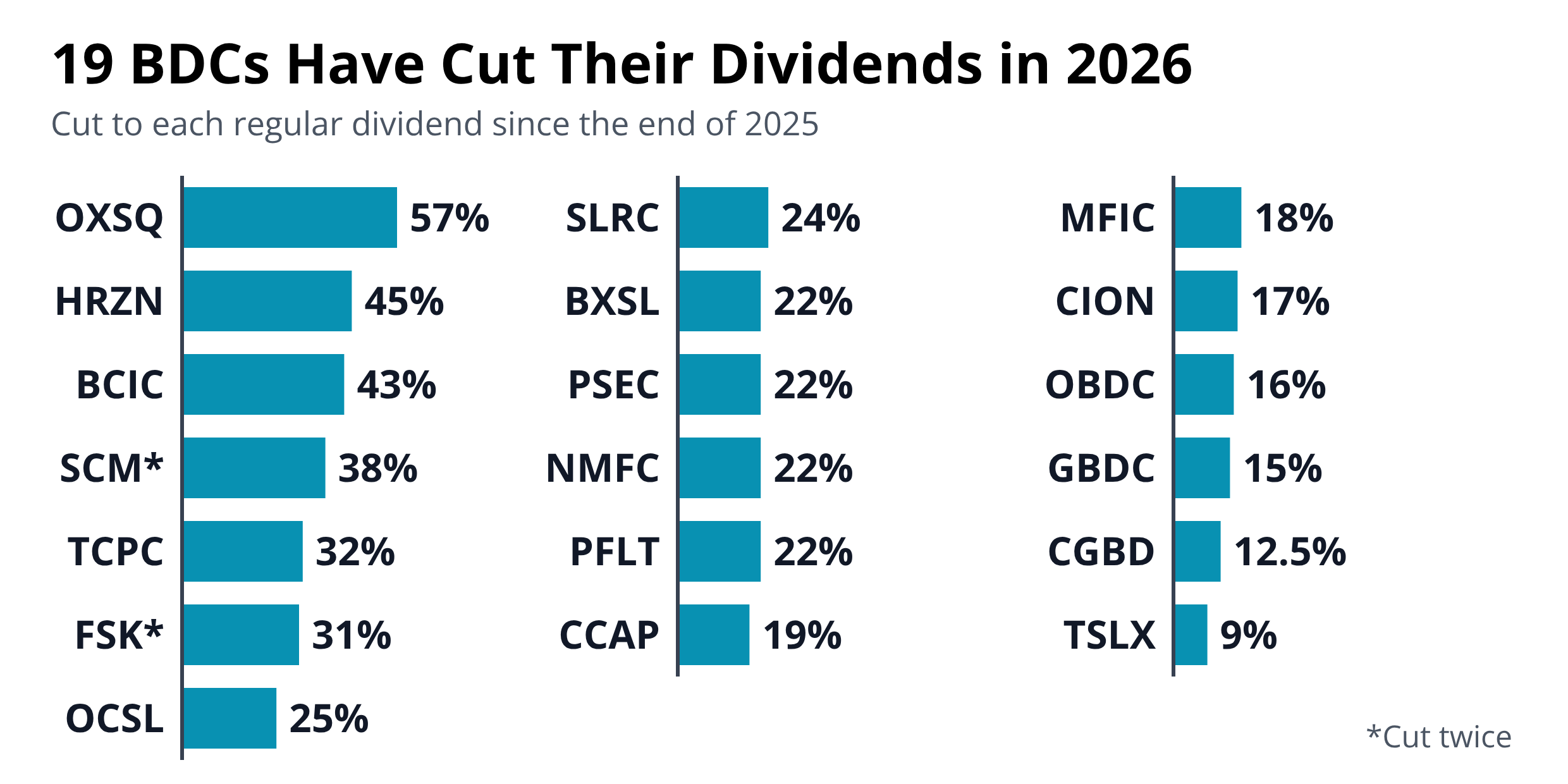
The cuts didn't come out of nowhere. In January, we expected roughly a dozen BDCs to cut their dividends over the following year and named the ones that looked most exposed. Golub, FS KKR, Horizon, Prospect, Stellus, and Oxford Square have all cut since. Of the six we said looked better positioned (Main Street, Ares Capital, Capital Southwest, Hercules, Sixth Street, and Gladstone Investment), only Sixth Street has cut, by about 9%.
Most BDC loans carry floating rates, so when the Fed cuts, the interest BDCs collect falls. Their own borrowing costs often don't, because much of their debt is fixed. Ares Capital's average loan yield fell from 12.5% at the end of 2023 to 10.3% at the end of 2025, while the average interest rate on its own debt held near 5%. That gap is what pays the dividend, and it has narrowed by more than two percentage points.
Some BDCs feel rate changes far more than others. In January, company disclosures showed the median BDC's net investment income falling about 8% for every one-percentage-point cut in short-term rates. The latest quarterly filings show how wide the range is. A one-point drop would reduce annual net investment income by roughly 27% at Saratoga, 20% at Stellus, and 12% at Gladstone Capital, while Trinity and Hercules would lose less than 5% and Gladstone Investment's would barely change.
The math also works in reverse. After cutting rates by 1.75 percentage points between September 2024 and December 2025, the Fed raised them by a quarter point in September 2026. That helps, but it recovers only a small part of the income BDCs lost.
Competition has made it worse. Money has poured into private credit faster than demand for new loans, which forces lenders to accept thinner spreads and lower fees. And some BDCs face a second hit as cheap debt they issued years ago comes due and has to be refinanced at higher rates.
Credit is the next test. Loans that have stopped paying and interest paid with more debt instead of cash have both crept up at several BDCs, and software borrowers face questions about how AI will affect their businesses. A recession would add defaults on top of lower rates.
The BDCs holding up best share a few traits: low costs, often from managing themselves, mostly first-lien loans, moderate debt, and spillover from past gains that can cover a shortfall.
Managing themselves matters more than it sounds. Most BDCs pay an outside adviser fees tied to the size of the portfolio, which rewards growth for its own sake. In-house teams like those at Main Street, Capital Southwest, and Hercules cost less and keep management's interests closer to shareholders'.
The market keeps score through price to net asset value (NAV), what a BDC's loans and other investments are estimated to be worth after subtracting its debt. Based on each company's latest reported NAV, 29 of the 36 BDCs we rate trade at a discount, and the median trades about 29% below its NAV, wider than the roughly 20% gap in January. Prospect trades at less than a third of its NAV. The seven rated Safe or Borderline Safe trade at a median of about 1.1 times NAV, against about 0.7 times for the rest. A deep discount is usually a warning, not a bargain. The strongest BDCs trade at a premium, which lets them sell new shares to fund growth without diluting existing owners. Main Street has averaged about 1.5 times its NAV over the past 15 years, and that cheaper money lets it make safer loans.
Frequently Asked Questions
What are BDC stocks?
Business development companies are publicly traded firms that lend to and invest in small and midsize private businesses. They pass nearly all of their taxable income to shareholders, which is why most yield 9% or more. We rate 36 of them for dividend safety.
Business development companies are publicly traded firms that lend to and invest in small and midsize private businesses. They pass nearly all of their taxable income to shareholders, which is why most yield 9% or more. We rate 36 of them for dividend safety.
What are the best BDC stocks for dividends?
By our Dividend Safety Scores, the safest are Main Street Capital, the only one rated Safe, followed by six rated Borderline Safe: Sixth Street Specialty Lending, Ares Capital, Capital Southwest, SLR Investment, Hercules Capital, and Gladstone Investment. None of the 36 BDCs we rate scores Very Safe.
By our Dividend Safety Scores, the safest are Main Street Capital, the only one rated Safe, followed by six rated Borderline Safe: Sixth Street Specialty Lending, Ares Capital, Capital Southwest, SLR Investment, Hercules Capital, and Gladstone Investment. None of the 36 BDCs we rate scores Very Safe.
Which BDCs pay monthly dividends?
Fourteen of the BDCs we rate pay monthly: Main Street Capital, Capital Southwest, Gladstone Investment, Saratoga, Horizon, BCP Investment, Prospect Capital, CION, Trinity, PennantPark Floating Rate, Gladstone Capital, Stellus, PennantPark Investment, and Oxford Square. Our list of monthly dividend stocks ranks them alongside other monthly payers.
Fourteen of the BDCs we rate pay monthly: Main Street Capital, Capital Southwest, Gladstone Investment, Saratoga, Horizon, BCP Investment, Prospect Capital, CION, Trinity, PennantPark Floating Rate, Gladstone Capital, Stellus, PennantPark Investment, and Oxford Square. Our list of monthly dividend stocks ranks them alongside other monthly payers.
What are the highest-yielding BDCs?
As of November 9, 2026, the highest yields belong to PennantPark Investment (28.7%), Prospect Capital (27.4%), Saratoga (22.9%), Oxford Square (21.6%), and TriplePoint Venture Growth (21.4%). All five score Unsafe or Very Unsafe. Of the 12 BDCs we rate that yield 15% or more, none scores better than Unsafe.
As of November 9, 2026, the highest yields belong to PennantPark Investment (28.7%), Prospect Capital (27.4%), Saratoga (22.9%), Oxford Square (21.6%), and TriplePoint Venture Growth (21.4%). All five score Unsafe or Very Unsafe. Of the 12 BDCs we rate that yield 15% or more, none scores better than Unsafe.
Why do some BDCs pay supplemental dividends?
Some BDCs, including Main Street, Capital Southwest, and Gladstone Investment, set their regular dividend at a level they expect to sustain and pay out extra profits, often gains from selling investments, as supplemental or special dividends. Those extras can shrink or stop when profits fall, so the regular dividend is the better guide to dependable income. At PennantPark Investment, half of the monthly dividend is a supplemental payment that management expects to continue only through December 2026.
Some BDCs, including Main Street, Capital Southwest, and Gladstone Investment, set their regular dividend at a level they expect to sustain and pay out extra profits, often gains from selling investments, as supplemental or special dividends. Those extras can shrink or stop when profits fall, so the regular dividend is the better guide to dependable income. At PennantPark Investment, half of the monthly dividend is a supplemental payment that management expects to continue only through December 2026.
Are BDC dividends safe?
Most are not, by our measure. Only one of the 36 BDCs we rate earns a Safe Dividend Safety Score, and 29 score Unsafe or Very Unsafe. You can check our Dividend Safety Score track record on past cuts. Their dividends depend on interest rates and credit conditions, and 19 of them have cut their payouts in 2026.
Most are not, by our measure. Only one of the 36 BDCs we rate earns a Safe Dividend Safety Score, and 29 score Unsafe or Very Unsafe. You can check our Dividend Safety Score track record on past cuts. Their dividends depend on interest rates and credit conditions, and 19 of them have cut their payouts in 2026.
Why are BDC stocks down?
The Fed's 2024 and 2025 rate cuts reduced the income on their floating-rate loans, competition has squeezed lending spreads, and investors worry about rising defaults and software borrowers exposed to AI. The median yield of the 29 BDCs we rate Unsafe or Very Unsafe is 14.6%, against 9.8% for the seven rated Safe or Borderline Safe.
The Fed's 2024 and 2025 rate cuts reduced the income on their floating-rate loans, competition has squeezed lending spreads, and investors worry about rising defaults and software borrowers exposed to AI. The median yield of the 29 BDCs we rate Unsafe or Very Unsafe is 14.6%, against 9.8% for the seven rated Safe or Borderline Safe.
Looking for high yields with safer payouts? See our list of high dividend stocks, ranked by Dividend Safety Score.
We update this list as our Dividend Safety Scores change and after each earnings season.