Qualified vs. Ordinary Dividends: How Dividends Are Taxed
Qualified dividends are taxed at 0%, 15% or 20%, the same federal rates as long-term capital gains. Ordinary dividends, also called non-qualified dividends, are taxed as regular income at rates from 10% to 37%.
For 2026, a married couple filing jointly pays 0% on qualified dividends until taxable income passes $98,900. For a single filer, the 0% rate runs to $49,450. Above those levels most investors pay 15%.
Most dividends from U.S. companies are qualified if you hold the shares long enough. Of the 861 dividend-paying companies we rate, 614 (71%) pay qualified dividends. The exceptions cluster among the highest yields: REITs, business development companies (BDCs) and partnerships.
This guide covers both kinds of dividends, the 2026 and 2027 tax rates, how each type of dividend investment is taxed, and which accounts suit each one.
Qualified vs. Ordinary Dividends
Every dividend you receive in a taxable account shows up on Form 1099-DIV, which your broker sends early each year. Two boxes matter most.
Box 1a shows your total ordinary dividends, including dividends from money market funds. Box 1b shows the part of box 1a that qualifies for the lower capital gains rates. So qualified dividends are a subset of ordinary dividends, and only the amount in box 1b gets the lower rate.
A few other boxes come up often for income investors:
- Box 2a shows capital gain distributions from funds and REITs.
- Box 3 shows nondividend distributions, which are a return of capital.
- Box 5 shows Section 199A dividends, the qualified REIT dividends that can get a 20% deduction.
- Box 7 shows foreign tax paid on your dividends.
The IRS sets two tests for a dividend to be qualified, laid out in Publication 550. The company must be a U.S. corporation or a qualified foreign corporation, and you must meet a holding period.
For common stock, you must hold the shares for more than 60 days during the 121-day period that begins 60 days before the ex-dividend date. For most preferred stock, the IRS requires more than 90 days during the 181-day period that begins 90 days before the ex-dividend date.
Say a stock goes ex-dividend on May 1. The 121-day window runs from March 2 through June 30, and you need to own the shares on at least 61 of those days. A long-term investor clears that easily. A trader who buys just before the ex-dividend date and sells soon after does not.
Some payments are never qualified, whatever box they land in. Publication 550 lists capital gain distributions, dividends on deposits at banks and credit unions (which are really interest), dividends from tax-exempt organizations and farmers' cooperatives, dividends on employer stock held in an ESOP, dividends where you must make related payments such as on a short sale, and payments in lieu of dividends.
Dividend Tax Rates for 2026 and 2027
The rate on qualified dividends depends on your taxable income, which is your income after deductions. These are the federal thresholds for 2026 from IRS Revenue Procedure 2025-32:
- 0% rate: taxable income up to $49,450 for single filers, $98,900 for married couples filing jointly and $66,200 for heads of household.
- 15% rate: up to $545,500 single, $613,700 married filing jointly and $579,600 head of household.
- 20% rate: taxable income above those amounts.
The IRS released its 2027 adjustments on November 5, 2026. For 2027 the 0% rate runs to $51,050 single, $102,100 married filing jointly and $68,350 head of household, and the 15% rate to $563,200, $633,600 and $598,400.
Ordinary dividends are taxed at the same rates as wages. For 2026 those brackets run from 10% to 37%. The 22% bracket starts above $50,400 of taxable income for single filers and $100,800 for married couples, and the 37% bracket starts above $640,600 and $768,700.
Higher earners also owe the 3.8% net investment income tax on dividends once modified adjusted gross income passes $200,000 for single filers or $250,000 for married couples filing jointly. The IRS notes those thresholds are not indexed for inflation, so more investors cross them each year. That puts the top federal rate at 23.8% on qualified dividends and 40.8% on ordinary dividends.
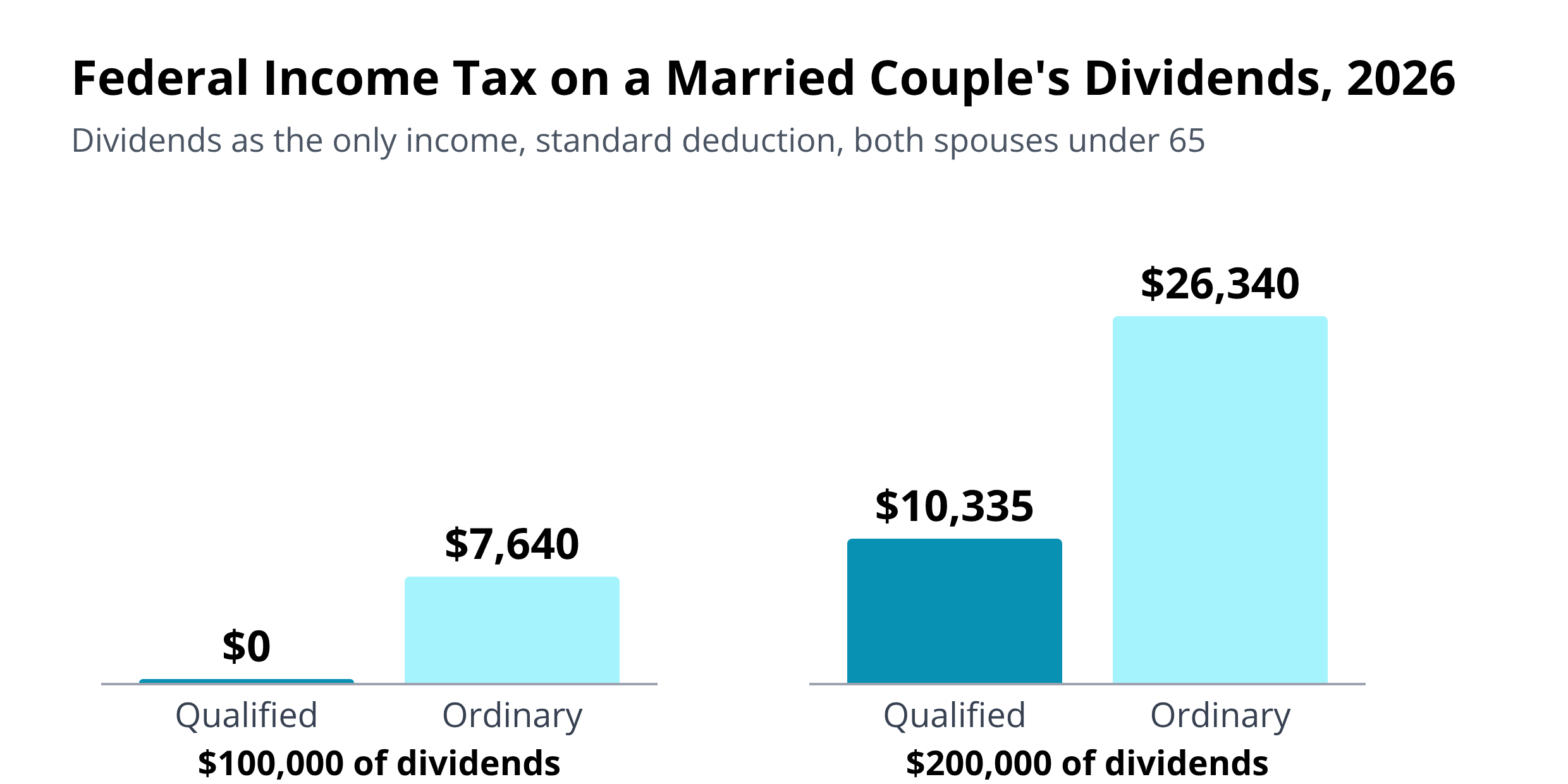
The gap between the two adds up quickly. Take a married couple under 65 whose only income in 2026 is $100,000 of dividends. After the $32,200 standard deduction, their taxable income is $67,800.
If those dividends are qualified, all $67,800 falls under the $98,900 threshold for the 0% rate, and the couple owes no federal income tax. If the same dividends were ordinary, by our math they would owe $7,640. At $200,000 of dividends, the bill is $10,335 if they are qualified and $26,340 if they are ordinary.
Retirees get even more room. For 2026 a married couple who are both 65 or older add $1,650 each to their standard deduction. Through 2028 they can also claim the $6,000 senior deduction each, which phases out once modified adjusted gross income passes $150,000 for joint filers.
Together that takes their deductions to $47,500. By our math, such a couple could collect about $146,400 of qualified dividends, with no other income, and owe no federal income tax for 2026.
Most retired couples also collect Social Security, and up to 85% of benefits can become taxable once other income is high enough. Even so, the room stays large. Take a couple, both 65 or older, who receive the Social Security Administration's estimated average benefit for a retired couple: $3,238 a month in 2026, or about $38,900 a year.
By our math, they could collect about $113,400 of qualified dividends on top of those benefits and still owe no federal income tax for 2026. About $33,000 of their benefits would be taxable, their deductions would cover it, and the rest of their taxable income would stay just under the $98,900 limit for the 0% rate.
That is roughly what a $2.8 million portfolio yielding 4% would pay. The math holds only if the dividends are qualified and the couple has no other taxable income, and state income taxes are separate. The most common catch is a traditional IRA. Once required minimum distributions begin, each withdrawal counts as ordinary income and uses up some of that room. Our guide to required minimum distributions shows how large those withdrawals get with age. A pension does the same thing. Our guide to how dividends affect Social Security benefits explains how benefits are taxed.
Why the Highest Yields Are Usually Not Qualified
The higher a stock's yield, the less likely its dividend is qualified. That pattern runs straight through the 861 dividend payers we rate.
Of the 299 companies yielding under 2%, 273 (91%) pay qualified dividends. Among the 134 yielding 6% or more, only 26 (19%) do.
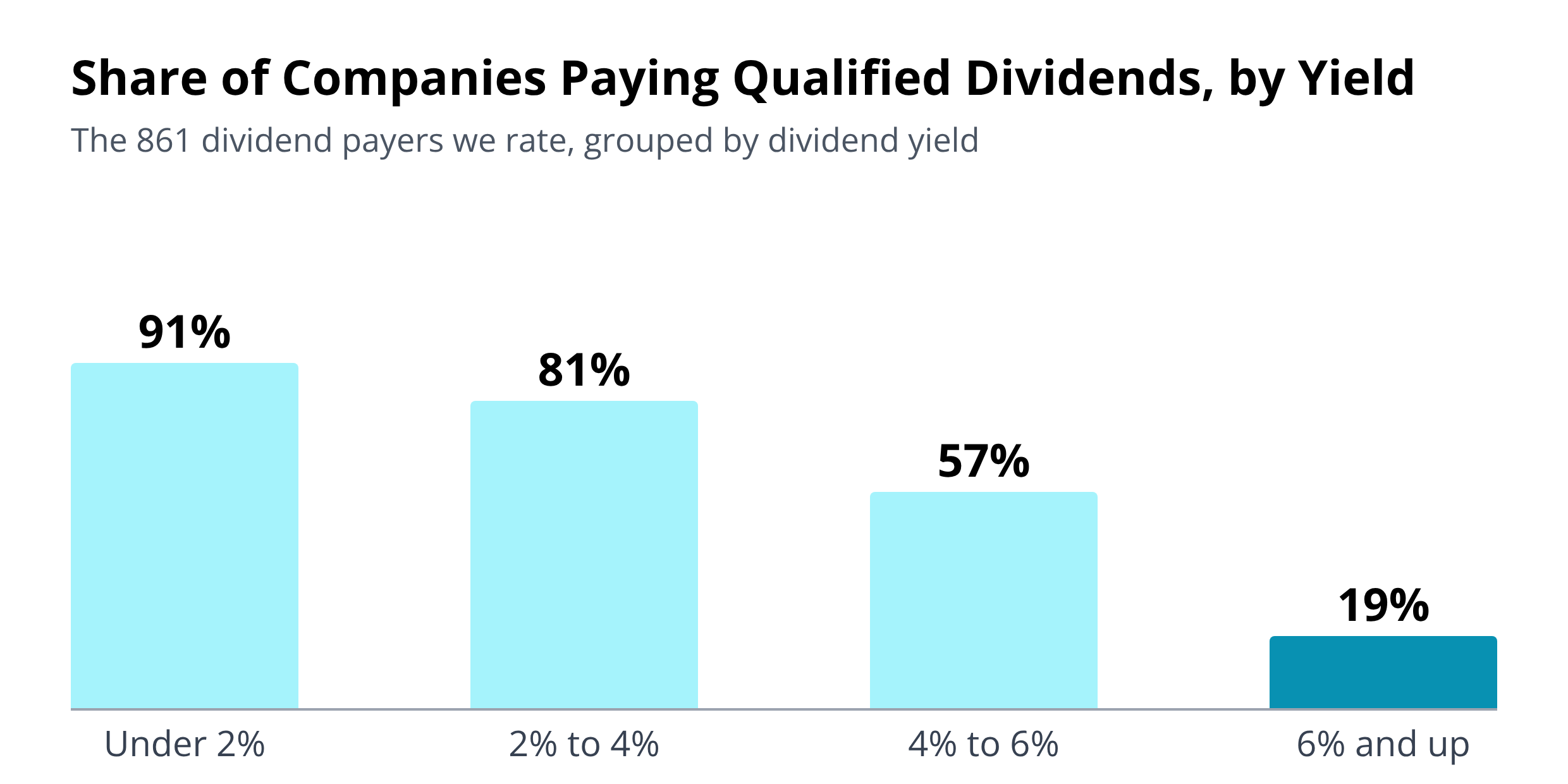
Most of the high-yield exceptions are REITs, BDCs and partnerships. Their payouts are generally taxed as ordinary income, or arrive with a K-1 in the case of partnerships, rather than at the qualified rate.
Those same names also carry more dividend risk. The 154 companies whose dividends our stock pages label non-qualified have a median yield of 7.0%, compared with 2.3% for qualified payers. Only 30 of them (19%) earn a Safe or Very Safe Dividend Safety Score, against 344 of the 614 qualified payers (56%).
The 20 partnerships we rate that issue K-1s yield even more, a median of 8.4%. Only two earn a Safe Dividend Safety Score.
So a high yield taxed at ordinary rates has two hurdles to clear: the bigger tax bill and a higher chance of a cut. We think both are worth checking before buying. Our Dividend Safety Scores handle the second.
How REIT Dividends Are Taxed
Most REIT dividends are not qualified dividends. They are reported as ordinary dividends and taxed at your regular income tax rate.
REIT investors do get a break. The ordinary dividends a REIT reports in box 5 as qualified REIT dividends are eligible for the 20% Section 199A deduction, which the 2025 tax law made permanent. To claim it, you must hold the shares for more than 45 days during the 91-day period around the ex-dividend date.
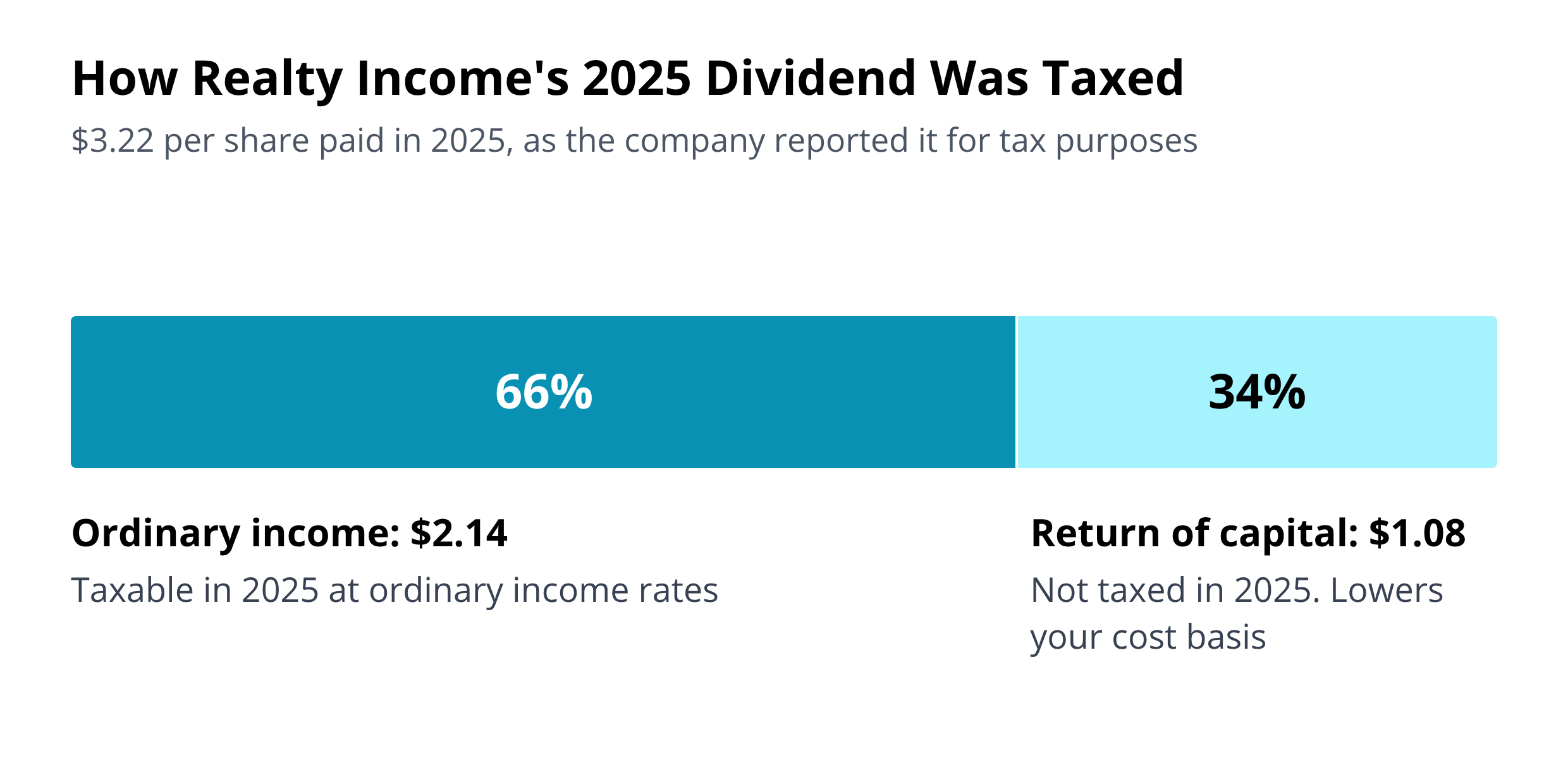
Part of a REIT's dividend is often a return of capital. Publication 550 says that portion is not taxed when you receive it. Instead it lowers your cost basis in the shares, which defers the tax until you sell. Once your basis reaches zero, any further return of capital is taxed as a capital gain.
Realty Income (O) shows how large that piece can be. Of the $3.22 per share it paid in 2025, the company reported $2.14 (66%) as ordinary income and $1.08 (34%) as a nontaxable return of capital.
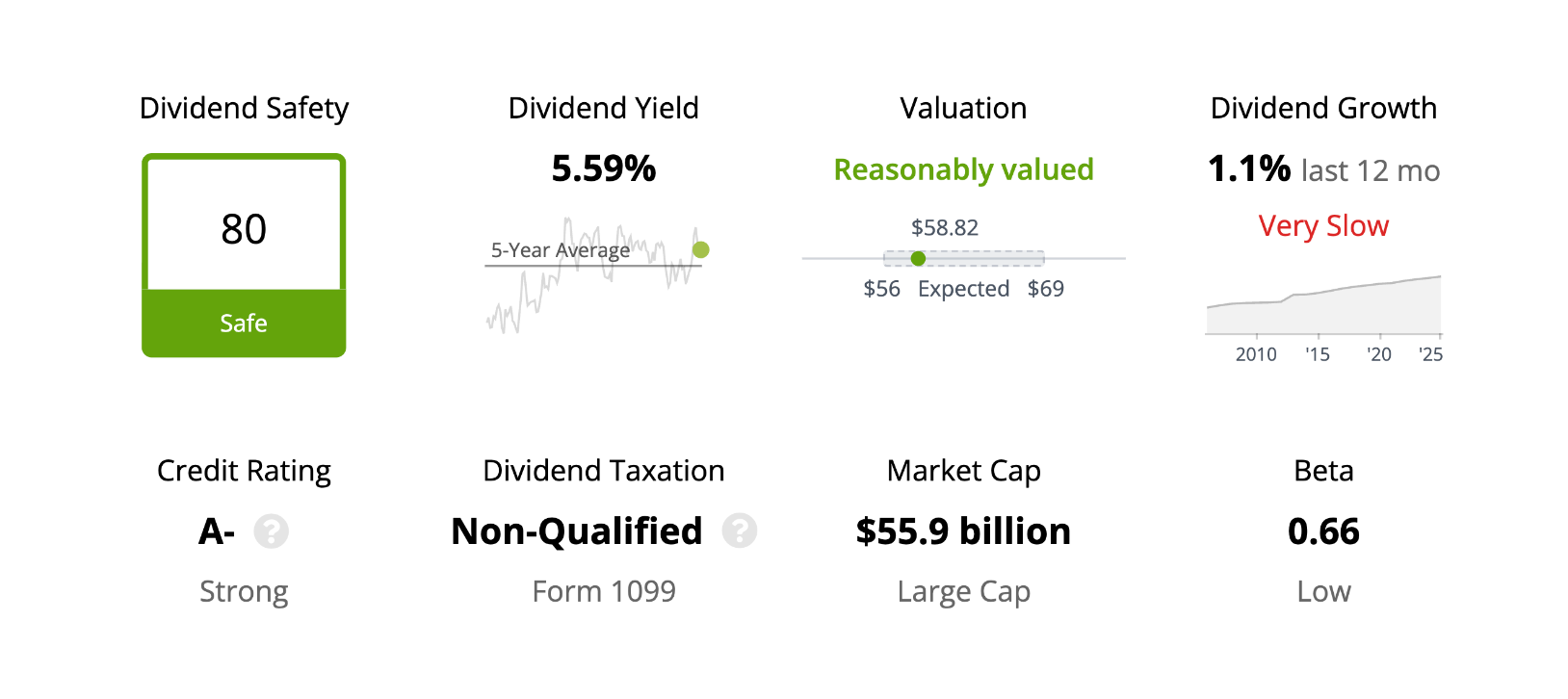
Every stock page on our site lists how a company's dividend is taxed. Realty Income's shows Non-Qualified, next to its Safe Dividend Safety Score.
Read More: A Short Lesson on REIT Taxation
How BDC Dividends Are Taxed
Business development companies earn most of their income as interest on loans to midsize companies, so most of what they pay is reported as ordinary dividends and taxed at regular income rates. A BDC that sells investments at a profit may also pay capital gain distributions, which show up in box 2a.
Publication 550 says capital gain distributions are taxed as long-term capital gains no matter how long you have owned the shares. A small part of some BDC payouts can also be qualified, which box 1b would show.
Of the 37 BDCs and other asset managers our stock pages label non-qualified, only one, Main Street Capital (MAIN), earns a Safe Dividend Safety Score, and it sits just above the line. Our guide to business development companies explains why so few qualify.
How MLP Distributions Are Taxed
Master limited partnerships don't send a 1099-DIV. Each year they send a Schedule K-1 showing your share of the partnership's income, deductions and credits.
The IRS says you may owe tax on your share of that income whether or not it was paid out to you.
MLPs also raise a problem in IRAs. An IRA with $1,000 or more of gross income from an unrelated trade or business has to file Form 990-T, and income passed through from an MLP can count toward that. That is a big reason we generally keep MLPs in taxable accounts.
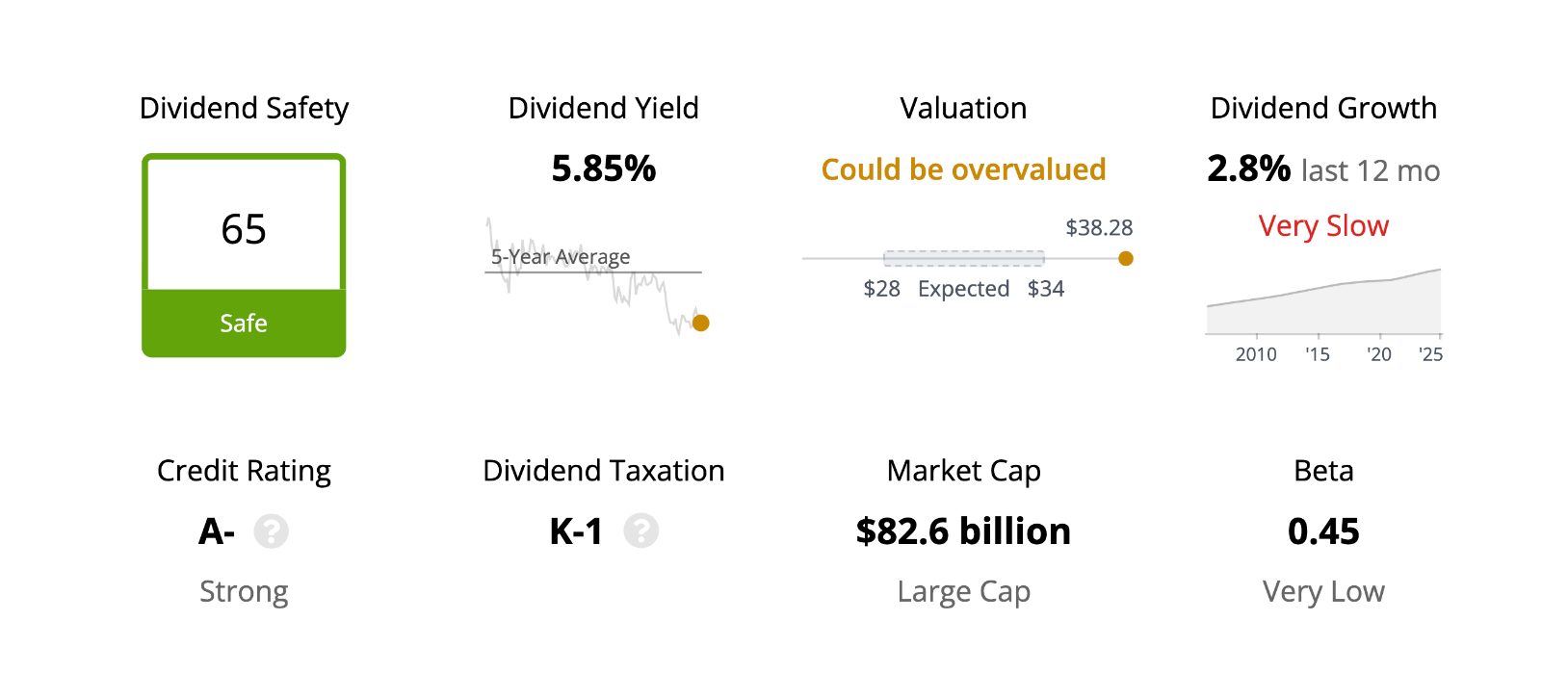
Enterprise Products Partners (EPD) is the best-known example. Its stock page shows K-1 under Dividend Taxation, and it is one of the two K-1 issuers we rate Safe.
Our guide to master limited partnerships covers K-1s and cost basis in more detail.
How Foreign Dividends Are Taxed
Dividends from foreign companies can be qualified too. Publication 550 treats a foreign corporation as qualified if it is incorporated in a U.S. territory, is eligible for a comprehensive U.S. income tax treaty, or has stock that trades readily on an established U.S. market, such as an American depositary receipt on the NYSE. A passive foreign investment company does not count.
The bigger issue is usually foreign withholding tax. Many countries withhold tax before the dividend reaches you, and box 7 of your 1099-DIV shows the amount. You can often claim it as a foreign tax credit. If your total foreign taxes are $300 or less ($600 for married couples filing jointly) and all come from dividends and interest reported on a 1099, the IRS lets you skip Form 1116.
We rate 47 Canadian companies and 26 others based outside the U.S., and our stock pages flag them so you know withholding may apply. Our guide to foreign tax withholding covers country rates and how the credit works.
How Fund Dividends Are Taxed
ETFs, mutual funds and closed-end funds pass along the character of what they earn. One fund's 1099-DIV can include qualified dividends, ordinary dividends, capital gain distributions, tax-exempt interest and a return of capital all at once.
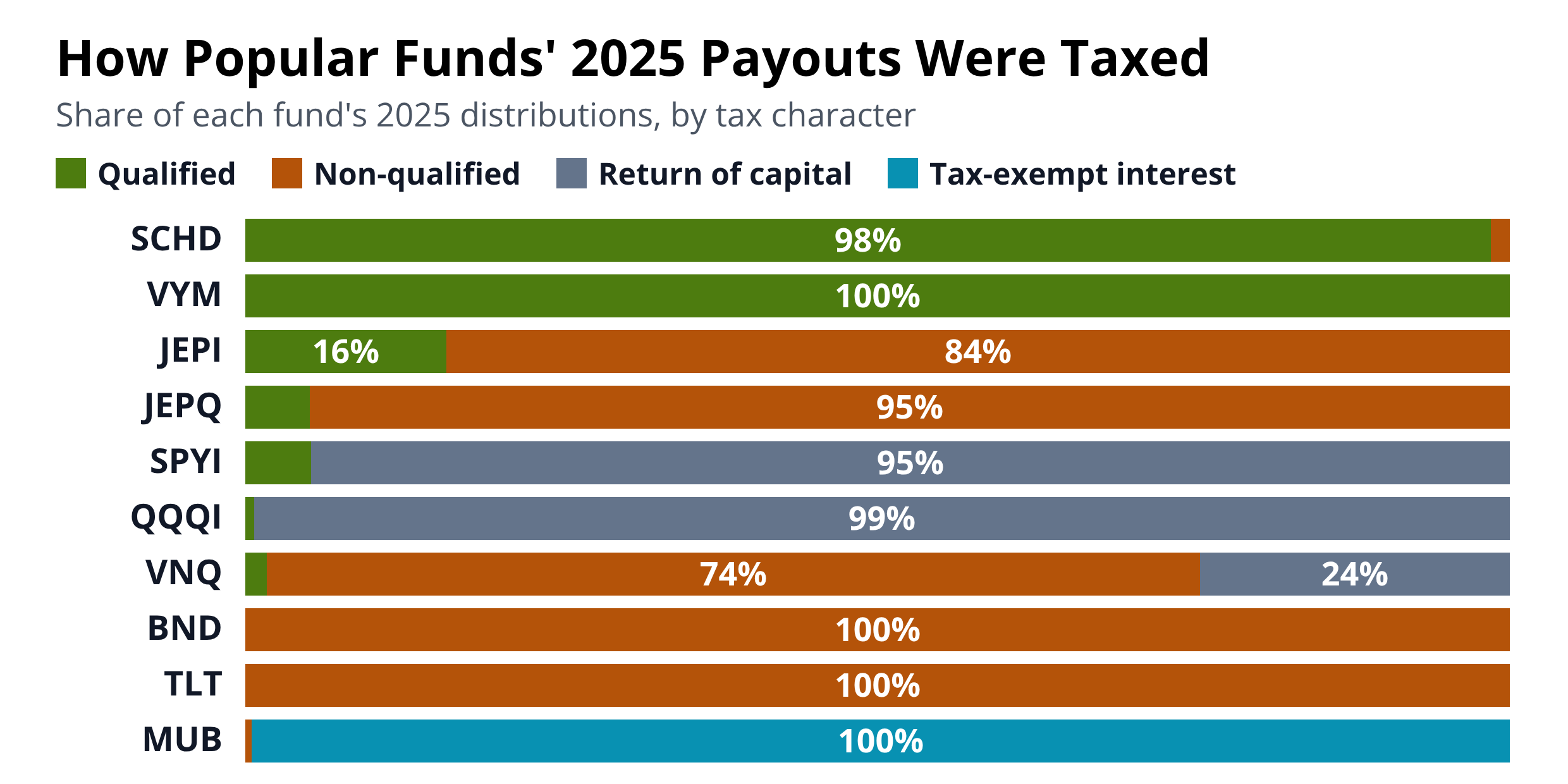
So there is no single answer to whether ETF dividends are qualified. Every fund page on our site now shows how its distributions were taxed in each recent year, drawn from the fund company's year-end tax reporting, and the 2025 figures show how wide the range is:
- Dividend stock funds. Schwab U.S. Dividend Equity ETF (SCHD) reported 98% of its 2025 distributions as qualified, and Vanguard High Dividend Yield ETF (VYM) reported 100%.
- Bond funds. Vanguard Total Bond Market ETF (BND) and iShares 20+ Year Treasury Bond ETF (TLT) reported 100% non-qualified. A fund that owns bonds earns interest, and the IRS notes that certain distributions commonly called dividends are actually interest.
- Municipal bond funds. Nearly all of iShares National Muni Bond ETF's (MUB) payout was tax-exempt interest.
- REIT funds. Vanguard Real Estate ETF (VNQ) reported just 2% qualified, 74% non-qualified and about a quarter return of capital.
Funds that look alike can be taxed very differently. JPMorgan's JEPI and JEPQ, which sell call options for income, reported 84% and 95% of their 2025 distributions as non-qualified. NEOS's SPYI and QQQI, which also sell options, reported 95% and 99% as return of capital, which Publication 550 says is not taxed when you receive it but lowers your cost basis.
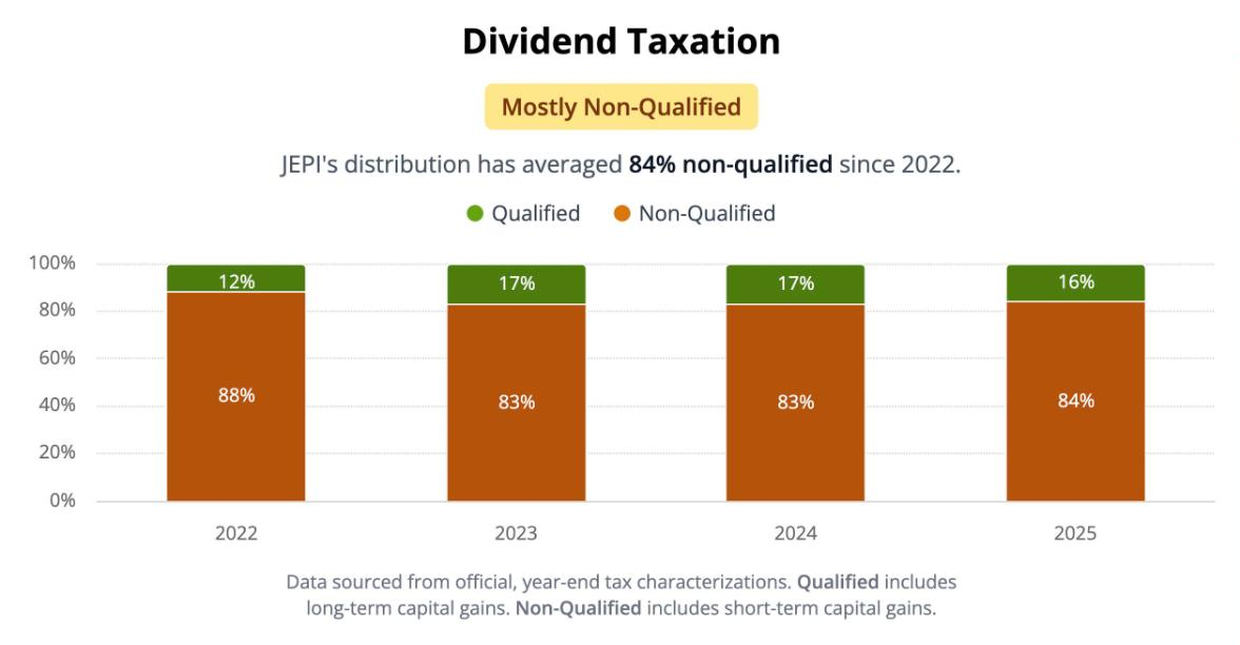
JEPI's mix has barely moved. At least 83% of its distributions have been non-qualified every year since 2022, so an investor holding it in a taxable account pays ordinary income rates on most of its payout.
Before assuming a fund's payout gets the qualified rate, check its history on our site or box 1b of its 1099-DIV.
Money market and Treasury bill funds work the same way on paper. The IRS says to report what you receive from money market funds as dividend income, and it is included in box 1a. iShares 0-3 Month Treasury Bond ETF (SGOV), which holds short-term Treasury bills, reported 100% of its 2025 distributions as non-qualified.
Closed-end funds deserve a closer look. Of the 316 closed-end funds with 2025 tax data on our site, 213 (67%) paid at least some return of capital, and 127 paid a quarter or more of their distributions that way. A return of capital from a fund that pays out more than it earns shrinks the fund's assets, whatever the tax treatment.
Our Dividend Safety Scores line up with that. The 119 closed-end funds we rate Unsafe or Very Unsafe paid a median of about 25% of their 2025 distributions as return of capital, and 61 of them paid at least a quarter that way. Of the 46 we rate Borderline Safe or better, only four did. Our guide to closed-end funds explains how to tell the difference.
Are Reinvested Dividends Taxed?
Yes. Publication 550 says that if you use dividends to buy more shares through a dividend reinvestment plan, you must still report the dividends as income. They are taxed exactly as if you had received the cash.
A qualified dividend that you reinvest is still taxed at the qualified rate, and an ordinary one at your regular rate. Each reinvestment also adds to your cost basis, so keep those records for when you sell. Our guide to dividend reinvestment plans covers the rest.
Which Account to Hold Dividend Stocks In
The account a stock sits in can matter as much as the type of dividend it pays. Dividends earned inside a traditional IRA or 401(k) aren't taxed each year, and qualified Roth IRA withdrawals are tax-free once you are 59½ and the account has been open five years.
Because qualified dividends already get a low rate in a taxable account, we generally prefer to hold REITs and BDCs, whose dividends are mostly taxed as ordinary income, inside retirement accounts. Qualified payers are the natural fit for taxable accounts. MLPs usually belong in taxable accounts too, for the Form 990-T reason above.
Traditional accounts eventually require withdrawals, starting at age 73, while Roth IRAs have no required withdrawals during the owner's lifetime. Our guides to traditional vs. Roth IRAs for dividend investors and required minimum distributions cover the trade-offs.
Frequently Asked Questions
What is the difference between qualified and ordinary dividends?
Qualified dividends are taxed at the long-term capital gains rates of 0%, 15% or 20%. Ordinary dividends are taxed as regular income at 10% to 37%. To be qualified, a dividend must come from a U.S. or qualified foreign corporation and you must hold the stock more than 60 days in the 121-day window around the ex-dividend date.
Qualified dividends are taxed at the long-term capital gains rates of 0%, 15% or 20%. Ordinary dividends are taxed as regular income at 10% to 37%. To be qualified, a dividend must come from a U.S. or qualified foreign corporation and you must hold the stock more than 60 days in the 121-day window around the ex-dividend date.
What is the qualified dividend tax rate for 2026?
0% for taxable income up to $98,900 for married couples filing jointly ($49,450 single), 15% up to $613,700 ($545,500 single) and 20% above that. High earners also owe the 3.8% net investment income tax.
0% for taxable income up to $98,900 for married couples filing jointly ($49,450 single), 15% up to $613,700 ($545,500 single) and 20% above that. High earners also owe the 3.8% net investment income tax.
What are non-qualified dividends?
They are dividends that don't meet the IRS tests for the lower rate, so they are taxed as ordinary income. Most REIT and BDC dividends are non-qualified, as are dividends on shares you held for too short a time. Of the 861 companies we rate, 154 pay dividends our stock pages label non-qualified.
They are dividends that don't meet the IRS tests for the lower rate, so they are taxed as ordinary income. Most REIT and BDC dividends are non-qualified, as are dividends on shares you held for too short a time. Of the 861 companies we rate, 154 pay dividends our stock pages label non-qualified.
Do you pay taxes on reinvested dividends?
Yes. The IRS treats reinvested dividends the same as cash dividends, so they are taxable in the year paid at the qualified or ordinary rate that applies. Each reinvestment adds to your cost basis.
Yes. The IRS treats reinvested dividends the same as cash dividends, so they are taxable in the year paid at the qualified or ordinary rate that applies. Each reinvestment adds to your cost basis.
Are REIT dividends qualified?
Usually not. Most REIT dividends are taxed as ordinary income, though qualified REIT dividends are eligible for the 20% Section 199A deduction. Part of a REIT's payout is often a nontaxable return of capital, which was 34% of Realty Income's 2025 dividend.
Usually not. Most REIT dividends are taxed as ordinary income, though qualified REIT dividends are eligible for the 20% Section 199A deduction. Part of a REIT's payout is often a nontaxable return of capital, which was 34% of Realty Income's 2025 dividend.
Are ETF dividends qualified?
It depends on what the ETF owns. Dividend stock funds such as SCHD and VYM reported 98% and 100% of their 2025 distributions as qualified, while bond funds such as BND and TLT reported none. Box 1b of the fund's 1099-DIV shows the qualified amount.
It depends on what the ETF owns. Dividend stock funds such as SCHD and VYM reported 98% and 100% of their 2025 distributions as qualified, while bond funds such as BND and TLT reported none. Box 1b of the fund's 1099-DIV shows the qualified amount.
Are TLT dividends qualified?
No. TLT owns long-term Treasury bonds, and its distributions have been 100% non-qualified every year since 2021, based on the fund's year-end tax reporting.
No. TLT owns long-term Treasury bonds, and its distributions have been 100% non-qualified every year since 2021, based on the fund's year-end tax reporting.
How much dividend income can a retired couple earn tax-free?
For 2026, by our math, a married couple both 65 or older with no other income could receive about $146,400 of qualified dividends and owe no federal income tax. With the average Social Security benefit for a retired couple, about $38,900 a year, the figure is about $113,400.
For 2026, by our math, a married couple both 65 or older with no other income could receive about $146,400 of qualified dividends and owe no federal income tax. With the average Social Security benefit for a retired couple, about $38,900 a year, the figure is about $113,400.
How long do you have to hold a stock for its dividend to be qualified?
More than 60 days during the 121-day period that begins 60 days before the ex-dividend date. For most preferred stock it is more than 90 days during a 181-day period.
More than 60 days during the 121-day period that begins 60 days before the ex-dividend date. For most preferred stock it is more than 90 days during a 181-day period.
Do qualified dividends count toward the net investment income tax?
Yes. Dividends, qualified or not, count as net investment income. The 3.8% tax applies once modified adjusted gross income passes $200,000 for single filers or $250,000 for married couples filing jointly.
Yes. Dividends, qualified or not, count as net investment income. The 3.8% tax applies once modified adjusted gross income passes $200,000 for single filers or $250,000 for married couples filing jointly.
Tax rules change, and your situation may differ from these examples. We suggest checking yours with a tax professional before acting on it.
Want to see how every dividend you own is taxed, next to its Dividend Safety Score? Our stock pages and portfolio tools show both. Take a look at our demo.