What Is a BDC? A Dividend Investor's Guide to Business Development Companies
A business development company (BDC) is a publicly traded company that lends money to small and midsize private U.S. businesses and sometimes takes ownership stakes in them. In exchange for avoiding corporate income tax, it must pay out at least 90% of its taxable income, which is why most BDCs yield 9% or more.
Those yields come with real risk. Of the 36 BDCs we rate, only Main Street Capital (MAIN) earns a Safe Dividend Safety Score, and 19 have cut their dividends in 2026.
This guide explains how BDCs work, why their dividends rise and fall, and the handful of measures that separate the strongest from the rest.
Prefer to watch? Our December 2025 video, I Built a Portfolio of All 44 BDCs: Here's What Happened, walks through several of these measures using real BDC data.
What Is a BDC?
Congress created BDCs in 1980 as a new type of closed-end investment company meant to steer capital to smaller businesses that can't easily raise money in public markets, according to the SEC.
Their customers are typically private companies with somewhere between $10 million and a few hundred million dollars in yearly revenue, many of them owned by private equity firms. Most are too small or too indebted to borrow cheaply from banks, and they can't issue bonds of their own.
Tighter bank rules after the 2008 financial crisis pushed more of this lending outside the banking system. BDCs became one of the main ways individual investors can own a piece of what is now called private credit.
Three rules shape every BDC.
- Most assets must be private U.S. businesses. The law requires at least 70% of a BDC's portfolio to sit in qualifying assets, mainly the securities of eligible private companies.
- Nearly all income must be paid out. BDCs can elect to be taxed as regulated investment companies, which spares them corporate income tax as long as they distribute at least 90% of their taxable investment income, according to the IRS.
- Borrowing is capped. Until 2018, a BDC could borrow only about $1 for every $1 of equity. The Small Business Credit Availability Act, passed that March, let BDCs raise the cap to about $2 of debt per $1 of equity with board or shareholder approval, as Capital Southwest's filing at the time explains.
Because they pay out almost everything they earn, BDCs keep little cash to grow. They raise new money by selling shares and borrowing, which is why the price their shares trade at matters so much, as we explain below.
About 45 BDCs trade on U.S. exchanges. Many more are non-traded BDCs sold through financial advisers, which can be far harder to sell. This guide covers the exchange-traded kind.
How BDCs Make Money
A BDC earns interest on its loans and pays interest on its own debt. What's left after those costs, management fees and other expenses is called net investment income (NII), and it is what pays the dividend.
Most BDC loans carry floating rates tied to short-term benchmarks such as SOFR, while much of the BDCs' own borrowing is fixed. So when the Fed cuts rates, loan income falls faster than interest costs. When the Fed raises rates, income climbs.
That is why BDC earnings boomed in 2022 and 2023, and why so many BDCs cut their dividends in 2026 after the Fed lowered rates by 1.75 percentage points between September 2024 and December 2025. In January, company disclosures showed the median BDC's net investment income falling about 8% for every one-point rate cut.
Where a loan stands in line matters too. A first-lien loan is repaid first if a borrower fails, so it is the safest kind of BDC loan. Second-lien and unsecured loans pay more interest but recover less in a default.
Some BDCs also take ownership stakes in the companies they lend to. Main Street and Gladstone Investment (GAIN) earn a share of the gains when those businesses are sold, and they often pay those gains out as supplemental dividends on top of the regular payout.
Others specialize. Hercules Capital (HTGC) and Trinity Capital (TRIN) lend to venture-backed technology and life sciences companies, while SLR Investment (SLRC) focuses on loans backed by specific collateral such as receivables, inventory and equipment.
Internal vs. External Management
Most BDCs are externally managed. They pay an outside adviser a base fee tied to the size of the portfolio plus an incentive fee tied to income and gains, which rewards growth whether or not it helps shareholders.
Prospect Capital (PSEC) shows the risk. It is one of the largest externally managed BDCs, and years of share issuance have worn down its net asset value per share.
Internally managed BDCs, including Main Street, Capital Southwest (CSWC), Hercules and Trinity, employ their own teams. Their costs tend to be lower, and management's pay is less tied to how big the portfolio gets.
External management isn't automatically a red flag. Ares Capital (ARCC), the largest publicly traded BDC, is run by alternative asset manager Ares, whose scale brings it deals smaller lenders never see. It earns a Borderline Safe Dividend Safety Score.
Why BDC Dividends Are So Risky
BDC yields are high because the risks are real. Their borrowers are smaller, more indebted companies, and BDCs add their own borrowing on top. That is leverage on top of leverage.
Payouts are tight by design. Since BDCs must pass along almost everything they earn, most pay out 90% to 100% of their net investment income, which leaves little room for a bad year.
Recessions hit hard. Oxford Square Capital (OXSQ) cut its dividend by 58% in the 2007 to 2009 financial crisis and by 48% in the 2020 pandemic, and even Ares Capital cut its payout by 17% in 2008.
Prices can fall faster than the market. In our experience, even high-quality BDCs can lose 30% to 50% of their value in a scare, as investors worry about loan losses that are hard to see from the outside.
Loan values involve judgment. Most BDC loans don't trade, so each quarter management estimates what they are worth, and investors don't always believe the estimates.
The long-run record is weak. When we built an equal-weighted portfolio of all 44 publicly traded BDCs in December 2025, its dividends had shrunk about 3% a year over the prior decade, before inflation.
How to Evaluate a BDC's Dividend
These measures say more than the headline yield. Each one appears in a BDC's quarterly earnings release or 10-Q.
Payout ratio. This is the share of net investment income paid out as dividends. We prefer BDCs below 95%, and cuts tend to come once a payout ratio approaches 110%. Main Street pays out about 81%, among the lowest in the industry.
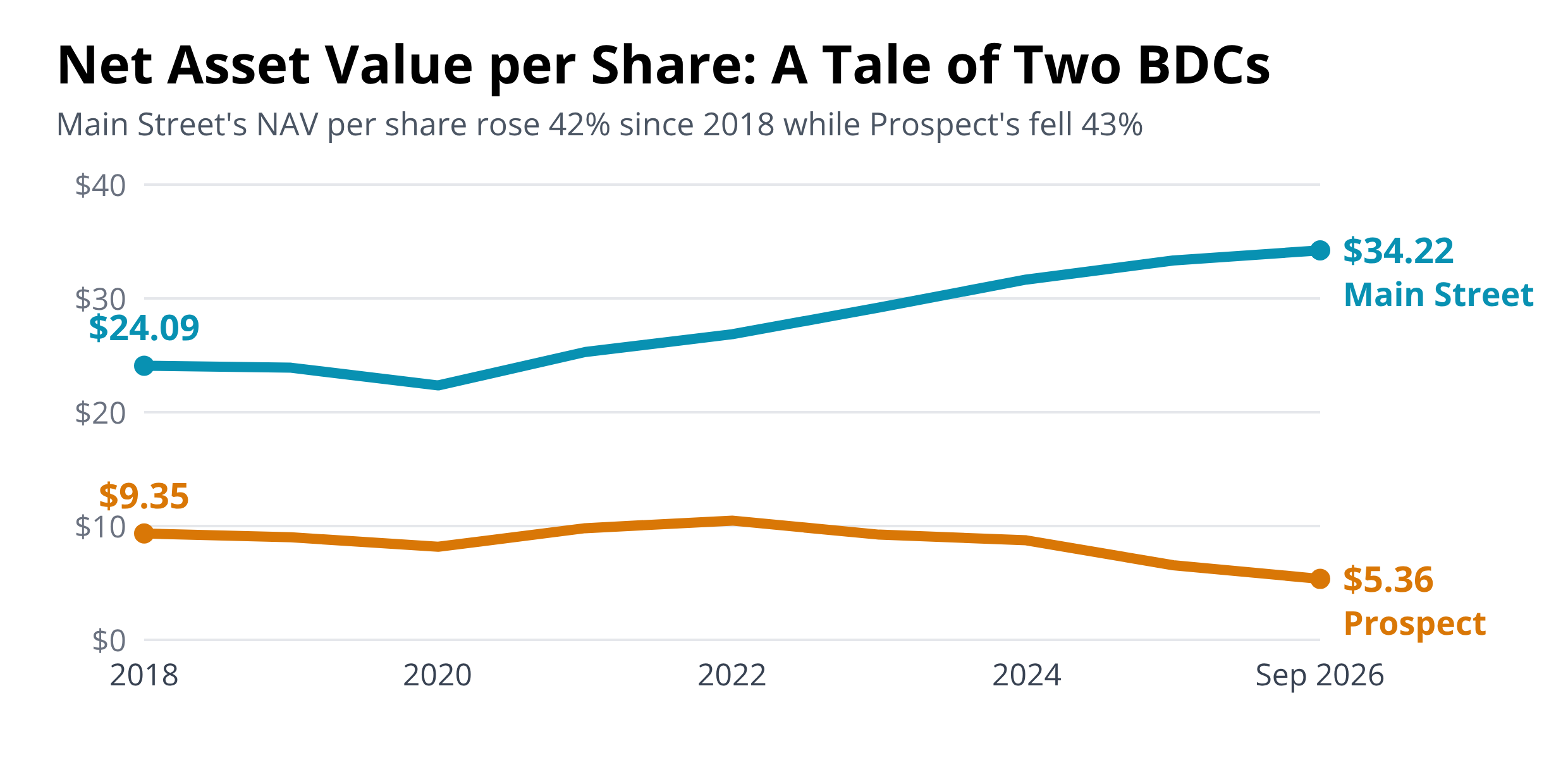
Net asset value per share. NAV is what a BDC's loans and other investments are estimated to be worth after subtracting its debt. A BDC that grows NAV per share while paying a big dividend is creating value. One whose NAV keeps shrinking is paying shareholders partly with their own capital.
Main Street and Prospect show the difference. From 2018 through September 2026, Main Street's NAV per share rose from $24.09 to $34.22, while Prospect's fell from $9.35 to $5.36.
Price to NAV. Most BDCs trade below their NAV, and a deep discount is usually a warning rather than a bargain. As of November 9, 2026, the seven BDCs we rate Safe or Borderline Safe traded at a median of 1.11 times NAV, against about 0.7 times for the 29 rated Unsafe or Very Unsafe.
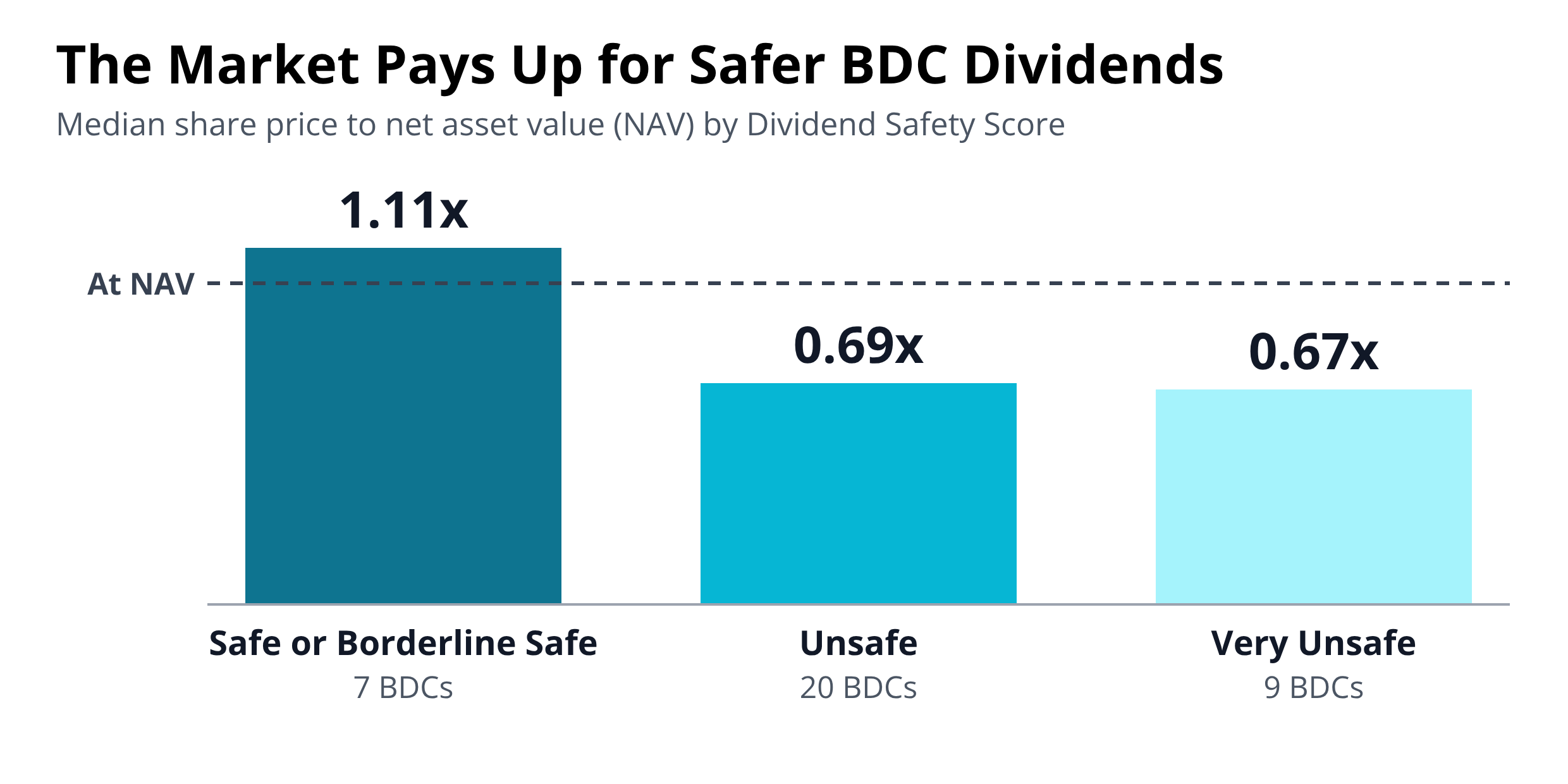
A premium helps the best BDCs keep winning. When shares trade above NAV, a BDC can sell new stock to fund loans without diluting existing owners. Below NAV, every new share sold shrinks what each existing share is worth.
Loans that have stopped paying. BDCs call these non-accruals. In January, the median BDC had about 1.2% of its portfolio on non-accrual at fair value. A rising figure is often the first sign of trouble.
Interest paid with more debt. Some borrowers pay interest by adding to their loan balance instead of paying cash, which BDCs call payment-in-kind (PIK) income. It counts as earnings but brings in no cash. In January it averaged about 6% of BDC income, and several BDCs relied on it for 20% or more.
Rate sensitivity. Every 10-Q includes a table showing how net investment income would change if rates moved. Based on its latest filing, a one-point drop would cut Saratoga Investment's (SAR) by roughly 27%, while Trinity's would barely move.
Leverage. Debt relative to equity shows how much cushion a BDC has before losses eat into its capital. Main Street borrows about half as much relative to its equity as its peers, which supports its BBB- credit rating.
Spillover. Some BDCs carry forward taxable income from past years, called spillover, that can cover a shortfall without a cut. Ares Capital entered 2026 with about $1.37 per share of it.
Regular vs. supplemental dividends. Many BDCs pay a regular dividend they expect to sustain plus supplemental payouts from extra profits. Supplements can stop when profits fall, so judge a BDC's income by its regular dividend.
How BDC Dividends Are Taxed
Each year, a BDC reports how its distributions break down on Form 1099-DIV. All taxable dividends count as ordinary income, and only the part the company identifies as qualified dividends is taxed at the lower capital gain rates, according to the IRS.
Some distributions can also be a return of capital, which isn't a dividend and instead reduces your cost basis in the shares.
Most of what BDCs earn is interest on loans, and our stock pages classify BDC dividends as non-qualified.
Are BDCs Right for Your Portfolio?
BDCs can make sense for investors who want high current income and can stomach volatility, but they are among the riskiest corners of the income market.
If you own them, keep positions small and stick with the strongest operators: a payout ratio comfortably below 100%, growing NAV per share, few problem loans and modest leverage. Broad sell-offs, when even quality BDCs trade at a discount, have historically offered the best entry points.
Our list of BDC stocks ranks all 36 BDCs we rate by Dividend Safety Score and explains what is driving this year's cuts.
Frequently Asked Questions
What does BDC stand for?
BDC stands for business development company, a type of closed-end investment company Congress created in 1980 to finance smaller U.S. businesses. About 45 trade on U.S. exchanges.
BDC stands for business development company, a type of closed-end investment company Congress created in 1980 to finance smaller U.S. businesses. About 45 trade on U.S. exchanges.
How do BDCs make money?
BDCs earn interest on loans to private companies, plus gains when equity stakes are sold. After interest costs, fees and expenses, what remains is net investment income, which pays the dividend. In January, the median BDC's net investment income fell about 8% for every one-point cut in short-term rates.
BDCs earn interest on loans to private companies, plus gains when equity stakes are sold. After interest costs, fees and expenses, what remains is net investment income, which pays the dividend. In January, the median BDC's net investment income fell about 8% for every one-point cut in short-term rates.
What is the difference between a BDC and a REIT?
Both avoid corporate income tax by paying out at least 90% of their taxable income, according to the IRS. A REIT owns or finances real estate, while a BDC lends to and invests in private businesses. Our guide to investing in REITs covers how they work.
Both avoid corporate income tax by paying out at least 90% of their taxable income, according to the IRS. A REIT owns or finances real estate, while a BDC lends to and invests in private businesses. Our guide to investing in REITs covers how they work.
Why do most BDCs trade below net asset value?
A discount usually means investors doubt the company's loan values or expect losses and dividend cuts. As of November 9, 2026, the median BDC we rate traded about 29% below its latest reported NAV.
A discount usually means investors doubt the company's loan values or expect losses and dividend cuts. As of November 9, 2026, the median BDC we rate traded about 29% below its latest reported NAV.
What is a non-accrual loan?
A non-accrual loan is one the BDC no longer expects to collect interest on, usually because the borrower has stopped paying. In January, the median BDC had about 1.2% of its portfolio on non-accrual at fair value.
A non-accrual loan is one the BDC no longer expects to collect interest on, usually because the borrower has stopped paying. In January, the median BDC had about 1.2% of its portfolio on non-accrual at fair value.
Are BDCs good investments for retirees?
Only for a small slice of a portfolio. Of the 36 BDCs we rate, only Main Street Capital earns a Safe Dividend Safety Score, and 29 score Unsafe or Very Unsafe, so most BDC dividends are likely to be cut over a full economic cycle.
Only for a small slice of a portfolio. Of the 36 BDCs we rate, only Main Street Capital earns a Safe Dividend Safety Score, and 29 score Unsafe or Very Unsafe, so most BDC dividends are likely to be cut over a full economic cycle.
We update this guide as BDC rules, rates and our Dividend Safety Scores change.