Everyone Wants to Grow Beets
About 20% of the sugar consumed in America starts out as beets grown in the Red River Valley, a stretch of rich farmland covering eastern North Dakota and northwestern Minnesota.
My dad grew up there and enjoyed helping his father on the farm. Two years before my dad was born, a sugar beet processing plant came to their small town.
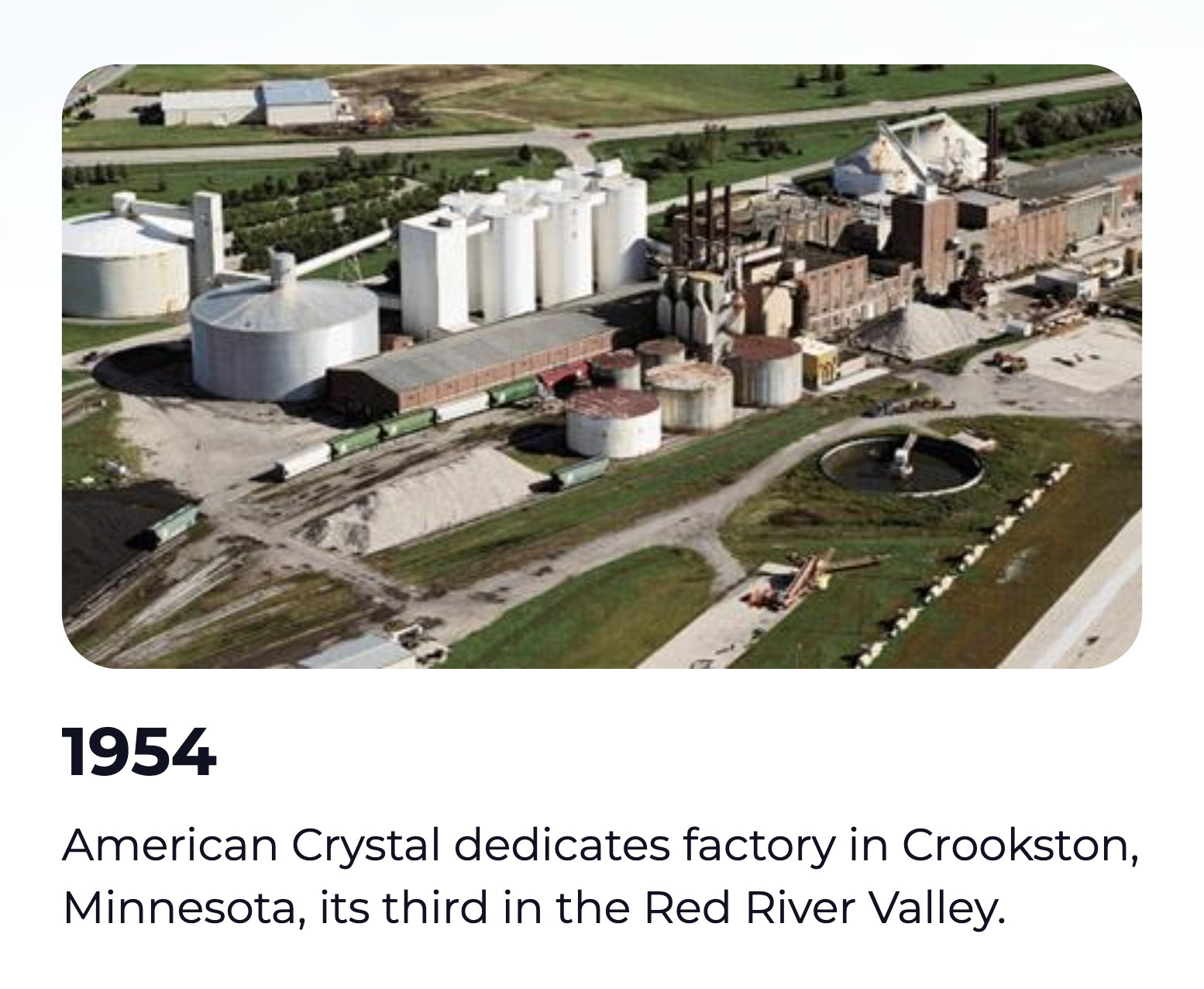
When the factory first opened, my grandfather planted and harvested beets for several years, barely breaking even but seeing the crop as a way to create new opportunities for his farm.
As a boy, my dad begged to join his father during beet harvest. They used an old truck with a wooden box until my grandfather replaced it with a steel one that could withstand the pounding from the beets.
Farmers teamed up during harvest, which ran around the clock in the fall, racing the weather. Sugar beets are among the densest crops, so when the fields got wet, the trucks often had to be pulled by tractors.
On one of those drives home from the farm, the beet plant was running at full capacity. Steam drifted across the highway, carrying a powerful, unpleasant smell. My dad said it really smelled bad. His dad replied it smelled like money.
He was right. Sugar beets became lucrative, and suddenly everyone wanted to grow them. But the plant could process only so many beets, so future acreage allocations went only to land with an established history of beet production. Latecomers were out of luck.
With four young children and nine consecutive years of diaper experience, I know a thing or two about tolerating bad smells in service of a long-term payoff. But that's not why I've been thinking about that story lately.
My grandfather had the temperament to evaluate a business opportunity based on its expected cash flow rather than how exciting it looked (or smelled) to everyone else in the moment. That sort of discipline has felt like a lost art lately. Everyone seems to want to grow beets.
Since I last wrote, U.S. stocks had their best quarter in nearly six years, and the tech-heavy Nasdaq soared as much as 30% from its March lows. Joining the Nasdaq in early July is Elon Musk's SpaceX, now a sprawling empire spanning rockets, satellite internet, AI, and social media, which went public in June.
AI excitement briefly pushed SpaceX's valuation to nearly $3 trillion, making it the world's fourth-largest company. Yet SpaceX is projected to generate only about $37 billion in revenue this year, and analysts expect it to burn through $70 billion over the next three years as it pours money into AI infrastructure, satellites, and rockets.
Like any good fireworks show here in Indiana, it's spectacular to watch, but when the smoke clears, financial gravity is stubborn. Stock prices and business fundamentals must find each other eventually.
Meanwhile, OpenAI and Anthropic, the two companies at the center of the AI spending boom, are rushing toward IPOs that could value each near $1 trillion. Together they're projected to bring in around $55 billion in revenue this year, while losing tens of billions on operations and bets on future models that have yet to prove their worth.
A $1 trillion valuation is roughly what you'd pay for profits on the scale of Apple — the most profitable company in the world — beginning within a few years and sustained for two decades.
That's a lot of beets to bet on for companies whose core business, training and selling cutting-edge AI models, has yet to produce a profit or demonstrate clear signs of a durable moat.
Some of today's AI companies will likely become enormously successful businesses. The challenge for investors is knowing which ones and how much future success is already reflected in today's stock prices.
With the number of birds in the bush this uncertain, I find myself returning to something Warren Buffett wrote in Berkshire's 2000 shareholder letter:
At Berkshire, we make no attempt to pick the few winners that will emerge from an ocean of unproven enterprises. We're not smart enough to do that, and we know it. Instead, we try to apply Aesop's 2,600-year-old equation to opportunities in which we have reasonable confidence as to how many birds are in the bush and when they will emerge.
Obviously, we can never precisely predict the timing of cash flows in and out of a business or their exact amount. We try, therefore, to keep our estimates conservative and to focus on industries where business surprises are unlikely to wreak havoc on owners.
While OpenAI and Anthropic aren't publicly traded yet, their uncertain fortunes are already partly embedded in most investors' portfolios. Nvidia, Microsoft, Amazon, Google, Oracle, Broadcom, and others provide the chips, data centers, and cloud infrastructure these AI labs rely on, and several have made sizable investments in them as well.
Those are the megacap tech stocks that have dominated the S&P 500's performance in recent years. As excitement surrounding AI has intensified, many dividend stocks have looked old, boring, and frankly disappointing by comparison. The Dividend Aristocrats Index, shown below, has notably trailed the broader market since ChatGPT's arrival in late 2022.
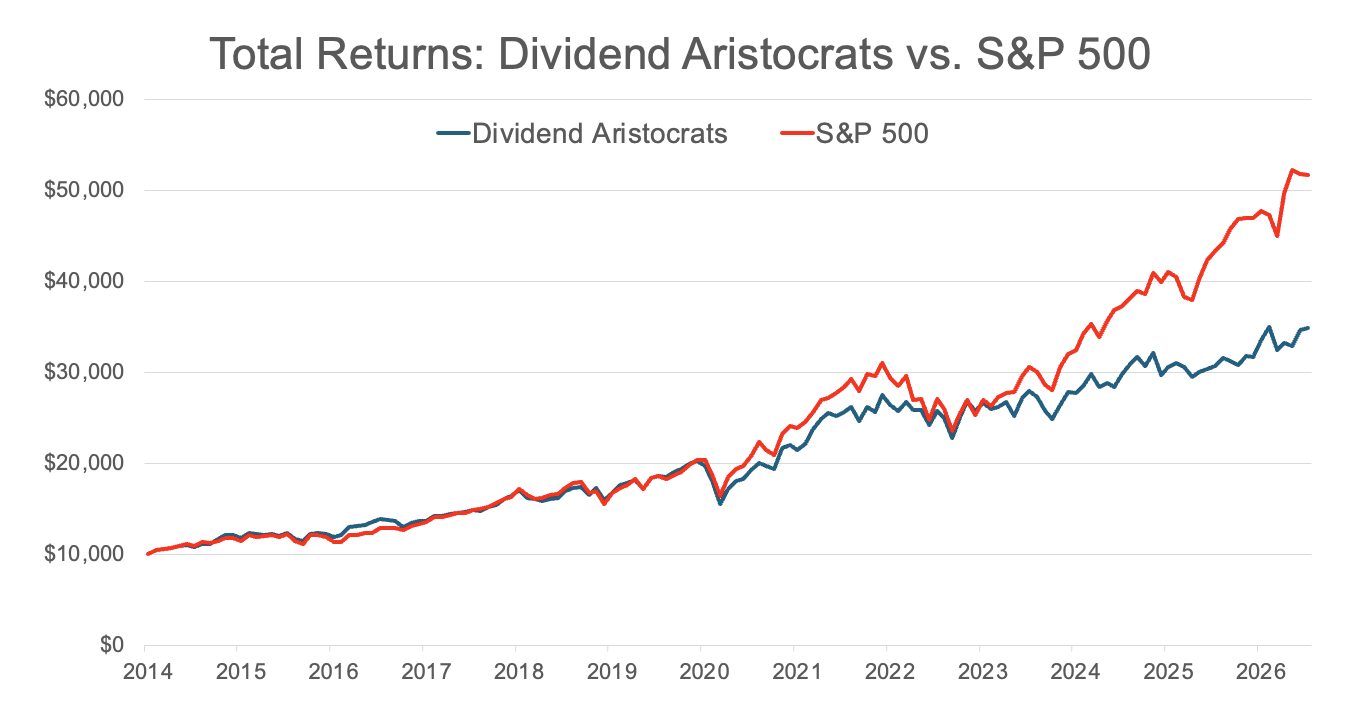
For investors focused on preserving capital and building a reliable stream of income that stays ahead of inflation, periods like this can be psychologically challenging. When the market's newest darlings are soaring 30% in a quarter (or more — many semiconductor stocks more than doubled), proven businesses paying steady dividends can feel like a consolation prize. It's tempting to wonder if the old rules no longer apply.
I would encourage caution. Investors have rarely been more willing to reach for returns. Margin debt, what investors borrow to buy stocks, has surged 54% to a record $1.4 trillion in just the past year, and assets in leveraged ETFs, which amplify both gains and losses, have nearly doubled since March to exceed $200 billion.
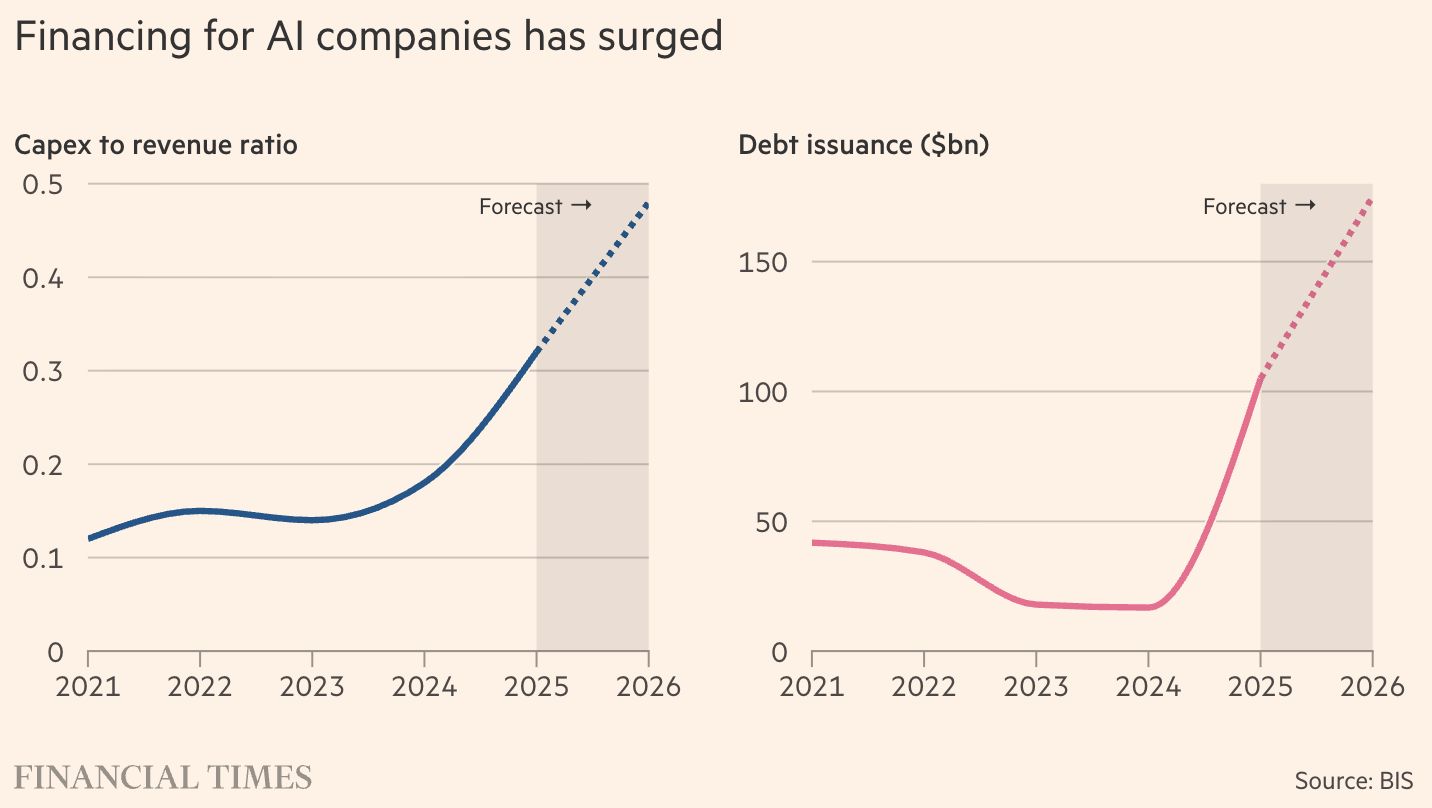
Risk appetite runs high, and tech companies have taken advantage by selling stock like it's the dot-com boom and issuing debt at remarkably thin premiums over Treasury rates, all to fund AI ambitions that are increasingly outpacing their own cash flows.
When sugar beets became lucrative in Crookston, everyone wanted to grow them. But most farmers didn't because they knew the processing plant could handle only so many beets. Scarcity imposed discipline.
With AI, there is no equivalent processing plant limiting investment, especially with external financing remaining abundant for now. Outside of Apple, many of today's technology giants appear willing to abandon their historically capital-light business models, at least temporarily, for something far more capital-intensive and uncertain to avoid the possibility of being left behind.
The companies doing the spending — Microsoft, Amazon, Google, Meta, and Oracle — have started to see their stocks lag or fall outright as more investors question whether the returns on all that capital will ever justify the cost. Oracle, which has borrowed tens of billions to build data centers for AI customers, saw its free cash flow turn deeply negative and its stock drop nearly 30% this year.
Meanwhile, downstream businesses benefiting from that spending remain red hot. Micron, which makes the memory chips these data centers require, tripled in a single quarter. Even Caterpillar, which makes the engines and generator sets that help power AI data centers, gained 50% in the second quarter and now trades at nearly 40 times earnings, more than double its five-year average, for what has historically been a cyclical business.
If the spending ever slows, the pain could travel down the chain quickly as growth expectations recalibrate. Rapid technological change can create big winners, but it can also lead to speculative overinvestment, disappointing returns on capital, and intense competition that ultimately benefits consumers far more than shareholders.
I am far from an AI expert. But I have lived through plenty of occasions where market enthusiasm made discipline feel foolish right before it didn't.
The businesses we favor don't require us to guess much about the future. We look for companies with unique, proven assets that are hard for rivals to take away or replace, that meet needs people always have, and that keep making money whether the economy is doing well or doing poorly.
Inside our portfolios, Coca-Cola has spent a century building the brand and distribution network that puts its products in the hands of consumers across 200 countries every day. Waste Management collects trash in recessions and booms alike, protected by the landfills and dense routes competitors can't easily duplicate. Exxon Mobil sits atop reserves, refineries, and pipelines that took decades and hundreds of billions to develop. Procter & Gamble sells the toothpaste, detergent, and diapers people trust and purchase out of habit regardless of what is happening in a data center.
These businesses rarely make headlines, but they have a way of looking very attractive when the exciting ones stop working.
For investors depending on their portfolios for income, reliability matters. A dividend that has been paid and raised through recessions, rate cycles, and bear markets continues arriving whether stock prices cooperate or not.
My grandfather would have appreciated that. I suspect he would look at opportunities in today's market and ask the same questions he likely did back then: How much cash will this business generate? How confident am I? And what am I paying for it?
Those questions are easy to ignore when effortless money is being made all around you. But over long periods of time, they have helped investors build and preserve substantial wealth.
On that drive home from the farm all those years ago, my dad thought the beet plant smelled terrible. My grandfather smelled money.
Today's market is full of businesses that smell exciting. We're continuing to focus on the ones that smell like money.
Thank you for your support of Simply Safe Dividends, and please reach out with any questions or ideas for how we can keep improving the service for you.